Embracing Mindset Diversity in Disciplined Agile


|
One of the mantras of the agile community is that you need to "be agile," that you need to adopt an agile mindset. Agilists will often point to the Manifesto for Agile Software Development, commonly referred to as the Agile Manifesto, as a good starting point to understand this mindset, which it is. Other mantras within the agile community include respecting others and having a safe environment that embraces diversity. All wonderful ideas, but what do you do when they collide with one another?
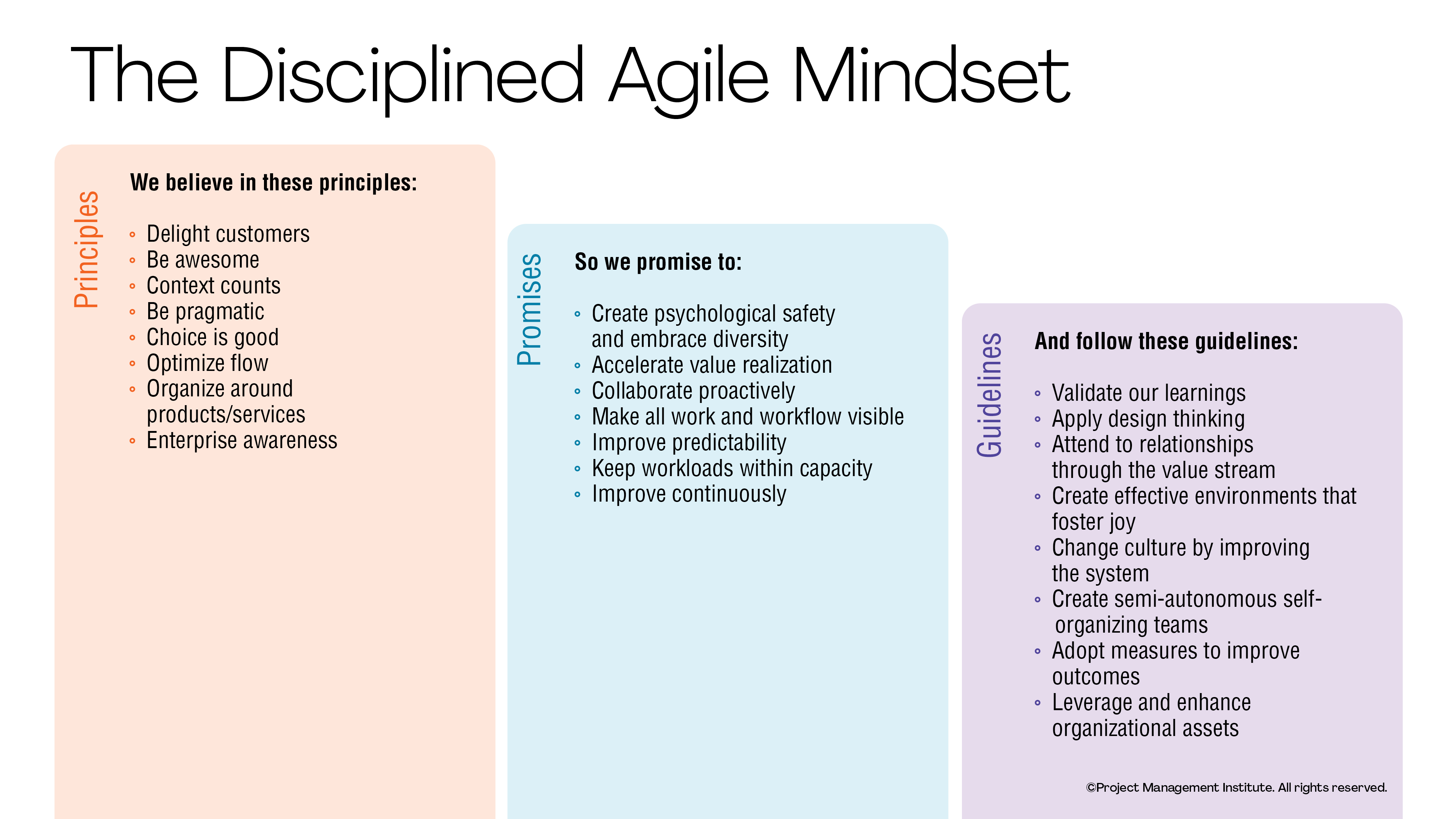
The Disciplined Agile MindsetFigure 1 depicts the Disciplined Agile (DA) mindset, which is captured in the form of principles, promises, and guidelines. Disciplined agilists believe in the DA principles, so we promise to adopt these behaviours and follow these guidelines when doing so. Where the Agile Manifesto addressed the environment faced by software developers 20 years ago, the DA mindset addresses the environment faced by organizations today. The DA mindset reflects our learnings over these past 20 years, adopting great ideas from a wide range of sources, in particular ideas around lean and flow, to describe concepts that enable enterprise agility.
Figure 1. The Disciplined Agile mindset.
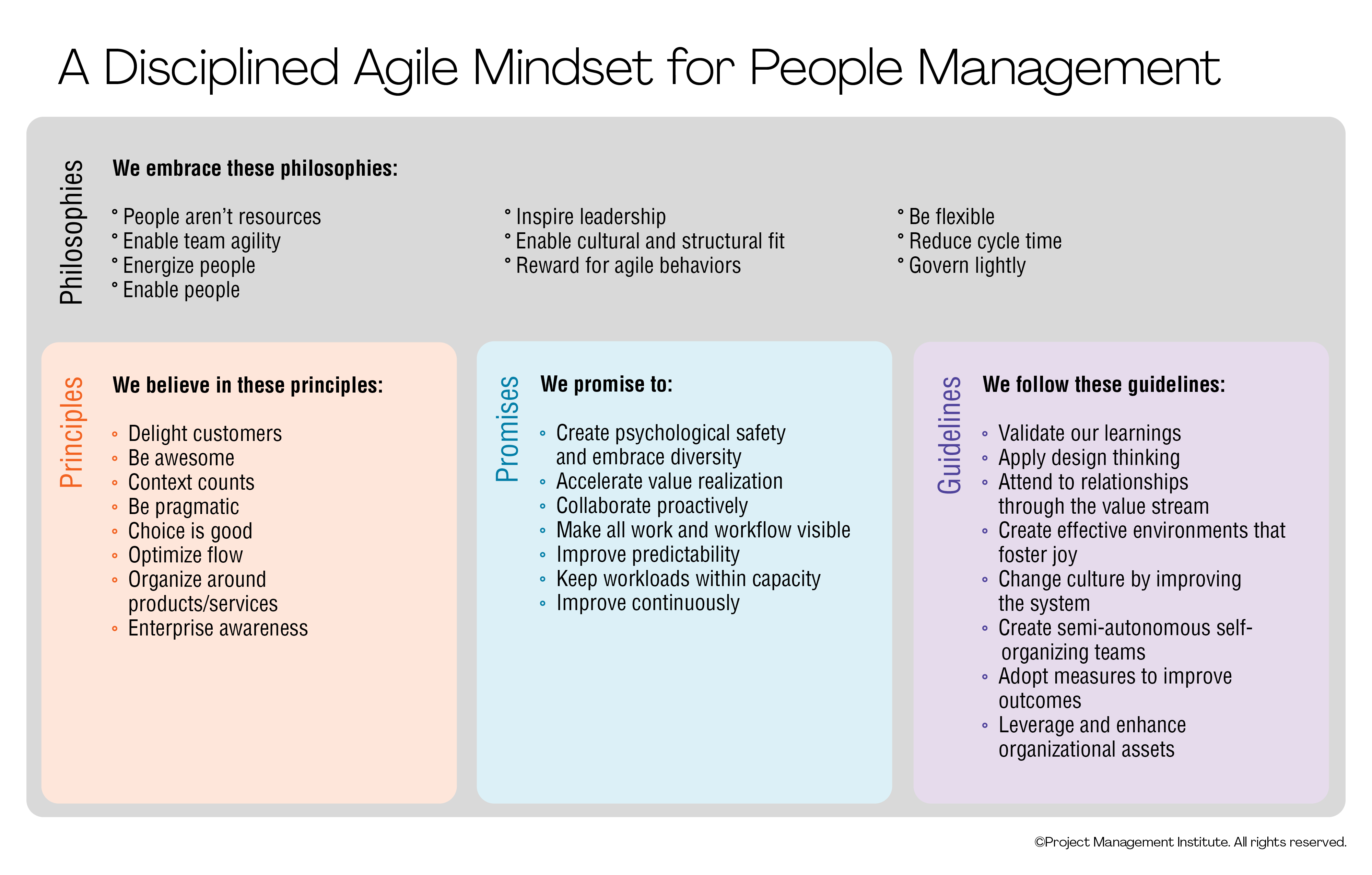
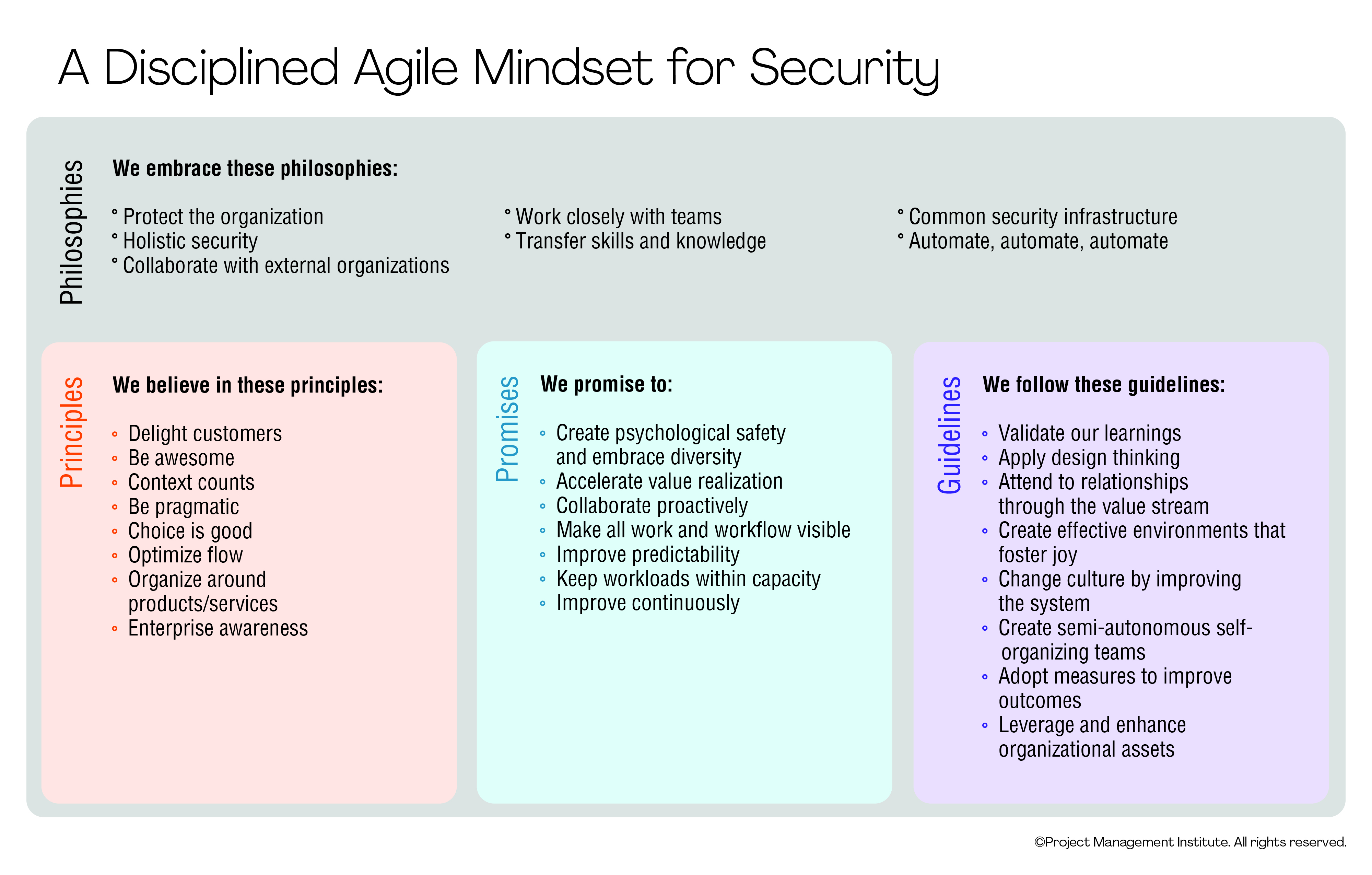
Embracing Different Mindsets in the DA Tool KitOne of the promises of the DA mindset is to create psychological safety and embrace diversity. Interestingly, when you do that you soon realize that people often have very different mindsets and that this is a very desirable thing. Yes,we want people to embrace an agile mindset so that we all share a similar point of view, but that's only one of many points of view. There are still noticeable differences between the way that you approach something and the ways that others do, even when everyone involved has an agile mindset. This happens because we are all unique people with unique experiences and backgrounds, and as a result you have other points of view than just the agile mindset. I'm sure that you've noticed that finance people have a different perspective than people from marketing, whose perspective differs from data management professionals, which is different yet again than research and development people, and so on. Each business function tends to attract, and then reinforce, people of a certain mindset. Some people find legal work incredibly interesting, whereas others find it spectacularly boring. To each their own. This is where it gets interesting. Remember that DA is a tool kit that supports improvement across all aspects of your organization, not just software development. One aspect of the architecture of the DA tool kit is that we've captured the different business functions within your organization as process blades, which in turn are described in terms of mindset, people, flow, and practices. Process blades include Finance, Strategy, Legal, Marketing, Security, IT Operations, Portfolio Management, and many more. Regarding mindset, for a given process blade, we extend the base DA mindset with philosophies that are applicable to that process blade. For example, Figure 2 depicts DA's People Management (Human Resources) mindset and Figure 3 DA's Security mindset.
Figure 2. Disciplined Agile's People Management Mindset.
Figure 3. Disciplined Agile's Security Mindset.
There are several important points to this strategy:
Just like one process does not fit all situations, one mindset doesn't either. The Disciplined Agile (DA) tool kit explicitly embraces mindset diversity. Do you? |

Disciplined Agile: An Executive's Starting Point
|
We used to say that software is eating the world, but the fact is today software is the world. Gone are the days where IT could be treated like a utility, one that more often than not was outsourced in the belief that you needed to focus on your core competencies and IT didn’t make it onto that list. These days being competent at IT is mere table stakes at best, you need to excel at IT if you hope to become an industry leader. Today business executives must focus on disruptors, new competitors entering their market space using technologies in new ways. Becoming an agile business – an adaptive, responsive, and learning organization – is the true goal. Business agility requires true agility across all of your organization, not just software development, not just DevOps, and not just IT. There isn’t a single industry now that either isn’t dominated by agile businesses or isn’t under threat of disruption by new agile competitors. The Disciplined Agile (DA) tool kit was created to apply agile in complex enterprise agile implementations. DA has been well received and implemented in organizations around the world. According to Gartner, Disciplined Agile is also the only available agile process explicitly allowing enterprises to customise agile for their unique enterprise challenges at both the organization and project levels. In their research report, Adopt Disciplined Agile Delivery for a Comprehensive and Scalable Agile IT Approach, Gartner reported:
In this article, we address several common questions executives have about Disciplined Agile (DA):
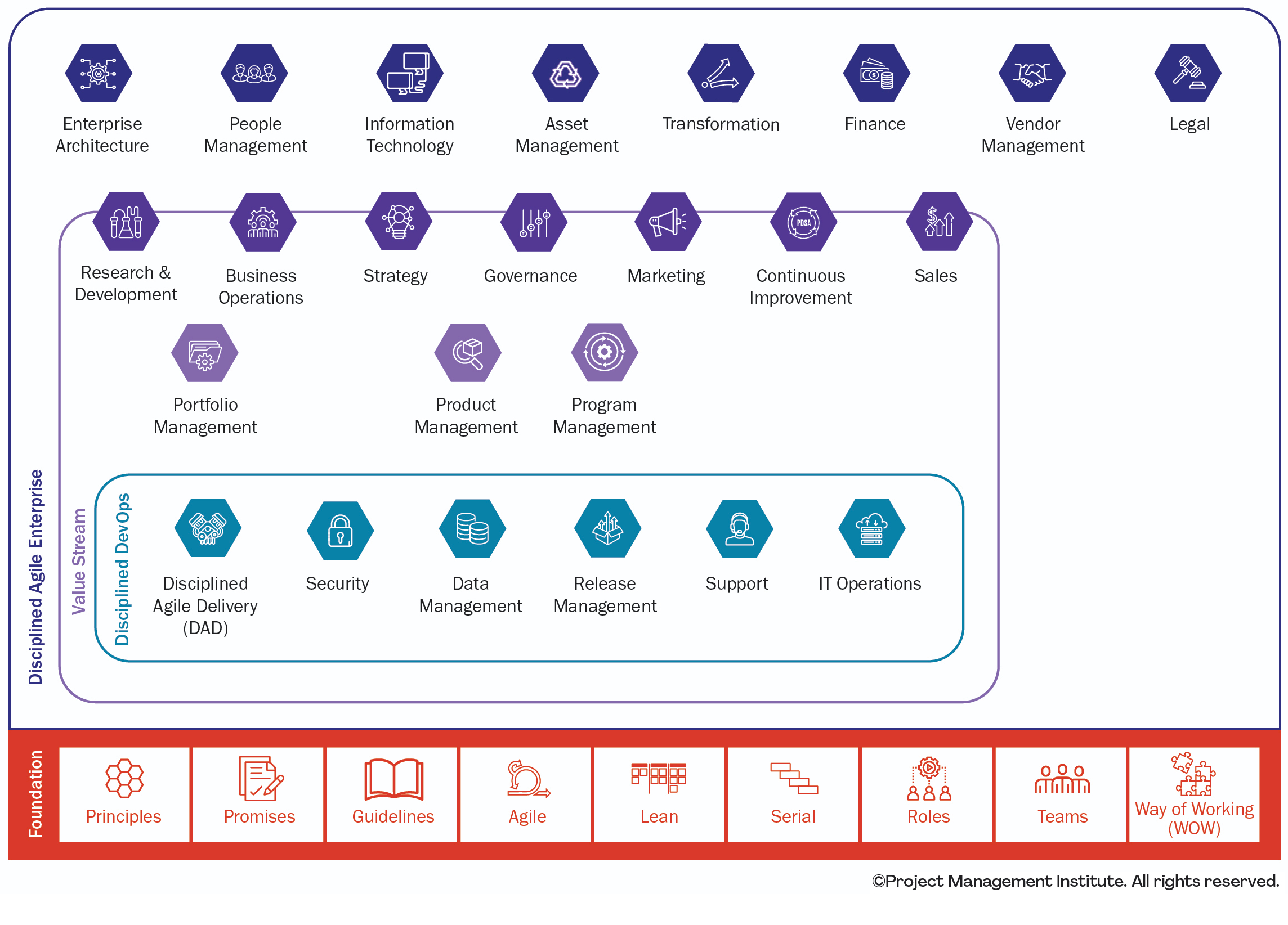
What is Disciplined Agile (DA)?The Disciplined Agile (DA) tool kit provides straightforward guidance to help organizations streamline their processes in a context-sensitive manner, providing a solid foundation for business agility. The figure below provides a high-level overview of the scope of DA (click on the diagram to zoom in).
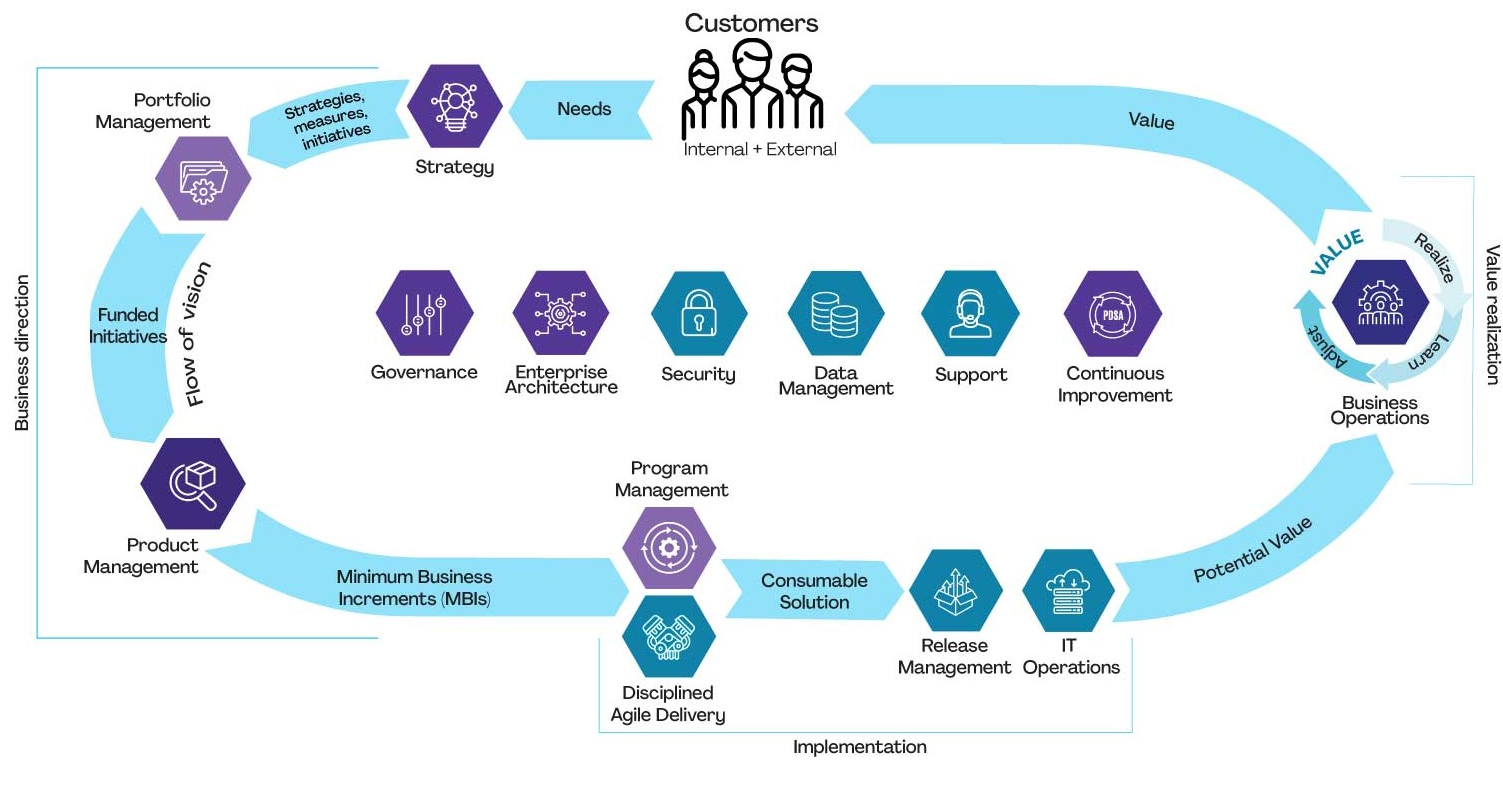
DA provides a foundation for business agility does this by showing how the various activities such as Finance, Portfolio Management, Solution Delivery (software development), IT Operations, Enterprise Architecture, Vendor Management and many others work together. DA also describes what these activities should address, provides a range of options for doing so, and describes the trade-offs associated with each option. DA also provides a straightforward strategy for implementing value streams, overviewed in the following diagram (click on it to zoom in).
You can read more about DA in Introduction to Disciplined Agile.
Why should I consider Disciplined Agile (DA)?There are several reasons why your organization should adopt the Disciplined Agile (DA) tool kit:
You can read more about why you should consider DA at Why Disciplined Agile?
Where is Disciplined Agile (DA) being used?DA is being used in numerous organizations, in a wide range of industries, around the world. You can see a list of a subset of the organizations using Disciplined Agile.
Are there any Disciplined Agile (DA) success stories?Yes. We have published several Disciplined Agile success stories with more on the way.
How can we get started with Disciplined Agile (DA)?The answer to this question depends on what you're trying to achieve:
Getting personally started with Disciplined AgileThere are several ways that you can learn more about DA, and we recommend following the one(s) that seem best for you:
Getting a team started with Disciplined AgileThere are also several options for getting a team going with Disciplined Agile, we recommend considering all three:
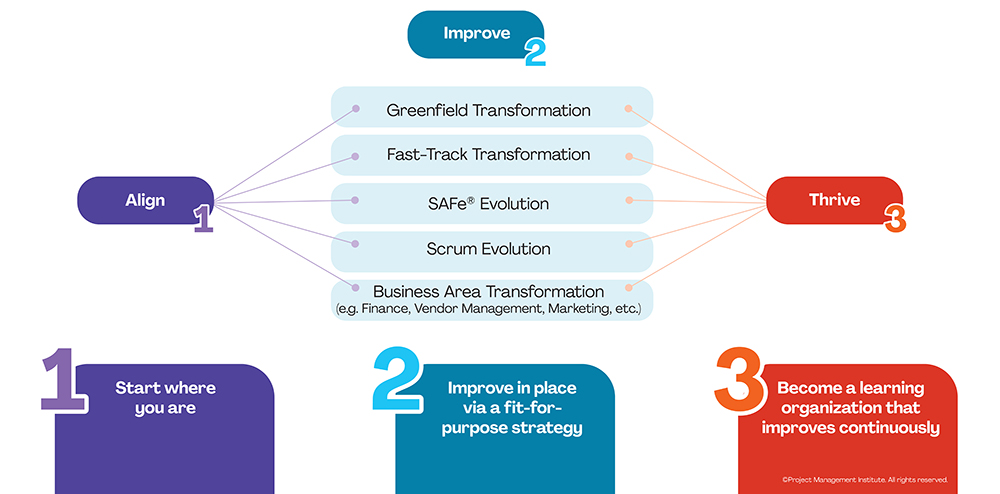
Getting your organization started with Disciplined AgileOur fundamental advice is to start where you are, do the best that you can given the situation that you face, and always strive to get better. To succeed, there are three key concepts to understand:
Although every organization's journey is unique, we have found that at a high-level they all follow a similar 3-step transformation path:
|

Using Lean Agile Procurement (LAP) in complex procurement situations
| In the Vendor management in the Disciplined Agile enterprise blog post, we overviewed a Disciplined Agile (DA) approach to vendor management, including procurement. In this post, we look closer at how to use lean and agile techniques to procure goods and services in complex situations. Context counts, also in procurementOne of the DA principles is that context counts. This principle is also applicable to the area of vendor management. Table 1 overviews three common types of procurement situations. Table 1. Common procurement situations
Figure 1 depicts the goal diagram for Vendor management (click here to view a larger version of the diagram) and table 2 maps the situations summarized in table 1 to the choices and strategies from the goal diagram. How we work matters and it has a dramatic impact on the result of our work. Matching our way of working to the context we face is the cornerstone of success at work. Figure 1. The vendor management goal diagram
Table 2. Mapping common procurement situations to potential procurement strategies
When it comes to developing a complex product or service, we have learned that working in an agile and lean way brings better results faster, more reliably, and with higher quality. The agile and lean way of working (WoW) takes an incremental approach with short feedback loops. The short loops act as learning points where we can adjust to new information and changes that inherently are a part of doing complex work. It turns out that the same is true for procuring goods and services. When we set out to procure complex goods or services, or are faced with a complex situation, applying agile and lean techniques is more successful than using traditional procurement approaches. How do you apply agile and lean practices to procurement?Generically speaking, procurement follows the flow of: Initialize, Analyze & prepare, Select & sign, and Execute & beyond as shown in figure 2. Figure 2. Generic procurement flow
Lean Agile Procurement (LAP) follows the same flow and takes advantage of agile and lean practices along the way to deliver more successful results in a complex procurement situation. Table 3 summarizes some of the agile and lean techniques that LAP applies in procurement. Table 3. Lean Agile Procurement Flow Steps
In summary, context counts and the DA tool kit for vendor management guide you in tailoring your WoW (way of working) to better match your situation increasing your chances of success. When faced with a complex procurement situation, Lean Agile Procurement (LAP) is a more successful approach. Authors: Klaus Boedker and Mirko Kleiner |


Vendor Management in the Disciplined Agile Enterprise
| The overarching goal of the Disciplined Agile (DA) is to guide organizations on their path to business agility, sometimes called organizational agility. When organizations increase their overall agility, they are able to rapidly adapt to market and environmental changes in productive and cost-effective ways. This enables organizations to deliver more value in a shorter amount of time, predictably, sustainably, and with high quality. Looking at the Disciplined Agile (DA) tool kit in figure 1, we get an idea of the organizational areas that are involved in pursuing business agility. Figure 1: The Disciplined Agile (DA) tool kit
The DA tool kit shows us that it is not enough to focus on delivery-level agility represented by the Disciplined DevOps layer. To achieve business agility, the organization must pursue agile and lean ways of working at the Disciplined Agile Enterprise layer; like legal, finance, and vendor management. In this post, we focus on the role of vendor management and how it can contribute to the overall agility in the DA enterprise. The mindset of vendor management: partnerships are keyVendor management is a process blade in the DA tool kit. In other words, it represents a functional area inside the organization that serves a specific purpose. The purpose of vendor management is to help obtain products and services from other organizations. To do that successfully in a disciplined agile way, vendor management follows a set of philosophies that extend the DA mindset: Figure 2: A Disciplined Agile mindset for vendor management
1. Value through partnerships. We increase value through partnerships with other organizations. 2. Collaborative partnerships. We seek to build collaborative partnerships with other organizations, even when those organizations are our competitors or competitors to each other. 3. Mutually beneficial partnerships. We seek to build, maintain, and evolve mutually beneficial relationships with our suppliers and partners. 4. We co-create with our partners. We co-create throughout the entire vendor management life cycle, including procurement. This means that we may even have both our own experts and vendor experts actively involved in the procurement process. 5. We are trusted advisors. We are a trusted advisor inside the organization to present and guide both supplier and partnering options. 6. Organizational outcomes come first. We pursue organizational outcomes over local process conveniences, working in an enterprise aware manner. 7. We protect our organization. We have a fiduciary responsibility to protect the organization. 8. We address risk holistically. We address risk in an appropriate, proactive, and holistic manner. The flow of Vendor management: context countsOne of the DA principles is that "context counts". This principle is also applicable to the area of vendor management. Table 1 lists three different types of procurement situations. Table 1: Different procurement situations
Each of the situations requires a different flow or approach to successfully find the right partners that can deliver the good or service to the organization. The practices of vendor management: choice is goodAnother DA principle states that “choice is good”. In vendor management, we see this manifested in its goal diagram. Click here to see a larger version of the goal diagram. Figure 3: Vendor management goal diagram
The diagram covers the key decision points of vendor management: from how to manage intake requests, and how to select a procurement strategy, to ways of governing partnerships. Most of the decision points’ options are non-ordered, meaning they are equally preferrable. It is worth noting the two areas that have ordered options: select procurement strategy, and capture working agreements. The ordered options are called out with an upwards arrow, meaning the choices at the top are more desirable than the choices at the bottom from an agility standpoint. With the goal diagram, you have access to a suite of options, choices and strategies that are presented in architected way for easy access and navigation. The suite of options, choices and strategies allows you first of all to find your baseline today: what is our existing way of working (WoW) in procurement? Secondly, the suite of options, choices and strategies allows you to find areas where you can improve and tailor your way of procuring to better match the given context. Let’s look at an example. One of the vendor management decision points is to select potential partners. Figure 4: Decision point for "select potential partners"
The decision point offers a suite of options, ranging from short-listing potential partners, comparing submitted proposals, and holding a big-room event for multiple vendors. In our example, you are part of the company’s procurement team. Up until this point, your team has solely been relying on the option of “compare submitted proposals” to select vendors regardless of what you are procuring. That is your baseline way of working (WoW). If your team procures goods or services that less straightforward than, say printer paper and toner, you have likely come across some challenges in finding the right vendor. Taking advantage of the information in the vendor management goal diagram, you can now pick a more tailored WoW depending on your procurement context. For example, procuring a commodity (new paper and toner for the office printers), a straightforward comparison of submitted proposals will likely be sufficient. In fact, you may even go so far as to automate the buying decision completely, such as with printers placing an order for toner when it runs low. But faced with a more complicated context, such as procuring a new fleet of delivery trucks, you have the option to employ additional strategies to increase your chances of success. These strategies could be: shortlisting potential partners, interviewing potential partners, and then comparing submitted proposals. You may even hold a vendor bake off where the shortlisted vendors demonstrate their vehicles. In summary, context counts. The DA tool kit guides you in tailoring your WoW for vendor management to better match your context increasing your chances of success. |


Asset Management: What Types of Assets Might You Manage?
|
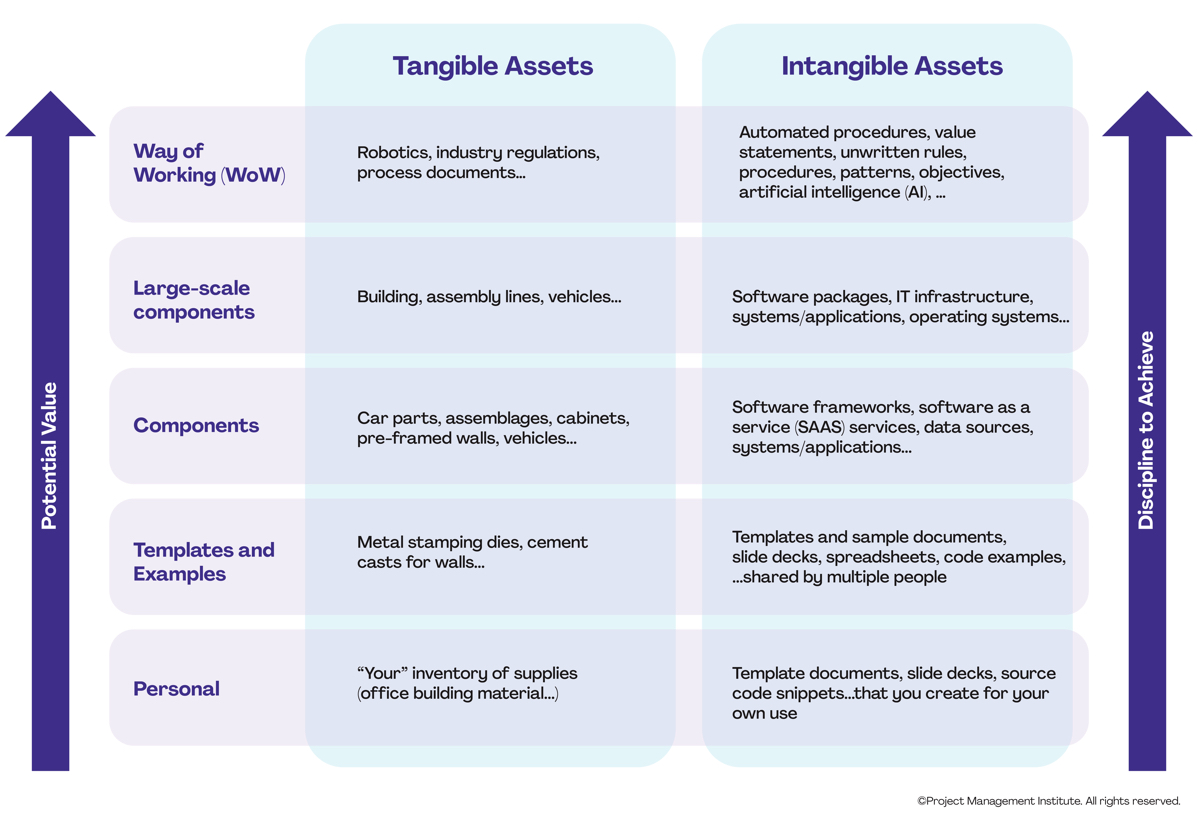
When we think about assets we often think "financial assets" such as money, stocks, bonds, and other financial instruments. But of course there are many more types of assets than just financial ones, particularly when we consider it from the point of view of our organization. We are currently in the process of evolve Disciplined Agile (DA)'s Reuse Engineering process blade, which had a very clear software focus to it, into a more robust Asset Management blade. Part of that effort is to rework the reuse categories, which we had originally adopted from the Enterprise Unified Process (EUP), depicted in Figure 1 into the asset categories of Figure 2. Figure 1. Categories of reuse.
Figure 2. Categories of assets.
As you can see, we've made several interesting changes:
We'd love to hear your feedback, particularly if you have ideas to improve Figure 2. Looking forward to reading your comments below. |