PMI and Disciplined Agile at Agile20Reflect


|
This month, February 2021, marks the 20th Anniversary of the meeting from which the Manifesto for Agile Software Development, or more colloquially the Agile Manifesto, emerged. To celebrate this, the Agile20Reflect Festival is being held and PMI Chapters around the world are involved. Here's what PMI chapters and individual members are doing:
I've likely missed a couple of events so please add a comment and I'll update as soon as I can. I hope you're able to attend some of these great sessions. Also, I checked with the organizers and they've agreed to keep the ability to add an event to Agile20Reflect open until February 28th, so it's not too late!
|
Update: Scaling Factors of Tactical Agility
|
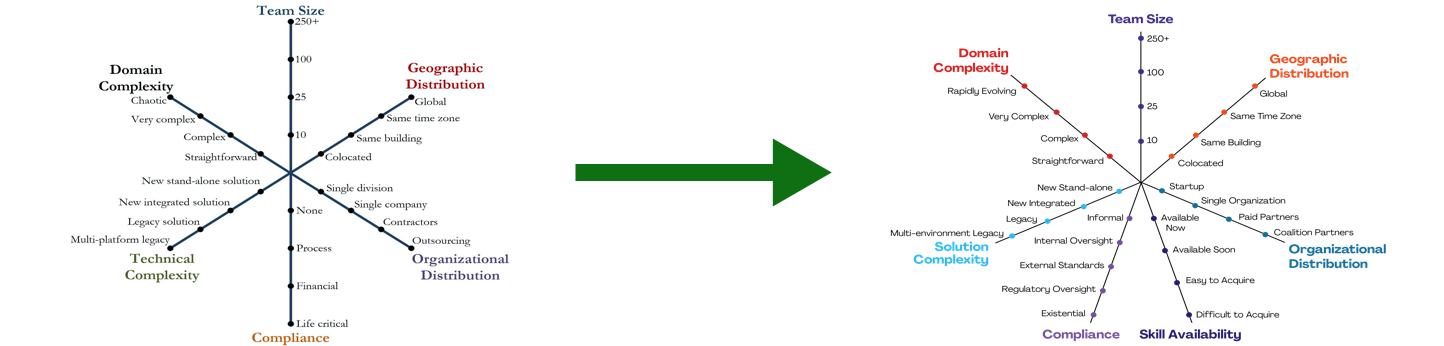
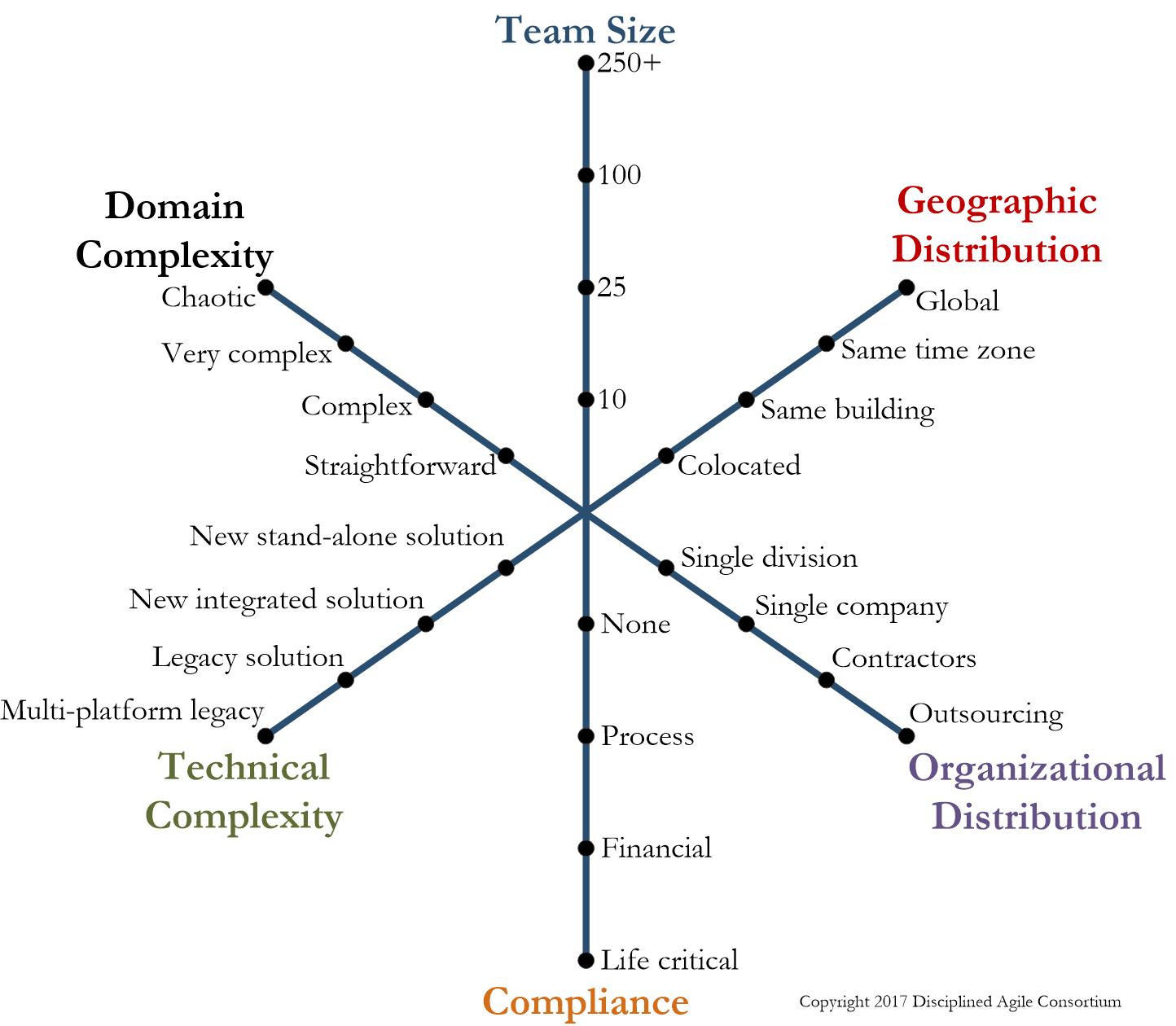
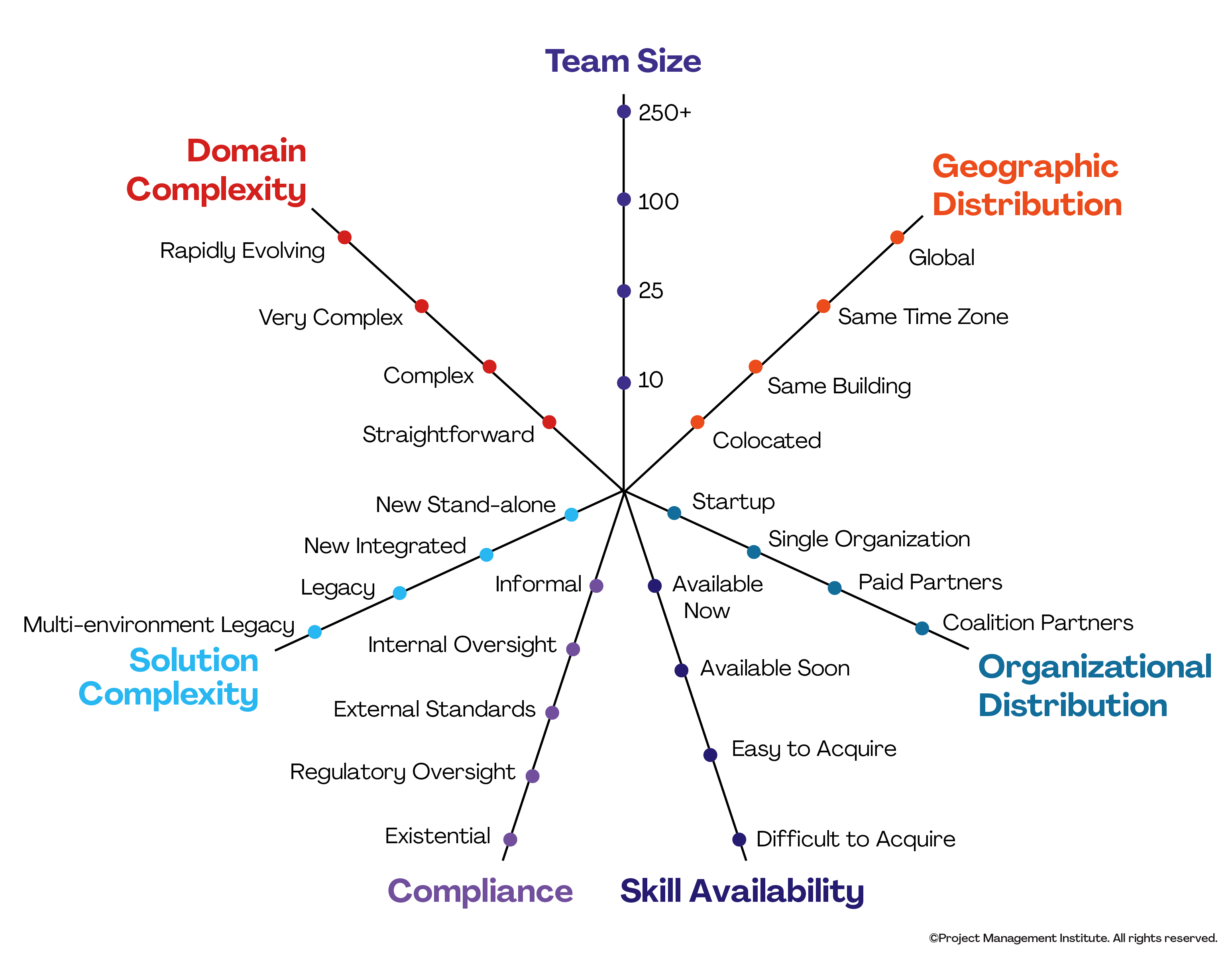
We've have recently updated our thinking around the tactical scaling factors that we apply in DA to help understand the context faced by a team or organization. Figure 1 depicts the original scaling factors and Figure 2 the new scaling factors. Below we discuss what changed and how this can affect anyone taking a Disciplined Agile (DA) certification exam.
Figure 1. The (original) scaling factors of the SDCF.
Figure 2. The scaling factors of the SCF.
What's Changed?The changes we made were motivated by our experiences applying the scaling factors outside of IT teams. Originally these scaling factors were described by the Software Development Context Framework (SDCF) which we evolved into the Situation Context Framework (SCF) in late 2020. Here is what has changed:
Implications for DA Certification ExamsAs you can see in Scaling Factors we have made it clear that the exam will test you for knowledge about the original version for now (in Figure 1) and that when we update the courseware and exam to reflect this update we will let you know. In general our intent is that whenever material on the web gets ahead of what is being tested for that we'll make it clear that this has happened. More on this in a future blog posting.
Further Reading
|
DA and Enterprise Risk Management
|
Risks are inherent with projects. They are an attribute of doing something new or novel that distinguishes projects from regular operational work. How well we navigate risk often decides the success of not just a project but also an organization. In a recent blog post, we looked at how Disciplined Agile (DA) teams can effectively navigate risk, both threats and opportunities, at the project level. This post examines DA’s Enterprise view of risks at the program and portfolio level. Often team members and project managers focussing on the success of their project may not see how their efforts at project optimization can be misaligned at an enterprise level. In Lean terms, this is known as local vs. global optimization. Program Risks Can Compound We know that breaking large endeavors into smaller ones helps reduce risk. Reducing complexity, the number of stakeholders involved, and the project’s duration (horizon of risk) all help increase the likelihood of success. However, risks compound when the overall benefit is contingent on the success of multiple dependant projects. If a business outcome depends upon “Project” A completing, followed by “Project B,” “C,” and “D” each at 75% of success, the overall program only has a .75 X .75 X.75 X.75= 32% chance of a successful outcome. Working on our endeavor, it is sometimes difficult to appreciate the dependency implications of connected chains. Downstream Risks Project teams are often incented to take a limited view of success based on how they are measured. Did we complete it on time? Was all the scope signed off? Did we finish within budget? Again, putting on our Lean hat and taking a global vs. local optimization view, how did we really do? The DA Governance process blade looks beyond the project for possible downstream risks. Project teams may ignore risks associated with increased operational load or sustainability. Sure, we shipped on time, but if we created increased maintenance costs, the organization might be worse off rather than better off as a result. Aggregate Risks Knowledge sharing is critical. Individually, a risk exposure may seem acceptable, but if it is common to 50 inflight projects, the aggregate risk may exceed the organization’s risk appetite. Likewise, if many different risks could be triggered by a single event, then that aggregate risk may not be fully appreciated at a project or product level. Sharing risk information allows for better steering at an organizational level. However, it takes a culture of support for bad-news communications as well as good-new communications for this to work. Creating psychological safety where leaders demonstrate the desired behavior is a good starting point. Then encourage information sharing throughout the organization and help rather than punish the messenger. The upside is that opportunities aggregate also. The time or cost savings for buying a tool or improving a process may not make economic sense for a single team, but it may be viable if applied to all teams. Ongoing Risk Governance We should make sure teams are actively managing the risks on their projects. Check that the appropriate risk tolerances and response strategies are being applied. For instance, one team lead’s view of an acceptable risk might be very different from another’s. Check that teams understand and are applying the basics of risk management. Have they established risk thresholds for recording risks and escalating them? Are they identifying and acting on risks and opportunities? Are they engaging the right stakeholders and with review and response actions? In short, are they following the advice captured in the Address Risk process goal? Reviews can seem like micromanagement and lead to a lack of trust and resentment. To avoid this, explain why risk management is essential and look for evidence of understanding and intent-based actions over compliance to rigid standards unless those standards are required for your industry. At the enterprise level, check risk tolerances are normalized, and teams are sharing their threats and opportunities across the organization appropriately. When teams are focused on delivering features or meeting a deadline, they may lose sight of risk management work. Risks as a Positive Sign of Progress and Growth It is important to recognize risks are a sign of healthy activity. By their very nature, projects are risky because they try new things. They create or change products and services which carry a risk of problems and failure. However, there is an ever-present opposing-risk of enterprise-inertia. Organizations that do not innovate, improve or even just keep pace with the speed of their industry’s evolution are moving backward compared to their competitors. The risk of reduced competitiveness, loss of market share, or market presence in new communication channels have real consequences. Innovation and evolution through projects counter-act this risk. “A ship in harbor is safe, but that is not what ships are built for.” This quote parallels the need for projects and some risk-taking. Organizations need project development, product development and other initiatives to stimulate change and to keep moving forward. They carry risk, but so too does standing still. DA provides Lean inspired guidance for applying global as well as local suggestions to help exploit opportunities and avoid or reduce the inevitable threats associated with innovation. |

PMI Chapter Opportunity: The Agile20Reflect Festival
|
February 2021 will be the 20th Anniversary of the meeting from which the Manifesto for Agile Software Development, or more colloquially the Agile Manifesto, emerged. To celebrate this, the Agile20Reflect Festival will be held around the world during the month of February. The festival is a collection of agile learning events around the world, where each event is run by a local group such as a PMI chapter. This is a great opportunity for PMI members to learn more about agile, and for PMI Chapters to host an event for their members as part of the festival. This blog is organized into the following topics: The EventsGood things to know:
Potential Ideas for an EventHere is a list of event ideas that should get you thinking about what your chapter can do:
The above list is just a start. If you have other ideas that you'd like to share, please do so (see below).
How to Organize an EventThis is what I suggest you do:
Let's Work TogetherTime is short, so we need to collaborate to make this successful. Let's take advantage of the Disciplined Agile discussion forum on LinkedIn to collaborate. Here's how we can use it:
|

The Fallacy of Instant Self-Organization: What Team Development Models Can Teach Us
| Right from the outset, agile teams are expected to self-organize. Let’s take a team that just started practicing Scrum. To do Scrum well, they must self-organize how they plan the next two weeks’ worth of work during the iteration planning. They must self-organize how to coordinate today’s work during their standups. They must also self-organize how to solicit feedback on what they built (iteration demo) and how they built it (iteration retrospective). On top of that is the matter of actually self-organizing the work of building the actual solution they are working towards.
That is a lot to ask any team, especially one that is newly formed, or one that has recently changed from their old way of working (WoW) to an agile WoW. I, for one, would venture that it is impossible. A newly formed team, or a team that recently changed WoW, have to normalize first before they can carry out those tasks in a self-organizing manner. The fact that Scrum and other agile ways of working expect this from the outset is what I call the fallacy of instant self-organization. What is team development?Team development and team building often get mixed up. Let’s be clear, team development is not team building. Rather, team building can be a part of team development. Team building is a catch-all phrase for activities where colleagues get to know each other better as fellow humans, not just people at work. Team building can be anything from quick social games (like Pecha Kucha or two truths and a lie) or getting away from the office for a celebratory meal, drink or game of bowling. Team development on the other hand is a deliberate process in which a team takes time to explore its potential; how it can become even greater than it’s been before. Team development is a journey. What is a team development model?There are plenty of team development models to pick from. How teams form and develop has been the fascination and research of many people. Before we move on, let’s recall the wise aphorism by George Box: that “all models are wrong, but some are useful.” Models are like a pair of spectacles. They help us see the world with more clarity to make better sense of it. But they are all inherently “wrong” because they are not the world itself.
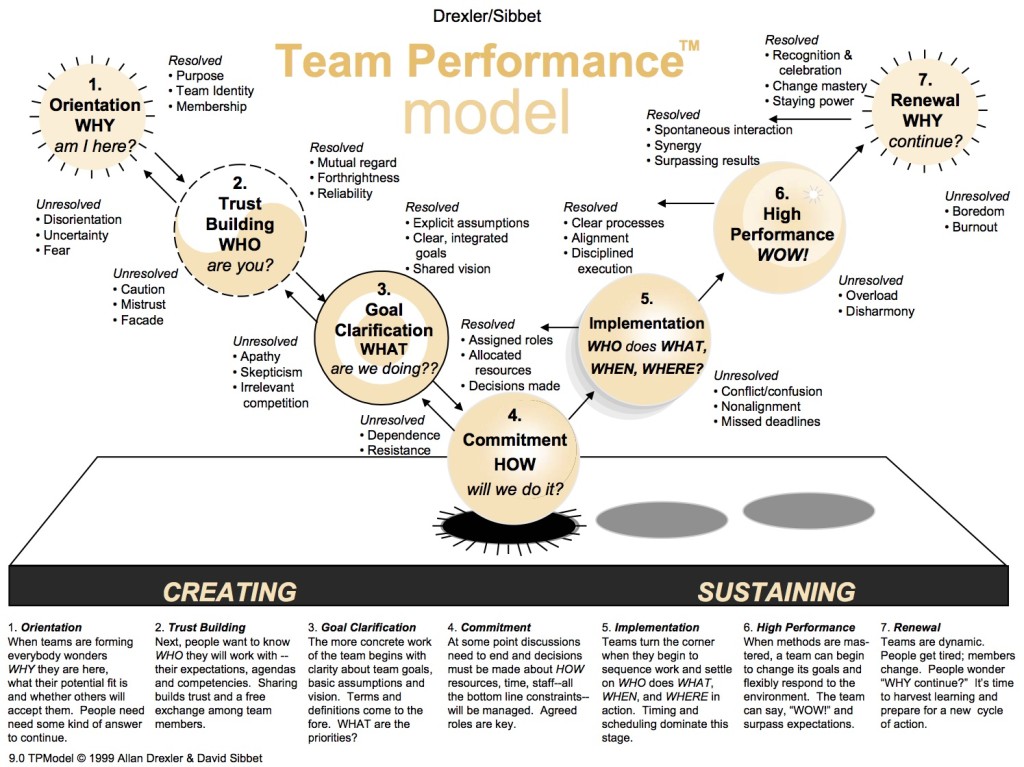
That said, models can be very useful and provide insight and guidance for our world of agile teams. As an agile practitioner, I find three models useful: Bruce Tuckman’s stages of team development model, the Drexler/Sibbet team performance model, and Patrick Lencioni’s five beaviors model. What can we learn from team development models when it comes to self-organization?Looking across all three models, we can extract some key points about team development. First, there are no shortcuts to high performance. In all the models, the team has to travel a journey of set steps or stages before reaching high performance. The steps start out very basic, like building trust and getting to know each other, and progresses to something more advanced where we learn to solve work tasks together. This all seems like a given, but it is often overlooked or forgotten. Secondly, even though the models all lay out the road to high performance as a neat step-by-step journey, the journey is not linear. We are dealing with people, not printers. People and their interactions are messy, complex and to a large degree unpredictable. Thirdly, regression can happen anytime. As I discussed above, the scenario of a team that has recently changed their WoW is a prime example of team development regression. The abrupt change of their way of working (say, from a traditional approach to an agile WoW) can likely cause the team members to be unsure of their role on the team, how they are supposed to work together now, and can even erode some of the trust inside the team. Regression can also occur when team members come and go, and in the case of significant external changes, regression is always something to be on the lookout for, and it is always a question that leaders should ask themselves when they make changes. Can this change adversely impact the team’s journey to high performance? The last and most important point seen from an agile practitioner’s perspective is that the models all offer guidance for the team’s journey. Take the Drexler/Sibbet model for example:
Source: http://www.robertmcneil.com/2016/02/12/the-drexler-sibbet-team-performance-model/ Not only does it tell you what’s going on in each stage (by naming the stage intuitively), it also describes how to move to the next step. If you look closely at the first step (Orientation: why am I here?), you see that if left unresolved, you will get patterns (or rather anti-patterns) of: disorientation, uncertainty, and fear. The tools that we as team leaders have to resolve this step and help the team onwards are: providing purpose, team identity and membership. Continue your learning journeyThe Disciplined Agile People Management process blade contains an overview of how to manage people in an agile enterprise. The Disciplined Agile Grow Team Members process goal contains a collection of tools and practices of how to continuously grow our team members. |