







Guessing is not a strategy: How to build decision velocity with AI and real-time data
June 10, 2026 | Live Webinar

Disciplined Agile 5.5 Released
Choose Your WoW! Second Edition Is Now Available
Requisite Agility applied in Project Management
Disciplined Agile and PMBoK Guide 7th Edition
#ChoiceIsGood, #ChooseYourWoW, #ConsumableSolution, #ContinuousImprovement, #CoreAgilePractices, #experiment, #Experimentation, #GuidedContinuousImprovement, #Kaizen, #LifeCycles, #ProcessImprovement, #TealOrganizations, Adoption, agile, agile adoption, Agile Alliance, Agile Business Analyst, Agile certification, agile data, agile governance, agile lifecycle, agile metrics, agile principles, agile transformation, Agile2018, Agile2019, Agile20Reflect, AgileData, Analogy, announcement, Architecture, architecture, architecture owner, Articles and publications, Asset Management, Atari, Backlog, Barclays, being agile, benefits, bi, blades, book, Branching strategies, Browser, Business Agility, business intelligence, business operations, capex, Case Study, Certification, certification, charity, Choose your WoW, CMMI, cmmi, Coaching, Collaboration, Communications Management, Compliance, Compliancy, Conference, Construction, Construction phase, Context, Continuous Improvement, coordination, COVID-19, Culture, culture, Cutter, DA, DAD, DAD Book, DAD discussions, DAD press, DAD roles, DAD supporters, DAD webcast, DADay2019, Data Management, database, dependencies, Deployment, Development Strategies, DevOps, disaster, Discipline, discipline, Disciplined Agile, disciplined agile delivery, disciplined agile delivery blog, Disciplined Agile Enterprise, disciplined devops, Documentation, Domain complexity, dw, DW/BI, Energy Healing, Enterprise Agile, Enterprise Architecture, Enterprise Awareness, enterprise awareness, Essence, estimation, Evolving DA, Executive, Experiment, facilitation, FailureBow, feedback-cycle, finance, Financial, FLEX, Flow, foundation layer, Funding, GCI, GDD, Geographic Distribution, gladwell, global development, Goal-Driven, goal-driven, goals, Governance, GQM, Guideline, Hybrid, Improvement, inception, Inception phase, India, information technology, infosec, Introduction, iterations, Kanban, large teams, layer, lean, Lean Startup, learning, Legal Project Management, LeSS, Lifecycle, lifecycle, Manifesto, mark lines, marketing, MBI, Metaphor, Metrics, metrics, mindset, Miscellaneous, MVP, News, News and events, Non-Functional Requirements, non-functional requirements, Non-solo development, offshoring, Operations, opex, Organization, Outsourcing, outsourcing, paired programming, pairing, paper, People, People Management, phases, Philosophies, Planning, PMBoK, PMI, PMI and DA, PMI Chapter, Portfolio Management, post-format-quote, Practices, practices, Principle, Process, process improvement, process tailoring, Product Management, product owner, Product Owners, productivity, Program Management, Project Management, project-initiation, Promise, Quality, quality, rational unified process, Refactoring, Reiki, Release Management, release management, Remote Training, Remote Work, repeatability, requirements, Requirements Management, research&development, responsibilities, retrospectives, Reuse, Reuse Engineering, ride for heart, rights, Risk Management, Risk Management, Risk management, Roles, RUP, SAFe, sales, Scaling, scaling, scaling agile, Scheduled Workshops, SCM, scorecard, Scrum, ScrumMaster, SDLC, Security, security, self-organization, SEMAT, serial, skill, solutions software consumable shippable, Stakeholder Management, strategy, Support, Surveys, Teal organizations, team development, Team Lead, team lead, Teams, Technical Debt, Teleconferencing, Terminology, terraforming, test strategy, testing, time tracking, Tool kit, Toolkit, tools, traditional, Transformation, Transition iteration, transition phase, Uncategorized, Upmentors, Using PMI Standards, value stream, velocity, vendor management, Virtual Training, Workflow, workflow, workspaces


|
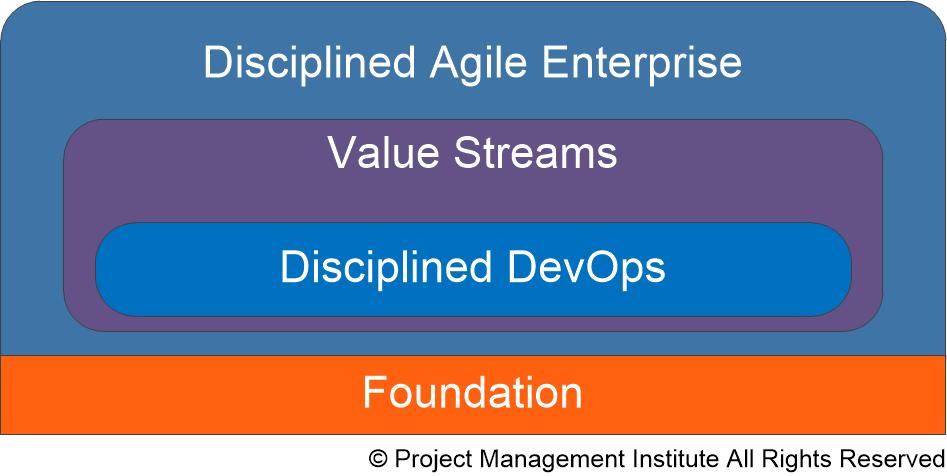
The Disciplined Agile (DA) tool kit is organized into four layers, overviewed in Figure 1. These layers are: Foundation, Disciplined DevOps, Value Streams, and Disciplined Agile Enterprise (DAE). This blog focuses on the Disciplined DevOps layer. Figure 1. The layers of the DA tool kit.
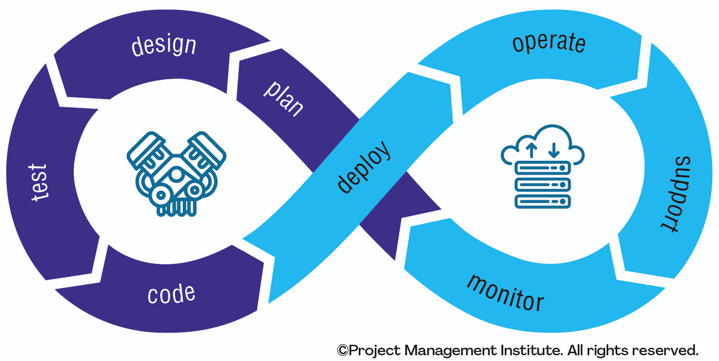
How is "Disciplined DevOps" different from normal/mainstream DevOps? Mainstream DevOps is the streamlining of software development, information technology (IT) operations, and support. This strategy is often depicted as an infinite loop as you see in Figure 2. Disciplined DevOps is an enterprise-ready approach that extends mainstream DevOps to include critical activities around security, data management, release management, and business operations. The high-level workflow for Disciplined DevOps is depicted in Figure 3. Figure 2. The classic DevOps workflow.
Figure 3. The workflow of Disciplined DevOps.
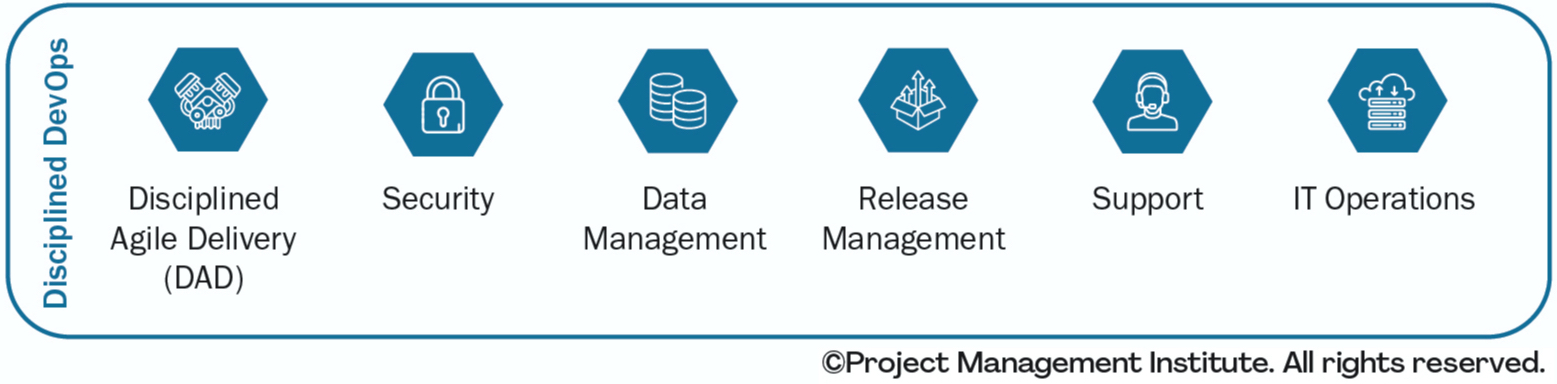
Let's explore the components of Disciplined DevOps. The hexes in Figure 3 represent process blades, sometimes called process areas. A process blade encompasses a cohesive collection of process options, such as practices and strategies, that should be chosen and then applied in a context sensitive manner. Process blades also address functional roles specific to that domain as well as extensions to the DA mindset specific to that domain. The process blades of Disciplined DevOps are:
Disciplined Agile Delivery (DAD)Disciplined Agile Delivery (DAD) is a people-first, learning-oriented hybrid approach to solution delivery. DAD teams focus on the creation of a new, or evolution of an existing, consumable solution for their customers. A solution may include any combination of software, physical assets (e.g. hardware), documentation, changes to the supported business process, and changes to the organizational structure(s) of the people involved. A solution is consumable when it is usable, desirable, and functional. DAD enables a flexible way of working (WoW), supporting several lifecycles in a manner that is tactically scalable. SecurityThe Security process blade focuses on how to protect your organization from both information/virtual and physical threats. This includes procedures for security governance, identity and access management, security policy management, incident response, and vulnerability management. As you would expect these policies will affect your organization’s strategies around change management, disaster recovery and business continuity, solution delivery, and vendor management. For security to be effective it has to be a fundamental aspect of your organizational culture. Data ManagementData management is the development, execution and supervision of plans, policies, programs and practices that control, protect, deliver and enhance the value of data and information assets. DA promotes a pragmatic, streamlined approach to data management that fits into the rest of your organizational processes – we need to optimize the entire workflow, not sub-optimize our data management strategy. Disciplined agile data management does this in an evolutionary and collaborative manner, via concrete data management strategies that provide the right data at the right time to the right people. Release ManagementThe release management process blade encompasses planning, coordinating, and verifying the deployment of solutions into production. Release management requires collaboration by the team(s) producing the solutions and the people responsible for your organization’s operational environment(s). In the case of organizations with a “you build it, you run it” DevOps mindset these people may be one in the same, although even in these situations you will often find a group of people responsible for governing the overall release management effort. In a true DevOps environment release management is fully automated for the intangible aspects (e.g. software and supporting documentation), and perhaps even some physical aspects, of your solution. SupportSupport focuses on helping customers/end users to work with the solutions produced by your delivery teams. Ideally your solutions should be designed so well that people don’t need anyone to help them but unfortunately it doesn’t always work out that way. So in many ways your support strategy is your “last line of defense” in your efforts to Delight Customers. Support goes by many names, including help desk, customer support, and customer care. IT OperationsThe primary aim of IT operations is to run a trustworthy IT ecosystem. From the point of view of your customers, you want to do such a good job that they don’t even notice IT. For older organizations this can be a challenge due to the existence of hundreds, if not thousands, of legacy systems that have been deployed over the decades. You may face daunting technical debt in these systems – poor quality data, overly complex or poorly written source code, systems with inadequate automated regression tests (if any), different versions of the same system, several systems offering similar functionality, numerous technology platforms, systems and technologies for which you have insufficient expertise, and more. Business OperationsBusiness operations is one of the process blades of the value stream layer, although as you see in Figure 3 it is a critical component of the Disciplined DevOps workflow. Business operations focuses on the activities required to provide services to customers and to support your products. The implementation of business operations will vary by value stream, in a bank retail account services is implemented in a very different manner than brokerage services for example. Business operations includes help desk and support services (integrated in with IT support where appropriate) as well as any technical sales support activities such as training, product installation, and product customization. As you can imagine close collaboration with both your Sales and Marketing efforts is required to successfully Delight Customers. |
|
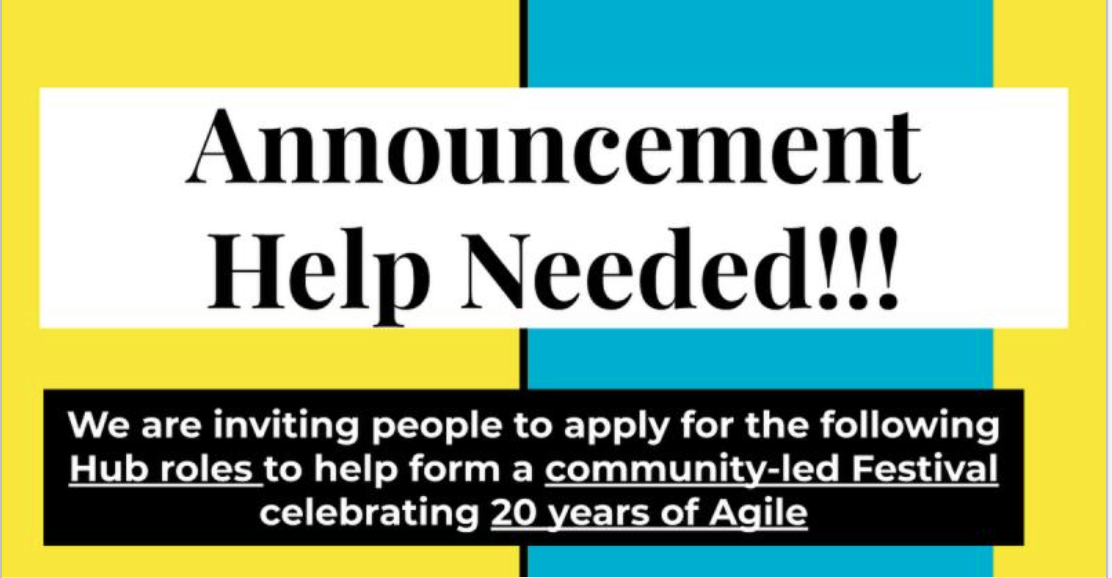
Scott Seivwright is leading the #Agile20Reflect effort to reflect on 20 years of the agile movement. He has posted a call for help to organize Agile20Reflect. He's looking for people to get involved who can help run things rather than argue and fight about various nuances. Given the Disciplined Agile strategy of embracing the various agile, lean, and even traditional strategies I suspect that some of you may be well suited to join in this effort. And yes, I'm already involved. |
| Each business challenge is both unique to your situation and informed by traditional conventions. By using the Disciplined Agile (DA) tool kit, you and your team can better understand how seemingly segmented activities - such as security, product management, portfolio management, solution delivery, and finance to name a few - can work together in a context-sensitive manner. By understanding what these activities should address, as well as the tradeoffs associated with each, you can make more informed decisions for better business agility. To help you to navigate the wealth of advice contained in the DA tool kit, we have organized it into a four layers as you see in the following diagram.
The four layers of the DA tool kit are:
|
|
The Disciplined Agile (DA) tool kit is organized into four layers: Foundation, Disciplined DevOps, Value Streams, Disciplined Agile Enterprise (DAE). This blog focuses on the Foundation layer, the purpose of which is to provide the underpinnings of the DA tool kit. The foundation layer itself is organized into four distinct topics:
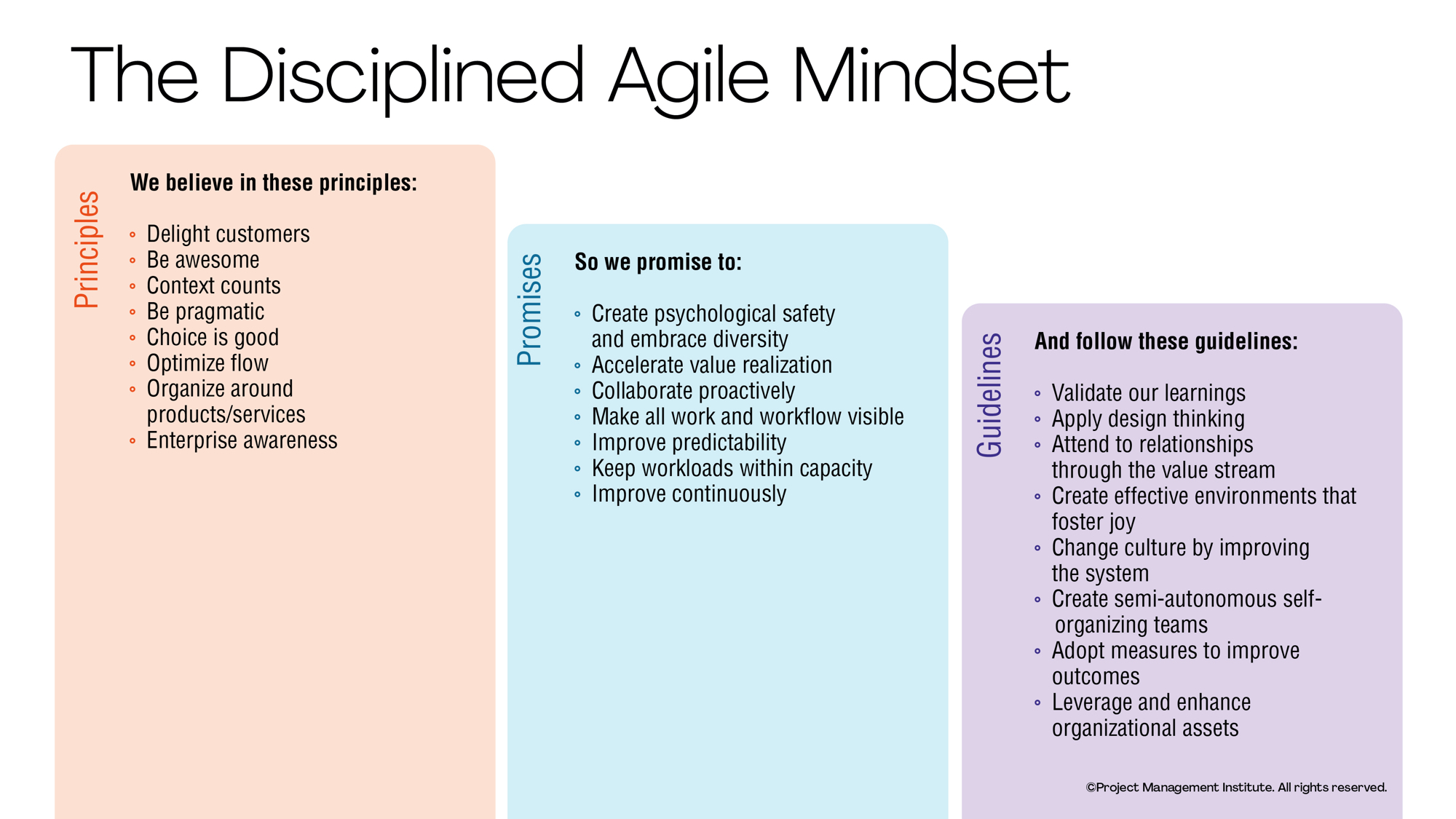
The DA MindsetThe Disciplined Agile (DA) mindset is captured in the form of principles, promises, and guidelines. Disciplined agilists believe in the DA principles, so we promise to adopt these behaviours and follow these guidelines when doing so. There is a purpose for each aspect of the mindset:
Fundamental ConceptsDisciplined Agile (DA) is a hybrid in that it adopts ideas and strategies from a wide range of sources. DA encompasses three categories of fundamental concepts:
PeopleThe people portion of the Foundation layer addresses two key aspects of agility:
Choosing Your WoWA fundamental philosophy of agile is that teams should own their own process, or as we like to say in Disciplined Agile (DA) teams should choose their way of working (WoW). Of course this is easier said than done in practice. The challenge is that every team is unique and faces a unique situation – in other words, context counts. Furthermore, there are no “best practices,” rather, every practice has tradeoffs and works well in some situations and poorly in others. Worse yet, you really don’t know how well a technique will work for you until you actually try it out in your environment. Given all of this, how can a team choose its WoW? While working with organizations to help them to learn how to improve their WoW, we’ve developed a technique that we call guided continuous improvement (GCI). GCI extends the kaizen-based continuous improvement approach, where teams improve their WoW via small incremental changes, to use proven guidance to help teams identify techniques that are more likely to work in their context. This increases the percentage of successful experiments and thereby increases your overall rate of process improvement. |
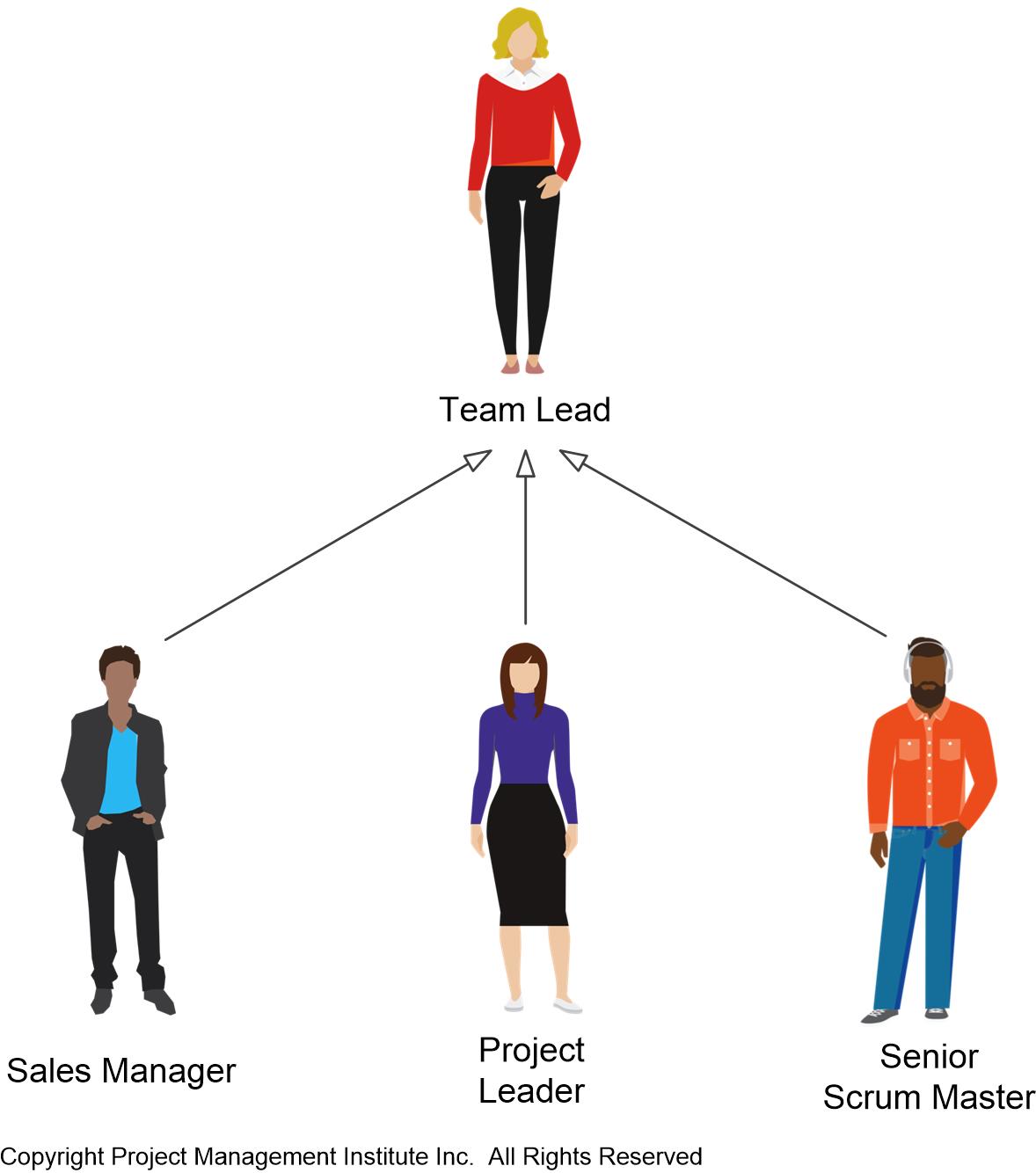
| We are often asked why Disciplined Agile (DA) has a team lead role instead of Scrum master or project manager. The answer is three-fold: different types of teams require different types of leaders, leadership responsibilities vary based on the type of team they are leading, and DA strives to be agnostic wherever possible. Let's explore the implications of this strategy. Team lead is what is known as a meta role. What we mean by this is that there are different types of team lead depending on the situation, as depicted in Figure 1. Think of team lead as a place holder for a more specific type of lead. So, a scrum master is a team lead of a Scrum team, a project leader is a team lead of a project team, a sales manager is a team lead of a sales team. At times, the team will choose to stick with the name “team lead” for the role due to their way of working best fitting that description. Figure 1. Types of team leads.
As I said above, there are three reasons for taking this approach with the team lead role:
The end result is that you may see some DA teams with a senior scrum master as the team lead, some DA teams with a project leader as a team lead, some DA teams with a functional leader in the role of team lead, and some teams with someone who is simply the team lead. Just like your way of working (WoW) should be fit for purpose, so should your approach to roles and responsibilities. |