


.jpg)



Guessing is not a strategy: How to build decision velocity with AI and real-time data
June 10, 2026 | Live Webinar

Disciplined Agile 5.5 Released
Choose Your WoW! Second Edition Is Now Available
Requisite Agility applied in Project Management
Disciplined Agile and PMBoK Guide 7th Edition
#ChoiceIsGood, #ChooseYourWoW, #ConsumableSolution, #ContinuousImprovement, #CoreAgilePractices, #experiment, #Experimentation, #GuidedContinuousImprovement, #Kaizen, #LifeCycles, #ProcessImprovement, #TealOrganizations, Adoption, agile, agile adoption, Agile Alliance, Agile Business Analyst, Agile certification, agile data, agile governance, agile lifecycle, agile metrics, agile principles, agile transformation, Agile2018, Agile2019, Agile20Reflect, AgileData, Analogy, announcement, Architecture, architecture, architecture owner, Articles and publications, Asset Management, Atari, Backlog, Barclays, being agile, benefits, bi, blades, book, Branching strategies, Browser, Business Agility, business intelligence, business operations, capex, Case Study, Certification, certification, charity, Choose your WoW, CMMI, cmmi, Coaching, Collaboration, Communications Management, Compliance, Compliancy, Conference, Construction, Construction phase, Context, Continuous Improvement, coordination, COVID-19, Culture, culture, Cutter, DA, DAD, DAD Book, DAD discussions, DAD press, DAD roles, DAD supporters, DAD webcast, DADay2019, Data Management, database, dependencies, Deployment, Development Strategies, DevOps, disaster, Discipline, discipline, Disciplined Agile, disciplined agile delivery, disciplined agile delivery blog, Disciplined Agile Enterprise, disciplined devops, Documentation, Domain complexity, dw, DW/BI, Energy Healing, Enterprise Agile, Enterprise Architecture, Enterprise Awareness, enterprise awareness, Essence, estimation, Evolving DA, Executive, Experiment, facilitation, FailureBow, feedback-cycle, finance, Financial, FLEX, Flow, foundation layer, Funding, GCI, GDD, Geographic Distribution, gladwell, global development, Goal-Driven, goal-driven, goals, Governance, GQM, Guideline, Hybrid, Improvement, inception, Inception phase, India, information technology, infosec, Introduction, iterations, Kanban, large teams, layer, lean, Lean Startup, learning, Legal Project Management, LeSS, Lifecycle, lifecycle, Manifesto, mark lines, marketing, MBI, Metaphor, Metrics, metrics, mindset, Miscellaneous, MVP, News, News and events, Non-Functional Requirements, non-functional requirements, Non-solo development, offshoring, Operations, opex, Organization, Outsourcing, outsourcing, paired programming, pairing, paper, People, People Management, phases, Philosophies, Planning, PMBoK, PMI, PMI and DA, PMI Chapter, Portfolio Management, post-format-quote, Practices, practices, Principle, Process, process improvement, process tailoring, Product Management, product owner, Product Owners, productivity, Program Management, Project Management, project-initiation, Promise, Quality, quality, rational unified process, Refactoring, Reiki, Release Management, release management, Remote Training, Remote Work, repeatability, requirements, Requirements Management, research&development, responsibilities, retrospectives, Reuse, Reuse Engineering, ride for heart, rights, Risk Management, Risk Management, Risk management, Roles, RUP, SAFe, sales, Scaling, scaling, scaling agile, Scheduled Workshops, SCM, scorecard, Scrum, ScrumMaster, SDLC, Security, security, self-organization, SEMAT, serial, skill, solutions software consumable shippable, Stakeholder Management, strategy, Support, Surveys, Teal organizations, team development, Team Lead, team lead, Teams, Technical Debt, Teleconferencing, Terminology, terraforming, test strategy, testing, time tracking, Tool kit, Toolkit, tools, traditional, Transformation, Transition iteration, transition phase, Uncategorized, Upmentors, Using PMI Standards, value stream, velocity, vendor management, Virtual Training, Workflow, workflow, workspaces


| In this posting we explore the goal-driven aspect of the Disciplined Agile (DA) toolkit. This goal-driven approach enables DAD to avoid being prescriptive and thereby be more flexible and easier to scale than other agile methods. For example, where Scrum prescribes a value-driven Product Backlog approach to managing requirements DAD instead says that during construction you have the goal of addressing changing stakeholder needs. DAD also indicates that there are several process factors/issues surrounding that goal that you need to consider, and there are several techniques/practices that you should consider adopting to do so. DAD goes further and describes the advantages and disadvantages of each technique and in what situations it is best suited for. Yes, Scrum’s Product Backlog approach is one way to address changing stakeholder needs but it isn’t the only option nor is it the best option in most situations. We start by describing how to visualize goals. We then summarize the goals called out by DAD, a topic we’ve written about in the past so we only cover this topic briefly here. We end with a summary of the advantages and disadvantages of a goal-driven approach over the more prescriptive approaches of older agile methods. Visualizing GoalsIn the original DAD book we described process goals in a non-visual manner using tables which explored the advantages and disadvantages of the techniques associated with a process factor. Since we wrote that book both Mark and I have spent a lot of time helping people to understand what a goals-driven approach entails and we’ve found that many people respond well to visual representations of a process goal. Yes, the process decision tables are very important but a visual overview helps to provide context for the detailed information. In the second half of 2012 we began developing a way to represent goals in a visual manner using what we call a goals diagram. A goals diagram, the notation for which is summarized in Figure 1, is in effect a form of decision tree. In Figure 1 you see that a process goal is indicated using a rounded rectangle and the decision points pertaining to a goal with normal rectangles. Process goals will have one or more decision points that you need to consider addressing, with most goals having four or five decision points although some have eight or nine. Each decision point is then addressed by two or more techniques/practices. Because there may be many techniques to choose from, we indicate “default” techniques in bolded italics. These defaults are good starting points for teams new to agile – they are almost always strategies from Scrum, XP, or Agile Modelling with a few Rational Unified Process (RUP) ideas thrown in to round things out. Some decision points you may choose not to address. Sometimes options are “ordered”, which is indicated by a upwards pointing arrow to the left of the list of techniques. What we mean by this is that the techniques appearing at the top of the list are more desirable from the point of view of agile and lean thinking and the less desirable techniques are at the bottom of the stack. Your team of course should strive to adopt the most effective techniques they are capable of performing given the context of the situation that they face. In Figure 1 the first decision point has an ordered set of options whereas the second one does not. Typically when the options are ordered you will only choose one of them whereas you MIGHT choose several options in unordered situations. Figure 1. The notation of goal diagrams.
Let’s work through some examples. Figure 2 depicts the goal diagram for Explore Initial Scope, a goal that you should address at the beginning of a project during the Inception phase (remember, DAD promotes a full delivery lifecycle, not just a construction lifecycle). Where some agile methods will simply advise you to populate your product backlog with some initial user stories the goal diagram of Figure 2 makes it clear that you might want to be a bit more sophisticated in your approach. What level of detail should you capture, if any (a light specification approach of writing up some index cards and a few whiteboard sketches is just one option you should consider)? What view types should you consider (user stories are one approach to usage modeling, but shouldn’t you consider other views to explore the data or the UI)? Notice how we suggest that you likely want to default to capturing usage in some way, basic domain concepts (e.g. via a high-level conceptual diagram) in some way, and non-functional requirements in some way. There are different strategies you may want to consider for going about modeling. You should also start thinking about your approach to managing your work. In DAD we make it clear that agile teams do more than just implement new requirements, hence our recommendation to default to a work item stack over Scrum’s simplistic Product Backlog strategy. Finally Figure 2 makes it clear that when you’re exploring the initial scope of your effort that you should capture non-functional requirements – such as reliability, availability, and security requirements (among many) – in some manner. Figure 2. Exploring the initial scope.
Figure 3 depicts one of the goals that you should address during the construction phase, in this case Address Changing Stakeholder Needs. This is an iteresting example for two reasons. First, it captures the key decisions surrounding the second of the 15 principles of the Disciplined Agile Manifesto, that of welcoming changing requirements. Second, it has a decision point that overlaps with that of another goal, in this case we indicate that your Work Item Management Strategy is important to consider for both this goal and Explore Initial Scope (see Figure 2). Figure 3 makes the process factors surrounding how to address changing stakeholder needs very explicit. How are you going to prioritize changes? A business value approach is one option, the approach popularized by Scrum, but we’ve found that the risk-value approach promoted by Unified Process (UP) to be a more robust strategy that leads to greater chance of agile project success. There’s advantages and disadvantages to each technique so you’ll want to choose the one best for you. When are you going to accept the change? During the current iteration as Extreme Programming (XP) suggests or a future iteration as Scrum suggests? Do changes come directly from stakeholders or via a proxy such as a product owner or business analyst? How will your team elicit changes (via modeling, demos, …)? Figure 3. Addressing changing stakeholder needs.
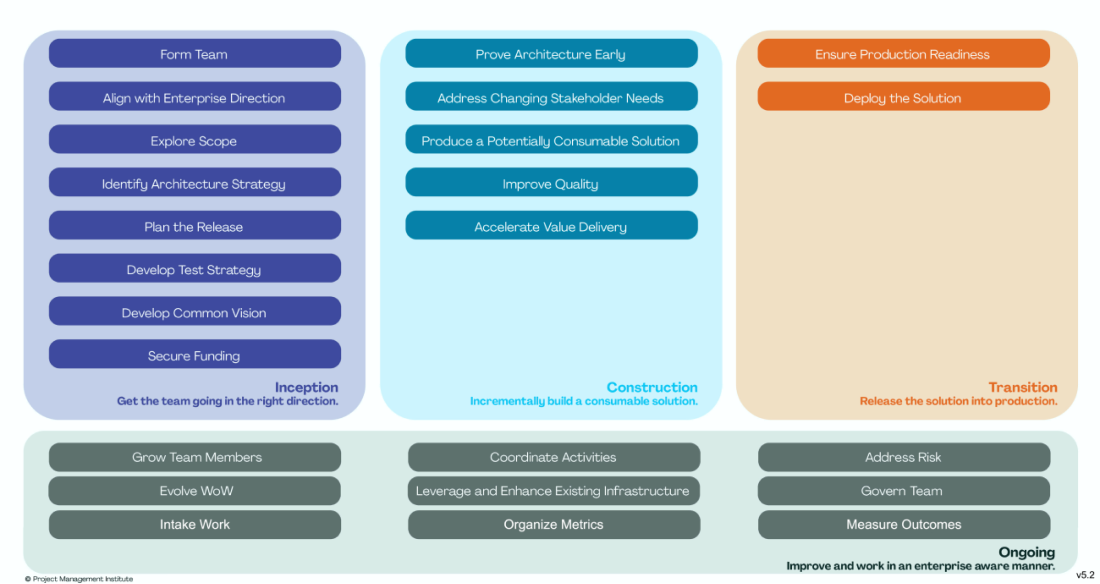
The advantage of visualizing goals as we’ve shown in Figures 2 and 3 is that it makes it very clear what process-related decisions you need to make and what options you have available to you. The disadvantage of this sort of diagram is that they get fairly big at times, as you can see. This effectively prevents us from taking the diagrams one step further to indicate the trade-offs associated with each technique and as a result you’ll still need the text tables we included in the DAD book for that. The Goals of DADIn the previous section we indicated that there are many goals called out by DAD, Figure 4 summarizes these goals, which have evolved slightly from what we published in the book (we refactored a few to make them more consumable). Notice how each of the three phases (Inception, Construction, and Transition) are described by specific goals. Also notice how some goals, such as Grow Team Members and Address Risk, are applicable throughout the entire lifecycle. Figure 4. Goals throughout the lifecycle.
Mark Lines’ post Being Goal-Driven Requires Discipline explores the history of the figure above if you’re interested in how the goals have evolved since the DAD book was published. The Advantage of Goals Over PrescriptionFirst and foremost, DAD is a process decision framework. One what that it achieves this through it’s goal-driven approach that guides people through the process-related decisions that they need to make to tailor and scale agile strategies to address the context of the situation that they face. Our experience is that there are several fundamental advantages to taking a goal driven approach to agile solution delivery. A goal-driven approach:
So far we’ve identified two disadvantages to DAD’s goal-driven approach when working with customer organizations. First, it makes the complexities of solution delivery explicit. Although some of us want to believe that the simplistic strategies of other agile methods will get the job done we inherently know that software development, or more accurately solution delivery, is in fact a complex endeavor in practice. Second, some people just want to be told what to do and actually prefer a prescriptive approach. DAD mitigates this problem a bit by suggesting default starting points (shown in italized bold text in the goal diagrams) but even this can be overwhelming for some people. Interestingly, when we were writing the book two of our 30+ reviewers were adamantly against giving people choices because they felt it was better to adopt a more prescriptive approach as we see in older agile methods. We hope that this blog posting has given you some food for thought that you can leverage on your next agile project. Got Discipline? |
| This blog has been replaced with the page Full Agile Delivery Lifecycles. |
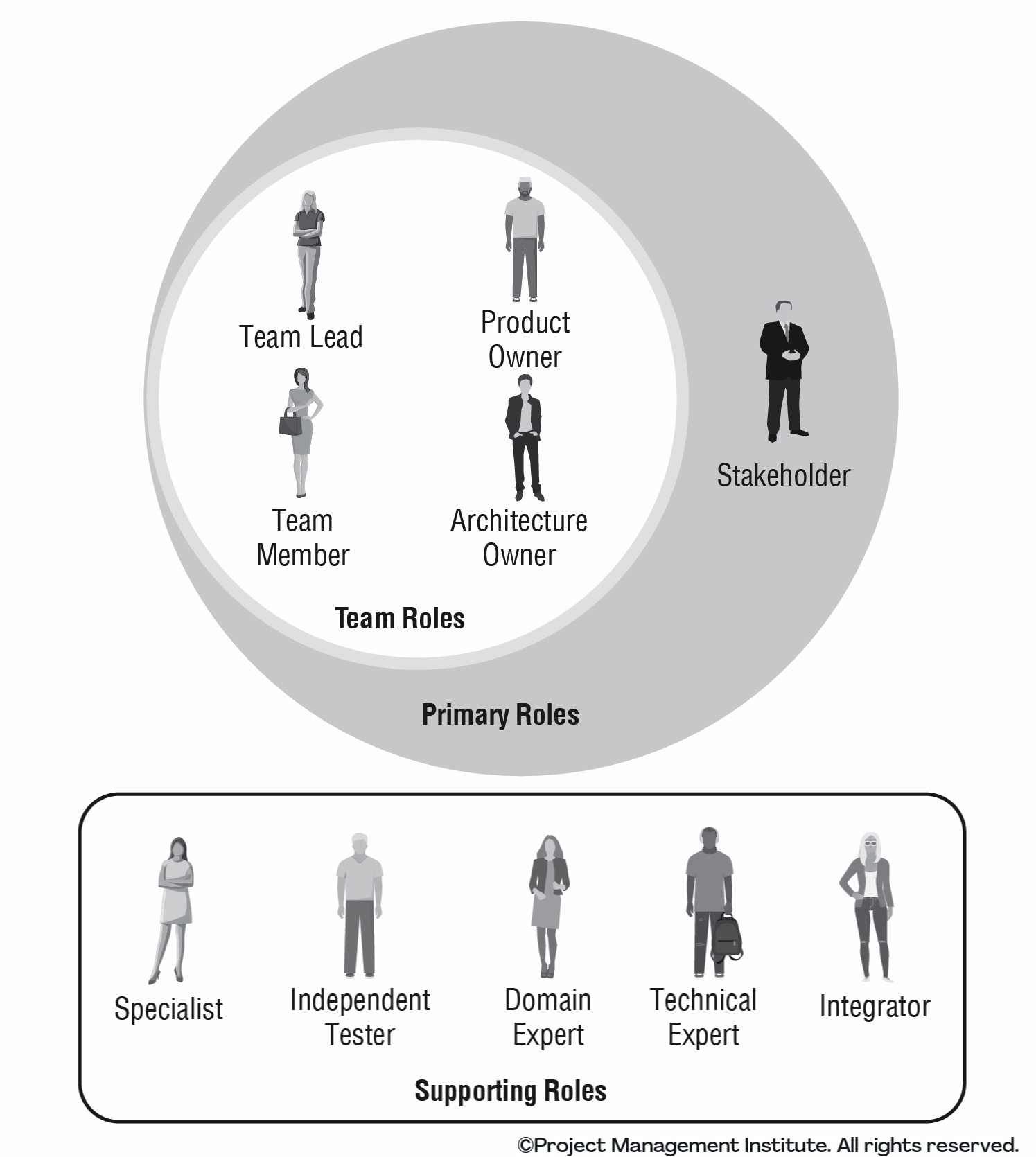
| The Disciplined Agile (DA) toolkit suggests a robust set of roles for agile solution delivery. These roles are overviewed in the following figure:
For a detailed description of these roles, please visit the page Roles on DAD Teams. |
| Governance establishes chains of responsibility, authority and communication in support of the overall enterprise’s goals and strategy. It also establishes measurements, policies, standards and control mechanisms to enable people to carry out their roles and responsibilities effectively. You do this by balancing risk versus return on investment (ROI), setting in place effective processes and practices, defining the direction and goals for the department, and defining the roles that people play with and within the department. Governance and management are two different things. Governance looks at a team from the outside, treating it as a system that needs to have the appropriate structure and processes in place to provide a stream of value. Management, on the other hand, occurs inside the team and ensures that the structure and processes are implemented effectively. The Disciplined Agile Delivery (DAD) process framework characterizes governance as an element of enterprise awareness from the team’s point of view because governance looks at the team from the outside. It is easier to avoid your traditional governance and tell management that “agile is different” than it is to work with your governors to adapt your governance to properly guide the delivery of your agile teams. As we described in the book every organization has a necessary degree of governance and there are ways to make it especially effective on agile initiatives. It takes discipline to work with your governors to help them understand how disciplined agile teams operate and then discipline to accept and conform to the resulting governance process. Our experience is that the most effective way to govern agile teams is to focus on collaborative strategies that strive to enable and motivate team members implicitly. For example, the traditional approach to motivating a team to provide good ROI would be to force them to develop and commit to an “accurate” project budget, and then periodically review their spending to ensure they’re on track. An agile approach would be to ask the team to provide a ranged estimate of what they believe the cost will be so as to set expectations about future funding requirements. Then the team works in priority order as defined by their stakeholders, visibly providing real business value through the incremental delivery of a potentially consumable solution. Costs are tracked via the team’s burn rate (the fully burdened cost of the people on the team plus any capital outlays for equipment or facilities) and value is tracked by the stakeholders’ continuing satisfaction (hopefully) with what the team is delivering for that cost. In short, a traditional approach often measures financial progress against a budget whereas an agile approach seeks to maximize stakeholder value for their investment by always working on the most valuable functionality at the time. The DA toolkit includes several important agile governance strategies:
Many of the strategies described above are “standard” agile governance strategies, and a few are unique to DAD. It requires discipline to adopt and then execute on effective governance strategies, particularly in organizations where you already have a strong traditional governance program in place. |
|
We recently started a discussion group on LinkedIn called, you guessed it, Disciplined Agile Delivery (DAD). You’re welcome to join and get involved in the conversation. |
|
"The good die young, because they see it's no use living if you have got to be good." - John Barrymore |