Why are there phases?
From the Disciplined Agile Blog
by Tatsiana Balshakova,
Mark Lines, Mike Griffiths, James Trott, Bjorn Gustafsson, Curtis Hibbs, Scott Ambler

This blog contains details about various aspects of PMI's Disciplined Agile (DA) tool kit, including new and upcoming topics.
View Posts By:
Tatsiana Balshakova
Mark Lines
Mike Griffiths
James Trott
Bjorn Gustafsson
Curtis Hibbs
Scott Ambler
Past Contributors:
Joshua Barnes
Michael Richardson
Daniel Gagnon
Valentin Tudor Mocanu
Kashmir Birk
Glen Little
Klaus Boedker
Recent Posts
DA 5.6 is released
Disciplined Agile 5.5 Released
Choose Your WoW! Second Edition Is Now Available
Requisite Agility applied in Project Management
Disciplined Agile and PMBoK Guide 7th Edition
Categories
#ChoiceIsGood,
#ChooseYourWoW,
#ConsumableSolution,
#ContinuousImprovement,
#CoreAgilePractices,
#experiment,
#Experimentation,
#GuidedContinuousImprovement,
#Kaizen,
#LifeCycles,
#ProcessImprovement,
#TealOrganizations,
Adoption,
agile,
agile adoption,
Agile Alliance,
Agile Business Analyst,
Agile certification,
agile data,
agile governance,
agile lifecycle,
agile metrics,
agile principles,
agile transformation,
Agile2018,
Agile2019,
Agile20Reflect,
AgileData,
Analogy,
announcement,
Architecture,
architecture,
architecture owner,
Articles and publications,
Asset Management,
Atari,
Backlog,
Barclays,
being agile,
benefits,
bi,
blades,
book,
Branching strategies,
Browser,
Business Agility,
business intelligence,
business operations,
capex,
Case Study,
Certification,
certification,
charity,
Choose your WoW,
CMMI,
cmmi,
Coaching,
Collaboration,
Communications Management,
Compliance,
Compliancy,
Conference,
Construction,
Construction phase,
Context,
Continuous Improvement,
coordination,
COVID-19,
Culture,
culture,
Cutter,
DA,
DAD,
DAD Book,
DAD discussions,
DAD press,
DAD roles,
DAD supporters,
DAD webcast,
DADay2019,
Data Management,
database,
dependencies,
Deployment,
Development Strategies,
DevOps,
disaster,
Discipline,
discipline,
Disciplined Agile,
disciplined agile delivery,
disciplined agile delivery blog,
Disciplined Agile Enterprise,
disciplined devops,
Documentation,
Domain complexity,
dw,
DW/BI,
Energy Healing,
Enterprise Agile,
Enterprise Architecture,
Enterprise Awareness,
enterprise awareness,
Essence,
estimation,
Evolving DA,
Executive,
Experiment,
facilitation,
FailureBow,
feedback-cycle,
finance,
Financial,
FLEX,
Flow,
foundation layer,
Funding,
GCI,
GDD,
Geographic Distribution,
gladwell,
global development,
Goal-Driven,
goal-driven,
goals,
Governance,
GQM,
Guideline,
Hybrid,
Improvement,
inception,
Inception phase,
India,
information technology,
infosec,
Introduction,
iterations,
Kanban,
large teams,
layer,
lean,
Lean Startup,
learning,
Legal Project Management,
LeSS,
Lifecycle,
lifecycle,
Manifesto,
mark lines,
marketing,
MBI,
Metaphor,
Metrics,
metrics,
mindset,
Miscellaneous,
MVP,
News,
News and events,
Non-Functional Requirements,
non-functional requirements,
Non-solo development,
offshoring,
Operations,
opex,
Organization,
Outsourcing,
outsourcing,
paired programming,
pairing,
paper,
People,
People Management,
phases,
Philosophies,
Planning,
PMBoK,
PMI,
PMI and DA,
PMI Chapter,
Portfolio Management,
post-format-quote,
Practices,
practices,
Principle,
Process,
process improvement,
process tailoring,
Product Management,
product owner,
Product Owners,
productivity,
Program Management,
Project Management,
project-initiation,
Promise,
Quality,
quality,
rational unified process,
Refactoring,
Reiki,
Release Management,
release management,
Remote Training,
Remote Work,
repeatability,
requirements,
Requirements Management,
research&development,
responsibilities,
retrospectives,
Reuse,
Reuse Engineering,
ride for heart,
rights,
Risk Management,
Risk Management,
Risk management,
Roles,
RUP,
SAFe,
sales,
Scaling,
scaling,
scaling agile,
Scheduled Workshops,
SCM,
scorecard,
Scrum,
ScrumMaster,
SDLC,
Security,
security,
self-organization,
SEMAT,
serial,
skill,
solutions software consumable shippable,
Stakeholder Management,
strategy,
Support,
Surveys,
Teal organizations,
team development,
Team Lead,
team lead,
Teams,
Technical Debt,
Teleconferencing,
Terminology,
terraforming,
test strategy,
testing,
time tracking,
Tool kit,
Toolkit,
tools,
traditional,
Transformation,
Transition iteration,
transition phase,
Uncategorized,
Upmentors,
Using PMI Standards,
value stream,
velocity,
vendor management,
Virtual Training,
Workflow,
workflow,
workspaces
Date
Yesterday Mark and I double teamed on a webcast overviewing DAD to a university class. After the webcast we got the following question:
I am wondering if it would make sense to entirely eliminate the word “phase” from DAD’s vocabulary. What about simply talking about different types of iteration? For instance, inception could become something like “pre-construction iterations”, construction could become “construction iterations”, and transition “transitions iterations”… That may be a bit cumbersome, but the word phase does scare people away.
Yes, the word phase might scare some people away. We’ve thought long and hard about the terminology that we use and were also a bit worried about the word “phase” at first. For some reason phase has become one of those dirty words in the agile community, along with other words such as governance or documentation. The primary concern seems to be that phase implies a serial approach, something many agilists believe to be foul and evil. Yet the reality is that projects do in fact proceed in a serial manner. There are some project initiation activities at the start. Then there are construction iterations/sprints one after the other in yes, a serial manner. Then there is an effort to deploy/release your solution into production. This is clearly “serial in the large”.
But, why the term phase? Why not iteration? Or season for that matter season (Gary Evans has a very coherent argument for that term)? Because phase is accurate (albeit an agile swear word). In the various IT surveys that I’ve run over the years I’ve found that the average agile team spends about 4.5 weeks performing initiation efforts, has construction iterations that are about 2 weeks in length, and takes an average of roughly 4 weeks to release their solution into production. So perhaps these initiation and release efforts could each be thought of as two iterations (on average, your mileage may vary) but they really aren’t iterations in their own right usually. Maybe they’re different length iterations? There are several ways of thinking about it, but notice how the application of the term iteration doesn’t really make perfect sense. Then we have numbering issues. Is the initiation effort iteration/sprint 0? If it’s two iterations would they be -1 and 0? Sigh.
One thing that we have done which some may feel to be radical is we’ve chosen to adopt phase names from Unified Process (UP) – Inception, Construction, and Transition. We could have made up different names, such as Initiation, Development, and Release respectively. Or adopted Start Up, Construction, and Hardening (yuck, there’s more to Transition than hardening and frankly I would consider a late “hardening” effort to be a clear sign you’ve likely got a process problem you need to deal with). And I have no doubt that there are many other options for each phase name. Whatever names we choose someone isn’t going to be happy, and why not give a bit of a nod to a proven software development framework such as UP?
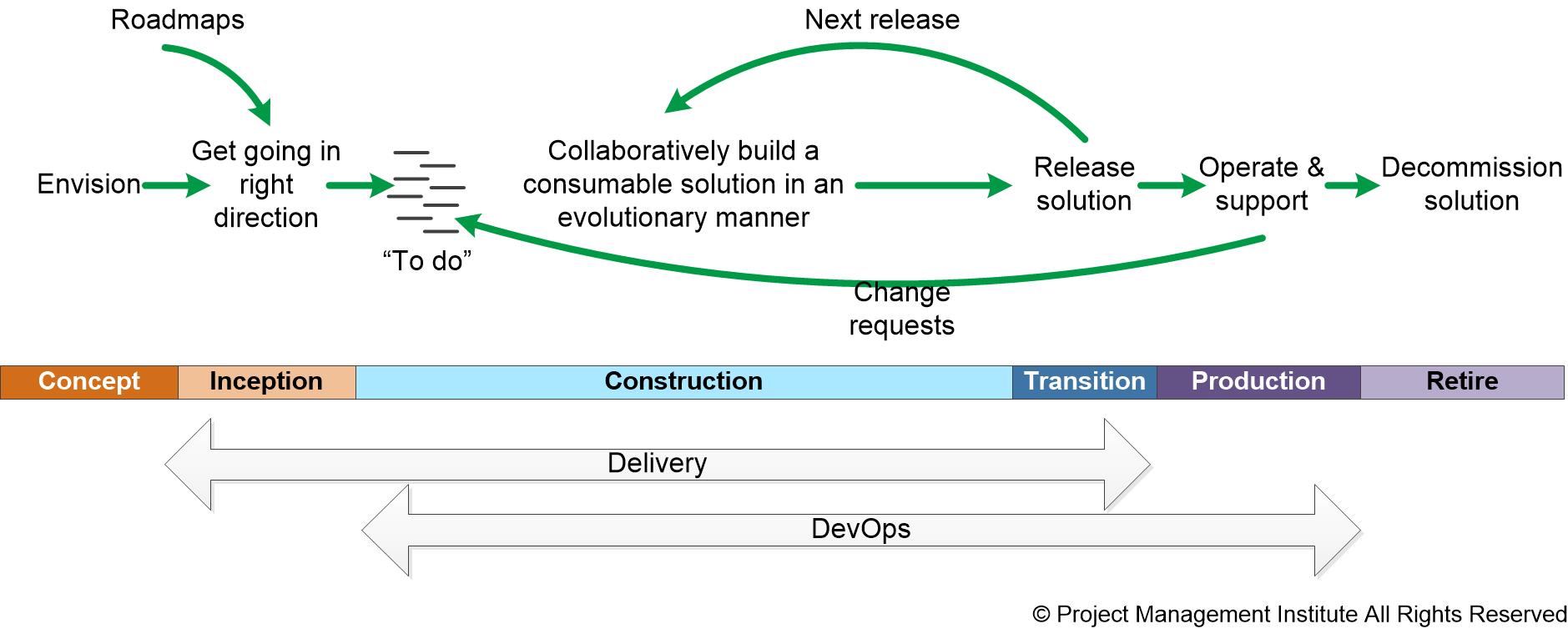
Another interesting thought is that by having named phases it makes it clearer where potential governance points in the lifecycle are. In the diagram below you can see how several of the suggested light-weight milestones – Stakeholder vision, Sufficient functionality, and Delighted stakeholders – corresponds to the end of a phase. Or perhaps more accurately, fulfilling the milestone is an indication that your team is moving from one phase to the next.

In the end, I think we’re pretty clear that when you tailor DAD that you can use whatever terminology you like. In fact one financial institution that adopted an early version of the DAD basic lifecycle, the one based on Scrum, reworked the diagram to use Scrum terminology. I think it’s a bit goofy but it works for them.
The term phase might in fact scare a few people away. But, it’s hard to imagine that anyone that concerned about what something is named will be flexible enough to be successful at DAD anyway.
Posted
by
Scott Ambler
on: February 08, 2012 06:36 PM |
Permalink
Comments (4)
Please login or join to subscribe to this item
es importante conocer ¿Qué es la gestión ágil de proyectos?
¿Qué es la gestión ágil de proyectos? La gestión ágil de proyectos es una forma iterativa de gestionar los proyectos de desarrollo de software que se basa en realizar entregas de forma continua y en integrar el feedback del cliente con cada iteración

Jon Jorgensen
Trainer, Coach, Consultant| Brett Palmer & Associates
Mission Viejo, Ca, United States
I've noticed a pre-occupation with synonymous terms used is certain agile frameworks. Scrum uses the term 'event' and I've heard Scrum trainers say that there's a distinction with 'meetings.' The curriculum for Disciplined Agile uses the term 'ritual' and 'ceremony' which may carry some nuance some people dislike, though I don't see any significant stigma to any such term. People gather and interact. Arbitrarily making a word a swear word out of something which people actually do to create value, or not is neither scientific nor logical. I propose that we endeavor to communicate ideas, minimize jargon that alienates people unfamiliar with it, and intentionally, consciously evolve our way of working to become more effective at work. It is in our interest to avoid imposing moral judgements on people or infer any motives from them because of their word choice. We learn faster speaking freely and just saying what we really mean. Let's acknowledge what's so: there are phases in agile.
Just to echo what was brought in here; In the world of Agile methodologies, discussions around terminology have gained significant traction, particularly in relation to Disciplined Agile (DA). There are actual concerns raised by certain members of the Agile community who view terms like "phase”, “documentation” and “Plan” in DA as counter to Agile principles, and suggests an alternative approach to enhance clarity and alignment with Agile philosophy.�The Agile community has fostered a culture of adaptability and iterative development, often challenging the traditional concept of phases in software projects. The term "phase" has encountered resistance due to its association with serial, rigid processes, seemingly at odds with Agile values.
DA always encourage understanding the context, and balancing proven practices with modern Agile principles in a pragmatic way
The adoption of phase names from the Unified Process (UP) underscores the commitment to drawing from proven software development practices. However, it also embraces the Agile philosophy of flexibility and continuous improvement.
It is essential to recognize that DAD allows for terminology tailoring to suit specific contexts. This adaptability preserves the core of Agile principles while accommodating varied interpretations.

Hector Boye
Consultant| TenStep Ghana Limited
Accra, Ghana
Use of the phase term indicates general links with the waterfall methodology, and that is okay with me.
Please Login/Register to leave a comment.
|
"Don't worry about people stealing your ideas. If your ideas are any good, you'll have to ram them down people's throats."
- Howard Aiken
|




