




Guessing is not a strategy: How to build decision velocity with AI and real-time data
June 10, 2026 | Live Webinar

Disciplined Agile 5.5 Released
Choose Your WoW! Second Edition Is Now Available
Requisite Agility applied in Project Management
Disciplined Agile and PMBoK Guide 7th Edition
#ChoiceIsGood, #ChooseYourWoW, #ConsumableSolution, #ContinuousImprovement, #CoreAgilePractices, #experiment, #Experimentation, #GuidedContinuousImprovement, #Kaizen, #LifeCycles, #ProcessImprovement, #TealOrganizations, Adoption, agile, agile adoption, Agile Alliance, Agile Business Analyst, Agile certification, agile data, agile governance, agile lifecycle, agile metrics, agile principles, agile transformation, Agile2018, Agile2019, Agile20Reflect, AgileData, Analogy, announcement, Architecture, architecture, architecture owner, Articles and publications, Asset Management, Atari, Backlog, Barclays, being agile, benefits, bi, blades, book, Branching strategies, Browser, Business Agility, business intelligence, business operations, capex, Case Study, Certification, certification, charity, Choose your WoW, CMMI, cmmi, Coaching, Collaboration, Communications Management, Compliance, Compliancy, Conference, Construction, Construction phase, Context, Continuous Improvement, coordination, COVID-19, Culture, culture, Cutter, DA, DAD, DAD Book, DAD discussions, DAD press, DAD roles, DAD supporters, DAD webcast, DADay2019, Data Management, database, dependencies, Deployment, Development Strategies, DevOps, disaster, Discipline, discipline, Disciplined Agile, disciplined agile delivery, disciplined agile delivery blog, Disciplined Agile Enterprise, disciplined devops, Documentation, Domain complexity, dw, DW/BI, Energy Healing, Enterprise Agile, Enterprise Architecture, Enterprise Awareness, enterprise awareness, Essence, estimation, Evolving DA, Executive, Experiment, facilitation, FailureBow, feedback-cycle, finance, Financial, FLEX, Flow, foundation layer, Funding, GCI, GDD, Geographic Distribution, gladwell, global development, Goal-Driven, goal-driven, goals, Governance, GQM, Guideline, Hybrid, Improvement, inception, Inception phase, India, information technology, infosec, Introduction, iterations, Kanban, large teams, layer, lean, Lean Startup, learning, Legal Project Management, LeSS, Lifecycle, lifecycle, Manifesto, mark lines, marketing, MBI, Metaphor, Metrics, metrics, mindset, Miscellaneous, MVP, News, News and events, Non-Functional Requirements, non-functional requirements, Non-solo development, offshoring, Operations, opex, Organization, Outsourcing, outsourcing, paired programming, pairing, paper, People, People Management, phases, Philosophies, Planning, PMBoK, PMI, PMI and DA, PMI Chapter, Portfolio Management, post-format-quote, Practices, practices, Principle, Process, process improvement, process tailoring, Product Management, product owner, Product Owners, productivity, Program Management, Project Management, project-initiation, Promise, Quality, quality, rational unified process, Refactoring, Reiki, Release Management, release management, Remote Training, Remote Work, repeatability, requirements, Requirements Management, research&development, responsibilities, retrospectives, Reuse, Reuse Engineering, ride for heart, rights, Risk Management, Risk Management, Risk management, Roles, RUP, SAFe, sales, Scaling, scaling, scaling agile, Scheduled Workshops, SCM, scorecard, Scrum, ScrumMaster, SDLC, Security, security, self-organization, SEMAT, serial, skill, solutions software consumable shippable, Stakeholder Management, strategy, Support, Surveys, Teal organizations, team development, Team Lead, team lead, Teams, Technical Debt, Teleconferencing, Terminology, terraforming, test strategy, testing, time tracking, Tool kit, Toolkit, tools, traditional, Transformation, Transition iteration, transition phase, Uncategorized, Upmentors, Using PMI Standards, value stream, velocity, vendor management, Virtual Training, Workflow, workflow, workspaces


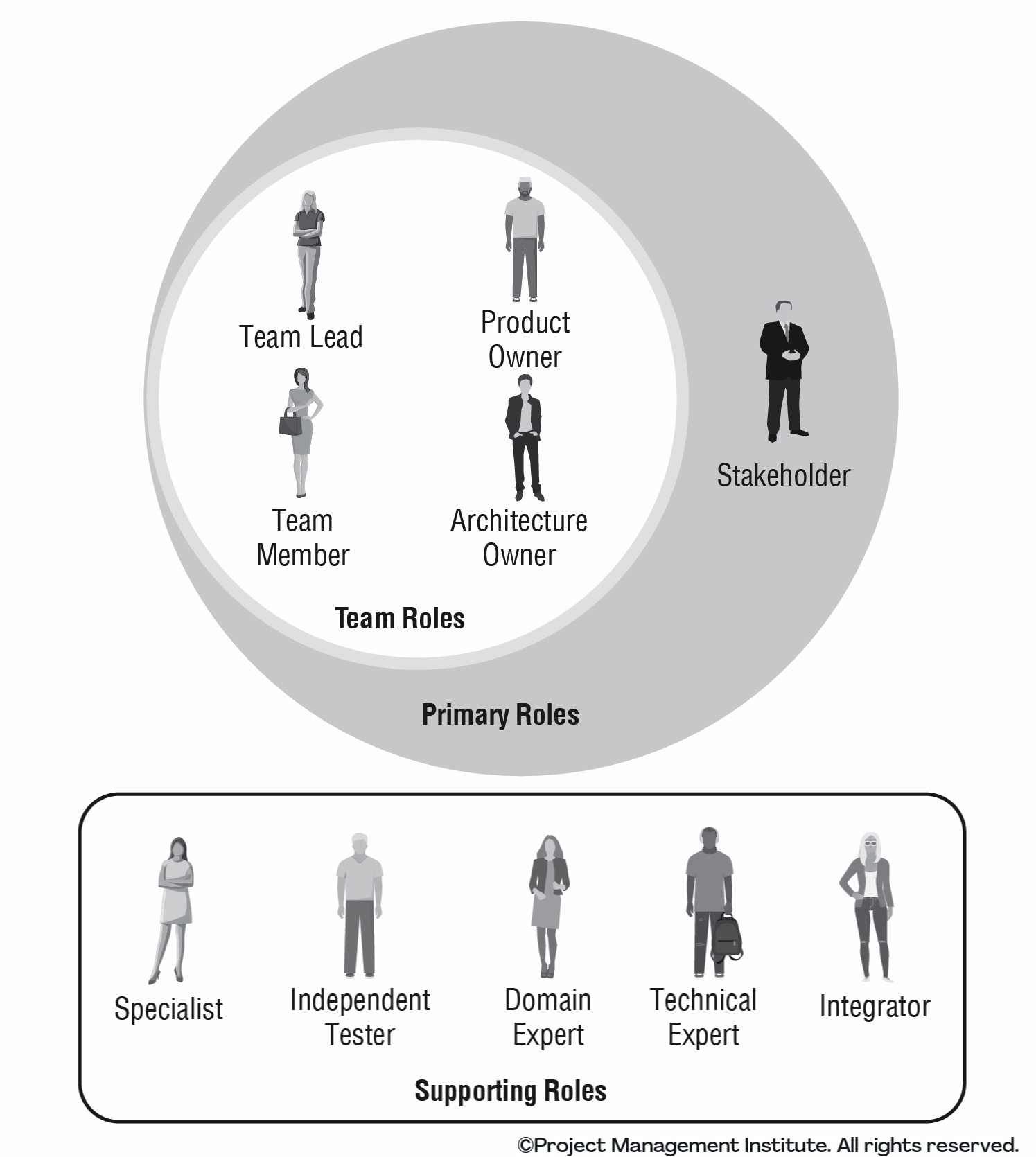
| The Disciplined Agile (DA) toolkit suggests a robust set of roles for agile solution delivery. These roles are overviewed in the following figure:
For a detailed description of these roles, please visit the page Roles on DAD Teams. |
| Governance establishes chains of responsibility, authority and communication in support of the overall enterprise’s goals and strategy. It also establishes measurements, policies, standards and control mechanisms to enable people to carry out their roles and responsibilities effectively. You do this by balancing risk versus return on investment (ROI), setting in place effective processes and practices, defining the direction and goals for the department, and defining the roles that people play with and within the department. Governance and management are two different things. Governance looks at a team from the outside, treating it as a system that needs to have the appropriate structure and processes in place to provide a stream of value. Management, on the other hand, occurs inside the team and ensures that the structure and processes are implemented effectively. The Disciplined Agile Delivery (DAD) process framework characterizes governance as an element of enterprise awareness from the team’s point of view because governance looks at the team from the outside. It is easier to avoid your traditional governance and tell management that “agile is different” than it is to work with your governors to adapt your governance to properly guide the delivery of your agile teams. As we described in the book every organization has a necessary degree of governance and there are ways to make it especially effective on agile initiatives. It takes discipline to work with your governors to help them understand how disciplined agile teams operate and then discipline to accept and conform to the resulting governance process. Our experience is that the most effective way to govern agile teams is to focus on collaborative strategies that strive to enable and motivate team members implicitly. For example, the traditional approach to motivating a team to provide good ROI would be to force them to develop and commit to an “accurate” project budget, and then periodically review their spending to ensure they’re on track. An agile approach would be to ask the team to provide a ranged estimate of what they believe the cost will be so as to set expectations about future funding requirements. Then the team works in priority order as defined by their stakeholders, visibly providing real business value through the incremental delivery of a potentially consumable solution. Costs are tracked via the team’s burn rate (the fully burdened cost of the people on the team plus any capital outlays for equipment or facilities) and value is tracked by the stakeholders’ continuing satisfaction (hopefully) with what the team is delivering for that cost. In short, a traditional approach often measures financial progress against a budget whereas an agile approach seeks to maximize stakeholder value for their investment by always working on the most valuable functionality at the time. The DA toolkit includes several important agile governance strategies:
Many of the strategies described above are “standard” agile governance strategies, and a few are unique to DAD. It requires discipline to adopt and then execute on effective governance strategies, particularly in organizations where you already have a strong traditional governance program in place. |
|
We recently started a discussion group on LinkedIn called, you guessed it, Disciplined Agile Delivery (DAD). You’re welcome to join and get involved in the conversation. |
| Early in the lifecycle, during the Inception phase, disciplined agile teams will invest some time in initial requirements envisioning and initial architecture envisioning. One of the issues to be considered as part of requirements envisioning is to identify non-functional requirement (NFRs), also called quality of service (QoS) or simply quality requirements. The NFRs will drive many of your technical decisions that you make when envisioning your initial architectural strategy. These NFRs should be captured someone and implemented during Construction. It isn’t sufficient to simply implement the NFRs, you must also validate that you have done so appropriately. In this blog posting I overview a collection of agile strategies that you can apply to validate NFRs. A mainstay of agile validation is the philosophy of whole team testing. The basic idea is that the team itself is responsible for validating its own work, they don’t simply write some code and then throw it over the wall to testers to validate. For organizations new to agile this means that testers sit side-by-side with developers, working together and learning from one another in a collaborative manner. Eventually people become generalizing specialists, T-skilled people, who have sufficient testing skills (and other skills). Minimally your developers should be performing regression testing to the best of their ability, adopting a continuous integration (CI) strategy in which the regression test suite(s) are run automatically many times a day. Advanced agile teams will take a test-driven development (TDD) approach where a single test is written just before sufficient production code which fulfills that test. Regardless of when tests are written by the development team, either before or after the writing of the production code, some tests will validate functional requirements and some will validate non-functional requirements. Whole team testing is great in theory, and it is strategy that I wholeheartedly recommend, but in some situations it proves insufficient. It is wonderful to strive to have teams with sufficient skills to get the job done, but sometimes the situation is too complex to allow that. There are some types of NFRs which require significant expertise to address properly: NFRs pertaining to security, usability, and reliability for example. To validate these types of requirements, worse yet even to identify them, requires skill and sometimes even specialized (read expensive) tooling. It would be a stretch to assume that all of your delivery teams will have this expertise and access to these tools. Recognizing that whole team testing may not sufficiently address validating NFRs many organizations will supplement their whole team testing efforts with parallel independent testing . With this approach a delivery team makes their working builds available to a test team on a regular basis, minimally at the end of each iteration, and the testers perform the types of testing on it that the delivery team is either unable or unlikely to perform. Knowing that some classes of NFRs may be missed by the team, independent test teams will look for those types of defects. They will also perform pre-production system integration testing and exploratory testing to name a few. Parallel independent testing is also common in regulatory compliance environments. From a verification point of view some agile teams will perform either formal or informal reviews. Experienced agilists prefer to avoid reviews due to their inherently long feedback cycle, which increases the average cost of addressing found defects, in favor of non-solo development strategies such as pair programming and modeling with others. The challenge with non-solo strategies is that managers unfamiliar with agile techniques, or perhaps the real problem is that they’re still overly influenced by disproved traditional theories of yesteryear, believe that non-solo strategies reduce team productivity. When done right non-solo strategies increase overall productivity, but the political battle required to convince management to allow your team to succeed often isn’t worth the trouble. Another strategy for validating NFRs code analysis, both dynamic and static. There is a range of analysis tools available to you that can address NFR types such as security, performance, and more. These tools will not only identify potential problems with your code many of them will also provide summaries of what they found, metrics that you can leverage in your automated project dashboards. This strategy of leveraging tool-generated metrics such as this is a technique which IBM calls Development Intelligence and is highly suggested as an enabler of agile governance in DAD. Disciplined agile teams will include invocation of code analysis tools from you CI scripts to support continuous validation throughout the lifecycle. Your least effective validation option is end-of-lifecycle testing, in the traditional development world this would be referred to as a testing phase. The problem with this strategy is that you in effect push significant risk, and significant costs, to the end of the lifecycle. It has been known for several decades know that the average cost of fixing defects rises the longer it takes you to identify them, motivating you to adopt the more agile forms of testing that I described earlier. Having said that I still run into organizations in the process of adopting agile techniques that haven’t really made embraced agile, as a result still leave most of their testing effort to the least effective time to do such work. If you find yourself in that situation you will need to validate NFRs in addition to functional requirements. To summarize, you have many options for validating NFRs on agile delivery teams. The secret is to pick the right one(s) for the situation that you find yourself in. The DA toolkit helps to guide you through these important process decisions, describing your options and the trade-offs associated with each one. Related Resources
|
| Non-functional requirements, also known as quality of service (QoS) or technical requirements, are typically system-wide thus they apply to many, and sometimes all of your functional requirements. Part of ensuring that your solution is potentially consumable each iteration is ensuring that it fulfill its overall quality goals, including applicable NFRs. This is particularly true with life-critical and mission-critical solutions. Good sources for NFRs include your enterprise architects and operations staff, although any stakeholder is a potential source for NFRs. As your stakeholders tell you about functional requirements they will also describe non-functional requirements (NFRs). These NFRs may describe security access rights, availability requirements, performance concerns, or a host of other issues as saw in my blog regarding initial architecture envisioning. There are three basic strategies, which can be combined, for capturing NFRs: technical stories; acceptance criteria for individual functional requirement (such as stories); and an explicit list. So what are the implications for implementing NFRs given the three previous capture strategies? Although in the DAD book we make this sort of comparison via a table to improve consumability, in this blog posting I will use prose due to width constraints. Let’s consider each one:
In most situations you should maintain an explicit list and then use that to drive identification of acceptance criteria as we’ve found that it’s more efficient and lower risk in the long run. Of course capturing NFRs is only one part of the overall process of addressing them. You will also need to implement and validate them during construction, as well as address them in your architecture. An important issue which goes to NFRs such as consumability, supportability, and operability, is that of deliverable documentation. At the start of the project is the best time to identify the required documentation that must be created as part of the overall solution. This potentially includes operations manuals, support manuals, training materials, system overview materials (such as an architecture handbook), and help manuals to name a few. These deliverable documents will be developed and kept up to date via the continuous documentation practice.
Related Posts |
|
"Imagine if every Thursday your shoes exploded if you tied them the usual way. This happens to us all the time with computers, and nobody thinks of complaining." - Jeff Raskin |