

Please don't call yourself a
Categories:
agile,
DAD Book,
Scrum,
Kanban,
lean,
Continuous Improvement,
Choose your WoW,
#ChooseYourWoW,
LeSS,
SAFe
Categories: agile, DAD Book, Scrum, Kanban, lean, Continuous Improvement, Choose your WoW, #ChooseYourWoW, LeSS, SAFe


|
Please don’t call yourself a “Disciplined Agile shop”. It is the kiss of death. I was recently having a discussion with a client about visiting them on an upcoming visit to the UK. At one point in the past they had proudly declared themselves a Disciplined Agile “shop”. The senior exec that I spoke with told me “We have moved on now from DA to SAFe”. Upon further discussion he admitted that SAFe is being used on just a few initiatives, but that they had sent lots of people to SAFe training. The inference seemed to be that since they had previously taken DA training, but had now taken SAFe training that they have now changed “shops”. Ironically while a lot of budget was committed to SAFe training and related consulting, most of the work done at this organization actually used other agile and lean lifecycles such as Scrum and Kanban. You know, DAD stuff. Why is it that our industry has an obsession with labelling themselves as a type of “shop”, when the reality is that they will likely use a variety of approaches depending on the context? You could be building something from scratch, extending a solution, or implementing a commercial off the self package. You could be in a straightforward situation, or building defence or life critical systems. Our industry has become extremely fragmented, with organizations trying to put themselves in a certain box such as Scrum, SAFe, Scrum/XP, LeSS, DAD, Kanban, Spotify, and it goes on and on. So let’s stop doing this. Unfortunately, Disciplined Agile (aka DAD) has gotten lumped in with scaling frameworks such as SAFE, LeSS, Nexus etc, when the reality is that DA is not a purpose-built framework for scaling situations exclusively, like a true scaling framework. It is, rather, a rich and flexible toolkit than can be used to apply fit-for-context strategies for your unique situation for initiatives of all sizes and types. If you need to apply them at scale, you can. But our preferred approach is to descale where possible rather than apply a prescriptive recipe to a large and risky problem. When we take a closer look at different types of shops, we see a lot of MethodBut. For example, ScrumBut is where teams use Scrum but they don’t do retrospectives or some other ceremony. Or teams use SAFe but management doesn’t buy in to doing quarterly 2-day big room planning sessions. Practitioners in these “shops” are ostracized and may be excommunicated from their religion for not following one of their prescribed ceremonies. Disciplined Agile’s core principles include context counts, choice is good and pragmatism. While we believe that skipping parts of a method early in your adoption is likely a mistake, as your teams mature and understand options that can make them more efficient we support the idea of being freed from the “method prisons” (as described by Ivar Jacobson) so that they can optimize their WoW (Way of Working). This essentially is why the DA “toolkit” was created. It contains hundreds of strategies to help you to make better decisions on your journey to high performance agility.
As you can see from the diagram, regardless of what framework or method you are using, there will likely be strategies that supplement your approach which are not described in the method recipe(s) that you have chosen. DA is a toolkit of ingredients, to enable you to be a better chef. If you don’t know what is in the pantry, and which combinations will delight the unique preferences of your guests/stakeholders, then you probably won’t meet your potential as a Michelin Star Chef. We have come to realize that the methods/framework industry is a moving target. Waterfall shops, then RUP, then SAFe, then….? There will be more frameworks, indeed it seems that we learn of a new one every few months. As consultants seek to differentiate themselves, and have something new to sell, or organizations fail in their agile adoption and look for the “next big thing”, new frameworks/recipes will continue to emerge, with related training programs and certifications.
At Disciplined Agile, we are beginning to make a concerted effort to separate ourselves from the toolkits, as we really shouldn’t be competing with them. It is not DA or . It should be DA and . So our recommendation is to take a DA workshop to expand your pantry of ingredients, and learn how to be a better cook. Or a good starting point is to read the Choose your Wow! book (Ambler/Lines). But please, don’t call yourselves a “Disciplined Agile shop”. |


Introduction to Disciplined Agile Delivery 2nd Edition is now available!
|
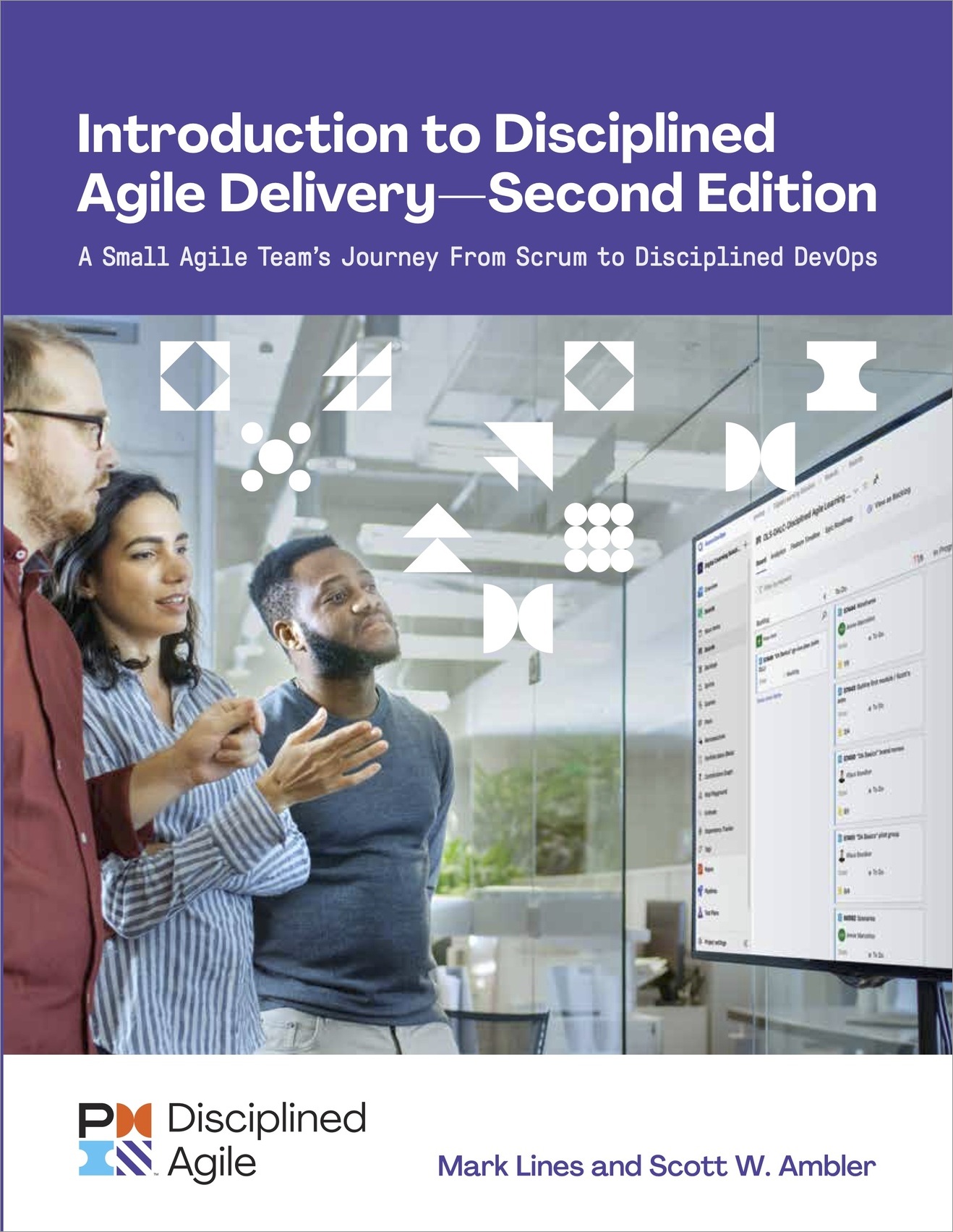
I’m happy to announce that Introduction to Disciplined Agile Delivery 2nd Edition: A Small Agile Team’s Journey from Scrum to Disciplined DevOps is now available. The 111 page book sells for $9.99 US for the paperback edition and $3.99 US for the Kindle edition. The book is currently available on Amazon.com in the US and will soon be available on Amazon in other countries as per Amazon’s usual deployment strategy. This book provides a quick overview of how agile software development works from beginning-to-end. It describes Disciplined Agile Delivery (DAD), the first of four levels of the Disciplined Agile (DA) process decision framework, and works through a case study describing a typical agile team’s experiences adopting a DA approach. The book describes how the team develops the first release of a mission-critical application while working in a legacy enterprise environment. It describes their experiences from beginning-to-end, starting with their initial team initiation efforts through construction and finally to deploying the solution into production. It also describes how the team stays together for future releases, overviewing their process improvement efforts from their Scrum-based beginnings through to a lean continuous delivery approach that fits in with their organization’s evolving DevOps strategy. What’s Different in This EditionIn the 2.5 years since the first edition was released DAD, and to a greater extent the DA toolkit in general, has evolved. Here are the major changes:
|
New Blog for the Japanese version of the Book
|
Mark met the team that just finished the translation of the DAD book into Japanese here at IBM Innovate in Orlando. They have created a Japanese version of the DAD Blog. A link has been added on the main page to the Japanese blog in the Blogroll links section. A big thank you goes out to the DAD community in Japan. Perhaps we will run a DAD workshop there soon! |

New DAD Book Review
|
We received a new book review from one of our younger readers. His comments:
Thanks for the feedback Brayden, keep it coming! |


Recording of InformationWeek webcast on DAD available
|
The recording of my 1-hour InformationWeek webcast on DAD is available here:
|


