
Project Management

The Power of Purpose

From the Transformation & Leadership - Insider Tips Blog
by , ,
Today's world is influenced by change. Project managers and their organizations need to embrace and sometimes drive changes to keep up with the pace in highly competitive environments. In this blog, experienced professionals share their experiences, tips and tools to manage and exploit changes and take advantage of them. The blog is complimentary to the webinar series of the Change Management Community Team and is managed by the same individuals.

About this Blog

RSS

View Posts By:

Jeffrey Martinez
Nic Jain
Aung Sint

Past Contributors:

Luisa Cristini
Rob Bogue
Angela Montgomery
Carole Osterweil
Ruth Pearce
Amrapali Amrapali
John ORourke
Kavitha Gunasekaran
Ronald Sharpe
Ross Wirth
Steve Salisbury
Ryan Gottfredson
Walter Vandervelde
Tony Saldanha
Joseph Pusz
Vitaly Geyman

Recent Posts

How to do a webinar in our Change Management Community - Updated 2023!

Call for Volunteer - Transformation & Leadership

Why Projects Fail Due to Lack of Sponsorship

PM - A cheerleader, a manager or the captain of the team?

Stakeholder management in research: How to keep people engaged and interested in your project

Categories

3-generational workforce, Agile, Agility, Authenticity, Carole Osterweil, change, Change Management, Change Resistance, Character Strengths, character strengths, CIO, communications management, creative organization, creativity, creatvity, Crisis management, Culture, curiosity, Decision Making, Design Thinking, Digital Transformation, Disruptive change, Embracing change, emotional intelligence, Employee engagement, Exponential, first birthday, Fourth Industrial Revolution, Future-readiness, Humanizing workplace interactions, ideas, Innovation, innovation management, innovative organization, inovation, Joe Pusz, Leadership, Leadership in 21st century, Leading change, Listening, Luisa Cristini, Management, managing crisis, Mental Maturity, mentalhealth, Mindsets, modern project management, Neuroscience, New normal, perspective, PM, PMI, PMO, pmo, PMO Joe, Project Delivery, Project Management, project management, research and development, Resilience, risk management, science management, self-esteem, Self-evolution, social intelligence, Sponsorship, Stakeholder Management, stakeholder management, Stakeholder Management; Engagement; Appreciation, Strengths-Based Project Management, Sustainability, systems thinking, Teams, Technologies, The Great Reset, Thought Leadership, Transformant, Transformative Leadership, Transformative leadership, Uncertainty, Upskilling, VUCA, Walter Vandervelde, Wise passivity, Workspace dynamics

Date

linkedin twitter facebook Request to reuse this  


It is common for many people to make New Year’s Resolutions at the beginning of each year.  What is your resolution for this year?  The Top 5 New Year’s Resolutions in 20191 were;

  1. Exercise to get in shape
  2. Diet to lose weight
  3. Save money
  4. Eat healthier in general
  5. Something for self-care

All seem to be great ideas for a resolution.  However, we find that keeping a resolution isn’t quite as easy as making a resolution.  By the middle of February about 80% of us fail with our resolutions2.  We only make it about 2 months!

There are many suggestions of how to do better with our resolutions.  Use steps such as “Keep it Simple”, “Only take on one resolution at a time” or “Tell friends and family to build accountability“.  All good ideas, but we still fail.  Why?

Let’s consider slight changes to the top 5 listed above and see if we can find a difference.

  1. Exercise to get in shape so I can fit into the dress for my daughter’s wedding.
  2. Diet to lose weight so I can resolve my type 2 diabetes and get off all these medications.
  3. Save money so I can take my wife on the honeymoon we couldn’t afford when we were younger.
  4. Eat healthier in general because my father recently passed away from heart disease and I want to avoid the struggles I saw him experience in his life.
  5. Something for self-care such as stopping smoking so that I don’t develop lung cancer like my mother who died when I was only 13.

I added a Purpose to each of the resolutions.  Now it’s not just "Getting in Shape", there is a purpose for getting in shape.  By adding a purpose, the resolution has a defined end result.  It gives the resolution more meaning.

What does all of this have to do with Project Management?  When we look at the trending statistics from the yearly PMI Pulse of the Profession, we find that as an industry we are mostly flat at about 55% success on projects over the past decade.
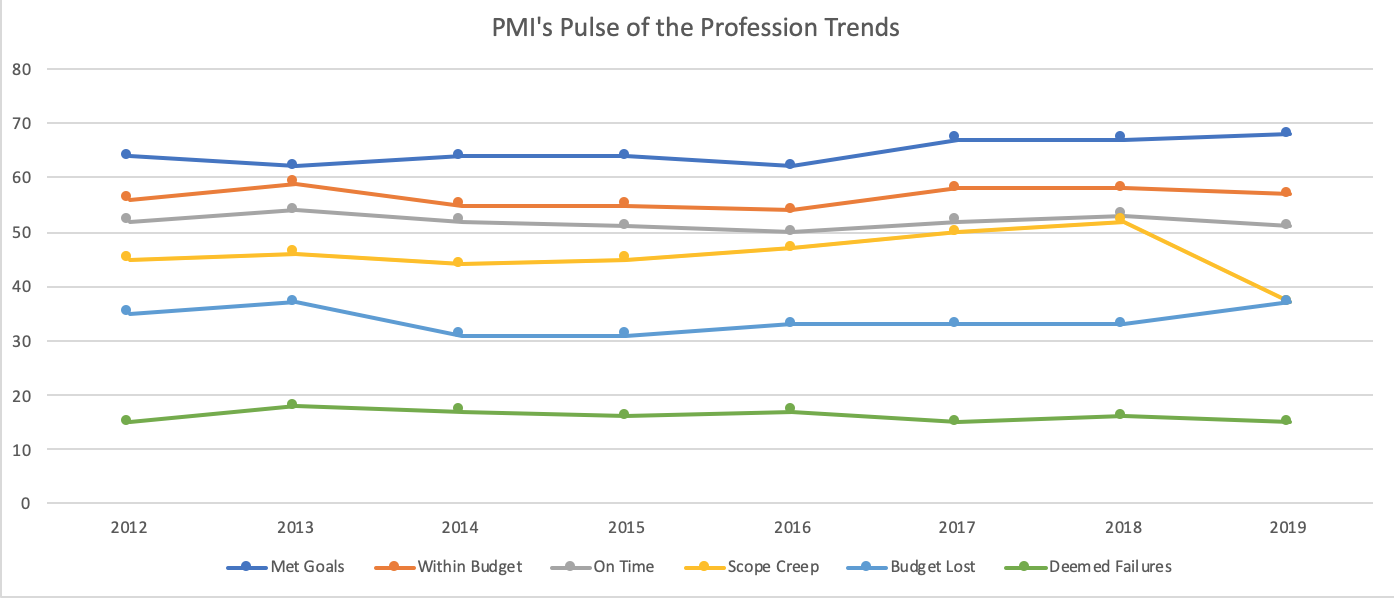
However, in that same decade we (PM industry) increased the number of PMPs.  We increased the amount of spending on training.  We made large investments in PPM tools.  We matured the discipline with certifications for SCRUM, CAPM, and more.  So why then are we remaining constant in success/failure rates all while we are increasing variables which should be making us more successful?

When we live with Purpose we perform better.  When our companies and careers have Purpose, we perform better3.

I’ll use an example from a recent client engagement.  The client was struggling with project delivery.  They had a defined consistent methodology, a robust PM toolset, skilled PMs, and a supportive leadership team.  All the basics for project success were in place but still they couldn’t get consistent project outcomes.  

One of the strategic projects they were working was an implementation of a CRM system.  I interviewed the team and asked them, “Why are you doing this project?”  The consensus answer was – the Leadership team wants a new CRM system to replace the outdated system.

I asked the Leadership team the same question but received a different response from them.  The Leadership team approved the CRM project not to upgrade the system, rather it is to achieve a 30% growth in revenue over the next 3 years.  

The team was unaware the purpose of the project was 30% revenue growth.  The project team didn’t take any ownership in helping the organization reach the revenue growth target, they all thought that is a sales team target.

When we in the PM space fail to align our work to the Purpose of the organization we are limiting our ability to achieve impactful results.  We aren’t placing ourselves in value-add roles and we fall into the dreaded overhead category.  We have to view our projects not just as projects, but pieces to a larger Purpose.  Our teams will engage better, they will take ownership of the project outcomes better and they feel valued.

Knowing why we are working projects is more important than how we work our projects.  I’ve found far too often that PMO leaders are focused on “how we work” and “what we work on” and aren’t spending enough time helping the teams understand our Purpose.  The Purpose Driven PMO empowers people to deliver results.  The Purpose Driven PMO provides value to the organization.  The Purpose Driven PMO starts with why.  The Purpose Driven PMO allows us to achieve success beyond what we see from the flat trend lines in the Pulse of the Profession trend data.


1 – Vitagene, https://vitagene.com/blog/most-popular-2019-new-years-resolution/

2 – US News & World Report - https://health.usnews.com/health-news/blogs/eat-run/articles/2015-12-29/why-80-percent-of-new-years-resolutions-fail

3 – Inc, https://www.inc.com/paul-grossinger/5-fascinating-stats-show-purpose-transforming-work.html


Posted by Joseph Pusz on: January 13, 2020 12:00 AM | Permalink

Comments (10)

Please login or join to subscribe to this item
avatar
Suzi MS United Kingdom
Timely indeed thank you for the useful reminders Joseph!

avatar
Luis Branco CEO| Business Insight, Consultores de Gestão, Ldª Carcavelos, Lisboa, Portugal
Dear Joseph
Interesting reflection on the theme: "The Power of Purpose"
Thanks for sharing

Are the goals to be achieved with the projects defined as what you call "New Year's Resolutions"?

No wonder that only about 55% of projects were up in the last decade.

avatar
Drew Craig Sr. Agile & Product Coach| Vanguard Philadelphia, Pa, United States
Thanks, Joseph. Absolutely need to have a value tie with the action. And much more impactful for it to be explicitly implied. If we don't understand 'why' then the 'how' will eventually break.

avatar
Drew Craig Sr. Agile & Product Coach| Vanguard Philadelphia, Pa, United States
As an aside, check the image links. They seem to be broken atm.

avatar
Abolfazl Yousefi Darestani Manager, Quality and Continuous Improvement| Hörmann-TNR Industrial Doors Newmarket, Ontario, Canada
Thank you for sharing

avatar
Rami Kaibni
Community Champion
Senior Projects Manager | Field & Marten Associates New Westminster, British Columbia, Canada
Great post and points Joseph, spot on.

avatar
Stéphane Parent Self Employed / Semi-retired| Leader Maker Prince Edward Island, Canada
An interesting twist on the Machiavellian "the end justifies the means".

avatar
George Freeman Thought Leader | Author | Architect| Florida, United States
100% in agreement with the why over the how. To state it differently, the why is directional and allows the project manager (i.e., the captain) to steer the project-ship towards success. Great Post!

avatar
Eduin Fernando Valdes Alvarado Project Manager| F y F Fabricamos Futuro Villavicencio, Meta, Colombia
Very interesting., thanks for sharing

avatar
LORI WILSON RETIRED - Technical Project Manager| RETIRED - LifePoint Health Clarkston, Wa, United States
Joseph - you are exactly right! People will not change unless they figure out what is in it for them, what it means to them and use their strengths to reach realistic goals. Thank you for the reminders!

Please Login/Register to leave a comment.

ADVERTISEMENTS

"Great souls have wills; feeble ones have only wishes."

- Chinese Proverb

ADVERTISEMENT

Sponsors


