Rolling Wave Planning in Disciplined Agile
From the Disciplined Agile Blog
by Tatsiana Balshakova,
Mark Lines, Mike Griffiths, James Trott, Bjorn Gustafsson, Curtis Hibbs, Scott Ambler

This blog contains details about various aspects of PMI's Disciplined Agile (DA) tool kit, including new and upcoming topics.
View Posts By:
Tatsiana Balshakova
Mark Lines
Mike Griffiths
James Trott
Bjorn Gustafsson
Curtis Hibbs
Scott Ambler
Past Contributors:
Joshua Barnes
Michael Richardson
Daniel Gagnon
Valentin Tudor Mocanu
Kashmir Birk
Glen Little
Klaus Boedker
Recent Posts
DA 5.6 is released
Disciplined Agile 5.5 Released
Choose Your WoW! Second Edition Is Now Available
Requisite Agility applied in Project Management
Disciplined Agile and PMBoK Guide 7th Edition
Categories
#ChoiceIsGood,
#ChooseYourWoW,
#ConsumableSolution,
#ContinuousImprovement,
#CoreAgilePractices,
#experiment,
#Experimentation,
#GuidedContinuousImprovement,
#Kaizen,
#LifeCycles,
#ProcessImprovement,
#TealOrganizations,
Adoption,
agile,
agile adoption,
Agile Alliance,
Agile Business Analyst,
Agile certification,
agile data,
agile governance,
agile lifecycle,
agile metrics,
agile principles,
agile transformation,
Agile2018,
Agile2019,
Agile20Reflect,
AgileData,
Analogy,
announcement,
Architecture,
architecture,
architecture owner,
Articles and publications,
Asset Management,
Atari,
Backlog,
Barclays,
being agile,
benefits,
bi,
blades,
book,
Branching strategies,
Browser,
Business Agility,
business intelligence,
business operations,
capex,
Case Study,
Certification,
certification,
charity,
Choose your WoW,
CMMI,
cmmi,
Coaching,
Collaboration,
Communications Management,
Compliance,
Compliancy,
Conference,
Construction,
Construction phase,
Context,
Continuous Improvement,
coordination,
COVID-19,
Culture,
culture,
Cutter,
DA,
DAD,
DAD Book,
DAD discussions,
DAD press,
DAD roles,
DAD supporters,
DAD webcast,
DADay2019,
Data Management,
database,
dependencies,
Deployment,
Development Strategies,
DevOps,
disaster,
Discipline,
discipline,
Disciplined Agile,
disciplined agile delivery,
disciplined agile delivery blog,
Disciplined Agile Enterprise,
disciplined devops,
Documentation,
Domain complexity,
dw,
DW/BI,
Energy Healing,
Enterprise Agile,
Enterprise Architecture,
Enterprise Awareness,
enterprise awareness,
Essence,
estimation,
Evolving DA,
Executive,
Experiment,
facilitation,
FailureBow,
feedback-cycle,
finance,
Financial,
FLEX,
Flow,
foundation layer,
Funding,
GCI,
GDD,
Geographic Distribution,
gladwell,
global development,
Goal-Driven,
goal-driven,
goals,
Governance,
GQM,
Guideline,
Hybrid,
Improvement,
inception,
Inception phase,
India,
information technology,
infosec,
Introduction,
iterations,
Kanban,
large teams,
layer,
lean,
Lean Startup,
learning,
Legal Project Management,
LeSS,
Lifecycle,
lifecycle,
Manifesto,
mark lines,
marketing,
MBI,
Metaphor,
Metrics,
metrics,
mindset,
Miscellaneous,
MVP,
News,
News and events,
Non-Functional Requirements,
non-functional requirements,
Non-solo development,
offshoring,
Operations,
opex,
Organization,
Outsourcing,
outsourcing,
paired programming,
pairing,
paper,
People,
People Management,
phases,
Philosophies,
Planning,
PMBoK,
PMI,
PMI and DA,
PMI Chapter,
Portfolio Management,
post-format-quote,
Practices,
practices,
Principle,
Process,
process improvement,
process tailoring,
Product Management,
product owner,
Product Owners,
productivity,
Program Management,
Project Management,
project-initiation,
Promise,
Quality,
quality,
rational unified process,
Refactoring,
Reiki,
Release Management,
release management,
Remote Training,
Remote Work,
repeatability,
requirements,
Requirements Management,
research&development,
responsibilities,
retrospectives,
Reuse,
Reuse Engineering,
ride for heart,
rights,
Risk Management,
Risk Management,
Risk management,
Roles,
RUP,
SAFe,
sales,
Scaling,
scaling,
scaling agile,
Scheduled Workshops,
SCM,
scorecard,
Scrum,
ScrumMaster,
SDLC,
Security,
security,
self-organization,
SEMAT,
serial,
skill,
solutions software consumable shippable,
Stakeholder Management,
strategy,
Support,
Surveys,
Teal organizations,
team development,
Team Lead,
team lead,
Teams,
Technical Debt,
Teleconferencing,
Terminology,
terraforming,
test strategy,
testing,
time tracking,
Tool kit,
Toolkit,
tools,
traditional,
Transformation,
Transition iteration,
transition phase,
Uncategorized,
Upmentors,
Using PMI Standards,
value stream,
velocity,
vendor management,
Virtual Training,
Workflow,
workflow,
workspaces
Date

The basic idea with rolling wave planning is that you plan things that are near in time to you in detail and things that are distant in time at a higher level. The thinking is that the longer away in time that something is the greater the chance that it will change during that time, therefore any investment in thinking through the details is likely wasted. You still want to plan at a high level to both guide your current decisions and to set people’s expectations as to what is likely to come.
Rolling wave planning is implemented in several places of the DA toolkit. First, as you can see in Figure 1 below, it is an option of the Level of Detail decision point of the Develop Initial Release Plan process goal. A rolling wave approach to release planning has the advantages of more accurate and flexible planning although can be a bit disconcerting to traditional managers who are used to annual planning strategies.
Figure 1. The Develop Initial Release Plan goal diagram.
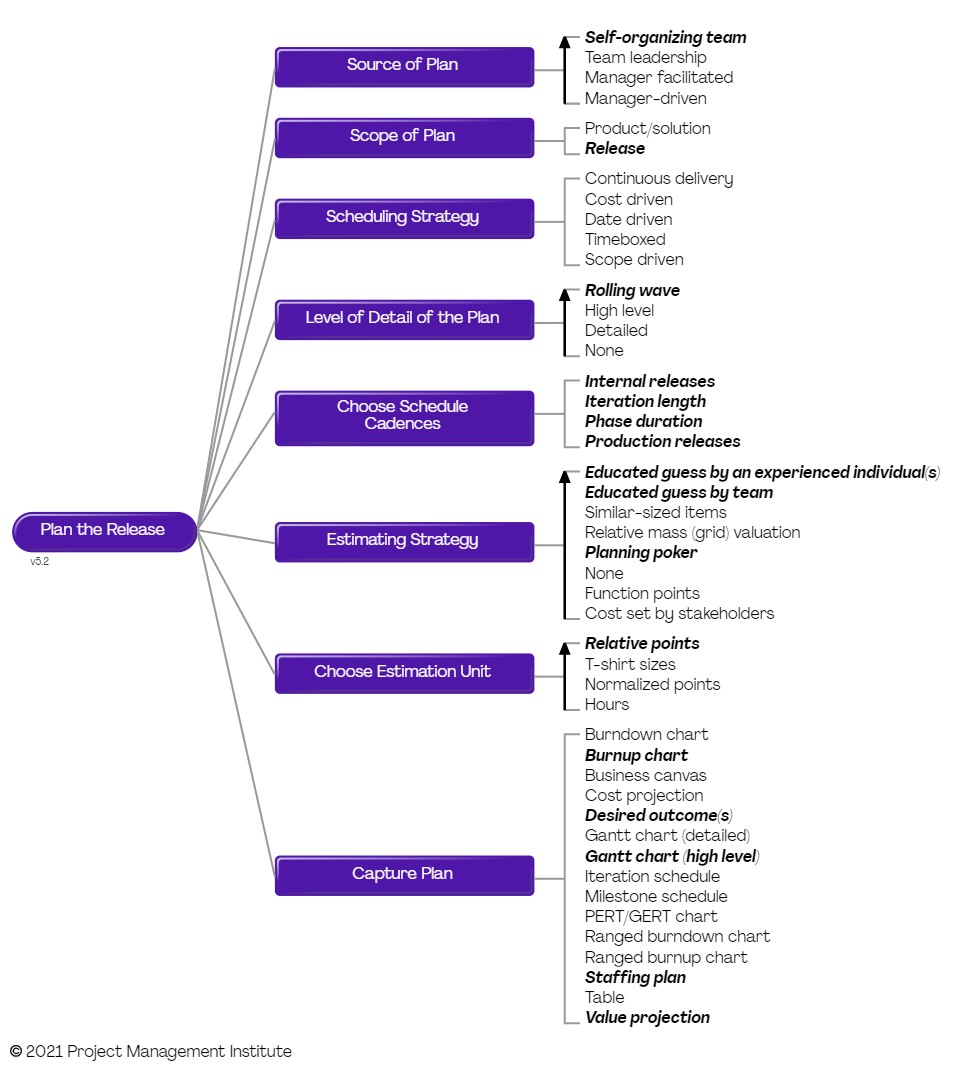
The Portfolio Management process blade supports rolling wave budgeting as an option for its Manage the Budget decision point. This is depicted in Figure 2. The advantages are greater flexibility and greater likelihood of investing your IT funding more effectively, albeit at the loss of the false predictability provided by an annual budgeting strategy.
Figure 2. The goal diagram for the Portfolio Management process blade.

The Program Management process blade supports rolling wave planning of a program itself, as you seen in Figure 3. Planning and coordination are critical on a large program, and rolling wave planning offers the advantages greater flexibility, the ability to think important cross-team issues through, and the ability to react to changing stakeholder needs. The primary disadvantage is that it can be disconcerting for traditionalists who are used to thinking every thing through from the beginning.
Figure 3. The goal diagram for the Program Management process blade.

As you can see in Figure 4, rolling wave strategies can be applied in Product Management to evolve the business vision/roadmap. A continuous, rolling wave approach is critical to your success because the market place changes so quickly – these days, few organizations can tolerate an annual approach to business planning and in the case of companies with external customers an ad-hoc approach can prove to be too unpredictable for them.
Figure 4. The goal diagram for the Product Management process blade.

Previously we saw that rolling wave strategies can be applied to evolve your technology roadmap, as indicated in the goal diagram for Enterprise Architecture in Figure 5. The advantages of this approach are that your roadmap evolved in sync with both changes in technology and with your organization’s rate of experimentation and learning. The main disadvantage is that your technology roadmap is effectively a moving target.
Figure 5. The goal diagram for the Enterprise Architecture process blade.

As you can see, rolling wave strategies are an integral part of the Disciplined Agile (DA) toolkit. In fact, in most situations they prove to be the most effective and flexible strategies available to you. The advantages of rolling wave planning tend to greatly outweigh the disadvantages. More on this next time.
Posted
by
Scott Ambler
on: October 25, 2016 11:39 AM |
Permalink
Comments (0)
Please login or join to subscribe to this item
Please Login/Register to leave a comment.
|
"When I have a kid, I wanna put him in one of those strollers for twins, then run around the mall looking frantic."
- Steven Wright
|




