Running Multiple Improvement Experiments in Parallel
From the Disciplined Agile Blog
by Tatsiana Balshakova,
Mark Lines, Mike Griffiths, Scott Ambler, Bjorn Gustafsson, Curtis Hibbs, James Trott

This blog contains details about various aspects of PMI's Disciplined Agile (DA) tool kit, including new and upcoming topics.
View Posts By:
Tatsiana Balshakova
Mark Lines
Mike Griffiths
Scott Ambler
Bjorn Gustafsson
Curtis Hibbs
James Trott
Past Contributors:
Joshua Barnes
Michael Richardson
Daniel Gagnon
Valentin Tudor Mocanu
Kashmir Birk
Glen Little
Klaus Boedker
Recent Posts
DA 5.6 is released
Disciplined Agile 5.5 Released
Choose Your WoW! Second Edition Is Now Available
Requisite Agility applied in Project Management
Disciplined Agile and PMBoK Guide 7th Edition
Categories
#ChoiceIsGood,
#ChooseYourWoW,
#ConsumableSolution,
#ContinuousImprovement,
#CoreAgilePractices,
#experiment,
#Experimentation,
#GuidedContinuousImprovement,
#Kaizen,
#LifeCycles,
#ProcessImprovement,
#TealOrganizations,
Adoption,
agile,
agile adoption,
Agile Alliance,
Agile Business Analyst,
Agile certification,
agile data,
agile governance,
agile lifecycle,
agile metrics,
agile principles,
agile transformation,
Agile2018,
Agile2019,
Agile20Reflect,
AgileData,
Analogy,
announcement,
Architecture,
architecture,
architecture owner,
Articles and publications,
Asset Management,
Atari,
Backlog,
Barclays,
being agile,
benefits,
bi,
blades,
book,
Branching strategies,
Browser,
Business Agility,
business intelligence,
business operations,
capex,
Case Study,
Certification,
certification,
charity,
Choose your WoW,
CMMI,
cmmi,
Coaching,
Collaboration,
Communications Management,
Compliance,
Compliancy,
Conference,
Construction,
Construction phase,
Context,
Continuous Improvement,
coordination,
COVID-19,
Culture,
culture,
Cutter,
DA,
DAD,
DAD Book,
DAD discussions,
DAD press,
DAD roles,
DAD supporters,
DAD webcast,
DADay2019,
Data Management,
database,
dependencies,
Deployment,
Development Strategies,
DevOps,
disaster,
Discipline,
discipline,
Disciplined Agile,
disciplined agile delivery,
disciplined agile delivery blog,
Disciplined Agile Enterprise,
disciplined devops,
Documentation,
Domain complexity,
dw,
DW/BI,
Energy Healing,
Enterprise Agile,
Enterprise Architecture,
Enterprise Awareness,
enterprise awareness,
Essence,
estimation,
Evolving DA,
Executive,
Experiment,
facilitation,
FailureBow,
feedback-cycle,
finance,
Financial,
FLEX,
Flow,
foundation layer,
Funding,
GCI,
GDD,
Geographic Distribution,
gladwell,
global development,
Goal-Driven,
goal-driven,
goals,
Governance,
GQM,
Guideline,
Hybrid,
Improvement,
inception,
Inception phase,
India,
information technology,
infosec,
Introduction,
iterations,
Kanban,
large teams,
layer,
lean,
Lean Startup,
learning,
Legal Project Management,
LeSS,
Lifecycle,
lifecycle,
Manifesto,
mark lines,
marketing,
MBI,
Metaphor,
Metrics,
metrics,
mindset,
Miscellaneous,
MVP,
News,
News and events,
Non-Functional Requirements,
non-functional requirements,
Non-solo development,
offshoring,
Operations,
opex,
Organization,
Outsourcing,
outsourcing,
paired programming,
pairing,
paper,
People,
People Management,
phases,
Philosophies,
Planning,
PMBoK,
PMI,
PMI and DA,
PMI Chapter,
Portfolio Management,
post-format-quote,
Practices,
practices,
Principle,
Process,
process improvement,
process tailoring,
Product Management,
product owner,
Product Owners,
productivity,
Program Management,
Project Management,
project-initiation,
Promise,
Quality,
quality,
rational unified process,
Refactoring,
Reiki,
Release Management,
release management,
Remote Training,
Remote Work,
repeatability,
requirements,
Requirements Management,
research&development,
responsibilities,
retrospectives,
Reuse,
Reuse Engineering,
ride for heart,
rights,
Risk Management,
Risk Management,
Risk management,
Roles,
RUP,
SAFe,
sales,
Scaling,
scaling,
scaling agile,
Scheduled Workshops,
SCM,
scorecard,
Scrum,
ScrumMaster,
SDLC,
Security,
security,
self-organization,
SEMAT,
serial,
skill,
solutions software consumable shippable,
Stakeholder Management,
strategy,
Support,
Surveys,
Teal organizations,
team development,
Team Lead,
team lead,
Teams,
Technical Debt,
Teleconferencing,
Terminology,
terraforming,
test strategy,
testing,
time tracking,
Tool kit,
Toolkit,
tools,
traditional,
Transformation,
Transition iteration,
transition phase,
Uncategorized,
Upmentors,
Using PMI Standards,
value stream,
velocity,
vendor management,
Virtual Training,
Workflow,
workflow,
workspaces
Date

In Continuous Improvement Through Experimentation we described how a team could improve their way of working (WoW) via the strategy depicted in Figure 1. In Better Decisions Lead to Better Process Outcomes we showed how you can increase the rate of improvement by identifying potential improvements that are likely to work in your situation. In this blog we describe how to accelerate your team’s improvement by running multiple improvement experiments in parallel.
Figure 1. Running an experiment to evolve your WoW (click to enlarge).
.png)
The strategy is exactly as it sounds. Instead of running a single process improvement experiment at a time you run several at once. You may decide to do this for one of several reasons:
- You want to compare several strategies that potentially address the same process issue you hope to resolve.
- You have several process issues that you hope to resolve at the same time.
- Your team is currently running an experiment and feels it has capacity to take on another improvement experiment.
- Techniques are dependent on one another, such as automated regression testing and continuous integration (CI).
Although this strategy will help your team to increase its rate of improvement, there are two fundamental challenges with it. First, it is harder to assess the effectiveness of an individual technique when multiple experiments are being run in parallel because they can interact with each other. For example, you decide to experiment with holding stakeholder demos and with active stakeholder participation at the same time (you weren’t doing either one until now). When you see improvements in the quality of stakeholder satisfaction with the product you’re developing, is that the result of one of the practices but not the other or both of them in combination? If can’t definitively answer that question, it will make it hard to assess the effectiveness of each technique.
Second, you only have so much capacity for experimenting with new WoW. It can be hard enough, sometimes, to convince your organization’s leadership to allow you the time to experiment in the first place. Getting time to run multiple experiments is even harder.
Our point is that running an experimentation-based approach to evolving your way of working (WoW) makes sense. In some cases running multiple experiments in parallel can be even more effective.
MORE INFORMATION
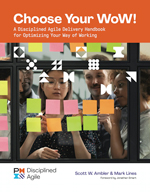
For more information about choosing and evolving your WoW, we humbly suggest that you consider reading our book Choose Your WoW! A Disciplined Agile Delivery Handbook for Optimizing Your Way of Working. If you want to succeed at enterprise agile you need choices, not prescriptions.
Posted
by
Scott Ambler
on: February 01, 2019 09:35 AM |
Permalink
Comments (0)
Please login or join to subscribe to this item
Please Login/Register to leave a comment.
|
"There is one way to find out if a man is honest: Ask him! If he says yes, you know he's crooked."
- Groucho Marx
|




