


Categories: Carole Osterweil, Change Management, communications management, Leadership, stakeholder management, Teams
Welcome to my second blog on dealing with Corona Uncertainty. The message in my first blog was clear
We need Thinking brains online for high quality decision making.
This means learning to contain anxiety so we don't get caught up in Project Stress Cycles. With Thinking Brains online we can have informed discussions and take high quality decisions about how to proceed.
In this blog, I'm offering a tool to facilitate your discussions and decision making. This tool is designed to help keep your Thinking Brains online because it allows you to talk explicitly about uncertainty.
Yes, you read that right! It's a tool for talking about uncertainty - not risk.
The case for talking about uncertainty
Project Managers love a business case - here's mine.
- Uncertainty is a driver of social threat
- It takes our Thinking Brains offline.
- In many project environments it takes a huge amount of courage to say 'I'm not sure about this' - especially when no one else is speaking out and the prevailing culture is to talk about risk.
I unpacked the differences between risk and uncertainty with help from Elmer Kutsch and colleagues in Project Delivery, Uncertainty and Neuroscience [1]
- Risks are associated with clarity and predictability – they can be quantified through a rational assessment of how likely, based on past experience, an event is to occur.
- Uncertainties are assumptions associated with ambiguity and novelty – they are difficult to articulate and define. But, this shouldn’t prevent you treating them seriously and exploring them carefully. After all, uncertainties that come to pass have a real, and sometimes catastrophic, impact on delivery and outcomes.
Corona is an uncertainty that has come to pass and it's bringing many more in its wake. We can't manage the risks away - no matter how much we want to! We simply don't have the past experience to draw on.
Sticking our heads in the sand or pretending we can manage the risks away doesn't work. It doesn't contain anxiety - people can see straight through it - as our politicians are discovering. The only way to proceed is by being transparent and talking about uncertainty.
Doing so reduces social threat and social contagion. When you use the tool below, talking about uncertainty it is quite straightforward. You'll find it makes a huge difference.
Tool for Exploring Uncertainty
My tool is based on Eddie Obeng’s project typology and Ralph Stacey’s work on complexity
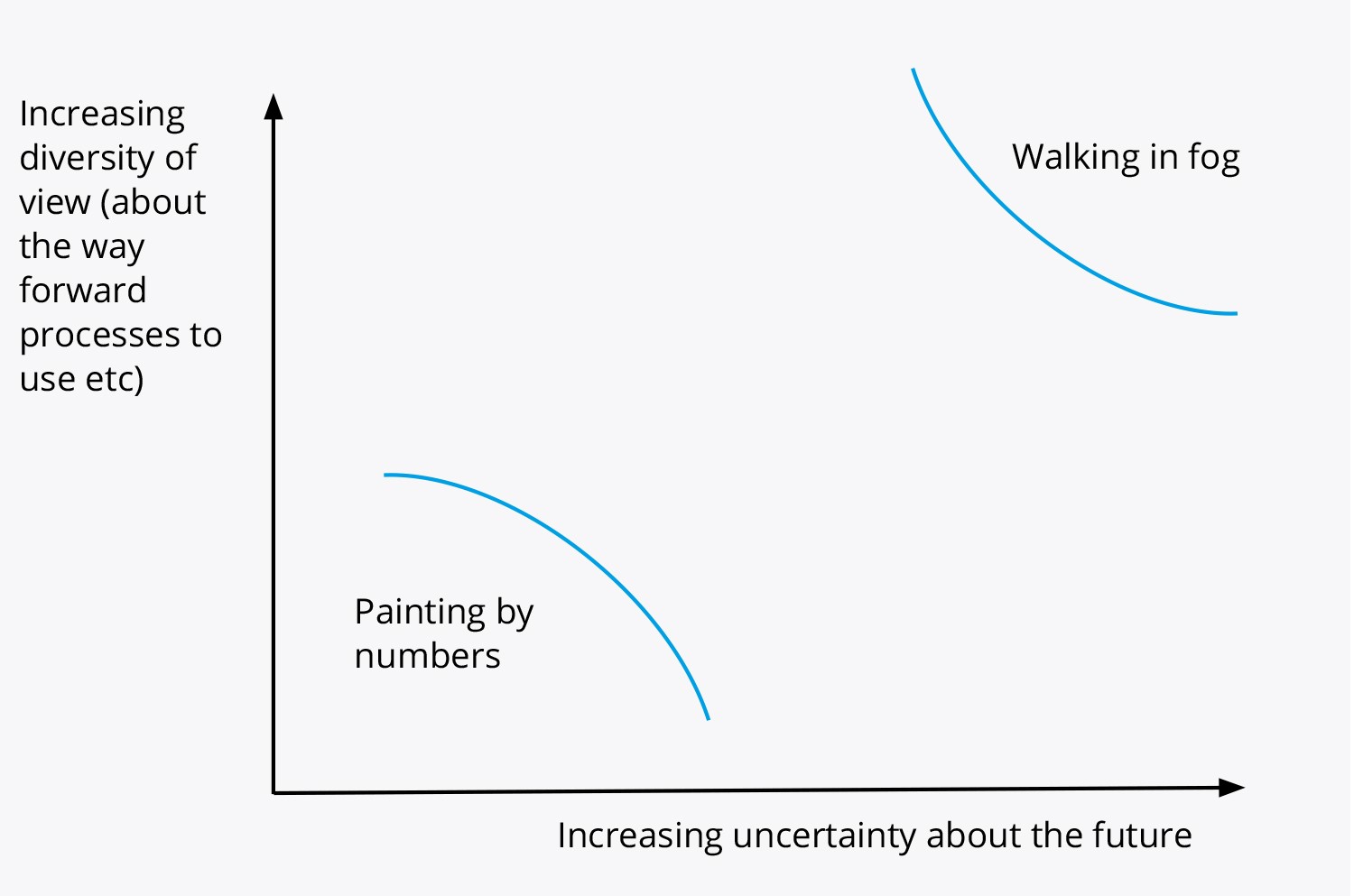
Source: Project Delivery, Uncertainty and Neuroscience © Visible Dynamics
Try it now in three steps. Go on.
Step 1 Use the graph to plot where you are today with a project to deliver and Corona looming. Put a cross in the top right if you feel like you’re Walking in Fog (very uncertain with little agreement on the way forward ). Put it in the bottom left if it’s more like Painting by Numbers (you know the kids’s game – where there's a clear outline and you just have to add the colours to make the picture)
Step 2 Forget about Corona, think about your personal preferences. Where do you usually feel most comfortable? Top right, bottom left, somewhere in the middle?
Step 3 What does this tell you about yourself and the impact of Corona Uncertainty on you and your Thinking Brain? I’m guessing that most of us are in the top right. I’m also guessing that it's a pretty uncomfortable place to be - even for those of us who like fog and are drawn to uncertainty.
And I’m curious, what is it like to have these labels and to be explicit about your response to uncertainty?
In my experience these labels help us make sense of uncertainty. They provide great clarity and help to bring our Thinking Brains online.
Add to this the knowledge that Walking in Fog needs a completely different approach to Painting by Numbers and you have a way forward.
Walking in Fog needs a completely different approach
When you’re Walking in Fog the best approach is to set out to explore and understand the uncertainty. You make progress by explicitly exploring the terrain, aiming to put stakes in the ground as you gain clarity, and making informed decisions about where to look next to reduce the uncertainty further.
Working in this way, you eventually develop enough experience of the terrain to make realistic risk assessments. When you reach this point it’s appropriate to adopt more traditional approaches to project planning and risk management. You can start Painting by Numbers.
TAKEAWAYS
There is no way of escaping the fog! Pretending it’s not foggy, or confusing risk and uncertainty leads to all kinds of problems.
If you don’t want to get caught out (and this applies to starting a new project or taking over an existing one) as well as responding to Corona:
- Recognise what you are dealing with and the nature of the journey
- Be explicit and label the project/ journey appropriately
- Remember risk and uncertainty are ‘in the eye of the beholder’
- Tell your stakeholders and your team members you are Walking in Fog – literally!
- Talk about uncertainties, what you don’t know and what you need to discover
- Ask them what they are uncertain about and where they feel most exposed
- Explain it may be uncomfortable, especially if they or others expect you to be Painting by Numbers
- Be confident that done right, the fog will clear and you’ll be able to turn uncertainties into risks – even though the fog will be patchy for a while
- Be ready to change approach and start Painting By Numbers where the fog has cleared sufficiently
And tell me how you get on!
Other Blogs in this Series
- What Can the Project World Learn from Neuroscience?
- SCARF a Brain–based Model for Managing People on Projects
- PM Point of View Episode 69: Neuroscience in Project Management Carole Osterweil in conversation with Kendall Lott (starts 40 mins in)
- Change Requests and the Project Stress Cycle
- Corona: Reducing Personal Uncertainty
References
[1] Osterweil, C (2019) Project Delivery, Uncertainty and Neuroscience – a Leader’s Guide to Walking in Fog, London: Visible Dynamics




