Evolving Disciplined Agile: The DA Mindset
From the Disciplined Agile Blog
by Tatsiana Balshakova,
Mark Lines, Mike Griffiths, Scott Ambler, Bjorn Gustafsson, Curtis Hibbs, James Trott

This blog contains details about various aspects of PMI's Disciplined Agile (DA) tool kit, including new and upcoming topics.
View Posts By:
Tatsiana Balshakova
Mark Lines
Mike Griffiths
Scott Ambler
Bjorn Gustafsson
Curtis Hibbs
James Trott
Past Contributors:
Joshua Barnes
Michael Richardson
Daniel Gagnon
Valentin Tudor Mocanu
Kashmir Birk
Glen Little
Klaus Boedker
Recent Posts
DA 5.6 is released
Disciplined Agile 5.5 Released
Choose Your WoW! Second Edition Is Now Available
Requisite Agility applied in Project Management
Disciplined Agile and PMBoK Guide 7th Edition
Categories
#ChoiceIsGood,
#ChooseYourWoW,
#ConsumableSolution,
#ContinuousImprovement,
#CoreAgilePractices,
#experiment,
#Experimentation,
#GuidedContinuousImprovement,
#Kaizen,
#LifeCycles,
#ProcessImprovement,
#TealOrganizations,
Adoption,
agile,
agile adoption,
Agile Alliance,
Agile Business Analyst,
Agile certification,
agile data,
agile governance,
agile lifecycle,
agile metrics,
agile principles,
agile transformation,
Agile2018,
Agile2019,
Agile20Reflect,
AgileData,
Analogy,
announcement,
Architecture,
architecture,
architecture owner,
Articles and publications,
Asset Management,
Atari,
Backlog,
Barclays,
being agile,
benefits,
bi,
blades,
book,
Branching strategies,
Browser,
Business Agility,
business intelligence,
business operations,
capex,
Case Study,
Certification,
certification,
charity,
Choose your WoW,
CMMI,
cmmi,
Coaching,
Collaboration,
Communications Management,
Compliance,
Compliancy,
Conference,
Construction,
Construction phase,
Context,
Continuous Improvement,
coordination,
COVID-19,
Culture,
culture,
Cutter,
DA,
DAD,
DAD Book,
DAD discussions,
DAD press,
DAD roles,
DAD supporters,
DAD webcast,
DADay2019,
Data Management,
database,
dependencies,
Deployment,
Development Strategies,
DevOps,
disaster,
Discipline,
discipline,
Disciplined Agile,
disciplined agile delivery,
disciplined agile delivery blog,
Disciplined Agile Enterprise,
disciplined devops,
Documentation,
Domain complexity,
dw,
DW/BI,
Energy Healing,
Enterprise Agile,
Enterprise Architecture,
Enterprise Awareness,
enterprise awareness,
Essence,
estimation,
Evolving DA,
Executive,
Experiment,
facilitation,
FailureBow,
feedback-cycle,
finance,
Financial,
FLEX,
Flow,
foundation layer,
Funding,
GCI,
GDD,
Geographic Distribution,
gladwell,
global development,
Goal-Driven,
goal-driven,
goals,
Governance,
GQM,
Guideline,
Hybrid,
Improvement,
inception,
Inception phase,
India,
information technology,
infosec,
Introduction,
iterations,
Kanban,
large teams,
layer,
lean,
Lean Startup,
learning,
Legal Project Management,
LeSS,
Lifecycle,
lifecycle,
Manifesto,
mark lines,
marketing,
MBI,
Metaphor,
Metrics,
metrics,
mindset,
Miscellaneous,
MVP,
News,
News and events,
Non-Functional Requirements,
non-functional requirements,
Non-solo development,
offshoring,
Operations,
opex,
Organization,
Outsourcing,
outsourcing,
paired programming,
pairing,
paper,
People,
People Management,
phases,
Philosophies,
Planning,
PMBoK,
PMI,
PMI and DA,
PMI Chapter,
Portfolio Management,
post-format-quote,
Practices,
practices,
Principle,
Process,
process improvement,
process tailoring,
Product Management,
product owner,
Product Owners,
productivity,
Program Management,
Project Management,
project-initiation,
Promise,
Quality,
quality,
rational unified process,
Refactoring,
Reiki,
Release Management,
release management,
Remote Training,
Remote Work,
repeatability,
requirements,
Requirements Management,
research&development,
responsibilities,
retrospectives,
Reuse,
Reuse Engineering,
ride for heart,
rights,
Risk Management,
Risk Management,
Risk management,
Roles,
RUP,
SAFe,
sales,
Scaling,
scaling,
scaling agile,
Scheduled Workshops,
SCM,
scorecard,
Scrum,
ScrumMaster,
SDLC,
Security,
security,
self-organization,
SEMAT,
serial,
skill,
solutions software consumable shippable,
Stakeholder Management,
strategy,
Support,
Surveys,
Teal organizations,
team development,
Team Lead,
team lead,
Teams,
Technical Debt,
Teleconferencing,
Terminology,
terraforming,
test strategy,
testing,
time tracking,
Tool kit,
Toolkit,
tools,
traditional,
Transformation,
Transition iteration,
transition phase,
Uncategorized,
Upmentors,
Using PMI Standards,
value stream,
velocity,
vendor management,
Virtual Training,
Workflow,
workflow,
workspaces
Date
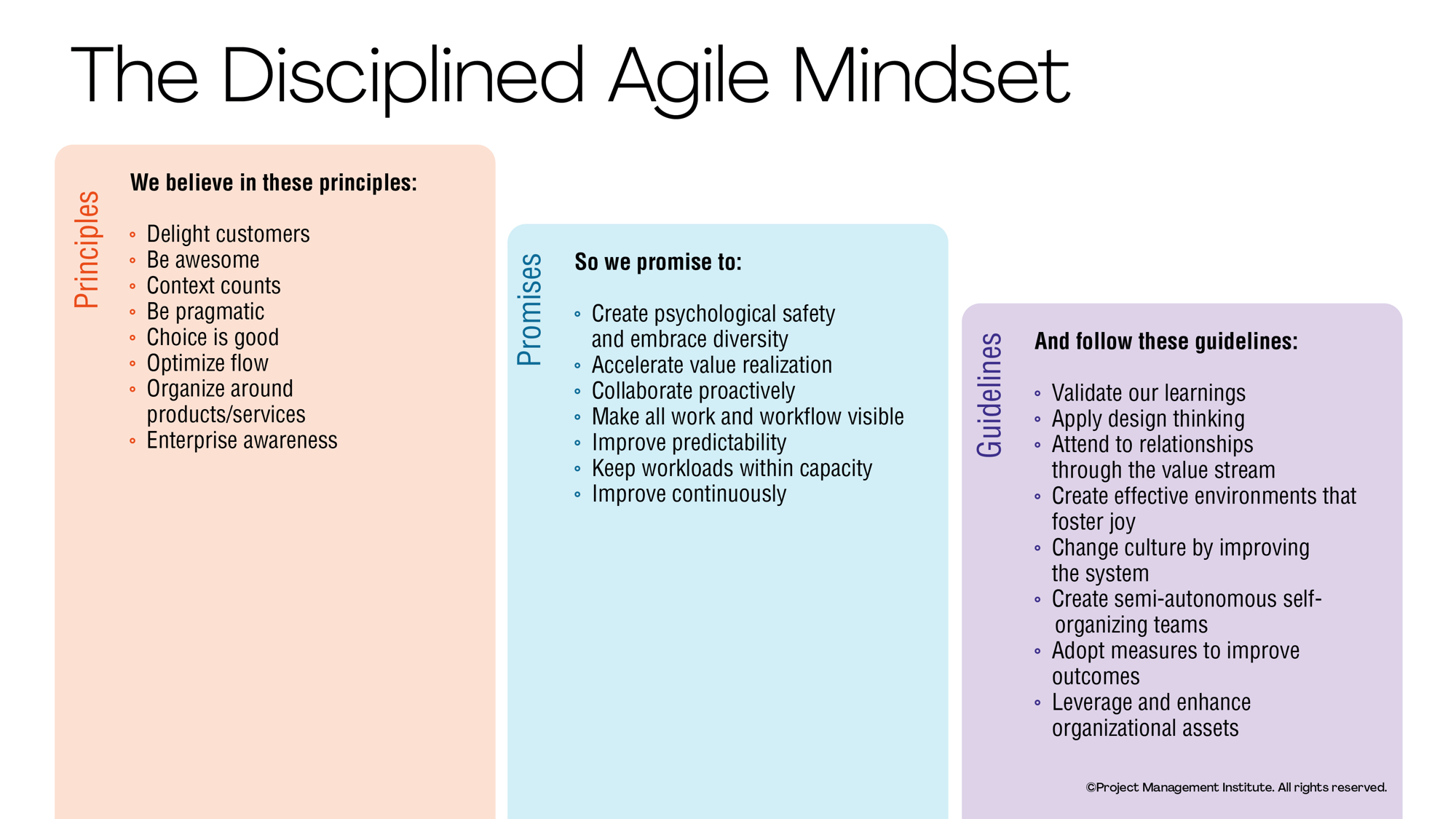
As I posted recently, the new version of our book Choose Your WoW! is now available. With this new release we have evolved the Disciplined Agile (DA) tool kit, and one of the things that we have updated is our approach to describing the DA Mindset. In this blog posting I overview our previous approach to describing the DA mindset and then describe our new strategy, which is summarized in the diagram above.
Our Previous Approach to Describing the DA Mindset
Until recently, we described the DA mindset as the combination of the DA Principles and the DA Manifesto. The DA Manifesto in turn was described in terms of five values and 17 principles behind the manifesto. The DA Manifesto was based on the Manifesto for Agile Software Development, or more colloquially known as the Agile Manifesto.
Three issues motivated us to move away from this approach:
- It was a bit confusing given that there were two levels of principles. We had originally developed the DA Manifesto in 2010 to reflect our belief that the Agile Manifesto wasn't sufficient for enterprise-class software development, let alone to support business agility. Over the years we evolved the DA Manifesto to reflect our learnings. Then around 2015 we found that we needed a layer above the DA Manifesto to capture key aspects of the DA mindset with respect to business agility, hence the DA principles. At this level the term principles made the most sense, even though the DA Manifesto had principles at a lower level.
- The Agile Manifesto was too constraining. The Agile Manifesto was written in 2001. While it was an incredibly important milestone for both the software world and now the business world, we've found that we need a more robust strategy. We've also found that some people struggle with why we would even need to extend the Agile Manifesto at all, or wanted to extend it in different ways, and we've grown tired of debating various nuances of the various extensions. It is time to move on.
- FLEX proved that a different approach works. When PMI decided to merge Al Shalloway's FLEX into DA one of the benefits was that we are able to benefit from Al's deep experience and thinking that is encapsulated in FLEX. The mindset behind FLEX wasn't based on the values and principles of the Agile Manifesto but instead on concepts based on lean and flow. Al had approached the same problem from a different direction and had found a different way to communicate very similar concepts. So we worked it through and developed our new approach.
Our New Approach to Describing the DA Mindset
Our new approach to describing the DA Mindset is straightforward: We believe in these principles, so we promise to adopt these behaviours and follow these guidelines when doing so. There is a purpose for each aspect of the mindset:
- Principles. The principles provide a philosophical foundation for business agility. They are based on both lean and flow concepts.
- Promises. The promises are agreements that we make with our fellow teammates, our stakeholders, and other people within our organization whom we interact with. The promises define a collection of disciplined behaviours that enable us to collaborate effectively and professionally.
- Guidelines. These guidelines help us to be more effective in our way of working (WoW) and in improving our WoW over time.
We will soon be updating DA pages on PMI.org and the Disciplined Agile courseware to reflect the changes being described in this blog series. Our strategy is to let the books lead, in other words we update the relevant book and then shortly afterwards we release updates to related material.
Future postings in this series explore the principles, promises, and guidelines behind the DA Mindset in greater detail.
Free Downloads
We have made several Disciplined Agile (DA) posters available to you for free download, including a Disciplined Agile Mindset poster.
Posted
by
Scott Ambler
on: April 20, 2020 10:27 AM |
Permalink
Comments (10)
Please login or join to subscribe to this item
Good overview of the some of the key changes, Scott! I noticed the addition of the "Organize around products/services" principle to the original seven. Why was the term "products/services" chosen over value streams? My concern is that the latter is universal whereas the former is not fully inclusive...

Scott Ambler
Consulting Methodologist| Ambysoft Inc.
Toronto, Ontario, Canada
Quick answer is wait and see when we publish the overview of principles. ;-)
Just joking. The reason why we went with this is that we wanted to be better aligned with the product-oriented terminology used elsewhere BUT also explicitly recognize that it's about more than just products (hence /services). I really would have preferred the term offerings but nobody would know what we're talking about.
We use the term value streams extensively elsewhere, in particular anything involved with the value streams layer.

Drew Craig
Sr. Agile & Product Coach| Vanguard
Philadelphia, Pa, United States
Scott, thanks, for this installment. I just saw the previous post highlighting the release of the new version. Thanks!

Rami Kaibni
 Community Champion
Senior Projects Manager | Field & Marten Associates
New Westminster, British Columbia, Canada
Great summary and highlights Scott, thank you.

Alexandre Costa
Scrum Master| Integer Consulting - Pictet technologies
Loures, Portugal
Scott,
I agree, like that is more clear and transparent.
Thanks for the detailed explanation.
Very interesting article, thanks for sharing
Scott Ambler
Consulting Methodologist| Ambysoft Inc.
Toronto, Ontario, Canada
Kiron, here's is an excerpt from tomorrow's more detailed blog about the principles:
To delight our customers we need to organize ourselves around producing the offerings, the products and services, that they need. We are in effect organizing around value streams because value streams produce value for customers, both external and internal, in the form of products and services. We chose to say organize around products/services, rather than offerings or value streams, as we felt this was more explicit.

Dave Davis
Senior Project Manager| Cincinnati Children's Hospital
Springboro, Oh., United States
I think this has a clearer message on DA mindset across the organization and different project types.
For example the concept of working product over comprehensive documentation is sprinkled in Principles, Promises, and Guidelines. And it applies to any product, not just software. i can also use it to deliver Organizational Change projects.

Délio Moreirinha
Senior Project Manager / Delivery Manager| Minsait | Indra Group
Oeiras, Lisboa, Portugal
Good! thanks for sharing your insignts.

Michael Berry
Chief Methodologist| Red Rock Research, Inc.
Draper, Ut, United States
I like the term "value proposition" when describing offerings at the end of value streams.
Please Login/Register to leave a comment.
|
"Weaseling out of things is good. It's what separates us from the other animals....except weasels."
- Homer Simpson
|




