Disciplined Agile is a Hybrid
From the Disciplined Agile Blog
by Tatsiana Balshakova,
Mark Lines, Mike Griffiths, Scott Ambler, Bjorn Gustafsson, Curtis Hibbs, James Trott

This blog contains details about various aspects of PMI's Disciplined Agile (DA) tool kit, including new and upcoming topics.
View Posts By:
Tatsiana Balshakova
Mark Lines
Mike Griffiths
Scott Ambler
Bjorn Gustafsson
Curtis Hibbs
James Trott
Past Contributors:
Joshua Barnes
Michael Richardson
Daniel Gagnon
Valentin Tudor Mocanu
Kashmir Birk
Glen Little
Klaus Boedker
Recent Posts
DA 5.6 is released
Disciplined Agile 5.5 Released
Choose Your WoW! Second Edition Is Now Available
Requisite Agility applied in Project Management
Disciplined Agile and PMBoK Guide 7th Edition
Categories
#ChoiceIsGood,
#ChooseYourWoW,
#ConsumableSolution,
#ContinuousImprovement,
#CoreAgilePractices,
#experiment,
#Experimentation,
#GuidedContinuousImprovement,
#Kaizen,
#LifeCycles,
#ProcessImprovement,
#TealOrganizations,
Adoption,
agile,
agile adoption,
Agile Alliance,
Agile Business Analyst,
Agile certification,
agile data,
agile governance,
agile lifecycle,
agile metrics,
agile principles,
agile transformation,
Agile2018,
Agile2019,
Agile20Reflect,
AgileData,
Analogy,
announcement,
Architecture,
architecture,
architecture owner,
Articles and publications,
Asset Management,
Atari,
Backlog,
Barclays,
being agile,
benefits,
bi,
blades,
book,
Branching strategies,
Browser,
Business Agility,
business intelligence,
business operations,
capex,
Case Study,
Certification,
certification,
charity,
Choose your WoW,
CMMI,
cmmi,
Coaching,
Collaboration,
Communications Management,
Compliance,
Compliancy,
Conference,
Construction,
Construction phase,
Context,
Continuous Improvement,
coordination,
COVID-19,
Culture,
culture,
Cutter,
DA,
DAD,
DAD Book,
DAD discussions,
DAD press,
DAD roles,
DAD supporters,
DAD webcast,
DADay2019,
Data Management,
database,
dependencies,
Deployment,
Development Strategies,
DevOps,
disaster,
Discipline,
discipline,
Disciplined Agile,
disciplined agile delivery,
disciplined agile delivery blog,
Disciplined Agile Enterprise,
disciplined devops,
Documentation,
Domain complexity,
dw,
DW/BI,
Energy Healing,
Enterprise Agile,
Enterprise Architecture,
Enterprise Awareness,
enterprise awareness,
Essence,
estimation,
Evolving DA,
Executive,
Experiment,
facilitation,
FailureBow,
feedback-cycle,
finance,
Financial,
FLEX,
Flow,
foundation layer,
Funding,
GCI,
GDD,
Geographic Distribution,
gladwell,
global development,
Goal-Driven,
goal-driven,
goals,
Governance,
GQM,
Guideline,
Hybrid,
Improvement,
inception,
Inception phase,
India,
information technology,
infosec,
Introduction,
iterations,
Kanban,
large teams,
layer,
lean,
Lean Startup,
learning,
Legal Project Management,
LeSS,
Lifecycle,
lifecycle,
Manifesto,
mark lines,
marketing,
MBI,
Metaphor,
Metrics,
metrics,
mindset,
Miscellaneous,
MVP,
News,
News and events,
Non-Functional Requirements,
non-functional requirements,
Non-solo development,
offshoring,
Operations,
opex,
Organization,
Outsourcing,
outsourcing,
paired programming,
pairing,
paper,
People,
People Management,
phases,
Philosophies,
Planning,
PMBoK,
PMI,
PMI and DA,
PMI Chapter,
Portfolio Management,
post-format-quote,
Practices,
practices,
Principle,
Process,
process improvement,
process tailoring,
Product Management,
product owner,
Product Owners,
productivity,
Program Management,
Project Management,
project-initiation,
Promise,
Quality,
quality,
rational unified process,
Refactoring,
Reiki,
Release Management,
release management,
Remote Training,
Remote Work,
repeatability,
requirements,
Requirements Management,
research&development,
responsibilities,
retrospectives,
Reuse,
Reuse Engineering,
ride for heart,
rights,
Risk Management,
Risk Management,
Risk management,
Roles,
RUP,
SAFe,
sales,
Scaling,
scaling,
scaling agile,
Scheduled Workshops,
SCM,
scorecard,
Scrum,
ScrumMaster,
SDLC,
Security,
security,
self-organization,
SEMAT,
serial,
skill,
solutions software consumable shippable,
Stakeholder Management,
strategy,
Support,
Surveys,
Teal organizations,
team development,
Team Lead,
team lead,
Teams,
Technical Debt,
Teleconferencing,
Terminology,
terraforming,
test strategy,
testing,
time tracking,
Tool kit,
Toolkit,
tools,
traditional,
Transformation,
Transition iteration,
transition phase,
Uncategorized,
Upmentors,
Using PMI Standards,
value stream,
velocity,
vendor management,
Virtual Training,
Workflow,
workflow,
workspaces
Date
The Disciplined Agile (DA) tool kit has always been a hybrid of great strategies from the very beginning, with the focus being on how all of these strategies fit together in practice. In the current release of DA we made its hybrid nature explicit when we refactored the foundation, depicted in Figure 1, into its own layer. You can see this in that we clearly indicate that Agile, Lean, and Serial (traditional) strategies are all foundational aspects of DA.
Figure 1. The foundation of DA is fundamentally hybrid in nature.

We like to say that DA does the heavy process lifting so that you don’t have to. We’ve mined the various methods, frameworks, and other sources to identify potential practices and strategies that your team may want to experiment with and adopt. DA puts these techniques into context, exploring fundamental concepts such as what are the advantages and disadvantages of the technique, when would you apply the technique, when wouldn’t you apply the technique, and to what extent would you apply it? Answers to these questions are critical when a team is choosing its way of working (WoW). Figure 2 shows that DA is a hybrid tool kit that puts great ideas from PMBOK Guide, Scrum, SAFe, Spotify, Agile Modeling (AM), Kanban, and several other methods into context.
Figure 2. Some of the process sources leveraged by DA.
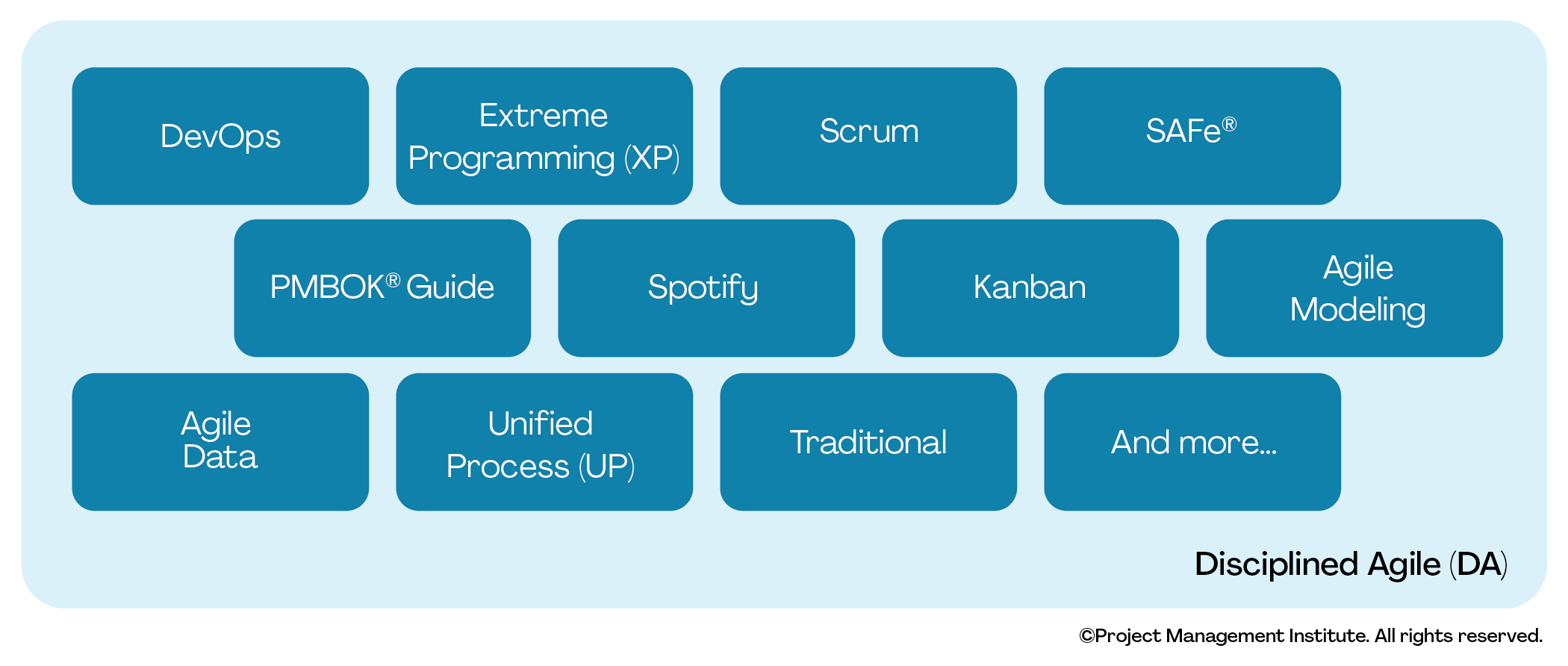
DA has taken this approach because no framework, no book of knowledge (BoK), is complete. For example, XP is the source of technical practices such as test-driven development (TDD), refactoring, and pair programming but has nothing to say about project management. The PMBoK Guide has great strategies for project managers, but has nothing to say about data analytics. The Agile Data (AD) method has great strategies for creating and evolving data sources but has nothing to say about organizing agile teams. Scrum offers great strategies such as product backlogs, sprint/iteration planning, and daily coordination meetings for organizing agile teams but has nothing to say about documentation strategies. Agile Modeling gives us model storming, architecture envisioning, and continuous documentation strategies but has nothing to say about governance. You get the point.
Each framework, each BoK, has its specific focus and thus is not sufficient on its own. The upside is that there are great strategies presented by each, often in great detail. The downside is that each source is locally optimize, they are inconsistent with one another, and there is very little advice for how to integrate these sources. This is where DA steps in - DA is hybrid that combines and puts these great ideas into context, providing advice for how to apply them effectively when you choose your WoW.
Posted
by
Scott Ambler
on: July 07, 2020 09:05 AM |
Permalink
Comments (3)
Please login or join to subscribe to this item

Rami Kaibni
 Community Champion
Senior Projects Manager | Field & Marten Associates
New Westminster, British Columbia, Canada
Scott
Spot On - Very Straight forward and to the point. I like the way you put this together by showing how one framework or Bok complements the other.
However, I didn't see any mention to the DSDM. After exploring a lot, with some applications in my projects and trainings I provide, I found that DSDM works well in the Construction Field in a Waterfall-Adaptive Hybrid Environment.
On another note, PRINCE 2 Agile, provides good value on its own as well in terms of being Agile and having the agile mindset at certain levels while maintaining control. Maybe this is something you can also look at for the next version of the WoW book, if not already.
RK
Please Login/Register to leave a comment.
|
"Always do right. This will gratify some people and astonish the rest."
- Mark Twain
|




