


The Key to Agility
Individuals who are agile share similar characteristics. They include:
- Innovative
- Change-willing
- Opportunistic
- Purpose-seeking
- Problem-solving
Individuals who are not as agile, generally share the opposite characteristics:
- Traditional
- Change-resistant
- Risk-averse
- Comfort-seeking
- Problem-avoiding
As you consider these lists and the basic idea that we want to help people shift from being less-agile to being more-agile, which part of an individual controls whether or not they are innovative versus traditional or change-willing versus change-resistant?
The answer: Their mind.
How individuals’ minds digest and process information shapes how agile they are. Thus, it stands to reason that if we want to become more agile or if we want to help others to become more agile, we must focus on the mind.
Harnessing the Power of the Mind in Agility Development
How often is the mind focused on when discussing the development of agility?
In my experience, rarely.
To harness the power of the mind in agility development, we need to focus on an aspect of our brain that drives our brain’s processing: our mindsets.
Our mindsets are often described as our mental lenses that shape how we see and process our world, and therefore are foundational to how we operate in our world.
But, in reality, our mindsets are long-range neural connections in our brain that connects three different regions of the brain:
- Basal Ganglia (Reptilian Brain) – In charge of body sensations and impulses. It is what rapidly gets us into fight/flight/freeze mode if it senses or interprets danger.
- Limbic System (Mammalian Brain) - It is in charge of emotions, feelings, and implicit memory, which greatly inform and influence decisions.
- Neocortex (Human Brain) - It is in charge of thought, verbal expression, and emotional intelligence. Everything below this brain region is largely instinctual and reactive. This is the part of our brain that allows for rationality and responsiveness.
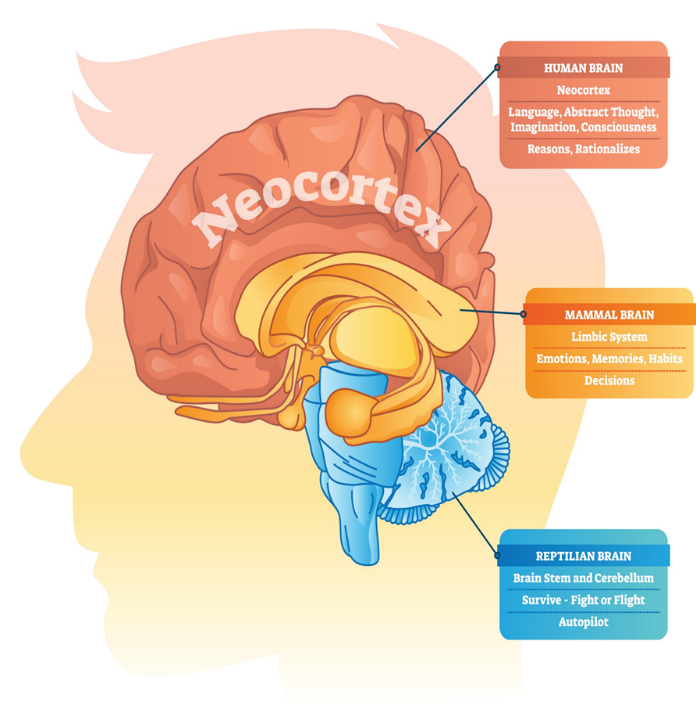
Since our mindsets are the neural highway connecting these three brain regions, they effectively serve as the circuit board for our brain that performs three primary jobs:
- Since our body sends our brain way more information than we can process, our mindsets first filter in the most important and valuable information (largely occurs in the basal ganglia).
- Our mindsets then put meaning on, or interprets, this information, largely based upon our memory and past experiences (largely occurs in our limbic system).
- Based upon the information filtered in and how it is interpreted, our mindsets activate the different traits and goal-regulation strategies to best respond to what we have filtered in and interpreted.
What Mindsets Do Employees Need to Develop?
If employees’ mindsets are central to how employees process and operate, they need to become a primary focus when developing agility. This is perhaps the best way we know how to focus on the mind as part of agility development.
But, something that often holds organizations up from focusing on mindsets is that they don’t know what mindsets to focus on.
I have scoured the academic literature to identify mindsets that have been researched and have been continually demonstrated to impact how people think, learn, and behave. From this research, I have identified four mindsets that have been repeatedly found to lead to agile processing and operation. They are:
- Growth Mindset: The belief that people can change their talents, abilities, and intelligence, leading to a focus on learning and growing
- It is difficult to be agile if you don’t believe that one and/or others cannot change
- Open Mindset: The belief that one can be wrong, leading to a focus on thinking optimally, and finding truth
- It is difficult to be agile if we always think that what we know is best, leading us to close down our mind to new or divergent ideas
- Promotion Mindset: Having a meaningful destination that one is working toward (i.e., focus on winning), leading to a willingness to do the difficult but necessary things to get to that destination
- It is difficult to be agile if we are always trying to “play it safe”
- Outward Mindset: The belief that others are just as important as oneself, leading to one seeing others as people and valuing them as such
- It is difficult to be agile if we are primarily focused on ourselves and what is best for us.
Conclusion
I hope this article has done three things for you:
- Helped you see how important it is to focus on the mind when developing agility
- Helped you see that a focal aspect of the mind that is optimal for development is mindsets
- Helped you know what mindsets you should focus on when enhancing your personal agility or the agility of those in your organization
Ryan Gottfredson, Ph.D. is the Wall Street Journal and USA Today best-selling author of “Success Mindsets: The Key to Unlocking Greater Success in Your Life, Work, & Leadership.” He is also a leadership professor at the Mihaylo College of Business and Economics at California State University-Fullerton. You can connect with him and take a FREE Personal Mindset Assessment at https://ryangottfredson.com/.


 Community Champion

