Artificial Intelligence & Machine Learning: Data is King


| I am far from being an expert in artificial intelligence (AI) and machine learning (ML). Actually, I spent some time googling these two concepts which - the truth to be said - are commonly used interchangeably. The ultimate goal of AI is to create intelligent machines that simulate the human thinking capability and behavior. Deep Blue, the famous supercomputer that defeated chess world champion Garry Kasparov falls into this category. On the other hand, ML is the art of these machines to learn in real time from all gathered data without being programmed explicitly. Most subject matter experts state that Deep Blue cannot be considered an example of ML because it was programmed to beat humans but learned little along the way. ML has evolved tremendously since the Deep Blue times in late 1990s. Its skyrocketing advancement poses novel challenges in our lives, especially when it comes to trust. An example of this - perhaps not the most relevant, yet illustrative - can be observed in Nascar races. In them, AI and ML play a vital helping hand in understanding a massive data set, such as identifying anomalies and contributing causes in real-time. The algorithms analyze the real time data and yield the best course of action to win the race: optimum timings to tank or change tires, best time to overtake a rival, etc. In one of the races, the machine advised to do A, yet the team went with their gut feeling (they knew better!) and picked B. They lost and realized that option A, indeed, would have been a far better choice.
At the end of the day, AI and ML require above all just one thing, data. And a project generates a massive amount of it. Having in mind the DIKW pyramid, data is treated to obtain information, which is then further processed into knowledge and finally wisdom. How this translates to project management? One can think of a situation that project managers often come across during a project: making scenarios. The PM is responsible for gathering and process all relevant inputs from SMEs or any other suitable sources and present the various options with their cons and pros to the sponsor, steering committee... It is easy to envision a machine (or software) that is able to not only analyze the data and define possible scenarios but also to provide timely alerts to avoid certain less favorable scenarios, thereby increasing the odds of delivering a successful project. This specific case example wants to reflect on the adapting role that the PM must face as the AI/ML technology becomes more mature. Cab drivers will become obsolete when self-driving cars become available at mass scale level. The threats that AI/ML will exert in project management is yet to be seen. Can they live in perfect harmony? Have your saying in the comments section below. |

Passing PSPO I Test
| After earning the PSM I certification last year, I then decided to pursue the PSPO I. I took and passed the exam, obtaining 73 out of 80 points (minimum to pass is set at 68). I would like to share with you my experience in this short journey hoping that it can be of use for future aspirants. It was short since I basically prepared two weeks prior the test. I practiced scrum quizes from M. Lapshin (https://mlapshin.com/) and from the scrum.org website until I got a consistent >95% in both. Every simulation was useful in further retaining and understanding concepts and their situational applicability. At the end of the day, it is not only about passing the exam, it is mainly about acquiring new knowledge. It is relevant to note that even though some questions in the real test ressembled the ones displayed in the simulators, some of them (around 25%) were completely new. Before I sat for the exam I was confident I knew everything inside out, but these new questions challenged my self-confidence. Thus, do not get misdirected by very high scores in the simulators because the real test will pose some questions with which you will not be familiar. Therefore, it is a good practice to be prompt answering questions that you know by heart and spend more time to think the answers of the more challenging questions. Bear in mind that you have 60 minutes to answer 80 questions, or 45 seconds per question. In 45 seconds one must read the question, the answers, and think and pick the best answer(s). If you are able to answer an " easy" question in 20 seconds, you then accumulate an extra 25 seconds to answer a more ellaborated and/or unfamilar question.
Even though the test was about the PO, it included several questions about the SM role. Therefore, I would recommend to do a few simulators of PSM I as part of the preparation of PSPO I exam. In addition, it is important to read well the questions and the answers. Sometimes it is tempting to go fast through questions that we have seen before and are positive we know the answer. This holds true in the majority of cases, but a couple times it happened that I rushed and picked the wrong answer (and of course changed it after a second thorough reading). Finally, take the test when you are relaxed and not during peak work hours. In my case, Friday afternoon fits very wel. Set your phones on airplane mode, get a glass of water, take a deep breath and start. Hopefully one hour later (or less) you will receive an email saying " Congratulations on passing the PSPO I assessment". |

Paradigm change in the horizon
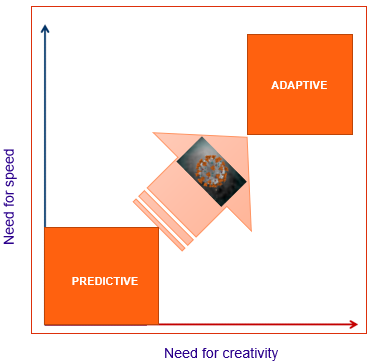
| Gallons of virtual ink have been poured in debating whether predictive lifecycle project management is outdated or not. It is also frequent to be confused about terms that are used interchangeably. In the projectmanagement.com forum is recurrent to find questions like "Is agile booming in detriment of waterfall?" without realizing that waterfall is a lifecycle management and agile is a mindset, an approach, and not a methodology. Both can live together – and they do – in complete harmony. Simplifying, there are two parameters that must be taken into consideration prior to assessing the lifecycle management that best fits the project needs.
The Pharmaceutical industry: a changing paradigm? When someone thinks of projects in the pharmaceutical industry tends to consider projects in R&D and in the development of new molecules in particular. In short, about 5 to 10 thousand molecules are kicked off in the drug discovery phase. Around 250 will make it to the preclinical phase and clinical trials will start with only 5 of those. Finally, 1 out of these 5 molecules will obtain approval for commercialization from the regulatory agencies. The whole process takes a minimum of 10 years, and can easily go up to 15. One can conclude that these projects are long, complex and extremely expensive. The search for a vaccine against SARS-CoV2, the virus that causes Covid-19, has shaken up the playing board. Timelines are being very significantly shortened and certain constraints have been loosen up in order to allow creative approaches. For example, drugs against malaria have been tested against the virus. Or timelines to start clinical trials have been very notoriously slimmed down. The need for speed is paramount given the death toll that this pandemic is causing. The commitment at a global scale to resolve this situation as quick as possible has caused fundamental changes not only in our personal life but also in the approach to manage R&D projects in the pharmaceutical industry. Time will tell if these changes have come to stay. |
Our iceberg is melting - revisited
Categories:
Change; Change management; Team management
Categories: Change; Change management; Team management
| Our iceberg is melting is not a new release – in fact its first edition dates back from 2005. Nevertheless, the content of this wonderful fable about change management is still valid today. Organizations are constantly evolving in order to adapt to a changing environment. The authors of the book, John Kotter and Holger Rathgeber, describe the change that a penguin colony must undertake in order to adjust to a changing reality and save their lives.
The reader shall not get fooled by the numerous illustrations that populate the pages of this book. This is not a children’s book. And this is precisely what makes it so valuable. In a world with abundance of academic materials about change management, using penguins instead of complex flowcharts increases the reader engagement – and makes the key concepts stick. The reader will surely recognize the characters of the book. For instance, Fred, an observant penguin who identifies and reports the worrying issue to Alice. She is the go getter penguin that puts the valuable information in the agenda of colony’s counsel. Or Louis, the head penguin, wise and respected by all except the naysayers (sure we can all think of naysayers in our organizations!). And Buddy, a not so wise but charismatic penguin whose main role is to provide assurance and confidence in times of distrust. Finally, don’t forget the Professor, who will make use of scientific evidence to back up the need for change throughout the arduous journey. The change team is ready, and they will be covering all required stages; creating and communicating a vision of the new reality, circumventing all obstacles, getting the colony onboard by empowering it and recognizing the efforts carried out by all colony members. These are, in a nutshell, the stages that the reader is navigated through since the need for change is detected until it is successfully implemented (apologies for the spoiler, but when has a fable end up badly?). I read this book during the lockdown caused by coronavirus, which made its lecture very special. At the end of the day, this pandemic will lead the whole world to live in a different way, what has been coined as “new normality”. What a better example of change management than this? One can mull over the reasons that have caused a poor management of the pandemic, specially during the initial stage. A scientific article published in 2007 (Clin. Microbiol Rev 20(4)) took the role of Fred and warned about it: “The presence of a large reservoir of SARS-CoV-like viruses in horseshoe bats, together with the culture of eating exotic mammals in southern China, is a time bomb. The possibility of the reemergence of SARS and other novel viruses from animals or laboratories and therefore the need for preparedness should not be ignored.” Was there an Alice to put this item in the agenda of all world leaders? Were there too many Louis’ leading the efforts to fight the battle against the virus? Did the community trust its leaders? The lecture of this book brings an opportunity to reflect about these aspects and change management in general. |

The Adaptation of Project Management in a Changing World
Categories:
Project Management
Categories: Project Management
| The tune that Bob Dylan released in the sixties, “The times they are a-changing” holds true after 50 years. And like Professor Leon C. Meeginson said “It is not the strongest or the most intelligent who will survive but those who can best manage change”. Read my article below to find out more about the adaptation of project management to the current society and economy. https://pmtips.net/article/the-adaptation-of-project-management-in-a-changing-world
|