


Categories: Agile, pharmaceutical; lifecyle management; agile; waterfall, Project Management, Scheduling
One of the most popular thread in a project management forum is about predictive and adaptive project management methodologies, and whether only of the two will prevail. Black or white. Sweet or salty. Hot or cold. Like in most things in life, the sweet spot is somewhere in the middle. In this blog, I’d like to scratch the surface of this “dilemma” in the pharmaceutical industry. There are two factors to consider to assess the suitability of a predictive or an adaptive model in order to achieve the project goals: the need for creativity and the speed to market. If these two score low, a predictive model will likely be the best fit. Think of projects like the commissioning and qualification of a new manufacturing line or the implementation of a laboratory information management system. However, projects that require high doses of creativity or are time-to-market constrained fit better in an adaptive model. Think of projects related to the development of new drugs or investigation of new indications for existing products.
At the end of the day, most projects are managed following a mix of these models, leaning more towards adaptive or predictive depending on the particularities of the project. The development of a vaccine against covid-19, the disease caused by SARS-CoV-2, is an example of this. On one hand, it was (still is) a project subjected to an enormous pressure. Speed to market scores very high. On the other hand, the steps to conceive, develop, register and mass produce a vaccine do not require creativity and are subjected to a stringent regulation from several regulatory bodies across the globe.
The prestigious scientific journal Nature published a very informative infographic that depicts the roadmap for the development and commercialization of SARS-CoV-2 vaccine versus a traditional vaccine (Nature 586, 516–527, 2020). In short, both differ by a factor of 10!
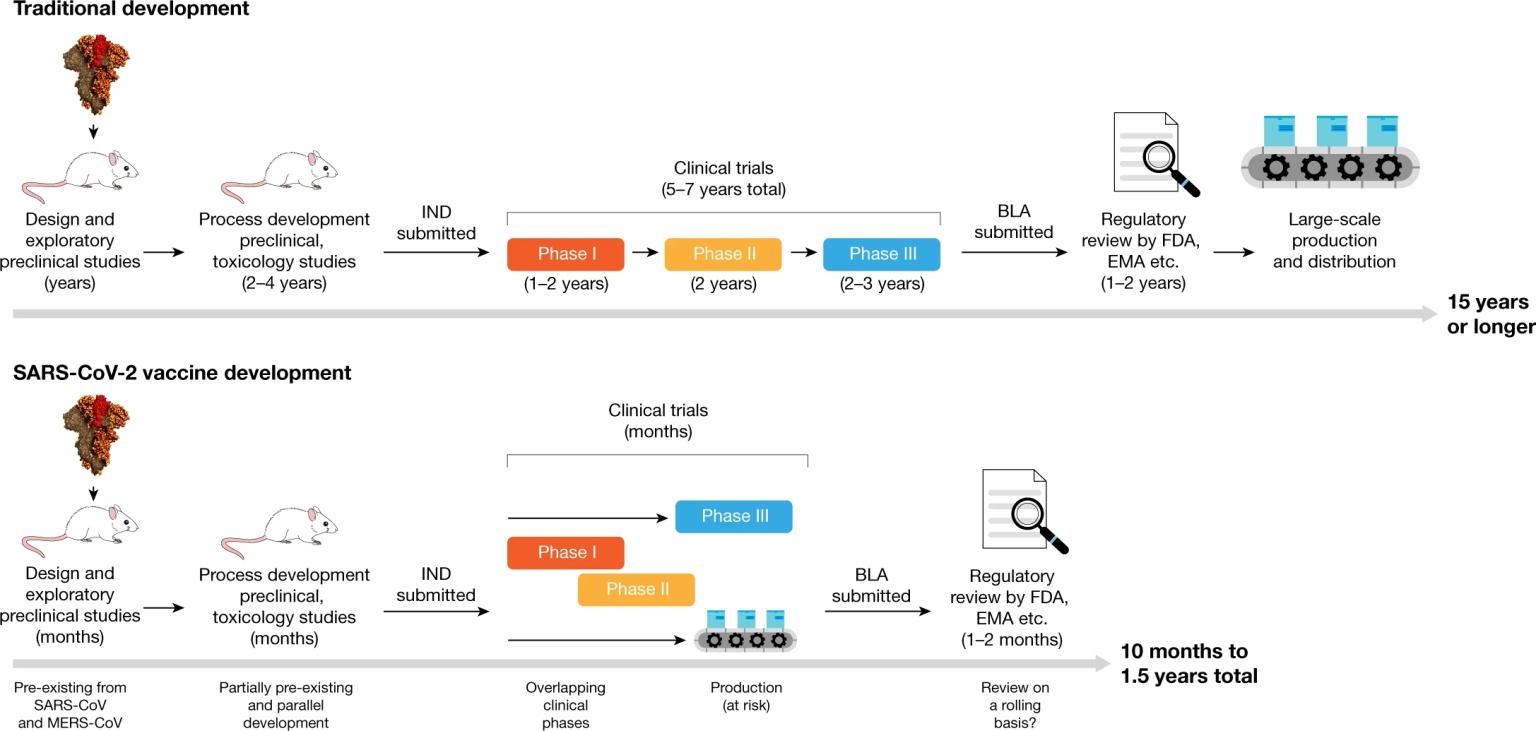
Compared to the traditional development, the schedule of SARS-CoV-2 vaccine makes use of two techniques that typically fall under the predictive model: fast tracking – by running clinical phases in parallel instead of sequentially – and crashing – throughout the whole project but more obvious in the assessment phase by the regulatory authorities (from 1 to 2 years to 1 to 2 months!).
To summarize: “the best” model or a model that fits all does not exist. In a fast changing world it is crucial to avoid dogmatism and embrace the challenges that present themselves with an open mind.


 Community Champion


