
The accidental path to Project Management
Categories:
Career Development
Categories: Career Development


| Project management has quietly become one of the most widespread professions in the modern economy. According to the PMI, there are more than 1.4 million active PMP-certified professionals worldwide, and tens of millions of people work in project-related roles across industries. Demand continues to grow, with estimates suggesting that around 89 million people will be needed in project management roles by 2027. And yet, despite the size and maturity of the profession, many project managers share a similar story: they did not plan to become one. They simply ended up there. A project needed coordination, someone stepped up, and the role slowly evolved into a career. Looking back, I sometimes ask myself: why did I accept that first role that resembled project management? Applying the Five Whys technique (traditionally used to find root causes) can be surprisingly revealing. 1. Why did I accept the role? Because I wanted to be close to where decisions are made. 2. Why did I want that? Because I wanted to see the impact of my work. 3. Why did I want to see that impact? Because it gives a sense of accomplishment. Interestingly, I did not need five whys to reach the root cause. After three, the answer already felt clear. In a way, this resembles the idea behind ikigai, represening the intersection between what you are good at, what you enjoy, and what creates value for others. For me, project management sits precisely there: close to the “engine room” of an organization, where decisions translate into action and outcomes. Looking at it from this perspective also raises another question: what comes next? One of the challenges of our profession is that job titles rarely tell the whole story. Two roles called project manager can have very different scopes and responsibilities depending on the organization. The same ambiguity applies when project managers start evolving in their careers. For many, the natural progression is upward within the discipline itself: becoming a program manager, portfolio manager, or leading a PMO. These roles expand the same core capabilities (coordination, prioritization and strategic alignment) while increasing the level of influence on how initiatives are selected and executed. Others take a slightly different path but remain close to that same “engine room” where decisions take shape. Roles such as transformation manager, change manager, or even chief of staff often rely on the same skills that project managers develop over time: connecting strategy with execution, aligning stakeholders, and ensuring that ideas translate into outcomes. Seen this way, project management is not only a profession in itself but also a platform. It places you at the intersection of strategy, operations and people, an excellent vantage point from which several career paths can emerge. And that leads to another reflection. How has your own path evolved since you first stepped into project management? Have you stayed within the discipline, or has it opened the door to other roles close to the decision-making core of your organization? |
What history reveals about AI and the Project Manager profession
| Every major technological revolution has triggered the same anxiety. Steam engines would destroy artisanal work. Tractors would eliminate farm labor. Computers would make offices obsolete. Each time, the warning sounded familiar: “This time is different.” Today, artificial intelligence has taken that role. For months, if not years, the impact of AI on the Project Manager profession has been debated. Will AI replace Project Managers? Will project management as a discipline disappear? Or will it be fundamentally transformed? I want to elevate this debate by stepping away from prediction and alarmism and instead looking backward. History, as economist Xavier Sala‑i‑Martín argues in De la sabana a Mart (literally From the Savannah to Mars), is not a forecast but a powerful teacher. In his book (unfortunately still untranslated into English), Sala‑i‑Martín traces how Homo sapiens evolved from its emergence roughly 200,000 years ago in the Serengeti savannah to a species capable of landing spacecraft on Mars. In spirit, it sits close to the work of authors like Yuval Noah Harari: a long‑arc view of human progress, and adaptation. One of its most relevant messages for today’s AI debate is simple but profound: while technology repeatedly destroys specific jobs and tasks, it has never eliminated human work as a whole. What changes is where humans add value. Below, I map five historical lessons from technological revolutions to concrete project management competencies; not to argue that Project Managers are “safe,” but to explain why the role is likely to become more human, not less. 1. We are bad at imagining future jobs and future project workOne of Sala-i-Martín’s central arguments is that humans systematically fail to imagine the jobs that will be created by innovation. In 1895, no expert could have predicted digital marketers, YouTubers, or UX designers. MIT economist David Autor estimates that roughly 60% of today’s occupations did not exist in 1940. The problem is not that experts were careless. Future work often emerges indirectly, as a second or third order effect of technology. What this means for Project Managers Much of today’s AI anxiety focuses on current PM tasks: scheduling, reporting, risk tracking, documentation... Yes, many of these will be automated or heavily augmented. But history suggests the more important question is: what new coordination problems will AI create? Early signals are already visible:
PM competencies amplified: systems thinking, strategic framing, ambiguity navigation. 2. Automation replaces tasks, not professionsWhen calculators entered offices, many believed accounting roles would vanish. When computers arrived, clerical work was expected to disappear. Neither happened. Instead, productivity rose and roles evolved. Technology consistently eliminates tasks, not entire professions. What this means for Project Managers AI will outperform us at:
PM competencies amplified: judgment, prioritization, decision‑making under uncertainty. 3. Technological transitions are painful and increase the need for PMsSala-i-Martín is explicit: the fact that innovation ultimately creates work does not mean transitions are easy. Workers displaced by mechanization did not automatically reskill. Societies had to invest in education, coordination, and institutional change. What this means for Project Managers AI adoption is not a technical rollout. It is a transformation. And transformations fail most often because of:
PM competencies amplified: change leadership, stakeholder management, organizational navigation. 4. Innovation creates new needs and new project portfoliosThe automobile didn’t just replace horses. It created tourism, hotels, road infrastructure, logistics networks and entirely new urban designs. Innovation doesn’t merely solve problems, it also creates new needs that later become essential. What this means for Project Managers AI is already creating new categories of work:
PM competencies amplified: portfolio management, value realization, cross‑functional integration. 5. “This time Is different” has always been wrong, including nowFrom tractors to computers to AI, the recurring claim has been: this time, humans will not adapt. History shows the opposite. Not because progress is guaranteed, but because societies reorganize around new constraints. What this means for Project Managers As automation increases, complexity does not disappear, it rather intensifies. And complexity elevates the value of deeply human capabilities:
PM competencies amplified: human leadership in complex systems. Conclusion: from controllers of work to designers of progressHistory does not tell us that Project Managers are immune to technological change. It tells us something more useful. Roles that sit at the intersection of technology, people, and decision making do not disappear. They evolve. AI will not end project management. But it will act as a filter. It will steadily automate coordination and execution mechanics, and leave behind the parts of the role that require judgment, ethical reasoning and leadership across uncertainty. For Project Managers, the real question is not whether AI will change our profession. It already is. The real question is whether we choose to remain controllers of tasks or step fully into our role as designers of progress, stewards of change, and leaders of complex human systems. For those willing to adapt, that shift is not a threat. It is an invitation. |
From the lab to the office. A brief story of my journey in Project Management
| This is the story of how, almost unintentionally, I moved from the world of chemistry into Life Sciences. It’s a journey of changes, lessons, and challenges. My hope is that, as you read it, you’ll find inspiration, a useful idea—or at least a good read.
I studied Chemical Engineering at the University of Barcelona, and when I graduated, I was convinced that job opportunities would come easily. They didn’t. At that time, the internet was still underdeveloped, and job applications meant sending résumés and cover letters by regular post. Many of those applications ended up as rejection letters—letters I still keep today as a reminder that perseverance pays off. Eventually, I earned a research grant at the Spanish National Research Council (CSIC, Consejo Superior de Investigaciones Científicas), marking the beginning of my professional career. There, I had an exceptional mentor who encouraged me to gain international experience. What was supposed to be one year in the U.S. turned into almost three and a half. During that time, I significantly improved my English and immersed myself in a new culture of work and life. My first step into medical devices came from a desire to move beyond pure R&D and into project management. In that very first role as a project manager, I also created an account on ProjectManagement.com, which was an invaluable resource to start understanding this marvelous field. The guidance of great professionals like Kiron and Rami, amongst many others, made the early learning curve much smoother and inspired me to keep developing as a project leader. That’s where I learned to lead complex initiatives and coordinate multiple stakeholders. I also discovered that a project plan is much more than a Gantt chart: it’s a living tool that must adapt constantly, reflect input from the people involved, and anticipate problems before they surface. This experience opened the door to the pharmaceutical industry in Amsterdam, where I further developed my career in Life Sciences. Over the years, I’ve had the privilege to lead projects of all kinds: from strategic initiatives to supply medical devices to a key client, to digitalization projects with critical timelines, to technology transfers and scale-ups in both upstream processing (USP) and downstream processing (DSP). Each project pushed me to grow new skills and adapt to different rhythms and circumstances—while always keeping the ability to prioritize and move forward, even when things didn’t go as planned. One of the most valuable lessons I’ve learned can be summed up in the principle of ABC: Assume nothing, Believe no one, Check everything. Never take things for granted. Validate assumptions. Execute diligently. And above all, keep communication flowing. Clear, consistent communication can be the difference between a project that moves forward and one that stalls. For those starting out in Life Sciences, my advice is simple: know your value and your value proposition. Research the company, understand your strengths, and learn to sell yourself. Define your area of expertise, ensure you have the right training and certifications, and analyze what makes you a stronger candidate than others. It’s not enough to be good, you need to demonstrate it. And if you need support for that introspective work (something we all know we should do but often postpone), don’t hesitate to work with a good coach who can guide you and ask the right questions. Follow your curiosity, stay humble enough to keep learning, and never underestimate the power of communication and collaboration. In the end, working in Life Sciences is about finding your own ikigai: that point where what you love, what you’re good at, what the world needs, and what you can be paid for all come together. |
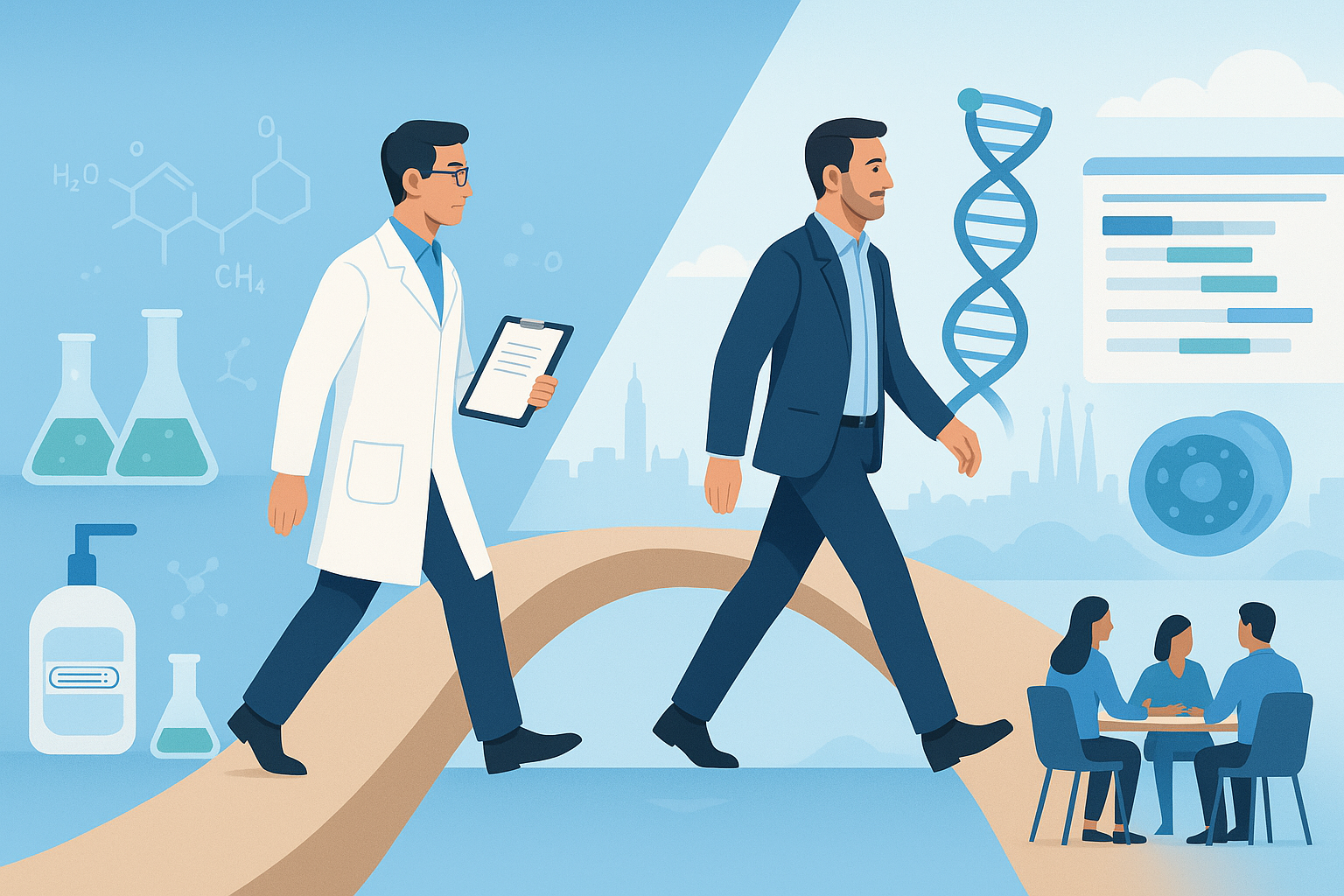 My entry into Life Sciences wasn’t something I actively sought from the start. With a background in Chemical Engineering and years of experience in R&D within the chemical sector, my professional aspirations eventually led me to explore opportunities outside the lab. That exploration opened the door to the world of medical devices.
Job hunting, Project Manager style
Categories:
Career Development
Categories: Career Development
| Looking for a job or the next career opportunity is a process that everyone goes through at some point—often more than once. It can be daunting, exhausting, and sometimes even disheartening when results don’t come as quickly as hoped. I’ve certainly felt that way. But one thing that has made a real difference in my approach is treating job hunting just like any other project.
1. Having a plan We all know how important it is to have a plan. As Seneca once said, “If one does not know to which port one is sailing, no wind is favorable.” The same logic applies to both project management and job hunting. Planning a project and planning a job search both require a clear understanding of where we are now (the "as-is" state) and where we want to be (the "to-be" state). Without a well-thought-out plan, job hunting can feel like drifting aimlessly, reacting to job postings without a clear direction. In both cases, it is essential to define the tools and techniques we will use to deliver results. Will I focus on networking or online applications? Will I need additional training to strengthen my profile? Just as in a project, it's also crucial to set milestones and regularly assess progress. What’s working? What isn’t? What needs to be reinforced, and what should be discarded entirely? This kind of retrospective thinking—something we practice in project management through lessons learned and iterative improvements—is just as valuable in job searching. And since job hunting can often be a solitary effort, it’s helpful to have a trusted companion who can provide feedback and a fresh perspective. In projects, this role is fulfilled by the team, but in job hunting, it could be a mentor, a career coach, or even a close friend who understands our goals and can challenge us to stay on track. 2. Stakeholder management In project management, we emphasize how crucial it is to understand and manage stakeholders—identifying their needs, expectations, and influence on the project's success. The same principle applies to job hunting. You’ve probably heard the phrase, “Your network is your net worth.” Well, I’ve come to understand just how true that is. Managing professional relationships isn’t something to be done only when I need a job; it’s an ongoing process of staying in touch with peers, industry leaders, and recruiters—even when I’m not actively looking. Developing these soft skills—engaging in insightful conversations, keeping up with industry trends, and adding value to my network—has led to opportunities I wouldn’t have come across otherwise. Just like in a project, understanding the landscape of key decision-makers is critical. I’ve found it useful to mentally draft a power-influence matrix to map out who plays what role in my job search. Who are the gatekeepers (recruiters, HR professionals)? Who are the decision-makers (hiring managers, executives)? Who can be advocates (mentors, industry connections)? Adjusting my communication style based on who I’m speaking with—whether it’s a recruiter screening candidates or a senior leader looking for strategic thinkers—has helped me tailor my approach and improve my chances of making a lasting impression. This strategic way of thinking has made networking feel less like a chore and more like a valuable part of my career development. And, just like in project management, when relationships are built with intention and authenticity, they often yield the best results. 3. Organization and documentation In project management, we know that what is not documented does not exist. Keeping clear records and excelling at organizational skills—whether through project documentation, dashboards, or structured communication—ensures that nothing falls through the cracks. The same applies to job hunting. Keeping a log of all job search activities is crucial, from tracking job applications and speculative applications to maintaining momentum with new contacts on LinkedIn, industry forums, or networking events. Without a structured approach, it's easy to lose track of follow-ups, forget where we've applied, or miss an opportunity to reconnect with someone valuable. There are multiple tools to stay organized. A simple notebook and pen can do the job for those who prefer traditional methods. Digital tools like Notion, Trello, or Google Calendar can help structure applications, networking follow-ups, and interview schedules. The key is to use a system that fits personal needs rather than forcing an unsuitable tool into the process. Beyond tracking, communication management is just as essential. In project management, we carefully define how and when to communicate—whether through meetings, status updates, or push/pull notifications. In job hunting, this translates into timely follow-ups, crafting thoughtful messages for recruiters or contacts, and ensuring that responses are professional, clear, and aligned with the job search strategy. By applying these organizational and documentation skills, job seekers can avoid unnecessary stress and improve efficiency—turning what often feels like a chaotic process into a structured and manageable one. Final thoughts Job hunting can feel overwhelming, but treating it like a project brings clarity, structure, and strategy to the process. Having a plan, managing stakeholders effectively, and staying organized are three core project management skills that significantly improve the chances of success. If you're currently searching for your next opportunity, consider applying these principles. The mindset shift alone can transform the way you approach job hunting—helping you stay focused, proactive, and in control of your journey. And, just like in project management, every challenge is an opportunity to learn, iterate, and improve. |
 Think about it: every project has a defined scope (what needs to be done), requirements (the type of role, industry, conditions, location), timelines (when I want to secure my next role), and even a budget (investments in courses, coaching, or networking events). With that mindset, I’ve realized that the project management skills I’ve developed over the years are invaluable when navigating this journey. In this blog, I want to highlight three key areas where PM skills can be successfully transferred to job hunting.
Navigating the “What’s next” feeling in your Project Management career
| After several years in project management, it’s natural to wonder, “What’s next?” Similar to a mid-life crisis, where one has secured a stable career, raised a family, and achieved personal milestones, project managers may also face a sense of plateau. The excitement of early career challenges begins to wane, leaving a desire for something more fulfilling or ambitious. Fortunately, there are various ways to reignite passion and elevate one’s career.
Interestingly, this sense of “what’s next?” is not uncommon. I recently conducted a poll on LinkedIn asking project management professionals how they approached this crossroads in their careers. The results? About 38% of respondents chose to transition to a new role—whether that’s climbing the leadership ladder or making a lateral move to leverage transferable skills. Another 30% opted to focus on personal projects, while 28% were eager to tackle bigger, more challenging assignments. Climbing the leadership ladder. One option is to transition into line management roles. If one is looking to take on more strategic responsibilities, positions like Program Manager, Portfolio Manager, or PMO Manager might be appealing. However, as Peter Drucker famously noted, “In a hierarchy, every employee tends to rise to their level of incompetence.” Not everyone is naturally suited to leadership, especially when it involves managing people. There’s a risk that the skills that made someone a great project manager may not translate to success in people management. It’s important to consider whether this path aligns with one’s strengths. Lateral moves for skill transfer. Project management skills are highly transferable to roles like Operations, Business Analysis, or Change Management. This offers a fresh perspective while keeping one close to the project world. However, a lateral move might mean stepping into an unfamiliar domain where one will need to develop new expertise. While this can be a rewarding challenge, the learning curve could feel steep, and it may take time to establish credibility in the new role. Tackle bigger challenges. If one is craving a deeper sense of achievement, seeking out larger, more complex projects can provide a rewarding sense of accomplishment. But bigger projects come with bigger risks and higher stakes. Is one prepared for the added stress? On the other hand, this strategy can open doors to uncharted opportunities. Take Arnold Schwarzenegger, for example. He didn’t stop at becoming a top actor—he kept pushing until he became the Governor of California. Tackling challenges head-on can lead to unexpected, game-changing results in one’s career, too. Engage outside of work. Many professionals find renewed purpose by engaging in projects outside of their core job—whether through pro bono work, mentoring, or pursuing long-neglected hobbies. This can sometimes lead to unexpected opportunities. For example, after finding fulfillment in charitable endeavors, actor Paul Newman founded Newman’s Own, a successful food company that donates all profits to charity. Similarly, professional shifts like this can reinvigorate one’s passion and even open the door to new career avenues. However, balancing these projects with regular work may require careful time management to avoid burnout. At the end of the day, there’s no one-size-fits-all solution. Whether it’s stepping up the ladder, making a lateral move, chasing bigger projects, or diving into personal passions—one should ensure it aligns with what keeps them motivated. As the poll results show, professionals take diverse paths. So, why not explore, experiment, and keep things exciting? There’s always more to learn, do, and experience! |



