
Value generation and project management: two sides of the same coin


| The objective of this article is to provide a high-level analysis of the relationship between project management and the contribution of value in the achievement of strategic objectives. Concepts such as agile transformation or project economy have become part of the business lexicon in a rapidly changing environment. The covid-19 vaccine development and commercialization project is a representative example of a new paradigm in the creation and management of value. From the Great Pyramids to the project economy Moving to more recent times, it was not until the 20th century that the popularity and professionalization of project management increased and different associations began to emerge to proselytize various project management frameworks, tools and techniques. A transition process is currently underway towards the so-called project economy, in which people acquire the skills and abilities necessary to turn ideas into reality. Value is created through successful project completion, product delivery, and alignment with the organization's strategic goals. In the project economy, project managers abandon operational tasks and begin to bear higher levels of responsibility in converting ideas into value. The project manager of the 21st century Broadly speaking, there are two factors to consider when evaluating the suitability of a predictive or adaptive model to achieve the objectives of a project: the need for creativity and the speed of commercialization.
A manufacturing line validation project or one for the development of new drugs requires different levels of creativity and speed to market. The former fits well into more traditional or predictive management while the latter requires an approach that facilitates greater adaptability. There is no one model superior to the other, the two models or their mixture are perfectly viable and must be molded according to the specific needs that each situation and moment demands. Something similar to what happens with the so-called scrumban, an unregulated mixture of scrum and Kanban that creates misgivings in some purists but can be highly effective. There is no doubt, the world today is changing at a great speed. The acronym VUCA has been added to the dictionary of professionals in all fields. The paradigm shift affects aspects such as corporate culture, promoting collaboration and entrepreneurship, or structural ones, moving from a hierarchical or silos arrangement to others with a higher level of self-management. Projects and their managers are not impervious to these changes, continuously adapting without losing sight of the main objective: to promote change and add value. A 2019 Gartner study ensures that 80% of the tasks carried out by a project manager will have been eliminated by 2030 as a result of the rise of artificial intelligence. Report writing, monitoring or data collection will add to the list of machine payroll activities. Even the selection of projects that make up the portfolio can be delegated to computers. However, the project manager is still in the top 20 of the most in-demand roles across all industries. To stay in this privileged position, the project management professional must expand their field of action and incorporate a series of elements such as agile, lean, design thinking or product management, among others, thus becoming an implementing agent of business strategy. Vaccines in record time
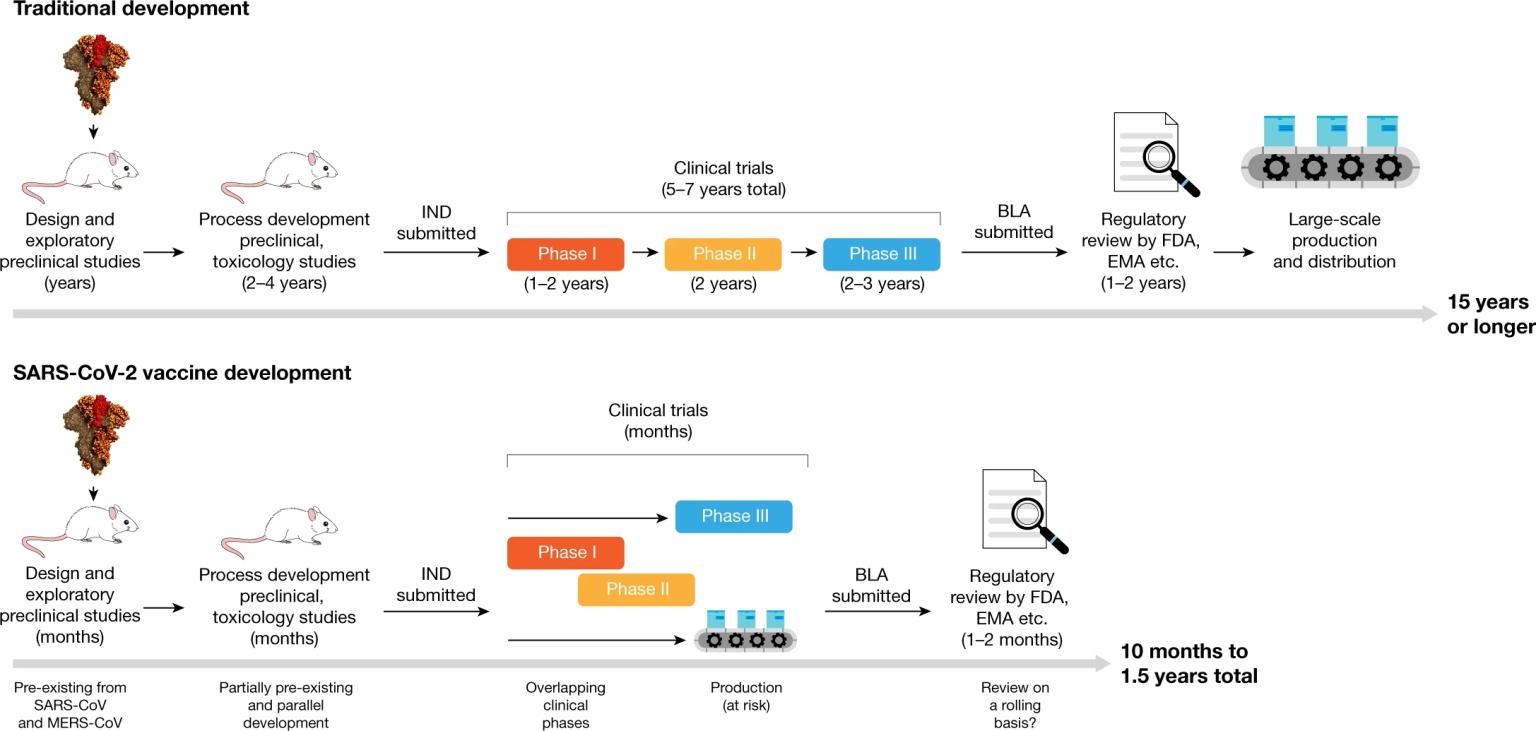
Although the stages are the same for both cases, there is a factor of 10 to 18 between the duration of the projects, thus making it possible to obtain value early. The accelerated development of vaccines against covid-19 is due to a multitude of circumstances: a very short research phase due to the prior knowledge of vaccines for SARS-CoV and MERS-CoV, the parallel execution of phases I and II of the clinical study (fast-tracking, in traditional project management jargon) and large-scale vaccine production before obtaining a marketing permit from regulatory authorities (another traditional project schedule management technique called lead). From a management point of view, the development of the new vaccines has used a hybrid model that adds traditional elements such as lead or fast-tracking to a highly agile environment. In addition, it is an example of generating value throughout the life cycle of the project. For example, mRNA technology was developed before the pandemic, thus generating value that was later realized in the creation of the vaccine. Gone are the times in which it was common to spend long periods without harvesting any fruit to end up delivering the value generated shortly before closing the project. The hybrid model used to commercialize coronavirus vaccines in record time has created a precedent for future developments in the biotechnology field. Driving change To quote the famous saying, the best way to deal with change is to help create it. Are you in? |


Predict or Adapt. Why should we choose?
| One of the most popular thread in a project management forum is about predictive and adaptive project management methodologies, and whether only of the two will prevail. Black or white. Sweet or salty. Hot or cold. Like in most things in life, the sweet spot is somewhere in the middle. In this blog, I’d like to scratch the surface of this “dilemma” in the pharmaceutical industry. There are two factors to consider to assess the suitability of a predictive or an adaptive model in order to achieve the project goals: the need for creativity and the speed to market. If these two score low, a predictive model will likely be the best fit. Think of projects like the commissioning and qualification of a new manufacturing line or the implementation of a laboratory information management system. However, projects that require high doses of creativity or are time-to-market constrained fit better in an adaptive model. Think of projects related to the development of new drugs or investigation of new indications for existing products. At the end of the day, most projects are managed following a mix of these models, leaning more towards adaptive or predictive depending on the particularities of the project. The development of a vaccine against covid-19, the disease caused by SARS-CoV-2, is an example of this. On one hand, it was (still is) a project subjected to an enormous pressure. Speed to market scores very high. On the other hand, the steps to conceive, develop, register and mass produce a vaccine do not require creativity and are subjected to a stringent regulation from several regulatory bodies across the globe. The prestigious scientific journal Nature published a very informative infographic that depicts the roadmap for the development and commercialization of SARS-CoV-2 vaccine versus a traditional vaccine (Nature 586, 516–527, 2020). In short, both differ by a factor of 10! Compared to the traditional development, the schedule of SARS-CoV-2 vaccine makes use of two techniques that typically fall under the predictive model: fast tracking – by running clinical phases in parallel instead of sequentially – and crashing – throughout the whole project but more obvious in the assessment phase by the regulatory authorities (from 1 to 2 years to 1 to 2 months!). To summarize: “the best” model or a model that fits all does not exist. In a fast changing world it is crucial to avoid dogmatism and embrace the challenges that present themselves with an open mind. |
Berlin Airport... or The money pit project
| The Sydney Opera House is one of the best-known iconic buildings, recognized around the world as a global symbol of Australia. The project was originally scheduled for four years, with a budget of AUS $7 million. It ended up taking 14 years to be completed and cost AUS $102 million. Yet, it was included in PMI’s 50 most influential projects on basis of “demonstrating architecture’s power to redefine a city”. Time heals all wounds. This saying holds true for a building that was inaugurated 47 years ago. This past 31st of October Berlin Brandenburg airport finally opened its doors. With a delay of 9 years – its completion was originally planned by 2011 – the budget experienced a massive overshoot of 300%. In other words, CPI and SPI got their permanent residency in Land < 1.
Several reasons can be found to explain the enormous delay and skyrocketing costs. The list below captures the most significant.
The failure is such that the family of Willy Brandt – German chancellor after whom the airport is named – requested the authorities to remove his name from the airport. Time will tell whether this airport will be able to bloom in the future, just like it happened to the Opera House. In the meantime, this project can be depicted in the books as an example of what not to do or avoid in order to deliver a successful project. |

74-343. Journey to get certified in MS Project
| Almost two years ago I posted a thread in the Discussions community asking for advice towards achieving the Microsoft Certification in Managing Projects with Microsoft Project (https://www.projectmanagement.com/discussion-topic/46131/74-343-Test--Ms-Project---Tips-and-or-Recommendations-). Several good tips were given; I was ready to take a shot at it, but for various reasons I kept postponing the examination date. This held true until today, when I took (and passed!) the exam.
Below some advice, tips and fun facts that could be helpful for other individuals that are considering getting certified. 1. Prepare, prepare and prepare! In my case, I chose web-based Udemy´s Microsoft Project 13/16/19 - Like a Boss (exam 74-343 prep) and book Microsoft Project Office for Dummies. 2. Practice test questions. There are several websites that offer mock up tests. I was able to find a tutorial free of charge from Exam Labs (https://www.exam-labs.com/exam/74-343#tutorial). Make sure that you practice this test at least twice before taking the exam, you will not regret it... 3. I do not appraise this test as easy to pass. In other words, passing the exam requires specific training to learn not only about the planning tool, but also in getting familiar in the manner that questions are asked. 4. The time given to complete the test is sufficient, but might fall short in some cases, depending on thoroughness of test preparation. Fifty questions to be answered in 120 minutes gives 144 seconds per question. Bear in mind that some questions (not many) contain up to three sub-questions! 5. The level of difficulty of these 50 questions varies very significantly. Some questions are really easy (so easy that I needed to triple check that I was not getting tricked by the wording of the questions or answers) and some others take significant time to fully understand the context and the various answers, increasing the difficulty in choosing the right one. 6. As a rule of thumb, answers containing "copy and paste" can be 90% of times ruled out. 7. It is crucial to fully understand and get familiar with the following views in MSP: Gantt, Tracking Gantt, Resource Usage, Task Usage and Team Planner. 8. Attention! Make sure to study the basics of SharePoint. Some questions deal with MSP and SharePoint! 9. Make sure that you focus on the areas that you appraise the weakest. For instance, if you do not typically use MSP build-in reporting options in your daily duties, spend some time in learning more specifics about them (there are several tutorials on YouTube). 10. During the test, try to stay as calm as possible. Sometimes one can´t help feeling the heart racing. If so, take a deep breath, followed by a 20 seconds break, and carry on. If you get blocked in a question, just flag it and tackle it afterwards. Good luck to all future MSP Certificate candidates!
|



