


How to Tailor Your Project Management Approach For Successful Digital Transformation


| Digital Transformation is a 1.7 trillion dollar industry as of 2019, which has obvious demand implications for project managers. At the same time an estimated 70% of all digital transformations fail based on a Mckinsey report on retail. What can project managers do to stand out from the crowd on successful digital transformation? Based on my own experience of having led multi-billion dollar organization transformations over a three decade career at Procter & Gamble, combined with industry research, project managers need to tailor project management approaches to complement mainstream methodologies with “transformation” related disciplines when managing true digital transformation efforts.
What’s Missing in Current Digital Transformation Approaches? To understand why current project management approaches need to be complemented, we need to dig into why 70% of all digital transformations fail. The answer comes down to two issues – a lack of clarity on the definition of digital transformation and the use of incomplete methodologies to execute it.
Figure 1: Five-Stage Digital Transformation Model
How to tailor your approach for leading digital transformation programs In 2015 Procter & Gamble’s Global Business Services (GBS) unit set out to digitally disrupt itself. The 5,000-strong GBS organization provided more than 160 business services worth multi-billion dollars of operations including IT, finance, facilities, purchasing, employee services, and more. Despite GBS’s already best-in-class capabilities, we wanted to transform it into what we called Next Gen Services (NGS), capable of delivering long-term operational superiority. To avoid the trap of the 70% failure rate of digital transformations, we started by examining what had driven successful transformation in the past.
To increase change demand, we brought in leaders from disruptive companies to talk to our operational leaders about looming digital disruption. In addition, operational leaders made consideration of disruptive innovation goals part of routine annual strategy reviews.
But such attitudes to middle managers unfairly penalize them for doing what their reward systems dictate—running stable operations and being wary of destabilizing effects. So we identified the middle management leaders affected by each project, involved them in the initial “fun” of designing the disruption, and jointly designed the risky roll-out of disruptive projects that could destabilize ongoing operations.
If sufficient time, internal capability, and a relatively straightforward path forward are available, then transformation can usually be handled via organic change. After the 2008 economic crisis for instance, Fidelity Investments increased its investments in digital capabilities while competitors were slashing budgets, giving the company room to move forward with a deliberate organic transformation. That consistent focus on digital transformation strategy has pushed them ahead of competition in areas like blockchain, artificial intelligence, and crypto currency. If existing capabilities, time, and internal resistance to change are all a challenge, then your best bet may be inorganic change—look for an acquisition or partnership with an external entity, as Walmart did in acquiring Jet.com. Inorganic change comes with its own risk, since a majority of acquisition-related changes fail. However, by giving the acquired entity a strong mandate and change-management support, this approach can jump-start new capabilities quickly. If there is little time and the prevailing organization culture is partly resistant to change, then organic change won’t work. In such cases, edge organizations, given full freedom to operate differently from the rest of the business, are the preferred approach. At GBS, we felt that time was at a premium. We knew that our real standard of comparison wasn’t just other large companies any more, but digitally native startups with far more cost-efficient and agile internal business operations. Resting on our laurels—our superiority to peer companies—would be risky. So to drive disruptive change faster than an organic approach could, we set up NGS as an edge organization. To facilitate agility, NGS would be allowed “amnesty” on purchasing standards, IT architectures, and even some HR practices in the early stages of idea development. As a successful project manager of complex digital transformations, your methodology needs to complement best in class thinking on project and portfolio management with the latest approaches on scaled organization change leadership. Most executions of digital transformations fail due to organizational reasons, not work-process or technology design. That issue becomes much more material when leading transformations to overcome existential threats caused by digital disruption. |


SCARF a Brain–based Model for Managing People on Projects
| Welcome to the second in this series of blogs exploring what the project world can learn from neuroscience. I set out my stall in the first blog - projects don’t behave the way textbooks say they should. Neither do people. How often have you seen a team member becoming defensive or a client getting wound up and quite aggressive over something relatively minor? Or perhaps you’ve sat in a meeting when you suspect that several others, like you, are convinced that the discussion is adding no value, or even worse it’s downright unhelpful – yet nobody does anything about it. Have you noticed how few people talk openly about finding project delivery, with its complexity and uncertainty, stressful and anxiety-provoking? Yet plenty do so in private! Neuroscience tells us stress and anxiety impact our ability to think clearlyNeuroscience tells us that stress and anxiety impact our ability to think clearly, increasing the chance that we’ll misread the situation and behave in ways which raise the stakes and add complexity. This blog sets out five Brain Basics and explains the SCARF model which will help you spot what’s going on beneath the surface in these highly charged moments. Read on and you'll see why I recommend that everyone involved in project delivery acquires a basic understanding of how the human brain works and uses this knowledge to inform their actions. 5 BRAIN BASICS
Source: Visible Dynamics Take a moment to reflect on charged moments you’ve been party to. Use the five Brain Basics to consider what might have been going on beneath the surface. How does thinking in terms of ‘avoidance’ and ‘approach’ emotions and behaviours help you make sense of the situation? Social threats cause avoidance behaviours, so we need to understand what they are and where they come from. That’s where SCARF comes in! What is the SCARF Model?There are five factors that the brain is always monitoring and they have a huge impact on how we behave. David Rock developed the SCARF model to explain these factors[i] We are acutely sensitised to look out for them. SCARF stands for:
When people sense a change in any one of the SCARF factors, it can activate an avoidance response - The bigger the change the stronger the response. An example of SCARF in action Source: Project Delivery, Uncertainty and Neuroscience - A Leader's Guide to Walking in Fog .[ii]
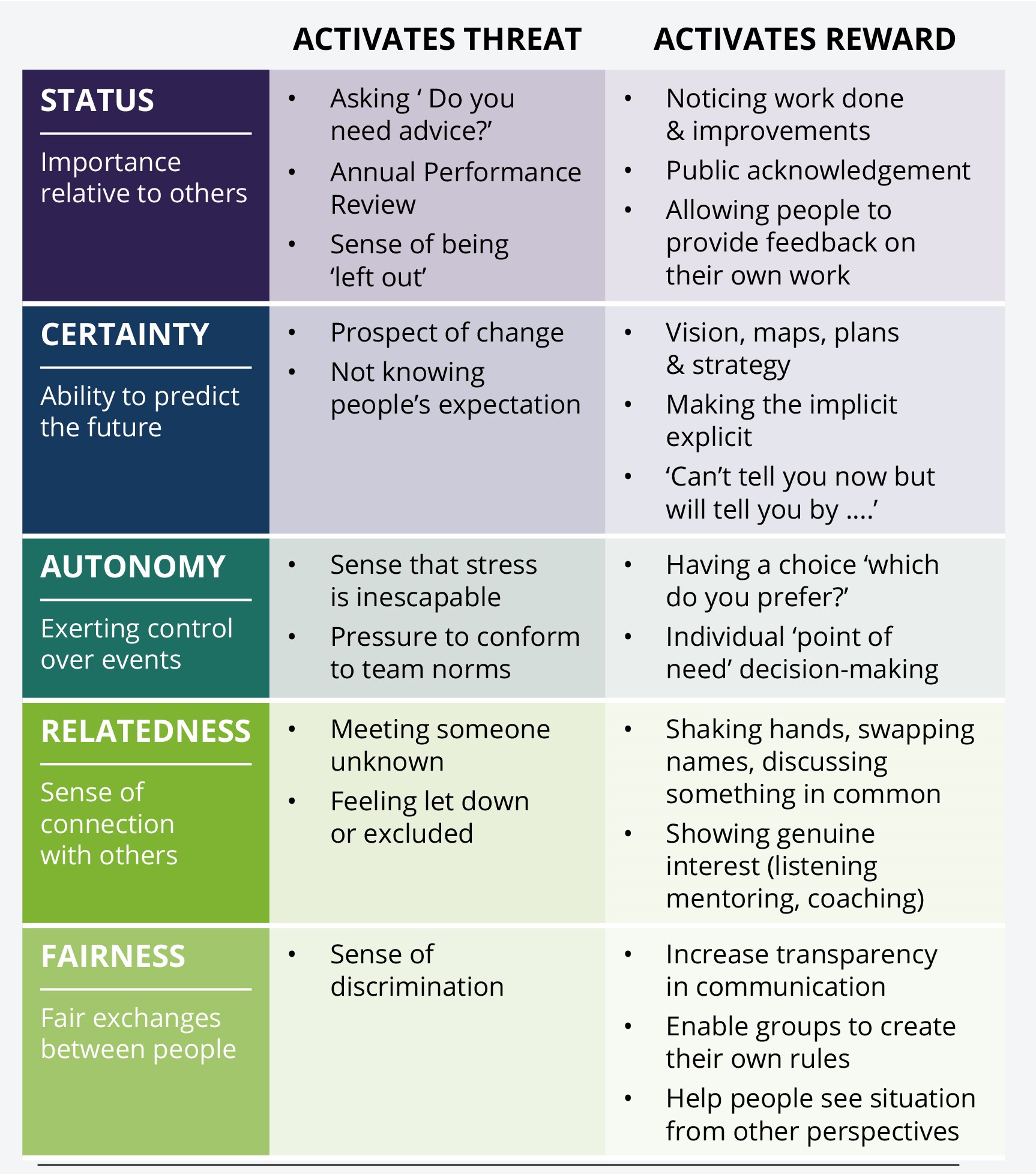
Responding to Social ThreatWe see and respond to social threat in the most mundane situations. These threats do not have to be explicit, intentional or real. We only have to perceive that our status has been reduced or that we are being treated unfairly and we will respond with avoidance behaviours. The converse is also true. When we believe we are being treated fairly and that we have a degree of control over the future it’s easier be highly productive. We want the feelings of excitement and trust that come with engagement. USING SCARF TO HELP MANAGE CHANGE ON PROJECTSUnderstanding how the brain works adds new perspectives to many good leadership practices. Take the adage ‘When dealing with change communicate, communicate, communicate!’ SCARF guides us to five areas that need to inform all our actions in organisational and project settings. For example, by highlighting our desire for certainty, SCARF tells us that the prospect of change – whether a tweak to the IT system or wholesale digital transformation is likely to activate a threat response. We need to include this knowledge in our project planning, and make sure that we prioritise activities to reduce the degree of uncertainty and counter the threat response. This means speaking to people about the vision for the future, and sharing plans for achieving objectives; it means explicitly discussing what you do know about the future and being willing to admit what you have yet to work out; and it means offering timescales or admitting ‘we can’t tell you now but we will tell you by …’ This table gives further examples for using SCARF in organisational and project settings.
Using SCARF on Projects Source: Project Delivery, Uncertainty and Neuroscience - A Leader's Guide to Walking in Fog We’ve seen from Brain Basics and the discussion of SCARF and that every interaction with another person triggers a change in the intensity and quality of our emotions. Most of us are unaware of the ebbs and flows of our emotions. Yet it’s these changes, driven by our innate need to survive, that determine how we behave.
KEY TAKEAWAYSOn projects we rarely work in isolation. There are as many sources of social interaction and emotional triggers as people in the proverbial room (which includes those we connect with digitally via email, video and social media). This means we must:
It will stop you adding to the volatility uncertainty, complexity and ambiguity of VUCA environments. It will bring down stress levels, reduce distractions and allow you to focus on what really matters - achieving your project goals. BLOGS IN THIS SERIES
[i] Rock, D (2009) Managing with the Brain in Mind Strategy +Business, Autumn 2009, Issue 56 Retrieved from: https://www.strategy-business.com/article/09306?gko=5df7f [ii] Osterweil, C (2019) Project Delivery, Uncertainty and Neuroscience – a Leader’s Guide to Walking in Fog, London: Visible Dynamics
|


The Power of Purpose
|
It is common for many people to make New Year’s Resolutions at the beginning of each year. What is your resolution for this year? The Top 5 New Year’s Resolutions in 20191 were;
All seem to be great ideas for a resolution. However, we find that keeping a resolution isn’t quite as easy as making a resolution. By the middle of February about 80% of us fail with our resolutions2. We only make it about 2 months! There are many suggestions of how to do better with our resolutions. Use steps such as “Keep it Simple”, “Only take on one resolution at a time” or “Tell friends and family to build accountability“. All good ideas, but we still fail. Why? Let’s consider slight changes to the top 5 listed above and see if we can find a difference.
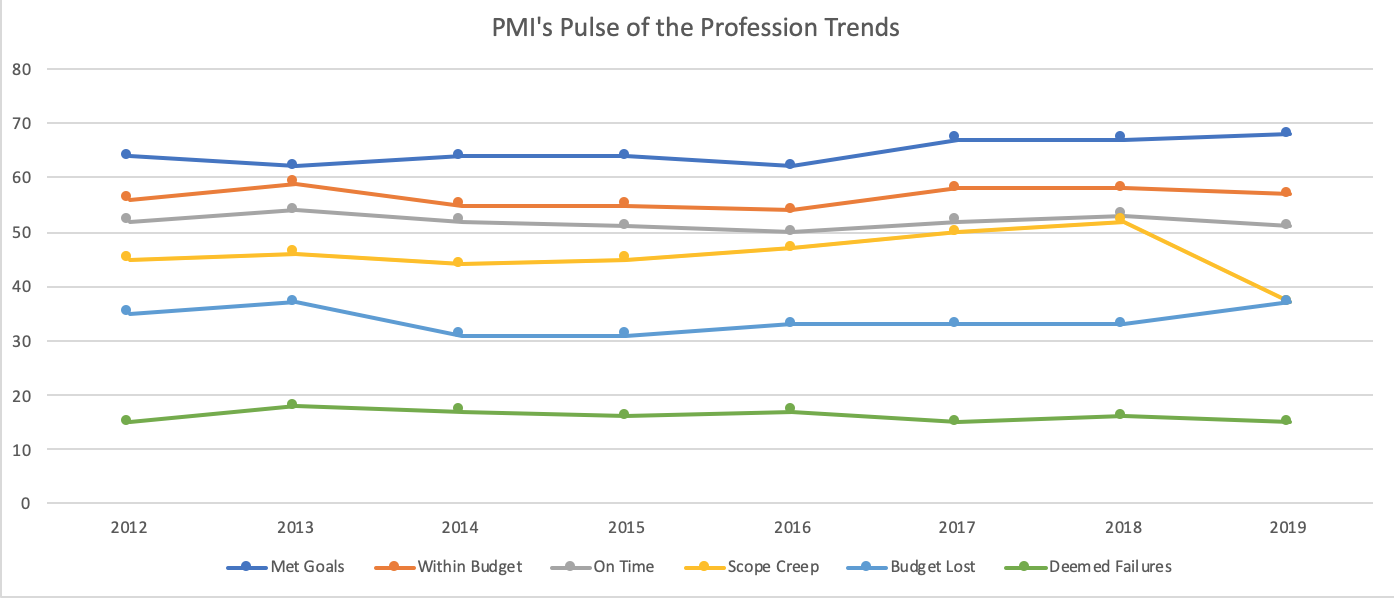
I added a Purpose to each of the resolutions. Now it’s not just "Getting in Shape", there is a purpose for getting in shape. By adding a purpose, the resolution has a defined end result. It gives the resolution more meaning. What does all of this have to do with Project Management? When we look at the trending statistics from the yearly PMI Pulse of the Profession, we find that as an industry we are mostly flat at about 55% success on projects over the past decade.
However, in that same decade we (PM industry) increased the number of PMPs. We increased the amount of spending on training. We made large investments in PPM tools. We matured the discipline with certifications for SCRUM, CAPM, and more. So why then are we remaining constant in success/failure rates all while we are increasing variables which should be making us more successful? When we live with Purpose we perform better. When our companies and careers have Purpose, we perform better3. I’ll use an example from a recent client engagement. The client was struggling with project delivery. They had a defined consistent methodology, a robust PM toolset, skilled PMs, and a supportive leadership team. All the basics for project success were in place but still they couldn’t get consistent project outcomes. One of the strategic projects they were working was an implementation of a CRM system. I interviewed the team and asked them, “Why are you doing this project?” The consensus answer was – the Leadership team wants a new CRM system to replace the outdated system. I asked the Leadership team the same question but received a different response from them. The Leadership team approved the CRM project not to upgrade the system, rather it is to achieve a 30% growth in revenue over the next 3 years. The team was unaware the purpose of the project was 30% revenue growth. The project team didn’t take any ownership in helping the organization reach the revenue growth target, they all thought that is a sales team target. When we in the PM space fail to align our work to the Purpose of the organization we are limiting our ability to achieve impactful results. We aren’t placing ourselves in value-add roles and we fall into the dreaded overhead category. We have to view our projects not just as projects, but pieces to a larger Purpose. Our teams will engage better, they will take ownership of the project outcomes better and they feel valued. Knowing why we are working projects is more important than how we work our projects. I’ve found far too often that PMO leaders are focused on “how we work” and “what we work on” and aren’t spending enough time helping the teams understand our Purpose. The Purpose Driven PMO empowers people to deliver results. The Purpose Driven PMO provides value to the organization. The Purpose Driven PMO starts with why. The Purpose Driven PMO allows us to achieve success beyond what we see from the flat trend lines in the Pulse of the Profession trend data.
1 – Vitagene, https://vitagene.com/blog/most-popular-2019-new-years-resolution/ 2 – US News & World Report - https://health.usnews.com/health-news/blogs/eat-run/articles/2015-12-29/why-80-percent-of-new-years-resolutions-fail 3 – Inc, https://www.inc.com/paul-grossinger/5-fascinating-stats-show-purpose-transforming-work.html |

Is Your Organization Primed for Future Success?
|
From about 2000 until 2013, Microsoft’s market capitalization hung around 200 billion and its stock price hovered around $26 per share. While a market capitalization of 200 billion is nothing to bat an eye at, Microsoft’s stagnation meant that they were losing ground to their competitors. Near the turn of 2014, it is safe to say that Microsoft was not primed for future success. Since 2014, Microsoft has been on a tear and their market capitalization recently eclipsing $1 trillion, passing Apple, and becoming the most valuable company in the United States. Further, its stock price is now five times greater than it was during their stagnant period: $132.45. Does Microsoft seem much more primed for future success now? Certainly! What has been the difference? Well, one obvious thing: a new CEO. During the early part of 2014, Satya Nadella took the helm at Microsoft. Since he has taken over Microsoft, he has focused on ensuring Microsoft has the characteristics that enable future success. This focus has clearly paid huge dividends, literally and figuratively. What Organizational Characteristics Enable Future Success? Step back and consider the industry in which your organization operates. Out of the organizations within your industry, some are going be highly successful 5, 10, 20 years from now, while others are going to be obsolete. This leads us to two questions:
The Characteristics that Hinder Future Success Among potentially many, the characteristics that hinder future success involve being short-sighted and change-resistant. The organizations that are short-sighted are so focused on figuring out how to be successful right now that they are unable to consider the needs of and opportunities associated with the future. The organizations that are change-resistant:
The Characteristics that Enable Future Success One characteristic that you will not find among the characteristics that enable future success is current success! Just ask organizations like Circuit City, Blockbuster, and Toys ‘R’ Us. Being successful today does not mean that you will be successful in the future. In fact, 52% of the Fortune 500 companies from 2000 no longer exist. The characteristics that enable future success involve being future-centered and agile. Being future-centered does not mean your organization isn’t concerned with the ‘right now,’ rather it means that your organization recognizes that your current level of success is based upon how future-centered you were leading up to the ‘now.’ Further, it means that your organization recognizes that what might be working now, is not likely to be what will work in the future. Being agile means being willing and able to quickly adapt to the changing market conditions. It is speed, nimbleness, and athleticism. Characteristics that fuel agility include:
How did Microsoft become Primed for Future Success? When Satya Nadella stepped in as CEO of Microsoft, he quickly recognized that Microsoft possessed more of the characteristics that hindered future success than those that enabled future success. This became evident in one of the first meetings he had with his leadership team. In the meeting, a facilitator asked for a volunteer amongst the team, promising whoever volunteered to have an extraordinary personal experience. Nobody was willing to stand up. This led Nadella to wonder: “Why wouldn’t everyone jump up. Wasn’t this a high performing group? Didn’t everyone just say they wanted to do something extraordinary? … The answers were hard to pull out, even though they were just beneath the surface: Fear of being ridiculed, of failing, of not looking like the smartest person in the room, and arrogance. ‘I am too important for these games.’” In his book, Hit Refresh, Nadella described Microsoft’s culture as: “Rigid. Each employee had to prove to everyone that he or she knew it all, and was the smartest person in the room. Accountability, delivering on time, and hitting the numbers trumped everything. Meetings were formal. Everything had to be planned in perfect detail before the meeting…Hierarchy and pecking order had taken control and spontaneity and creativity had suffered as a result.” Recognizing these limiting characteristics, Nadella made it his mission to change the culture at Microsoft. In fact, in his book, he continually states that the ‘C’ in CEO stands for curator of the organization’s culture, and is the CEO’s most important role. So, what did Nadella focus on to ensure Microsoft developed the characteristics that enable future success? Mindsets. Priming Your Organization for Future Success The solution for priming your organization for future success is the same as it was for Microsoft’s. As we makes shifts in our mindsets, we develop the characteristics that enable future success. Specifically, there are four shifts in mindsets that we need to make.
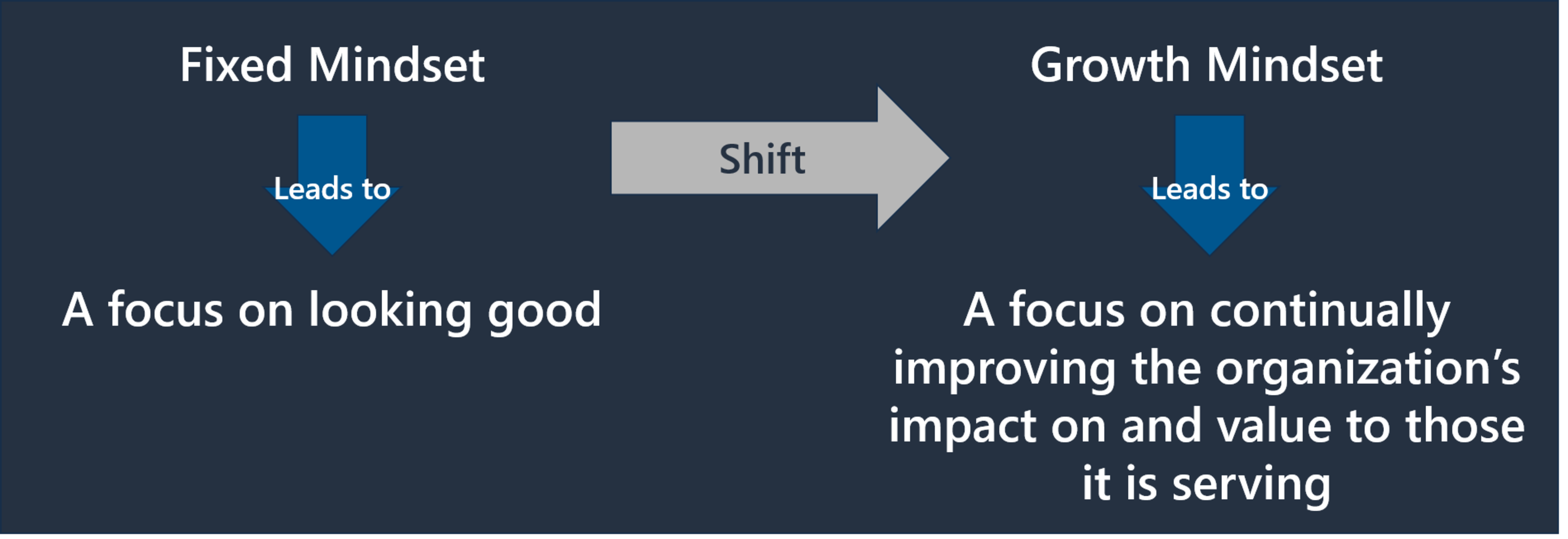
As an organization shifts from a fixed mindset to a growth mindset, it, and the employees within it, will focus less on looking good and more on continually improving the organization’s impact on and value to those it is serving. Nadella quickly realized that the negative culture at Microsoft was because of a fixed mindset. One way that he helped Microsoft make the shift was by putting the following on all employee ID cards: “Know it all to Learn it all.”
As an organization shifts from a closed mindset to an open mindset, it, and the employees within it, adhere less to tradition and become more willing to embrace innovation and new ideas. Also, this shift necessitates a change from communication and information going from the top down to communication and information coming from the bottom up. Such a change allows for the fostering of psychological safety, which is the #1 factor that drives top-performing teams. Nadella knew that if Microsoft was going to be the spontaneous and creative company that it once was and that it needed to be, there needed to be greater open-mindedness and psychological safety. Thus, Nadella sought to break down structures and policies that prevented empowerment.
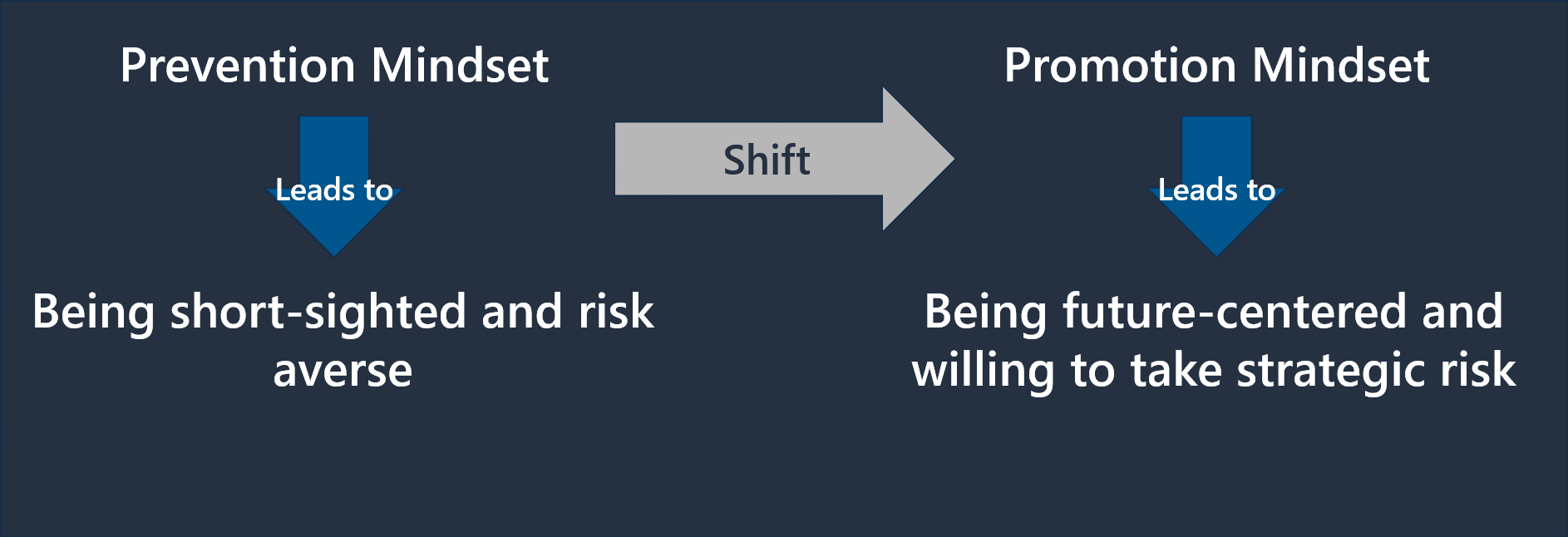
A shift from a prevention mindset to a promotion mindset requires that the organization develop a clearer purpose and destination they are shooting toward. This primes the organization for future success in two ways:
One of Nadella’s first priorities was to develop and evangelize a new, clear mission statement: “Empower every person and every organization on the planet to achieve more.” What a great mission statement! It gets leaders and employees to be forward-thinking, causing them to naturally ask the question: “How do we/I do that?”
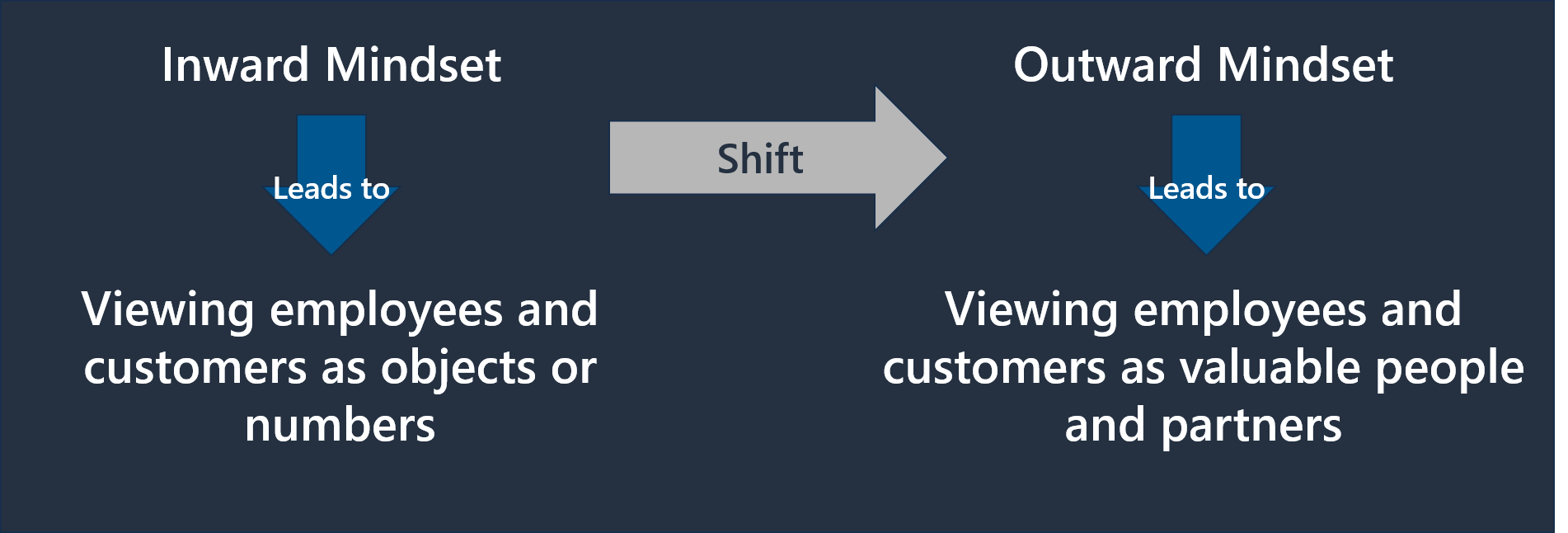
As an organization shifts from an inward mindset to an outward mindset, it, and the employees within it, view employees and customers less as objects or numbers and more as people of value. To help make this shift, Nadella has emphasized inclusivity, stating “Inclusion happens when…you are showing up, you are being an ally, a mentor, you are really creating, through your everyday actions, a more inclusive environment…that’s the journey we’re on…[its] very, very exciting.” He has even developed a mobile empathy museum.
Is Your Organization Primed for Future Success? Knowing the foundational role mindsets play in organizational agility and future-readiness, now the question becomes: Does your organization possesses the mindsets and characteristics required for future success?
|



How to drive greater value by listening
Categories:
Listening
Categories: Listening
| During my years in corporate America, I sat in lots of meetings. I often marveled at how some of my peers could bloviate their opinions. They appeared confident and seemed persuasive in advocating their position.
One of my peers was particularly skilled at this. Joe (fictitious name) seemed to have the attention of senior leaders as he moved up quickly through the ranks. Employees who worked for Joe liked him. I recall more than once sitting around the lunch table where his employees talked about how great it was to work for Joe. In the end, though, Joe did not make it through multiple reorganizations and restructurings conducted to streamline the operations. What happened?
I spoke with a few of Joe’s former employees sometime later. They told me that they liked Joe because he gave them attention their previous managers hadn’t. Much of their 1-on-1 meetings consisted of Joe telling them how the organization would have to change, describing excellent leadership of change. Joe did not, however, affect any real change himself. He was a great announcer of change, but not an enabler of change. He was ineffective in bringing his employees along on the change journey.
The big lesson? Don’t confuse influential advocacy for change with making it happen. The latter requires that you listen to employees to help gauge their progress through change and offer strategies to help them along.
Here are a few things I counsel my executive clients:
Leaders who follow this recipe for listening will be more successful with change, therefore increasing the value of the change project to the organization.
|


