The Character Strengths of a Leader


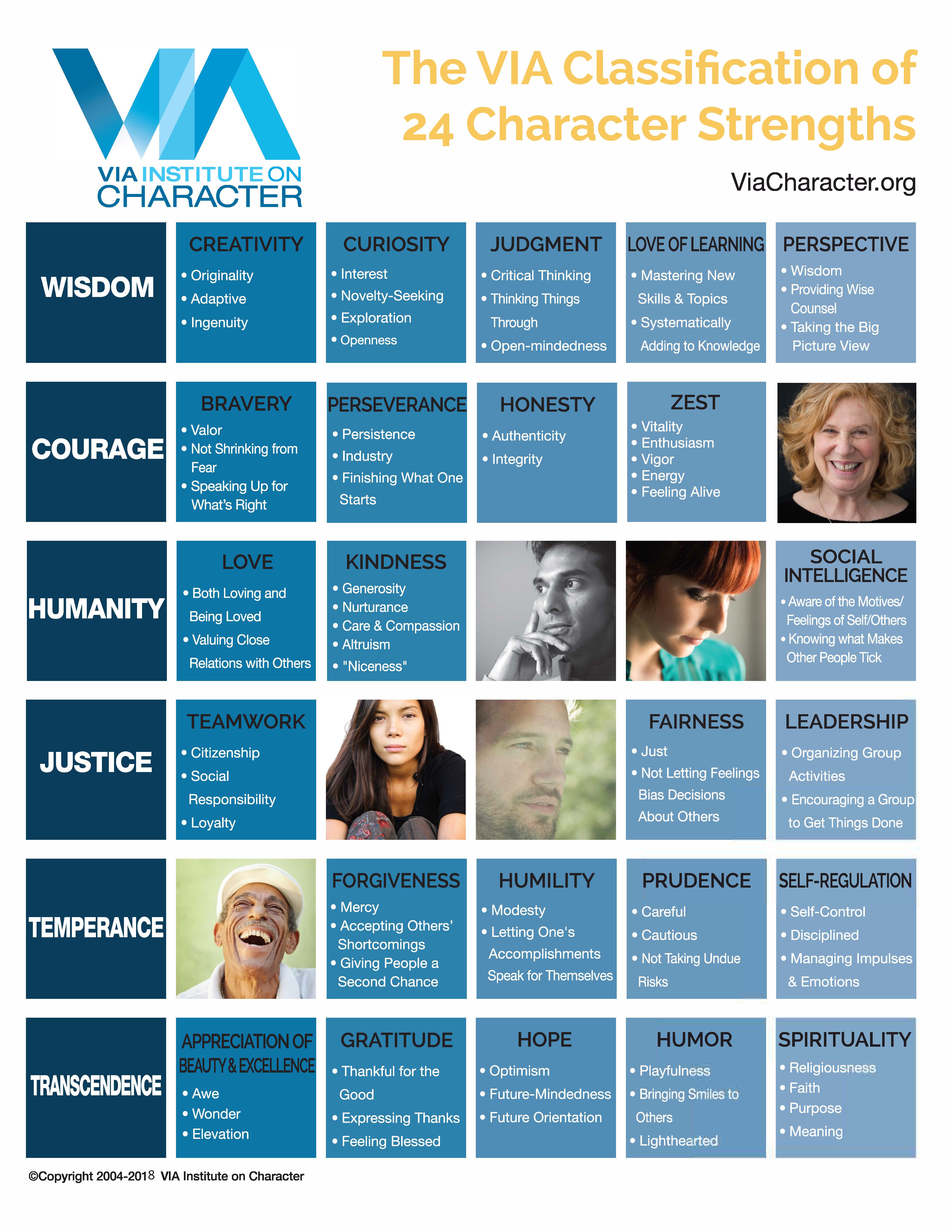
| One of the wonderful things about character strengths is that although we all have all 24, and they are a common language that lets us express our understanding and appreciation of each other’s qualities in a straightforward way, we do nevertheless express each strength uniquely. This combination of similarity and difference is what makes character strengths so powerful. They both connect us and differentiate us at the same time. Nowhere is this more apparent than when you speak to people who are leaders and to the people whom they lead. It is not uncommon to encounter expectations about what a leader will look like, what strengths they will have at their fingertips. We may even expect them to have superhuman capacities that translate into many signature strengths – more than your average person. One person even asked me once whether to be a good leader you needed to get all 24 strengths to the top level. And of course, the most common preconception of all is that in order to be a leader, we must have the strength of Leadership as a top strength. Will the Real Leader Please Stand Up? In reality, it is not the case that every leader or even every good leader has leadership as a top strength. On average across populations, Leadership is a strength that shows up squarely in the middle of the average profile[1]. As with any of the strengths, there are people with Leadership higher than average, but that does not automatically make them a leader. What we do know is that effective leaders recognize, acknowledge and cultivate the strengths of the people they lead[2]. They play to strengths and recognize that as leaders their job is not to know all the answers, or even provide all the structure and guidance. Their job is to create an environment where their teams flourish and can be their best selves. Over the years, I have been able to look at the character strengths profiles of many people in leadership positions, and what I find time after time is not that they are high in leadership, but that they know their top strengths and they use the strengths that are at their fingertips – their signature strengths – to be the best they can be. One person actually took their signature strengths and explained how they blended together to make them someone that others took for a leader[3]. Finding your pathway to Leadership Interesting preliminary research[5] has shown that there are some promising correlations between seven core team roles and specific character strengths. For example, the role of Decision Maker correlates with Zest, Hope, Bravery, Perseverance, and Leadership. Most people will not be surprised at the last strength, but all these strengths individually and together represent pathways to be a Decision maker – the person who is “energized by analyzing information from various perspectives, weighing evidence, applying logic, and choosing a fruitful course of action.” For most people that would be a leadership role! The secret to character strengths is to discover your personal profile and your unique way of using those strengths. Does your kindness get used at work to help colleagues, or at home with family to support them as they make their way through life or in your community as you help people facing personal challenges? Do you show your kindness with a hug and understanding when someone is in pain or by doing something practical to help? Does your bravery show up when you get comfortable with being uncomfortable in accepting a personal challenge, or when you speak up for others against a crowd, or you stand by a loved one in the face of criticism from family? And how do those two strengths show up together? As basic building blocks of personality, your character strengths are the same as mine, the same as a loved one’s, the same as those of your boss. What makes you you is how you use them and blend them and show them to the world. And that is as unique as your thumbprint. How will you use YOUR top strengths to set you apart today? [1] Park, N., Peterson, C., & Seligman, M. E. (2006). Character strengths in fifty-four nations and the fifty US states. The Journal of Positive Psychology, 1(3), 118-129. doi:10.1080/17439760600619567 [2] See for example Lavy, S., Littman-Ovadia, H., & Boiman-Meshita, M. (2016b). The wind beneath my wings: The role of social support in enhancing the use of strengths at work. Journal of Career Assessment. [3] Pearce, R. (2018). Be a project motivator: Unlock the secrets of strengths-based project management. Oakland, CA: Berrett-Koehler. [4] Be a Project Motivator, p124 [5] Ruch, W., Gander, F., Platt, T., & Hofmann, J. (2016). Team roles: Their relationships to character strengths and job satisfaction. Journal of Positive Psychology. DOI: http://dx.doi.org/10.1080/17439760.2016.1257051 |

The best ideas show up after the 'dip'
|
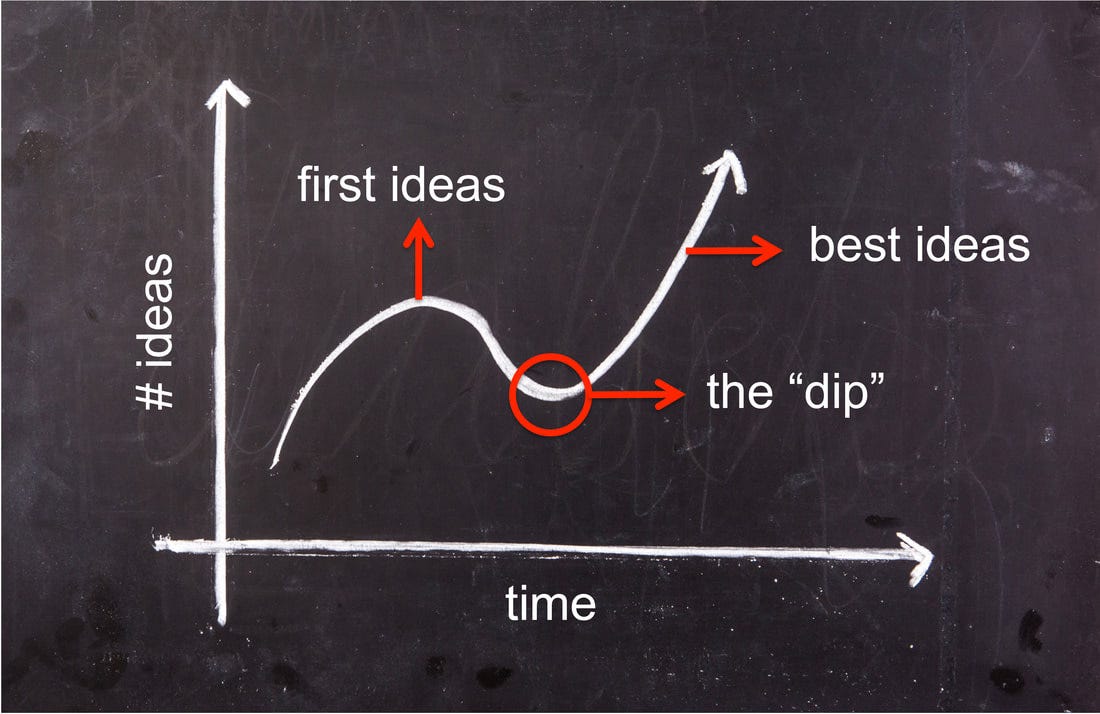
If you think brilliant ideas just simply drop out of the sky, you are wrong. A recent scientific study of Brian Lucas and Loran Nordgren shows that the best ideas actually occur only after the ‘dip’. So creativity is far and foremost a matter of persistence. During my career as a designer many years ago, I often experienced this. Long hours, evenings and sometimes even nights in which you are toiling for that ‘reasonably well’ concept for the customer, to bring that ‘ok it is a nice idea and it does have something’ to a higher level. Because it was supposed to be brilliant, great, original. And I knew it would come, I only didn’t know when this Eureka-moment would pop up. So you keep working, choose a new path, try to find inspiration in even the smallest things. And when you entirely have lost faith and have reached your ‘dip’, you take a break. But even during these short moments, the engine keeps running at full speed. And then it pops up, totally unexpected. And I knew, after all these years, it always would. It was that knowledge that, again and again, gave me the power to go on. And now — finally — this knowledge has been scientifically proven. Through a series of experiments Lucas and Nordgren demonstrated that people systematically underestimate the number of ideas they can generate to solve a problem. They started by asking a couple of students to come up with as much recipes as possible for a Thanksgiving Dinner. After this test, the students had to estimate how much more ideas they could come up with if they would continue for another ten minutes. On average, the students thought they could come up with ten more recipes, but the reality showed it was often more than fifteen. A similar test was done with other groups of people: stand-up comedians were asked to come up with punch lines for a joke, adults had to invent slogans for a product and another group of people needed to generate ideas to raise money for a charity project. In each and every one of these tests, the participants underestimated how many ideas they could come up with after their first ‘dip’. After every study, the researchers asked another group of people to judge the quality of the ideas. The result was even more surprising… The best ideas were the ones that were generated after the ‘dip’. So this means that persistence does not only generate significantly more ideas, but the quality of these additional ideas is even higher than the first batch of ideas. And still, we give up so easily. Not that surprising, because creative challenges are often perceived as very difficult. A lot of people consider themselves not to be very creative and are, because of that, convinced that after the dip the stream of ideas has entirely dried out. Hard labour and final failure on a non-creative task — for example a technical problem — often means that you need to quit. There often is only one solution, and if that solution doesn’t work, there’s simply no alternative. But with creative issues, more solutions are possible. Which is difficult to understand for most people who have a linear thought process. ‘Quantity breeds Quality’, Alex Osborn — the founder of modern-day brainstorming — already stated in the early sixties. And he was fully right! Finaly some small tips to give your unborn and potentially brilliant ideas the chances they deserve:
|
Ready…set…wait…who is going to do that?
| Have you ever been in this situation? You’re in a meeting, and the colleague on your left starts talking about the next big idea. The benefits are discussed and excitement builds to get started. So you ask, how are you going to do that? The colleague looks puzzled and says, “That’s not my job, my role is to come up with big ideas”. Nervously, you glance at the colleague to your right. Who responds, “That’s not my job, my role is to keep things running smoothly and the customers happy”. So, the question remains, who is going to turn the idea into action? The answer, a project team. Great, one problem solved. But, the follow up question is always, who should be on a project team? The project team should be comprised of strategic thinkers, ‘operators’, and individuals with specific skill sets such as project management, process improvement, change management, and learning and development. The organization is placing a significant amount of trust and responsibility in this team. Which means the members need to be carefully selected. When selecting the team from the possible candidates, how can you tell the difference between the individuals that have been there done that and those that just talk a good game? By asking questions about their past performance and, based on their answers, using the following model to determine their competency level. Novice
Advanced Beginner
Competent
Proficient
Expert
In a perfect world, you could fill a project team with experts. However, it isn’t feasible for everyone on the team to be an expert (which could present its own challenges). It is important to understand which roles are key to the success of the project, and fill those roles with qualified people. The remaining roles are prime opportunities for high performing talent that need experience. |
Driving a transformation doesn’t stop when you implement the change
Categories:
Sustainability
Categories: Sustainability
| “Just plan the project through go-live!” I recently had a conversation with a colleague working on a major transformation for a well-known Fortune 50. She told me that she was expressly told to only plan for work up through the launch of the change. This is a big mistake; let me explain. After I built and moved into my new home years ago, the builder presented me with a certificate explaining that the construction carried with it a five-year guarantee. They would take care of anything that went wrong with the house. Period. In the first few weeks I found a few minor issues. One door wasn’t closing correctly, and the builder promptly came out to repair it. Another time while I was away for the weekend, my son decided to enjoy an afternoon on the back porch and grilled up a juicy T-bone steak. He forgot to move the grill away from the house and voila, we had about 20 square feet of melted siding. My builder replaced the siding at no charge. When you make an investment in a transformation, it’s likely that you will spend much more than I did building this house. Yet many project managers consider their work done when the transformation is launched. Who is going to be around to make sure the change is institutionalized? How do you ensure that people permanently adopt the change and alter the way they need to work? How will you know that you are receiving the greatest value for your investment? Depending on the nature of the transformation, there are numerous ways you can ensure the systematic adoption of the change.
Putting these features in place will help you achieve the value you had planned, and in many cases, will drive even greater value. This greater value results from you paying more attention to the change far beyond that initial launch, and your employees finding ways to implement improvements beyond those originally planned.
|

Building A Culture of Appreciation - Part 2
| In my last post, I advocated looking for things to appreciate in yourself, to practice recognizing and acknowledging those traits that you share with others but express in ways that are uniquely you. In this post, I will dig deeper into the strength of appreciation and then suggest ways to use appreciation to the benefit of your team. Building a culture of appreciation builds rapport, a sense of inclusion and well-being for you and for those around you and you don’t need to be in charge to help make it happen.
Research shows that appreciation has three components.
Dacher Keltner, resident expert on the AWE aspect of appreciation at the Greater Good Science Center, UC Berkley, points to research that shows that spending one minute looking up at the trees make us more likely to help out someone in need than spending one minute looking at tall buildings[1]. He tells us that awe is an evolutionary phenomenon that is good for our minds, bodies and, maybe most important of all, our social connections. What could be more helpful to a team? What about the other components of appreciation? As I mentioned last time, research shows that appreciation is not used a great deal at work even though many of us rank it high in our strengths profiles.[2] It is often associated with appreciating nature, art, or skillful performances. And it is that last definition that is useful in teams in the workplace. Obstacles to using our appreciation at work In working with clients who have discovered this strength among their top five, I have often heard them lament, “I never thought of that as a strength!” One young woman (character strength of appreciation #1) told a group coaching session that she regularly takes walks in the local park to clear her head, improve her mood, and marvel at nature all around her. It helps her feel more connected to her team and to the purpose of the project. She was astonished to find that we are not all moved the same way. Another member of the same group (character strength of appreciation #3) mentioned how much they love to see someone at the top of their game – whether that be a musician, a scientist, a sportsperson or… a work colleague nailing some task or a new skill. When asked whether they ever tell their colleague how much they appreciate them, the answer came back, “No, they know already what they have accomplished right? They don’t want to hear it from me!” It is common to think that our positive opinion will not be valued, and yet experience and research says it is not so. For example, fundraisers who felt appreciated raised 50% more than those who just came to work and did their job as normal[3]. Managers who recognize, acknowledge and help cultivate the character strengths of their teams enjoy more highly engaged teams, healthier teams and less turnover than managers who don’t.[4][5]
Appreciation is more than just saying, “thank you”. And that is what makes it subtly different than gratitude – which gets lots of positive press by the way! It is about seeing the whole person, their strengths, their positive habits and giving them specific and personal appreciation. But how do you do that? My favorite way is using character strengths. We all have all 24, which is great because (a) everyone expresses all of them at one time or another and (b) we cannot go wrong! Expressing appreciation for the character strength(s) people demonstrate is something I do often. I have never had anyone say “What? You think I am kind? I don’t think so!” or “You think I used my judgment during that meeting? Nope! I just tossed a coin.” Mostly people beam with pleasure or they share a story with me of why that behavior is important to them. Four steps to full workplace appreciation: Step 1 observe strengths in other people any time you can. You can strengths spot during movies, during family dinner, while watching sports on TV. Use the list below and practice until you feel brave enough to share what you see with someone else. Step 2: Bring the list of strengths to a meeting at work. Instead of checking your messages on your smartphone under the table, hoping no-one will notice, keep the list of strengths with you, and listen to each speaker. Highlight the strengths you hear. Do this for a few days until you get comfortable. Don’t worry about being “right”! Step 3: After the meeting is over, choose one person and tell them specifically what you saw and why you appreciate it. For example, “I really saw you using judgment as you weighed up the options for our next steps on the project. It really helped us to sort through everything and come to a good decision.” Or, “I really loved how you turned the mood around with your sense of hope! You helped everyone feel that this is possible, and we were able to figure out actions to get us where we need to be.” Step 4: Note down afterwards (a) what their reaction was (b) how you felt. Some common reactions from those you appreciate are:
Step 5: Do this for a few days and see what happens. Ripple effect anyone?
[1] https://greatergood.berkeley.edu/article/item/why_do_we_feel_awe [2] Money, K., Hillenbrand, C., & Camara, N. D. (2008). Putting positive psychology to work in organizations. Journal of General Management, 34 (2), 21-26. [3] http://www.health.harvard.edu/newsletter_article/in-praise-of-gratitude [4] In a workplace study of 120 participants, it was supervisor support, not colleague support, of employee strengths use that was predictive of increased strengths use the next day (Lavy, Littman-Ovadia, & Boiman-Meshita, 2016b). [5] Gallup, Inc. “State of the American Manager.” Gallup.com, Gallup, 30 May 2019, www.gallup.com/services/182138/state-american-manager.aspx.
|