Call for Volunteer - Transformation & Leadership


|
Within PMI’s online community, ProjectManagement.com, a group of volunteers organizes monthly webinars on the topic of Change Management. To complement this webinar series, they also maintain a blog, Transformation & Leadership – Insider Tips, featuring lessons learned and diverse perspectives from experienced professionals. This team is currently looking for someone to assist with their endeavors to advance conversations around change management and provide tips and tools to the online community (in a volunteer capacity). The volunteer blog & webinar coordinator is responsible for sourcing, working with, and facilitating presenters through: 1) the webinar development process; and 2) the blogging process for the Transformation & Leadership blog He/she will host practice sessions for presenters and help facilitate live webinars for the team in the area of Change Management. The volunteer will also work with presenters to contribute change management content to the blog. The volunteer should be an active team member who is enthusiastic about providing great webinars and blog posts to the community on ProjectManagement.com. This volunteer will: • Meet with team on a regular basis to discuss plans for webinar & blog program • Assist in planning webinars and provide updates as necessary • Coordinate scheduling of webinars and complete PMI presenter forms for each webinar • Coordinate and facilitate presenter practice sessions • Host live webinar sessions (about one webinar per month) • Coordinate scheduling of blog posts for the Transformation & Leadership blog, and review blog content to ensure compliance with User Guidelines The estimated time commitment is 4-5 hours per month with weekly team meetings - all virtual. The volunteer should have strong project, program, and/or portfolio management skills and understand and commit to PMI’s objectives and goals around increasing member value and knowledge delivery. PMI membership is required for this role. This is a team of volunteers, so flexibility is needed, and experience with Webex is strongly encouraged. PDUs for Giving Back can be claimed in accordance with the policies outlined in your credential's handbook. If you are interesting in volunteering, please contact Laura Schofield via the Inbox on ProjectManagement.com with: -your statement of interest -an explanation of any experience that you have facilitating webinars by 30 June 2021. An interview with shortlisted candidates and the volunteer team will be conducted. |
PM perspectives - Lincoln on Leadership for Today
| This blog post has been created by: Ed Pelic, Nic Jain, Joe Colon, Cady Johnson, Smita Shetty, Heather Benson, Cathy Fisher, Simon Lato, Babette Ten Haken, Craig Karagitz The group of contributors is made of practicing project managers to help build their leadership skills, learning from the best minds of all times. Please note we are not endorsing any specific book or piece of content. The material is used only as a framework for the members to transform how they perform as leaders through principles discovered and applied to specific situations that Project Managers encounter. The group recently completed reading Lincoln on Leadership by Donald Phillps. Key learnings from a Project Management perspective have been summarized in this post. The extraordinary challenges Lincoln faced as President while the United States was engaged in civil war and his leadership actions in response are arranged in the theme categories (sections) of People, Character, Endeavor, and Communication. Some elements of Lincoln’s life prior to his Presidency were reviewed as well. We learned how Lincoln’s leadership actions demonstrated the golden principles. We explored the leadership principles practiced by Lincoln and reflected on ways to incorporate them into daily practices and interactions. In this way, leadership situations Lincoln experienced can be leveraged to develop and enhance individual leadership skills in a transformational way. Key Leadership Learnings
Know your audience - frame your message to suit your audience. Use clear and simple language. Don’t use terms or abbreviations unknown to your audience. One on one conversation - speaking one on one is a good technique to win over a friend or rival to adopt your position. Use anecdotes - be a good story teller to illustrate your point of view. People will understand the message in the story and remember it going forward. Humor - use of humor is effective in disarming people and putting people at ease. Lincoln worked diligently on the Gettysburg address. His few minute speech is considered one of the best speeches of all time. The speaker before Lincoln spoke for 2 hours, yet nobody remembers who the speaker was or his speech.
Character is very important for an effective leader - people will choose to follow a leader who establishes trust through his/her actions and character. “Have malice toward none and charity for all” Failure builds character - Do not let failures diminish your drive. Learn from the experience as a foundation to try again with greater knowledge.
Management by walking around - meet your team members on their own turf, get out into the field. Delegate effectively - provide opportunities for other. After communicating expectations, do not hesitate to take action if people are not performing. Believe in yourself - know yourself and promote your values. Remain determined. This video addresses additional scenarios discussed by participants, including how they would apply these learnings to real-world scenarios faced by Project Managers.
|
When High Performance Turns Toxic
Whilst this CEO was interested in leadership on big budget infrastructure, engineering and IT projects, we see a similar pattern in many sectors. The lessons are universal. Toxic cultures stymie high performance – it’s hardly newsworthy. How come these dynamics persist – even when leaders are charged with monitoring well-being? What are we missing? What can leaders do to improve success rates?
The CEO was Collin Smith, of ICCPM (international Center for Complex Project Management). He was talking about the toxic cultures identified in ICCPM’s Roundtable Research.[1] Toxic cultures and mental health"Teams in bigger and more complex projects often have a battle rhythm characterized by cognitive overload, decision fatigue, day in day out conflict and excessive stress. This results in poor mental health or even PTSD like symptoms He continued, Unfortunately, there’s a trend: leaders in these projects keep pushing and pushing – to the detriment of their own mental health and that of their teams. And productivity suffers. Although these project leaders are responsible for monitoring staff well-being, at times they seem to exhibit a pride in the scar tissue they’ve acquired over decades. They tend to baton down the hatches, crack the whip and crank up the stress to get things done. Yet our research tells us, when complex projects really get tough the opposite is needed. We need leaders at their very best in terms of critical thinking, creativity, collaboration and adaptability. We need leaders who, despite the overload and stress, can slow down rather than becoming more transactional and process driven."
That’s where the ideas I introduced in my earlier blogs come in. SCARF a Brain–based Model for Managing People on Projects explores how the human brain works, and how our response to social threat takes our Thinking Brain offline. Change Requests and the Project Stress Cycle extends these ideas by demonstrating how excess stress increases complexity, and reduces the chances of project success. Now consider the project leaders Collin was referring to. They are no different from you and me. We know from the SCARF model, the human brain loves certainty. Yet they are dealing with masses of uncertainty and the stakes on their projects are incredibly high. This means many of them are under constant stress. In other words, their Thinking brains are offline. And we know from those earlier blogs, when our Thinking brains are offline, we see things less clearly. If we can’t really see what’s going on, we start making assumptions about what is actually happening. After all, we’re wired for survival. The fight/ flight reflex says it all. If we’re not going to run away, we may well start fighting. And that increases stress levels, and makes a brutal culture far more brutal. So what can we do about it? Breaking the toxic cycle starts with self-awarenessIn my view we need to take a new look at the skills for successful project leadership, and put self -awareness at the top of the list. I argue it's THE key skill. By this I mean you need to be able to ask, at any time – ‘what is going on for me right now?’
Note I use the Feeling word, which doesn’t feature in many business conversations, because answering this question helps to bring our Thinking brains online. Once you know how you’re feeling, you can consider how other people might be feeling too. You can then move on to consider what do you have to do to:
Thinking brains have to be online
They have to be online for us to inspire people and learn well. If you're cracking the whip, all you're doing is evoking a fight and flight response. Nobody will be able to think clearly, so they will make poor decisions. Project performance will suffer. The research is clear. We need leaders who, despite the overload and stress, can slow down rather than becoming more transactional and process driven. And that means leaders with a high degree of self awareness. References Project Leadership: The game changer in large scale complex projects Image by Sebaastian Stam on Unsplash |
Is it Time to Re-brand and Re-charter the IT Function?
| Is it Time to Re-brand and Re-charter the IT Function? Very few functions have evolved as much in the past 3-4 decades as the IT function. It’s been in the vanguard of driving efficiency and transforming legacy operations, and has been rewarded in being moved out of the backrooms of the company and into the boardrooms. However, with great power comes great responsibilities. We need to ask if we in the IT function are doing enough to transform our own legacy behaviors. I would contend that not all organizations are. Which is why it might be time to re-brand and re-charter the IT function. I call this new re-branded organization the “digital resources function”. Why Re-charter the IT Function? With digital transformation becoming the #1 priority for most company boards, expectations from the IT functions have increased. At its heart is the change from “managing” technology to “leading” the digital transformation of the enterprise. The change isn’t just administrative though, there are technologies, platforms and people skills that will need to be redone. I have identified six vectors of change –
In contrast, the current technologies in most enterprises were originally built for enterprise efficiency and scale. They are large, complex, took a long time to implement, and take even longer to modify. Think large enterprise resource planning (e.g. SAP) implementations. These monolithic systems worked extremely well in the past because the goal at the time was scale. The new digital revolution has changed that goal.
Why Re-brand the IT Function?
[i] Scorsone, G. (2018). 5 hot and high-paying tech skills for 2018. [online] CIO. Available at: https://www.cio.com/article/3269251/it-skills-training/5-hot-and-high-paying-tech-skills-for-2018.html [Accessed 19 Dec. 2018]. [ii] Caminiti, S. (2018). 4 gig economy trends that are radically transforming the US job market. [online] CNBC. Available at: https://www.cnbc.com/2018/10/29/4-gig-economy-trends-that-are-radically-transforming-the-us-job-market.html [Accessed 19 Dec. 2018]. |
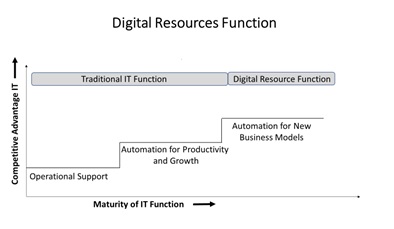 As we’ve learned from the experience with constantly upgrading our smartphones, technology gets old fast. That’s true of IT functions in the enterprise as well. IT technologies, IT scope of operations and IT skills all have incredibly short life cycles. That’s been historically true and is not a surprise. What’s new is that the piston-engine version of IT has reached an inflection point. It needs a consciously different engine. We’re no longer talking evolution; we’re talking about a dramatically different redesign. The new IT function is not just about new technology platforms, a new charter of work, or newer skills; it is about leading all the other functions and business units in the company to new technology-enabled business models. The digital enterprise needs digital to be done by every function, but powered by IT. Which is why I believe that the new IT function needs a totally new charter and a new name – The Digital Resources Function.
Being Agile – An experiential perspective
| When the concept of Agility was incorporated into Project Management Professional Certification a few years ago, the addition seemed like the beginning of the way the world was evolving. However, looking back it has been the best and the most important change that has become more relevant than ever before in this uncertain business landscape. We see that agility has not just touched businesses but even our personal and professional lives, making it an all-encompassing phenomenon. Our life itself is now depending on how well we thrive amidst sweeping changes – how agile we are to rapidly changing circumstances! It is but natural that I chose to write about ‘being agile’ from the individual level rather than just for the businesses.
What we need to be AGILE going forward?
People, as individuals, teams and even businesses are increasingly keeping their choices open, embracing open mindsets because it has become very clear than anything is possible and anything can happen. Though it may sound difficult most times, it seems to be the way around to handle the challenges that come with sweeping changes. Technology has been put to great use, almost stretched in fact, to accommodate the work-from-home scenario and innovations cropped up to find turnarounds from the business impacts that were caused. Learning to be agile and practising agility has become the new recipe for keeping our balance and going one step further, for attaining success in this ever transforming world for both individuals and businesses alike. Be AGILE, BALANCED and CHANGE-SEEKING - the ABC in today's uncertain world.
|