
The Self-Reinforcing Organization


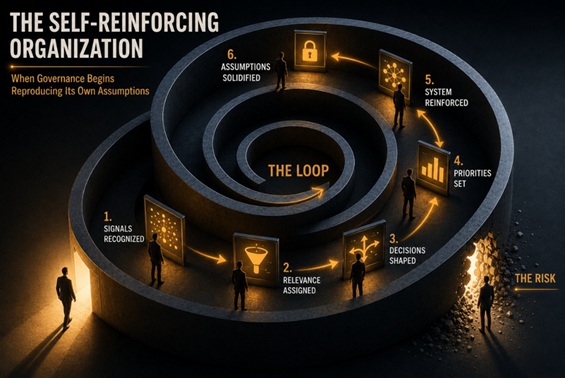 When Governance Begins Reproducing Its Own Assumptions Organizations rarely decide to become closed to challenge. They do not announce that certain assumptions should no longer be questioned. They do not formally declare that familiar interpretations deserve more legitimacy than uncomfortable ones. And they rarely design governance with the explicit intention of reproducing the same thinking indefinitely. Yet organizations can still move in that direction. Not because disagreement is prohibited. But because systems learn what to recognize. What to reward. What to measure. What to promote. And, eventually, what to expect. This creates a governance problem that is easy to miss. An organization may become increasingly aligned with itself while becoming progressively less capable of detecting where it is wrong. The process does not begin with censorship. It begins with reinforcement. Every organization develops ways of interpreting reality. Certain signals are treated as important. Certain risks receive attention. Certain explanations appear credible. Certain forms of evidence travel easily through decision structures. Others struggle to gain traction. Initially, these differences may simply reflect experience. Organizations need interpretive shortcuts. They cannot reconsider every assumption in every decision. They develop categories. Priorities. Decision criteria. Shared language. Patterns of attention. Without them, coordination would become impossible. The problem begins when these interpretive structures stop functioning only as aids to coordination and start becoming filters of organizational legitimacy. A signal that fits existing assumptions is understood quickly. A signal that challenges them requires more explanation. An argument expressed in familiar language moves easily. An unfamiliar interpretation appears less mature. A risk already represented in the organization's categories becomes visible. A risk outside those categories may remain difficult to name. Nothing has been prohibited. Yet the system has begun to develop an asymmetry. Some interpretations move through the organization with less friction than others. That asymmetry matters. Because what moves easily is more likely to be discussed. What is discussed is more likely to be measured. What is measured is more likely to influence decisions. What influences decisions is more likely to shape future priorities. And future priorities help determine what the organization will pay attention to next. A loop begins to form. Not a loop designed by any single leader. Not necessarily an algorithm. Not necessarily a policy. A systemic loop of recognition and reinforcement. The organization increasingly sees what its existing architecture has become good at seeing. This is where governance can become self-reinforcing. Governance does not merely respond to organizational reality. It helps determine which parts of reality become institutionally actionable. Through decision criteria. Escalation thresholds. Reporting structures. Investment priorities. Definitions of materiality. Promotion signals. Accepted forms of evidence. Each mechanism may be reasonable. Together, however, they influence what the organization repeatedly treats as relevant. And repeated relevance creates institutional weight. The consequences extend beyond decisions. They begin to affect people. Organizations continuously signal what competence looks like. What leadership sounds like. Which questions are considered strategic. Which forms of disagreement are constructive. Who appears aligned. Who is trusted with greater responsibility. Again, no explicit conformity policy is required. People observe the system. They learn which signals travel. Which arguments gain sponsorship. Which behaviors increase credibility. Which forms of challenge create friction. Some adapt deliberately. Others adapt unconsciously. Over time, those who interpret the organization well may become increasingly skilled at expressing ideas in forms the system already recognizes. That is not inherently problematic. Organizational fluency matters. Shared language matters. Coordination matters. But a deeper selection effect can emerge. The organization may become progressively better at recognizing and advancing people who are legible to its existing assumptions. Meanwhile, those who detect weak signals outside the dominant frame may face a different burden. Their observations require more translation. Their concerns appear premature. Their questions seem insufficiently aligned with current priorities. Their evidence does not fit existing categories. They may still be heard. But they are harder for the system to recognize as relevant. This distinction is critical. The risk is not necessarily that dissent disappears. The risk is that the organization's capacity to recognize valuable dissent deteriorates. An organization can maintain open forums. Encourage challenge. Celebrate psychological safety. Invite alternative perspectives. And still remain structurally more receptive to interpretations that confirm what it already knows how to process. This is why diversity of thought cannot be assessed only by the presence of different voices. The more difficult question is: Can materially different interpretations alter what the system considers relevant? If not, plurality may exist socially while remaining weak architecturally. People can speak. But the system does not learn to see differently. AI-native organizations may intensify this problem. Not because artificial intelligence necessarily creates conformity. But because AI systems learn from organizational traces. Historical decisions. Existing classifications. Past escalation patterns. Performance criteria. Approved language. Observed preferences. Repeated correlations. These traces contain valuable organizational knowledge. They also contain the boundaries of previous attention. When intelligent systems use those traces to recommend, prioritize, summarize, route, rank, or escalate, they can increase the operational consistency of the organization. That consistency can be extremely valuable. But it carries an epistemic risk when the assumptions embedded in those traces are no longer sufficiently challengeable. The system becomes faster at recognizing familiar relevance. More precise at reproducing established priorities. More efficient at directing attention toward known categories. And potentially less sensitive to what has never been adequately represented. This is not simply algorithmic bias. The problem is broader. An organization can automate the continuity of its own blind spots. The danger is difficult to detect precisely because the system may appear to be improving. Metrics align. Decision patterns stabilize. Recommendations become more consistent. Leadership language converges. Coordination friction decreases. The organization appears to understand itself better. Yet a system can become increasingly consistent with its own assumptions while becoming epistemically less responsive to realities those assumptions exclude. This is where self-reinforcement becomes a governance problem. The central question is no longer whether governance produces alignment. Organizations need alignment. Nor is the solution permanent disagreement. Organizations cannot operate by continuously reopening every assumption. The challenge is more demanding. How does an organization preserve the capacity for materially relevant reality to challenge the assumptions through which the organization interprets it? This is a problem of organizational contestability. Not contestability as permanent opposition. Not institutionalized skepticism toward every decision. And not the assumption that dissent is inherently wiser than consensus. Organizational contestability is the capacity of a system to allow materially relevant evidence, interpretation, or consequence to challenge the categories through which the system currently understands reality. That capacity cannot depend only on courageous individuals. If challenge requires exceptional personal resilience every time, the architecture is already telling us something. Nor can it depend on generic invitations to speak up. The issue is not merely whether people are allowed to disagree. The issue is whether unfamiliar evidence can become organizationally consequential. Can a weak signal alter attention? Can an emerging risk challenge existing materiality criteria? Can an interpretation outside the dominant frame reach decision-makers without first being translated into the language of the frame it questions? Can promotion and legitimacy systems recognize people who improve the organization's capacity to see, even when what they reveal creates discomfort? Can AI-supported decision systems distinguish between low-confidence noise and evidence that the organization's own categories may be incomplete? These questions do not weaken organizational alignment. They test whether alignment remains connected to reality. Because an organization does not become self-reinforcing simply by sharing assumptions. It becomes self-reinforcing when its assumptions increasingly determine what can count as meaningful evidence against them. The danger is not that information disappears. It is that some information becomes progressively harder to convert into relevance. The danger is not that dissent is eliminated. It is that the system becomes less capable of recognizing which dissent contains signal. The danger is not that identical people are selected. It is that organizational legitimacy repeatedly favors forms of legibility that fit what the system already understands. Eventually, the organization may continue to adapt. Continue to optimize. Continue to learn. But increasingly within a reality it has become structurally prepared to confirm. This may be one of the least visible risks of AI-native governance. As organizations become better at sensing, interpreting, recommending, and coordinating, they may also become better at reinforcing the assumptions embedded in how they sense, interpret, recommend, and coordinate. Intelligence accelerates the loop. Governance legitimizes what becomes actionable. Organizational progression influences who shapes the next iteration. And what began as a set of reasonable interpretive structures can become a system increasingly capable of reproducing the conditions of its own interpretation. The answer is not to eliminate shared assumptions. Organizations need them. The answer is not to preserve every alternative indefinitely. That would make decision-making impossible. And the answer is not to treat every dissenting view as insight. Most signals will not redefine the system. The deeper responsibility of governance is to preserve contestability where consequences may be material. To ensure that existing categories can be challenged. That legitimacy does not become self-confirming. That organizational memory informs judgment without becoming inherited authority. That AI amplifies learning without merely industrializing historical attention. And that people capable of seeing what the system has not yet learned to see remain organizationally consequential. Because the greatest risk may not be that organizations stop adapting. It may be that they become extraordinarily good at adapting within a reality they have progressively taught themselves not to question. And when that happens, the organization does not need anyone to silence dissent. The system has simply become better at hearing itself. |
Posted on: July 13, 2026 05:46 AM
| Permalink |
Comments (2)


