
Human Sovereignty


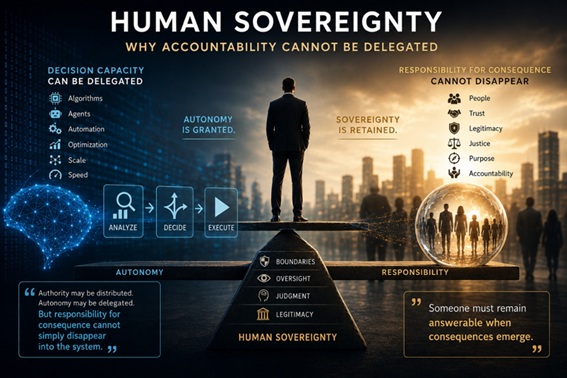 Why Accountability Cannot Be Delegated Artificial intelligence is becoming increasingly capable of making decisions. Not merely analyzing information. Not merely generating recommendations. But prioritizing. Coordinating. Selecting. Acting. Adapting. And increasingly, doing so with decreasing human intervention. For organizations, this creates extraordinary possibilities. Faster decisions. Continuous coordination. Greater scalability. Reduced operational friction. More adaptive systems. More autonomous execution. But beneath these capabilities, a deeper question is beginning to emerge. If AI can decide, who remains responsible? At first glance, the answer may appear obvious. Humans. Leaders remain accountable. Boards remain accountable. Executives remain accountable. Organizations remain accountable. The system may act. But responsibility remains human. This principle matters. Yet the problem is becoming more complex than this simple formulation suggests. Because decision-making itself is changing. For most of organizational history, decisions could ultimately be traced to identifiable human actors. A manager approved. A leader authorized. A committee decided. A board governed. Responsibility could be disputed. It could be fragmented. It could even be deliberately avoided. But the underlying architecture remained fundamentally human. Someone exercised authority. Someone made a choice. Someone could, at least in principle, be asked: Why did you decide this? AI-native organizations are beginning to alter this architecture. Decision capacity is becoming increasingly distributed across: Algorithms. Agents. Recommendation systems. Automated workflows. Human teams. Governance mechanisms. Continuous feedback loops. Adaptive systems. A decision may no longer emerge from a single identifiable moment of human choice. It may emerge through a sequence of interactions. A model detects a pattern. An agent generates an option. Another system prioritizes it. A workflow triggers an action. A human validates an exception. The environment changes. The system adapts. A consequence emerges. Consider a credit application. A customer is rejected. No individual consciously chose rejection. One model assessed risk. Another system adjusted thresholds. A workflow applied policy. No exception was triggered. The outcome is clear. The decision path is distributed. Who meaningfully owns the consequence? This is increasingly the problem. Who decided? The answer may increasingly be: The system did. But systems do not eliminate consequences. People experience consequences. Customers experience consequences. Employees experience consequences. Communities experience consequences. Institutions experience consequences. Organizations inherit consequences. This is where autonomy creates a profound governance problem. Decision capacity can be delegated. Consequence cannot be delegated away. The distinction matters enormously. Organizations may grant systems increasing authority to act. They may allow autonomous agents to operate within defined domains. They may distribute intelligence across complex human and machine networks. They may automate thousands of operational choices that once required human intervention. But delegating decision capacity does not, by itself, create a meaningful bearer of responsibility for consequence. The system may execute. The system may optimize. The system may adapt. The system may even explain aspects of its reasoning. But responsibility requires something more than causal participation in an outcome. It requires the capacity to answer for consequence. To justify boundaries. To defend trade-offs. To recognize harm. To accept that some outcomes should not have been pursued even if they were technically possible or operationally efficient. This is why the question of human sovereignty becomes increasingly important. Human sovereignty does not mean that humans must make every decision. That would be neither realistic nor desirable. Organizations already delegate decisions continuously. Leaders delegate to managers. Managers delegate to teams. Organizations delegate to processes. Governance systems distribute authority. Automation has long performed actions without continuous human intervention. Delegation itself is not the problem. The deeper question is: What must remain meaningfully human when decision authority becomes increasingly autonomous? This is where human sovereignty begins. Human sovereignty is not the preservation of human control over every decision. It is the preservation of meaningful human authority over the conditions, boundaries, and consequences of delegated autonomy. The distinction is fundamental. Control asks: Who makes the decision? Sovereignty asks: Who determines what may be delegated? Who defines the domain of autonomy? Who establishes the boundaries? Who decides which consequences are acceptable? Who retains the authority to challenge the system? Who can interrupt it? Who can revise the conditions under which it operates? And ultimately: Who answers when the system produces consequences no one intended? These are not merely technical questions. They are governance questions. And increasingly, they are questions of organizational legitimacy. Because authority without responsibility creates danger. But responsibility without meaningful authority creates something equally problematic. An accountability illusion. A human name remains attached to the system. A leader remains formally responsible. A governance body remains nominally accountable. Yet the architecture of decision-making may already have distributed influence across systems that operate continuously, adapt dynamically, and act at a scale no individual directly controls. This is why organizations must be careful not to confuse human presence with human sovereignty. A human in the process does not necessarily govern the process. A human approval does not necessarily represent meaningful judgment. A human signature does not automatically create substantive responsibility. A human may remain visible while the real architecture of influence has already moved elsewhere. This tension will become increasingly difficult as autonomous systems expand. Organizations will face a powerful pressure to delegate more. Not only because automation is attractive. Not only because systems perform well. But because competition itself may increasingly reward organizations that decide and act faster. When markets respond in milliseconds, agents coordinate continuously, and automated systems operate without pause, meaningful human intervention may begin to appear as latency. And this creates a far more difficult sovereignty problem. What happens when preserving human judgment becomes competitively expensive? Organizations may believe deeply in human oversight. They may value judgment. Responsibility. Reflection. Deliberation. But if competitors decide faster, adapt continuously, and operate with lower decision friction, the pressure to reduce human intervention becomes structural. Human judgment may slowly become interpreted not as a governance capability. But as a bottleneck. This is where the erosion of human sovereignty may become especially difficult to resist. Organizations may not abandon human sovereignty because they reject it. They may abandon it because the cost of preserving it becomes visible before the cost of losing it does. If systems perform well, increase efficiency, reduce errors, and accelerate execution, the natural response will be to delegate more. More decisions. More authority. More operational discretion. More adaptive capacity. Each delegation may appear reasonable. Each expansion of autonomy may produce measurable value. Each reduction in human intervention may appear efficient. But delegation has a cumulative effect. The relevant question is not only whether each individual decision can be automated. The deeper question is what happens to the architecture of responsibility as thousands of decisions progressively move beyond direct human judgment. At some point, organizations may discover that they have delegated not only execution. But interpretation. Prioritization. Trade-off selection. Risk acceptance. Behavioral influence. And eventually, parts of the organizational capacity to determine what should matter. This is where human sovereignty becomes fragile. Not because machines suddenly take control. But because humans gradually stop governing the conditions under which control is distributed. The erosion may be almost invisible. A recommendation becomes a default. The default becomes a workflow. The workflow becomes automated. The automation becomes trusted. The trusted system receives greater autonomy. And over time, questioning the system begins to appear inefficient. Human judgment remains theoretically available. But increasingly absent from practice. The organization still claims responsibility. Yet responsibility begins drifting away from meaningful human agency. This is the paradox of autonomy. The more capable systems become, the easier delegation becomes. The easier delegation becomes, the more important governance becomes. And the more distributed decision-making becomes, the more deliberately organizations must preserve the human capacity to govern delegation itself. This does not require resisting artificial intelligence. Quite the opposite. Responsible autonomy may become one of the most important organizational capabilities of the AI-native era. But responsible autonomy requires a distinction that organizations cannot afford to ignore. Autonomy is granted. Sovereignty is retained. Systems may decide within domains. Humans must remain capable of determining those domains. Systems may optimize within boundaries. Humans must remain responsible for determining which boundaries matter. Systems may act without continuous intervention. Humans must preserve the authority and capacity to question, interrupt, and redesign the conditions of action. Systems may expand what organizations can do. But humans must remain responsible for what organizations are willing to become. This is why accountability cannot simply disappear into intelligent systems. Not because humans must control every action. Not because human judgment is infallible. And not because autonomy itself is undesirable. But because consequences require a locus of responsibility. Someone must remain capable of asking: Should this authority have been delegated? Were the boundaries legitimate? Were the consequences acceptable? What should have remained protected? And what must now change? These questions cannot be answered by optimization alone. They require judgment. They require legitimacy. They require responsibility. They require human sovereignty. The future of AI-native organizations will not be defined only by how much autonomy they create. It will also be defined by whether humans remain meaningfully capable of governing the autonomy they have created. Because authority may be distributed. Decision capacity may be delegated. Autonomy may expand. But responsibility for consequence cannot simply disappear into the system. And if humans remain responsible for consequence, the next question becomes unavoidable: What should organizations never delegate? |
Posted on: July 20, 2026 03:14 AM
| Permalink |
Comments (2)


