


How to Operationalize Alignment Before Execution


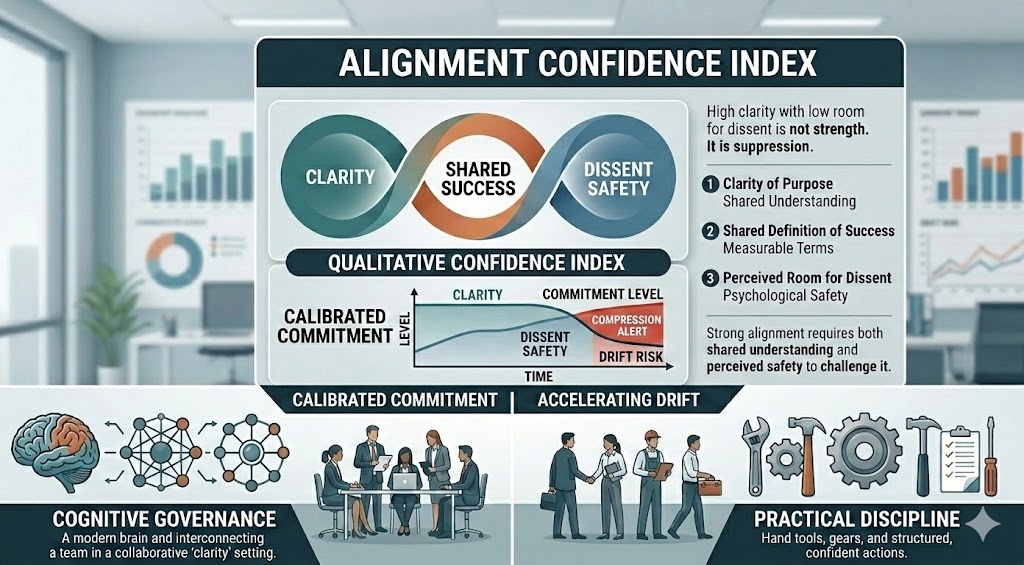 From Cognitive Governance to Practical Discipline If governance is cognitive architecture, it must become visible in practice. Awareness without structure becomes philosophy. Structure without awareness becomes bureaucracy. Operationalizing alignment does not require new layers of control. It requires deliberate validation rituals embedded before commitment. Below are four practical disciplines that translate cognitive governance into operational behavior. 1. Validation Before Authorization Before approving scope, funding or timelines, ask stakeholders to articulate the objective in their own words. Not to repeat the slide. But to explain:
Misalignment is cheaper to detect before commitment than after execution. 2. Assumption Mapping as a Governance Gate Every major decision rests on premises. Instead of documenting only risks, document:
Artificial intelligence can assist here. It can simulate scenarios, stress-test premises, and model what conditions would invalidate key assumptions. But simulation is not judgment. The discernment to accept, reject, or recalibrate a premise remains a human responsibility. Visibility reduces cognitive debt. 3. Structured Dissent Windows Speed compresses reflection. Create protected moments where questioning is expected. Before execution begins:
Alignment is not consensus. It is clarity in the presence of difference. 4. Alignment Pulse Checks Dashboards measure progress. They rarely measure coherence. Introduce periodic alignment reviews where stakeholders answer three questions:
It is a structured qualitative reading of coherence. High clarity with low room for dissent is not strength. It is suppression. Strong alignment requires both shared understanding and perceived safety to challenge it. The Alignment Confidence Index is directional, not absolute. It signals whether coherence is strengthening or eroding over time. A declining dissent signal with stable clarity is not stability. It is compression. The Alignment Confidence Index is not a performance metric. It is a viability metric. When the perceived room for dissent declines, project speed becomes its greatest danger. We are no longer accelerating value. We are accelerating drift without anyone feeling safe enough to pull the brake. Alignment is dynamic. It must be recalibrated, not assumed. From Speed to Discernment Operationalizing alignment is not about slowing projects indefinitely. It is about inserting disciplined pauses that prevent exponential rework. In complex environments, acceleration without validation creates structural drift. In the brain economy, information is abundant. Processing power is scalable. But discernment remains scarce. Discernment is not hesitation. It is calibrated commitment. Closing Reflection Projects do not drift because teams are inactive. They drift because interpretation was never synchronized. Governance becomes real when validation precedes execution. Alignment is not a declaration. It is a discipline. And discipline, when embedded early, protects both speed and trust. |
Posted on: March 04, 2026 03:44 AM
| Permalink |
Comments (0)
When Reflection Is Misread as Resistance
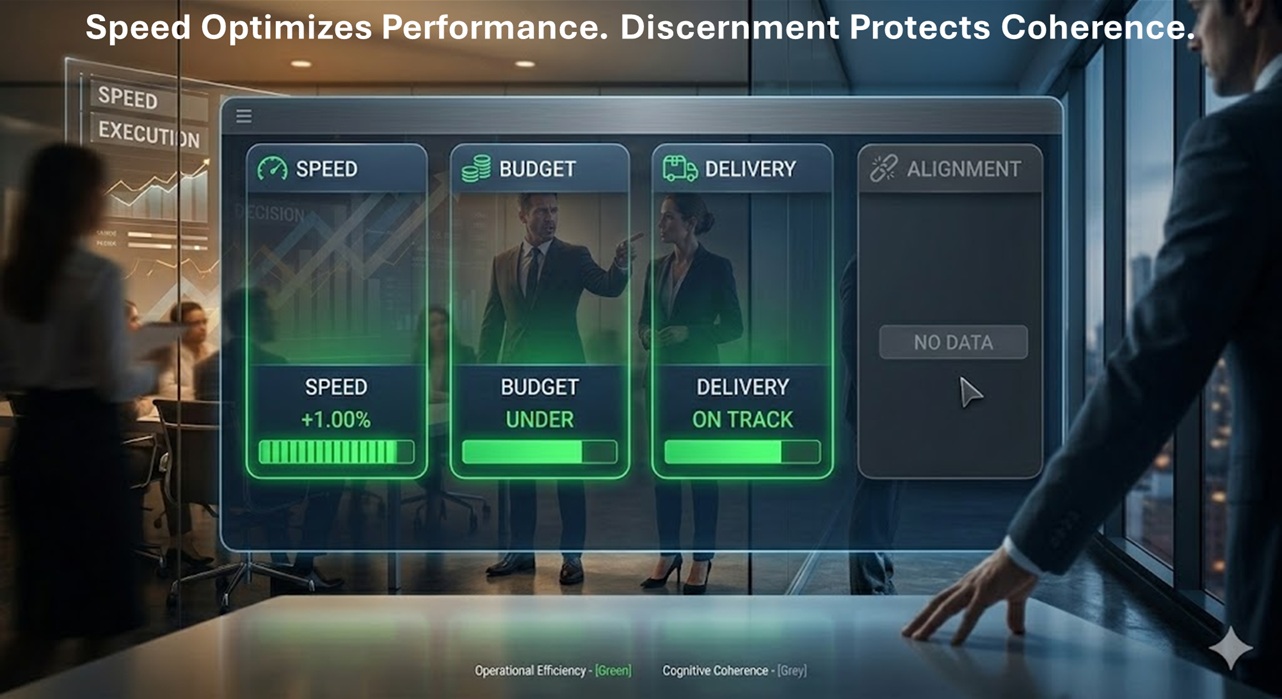 How High-Performance Cultures Accidentally Penalize Strategic Thinking High-performance cultures pride themselves on speed. Decisions are fast. Execution is decisive. Meetings are short. Momentum is visible. From the outside, this looks like strength. But inside many of these systems, a silent distortion emerges. Reflection begins to look like hesitation. Questioning begins to look like opposition. And dissent begins to look like disloyalty. That is where strategic drift quietly starts. The Invisible Cost of Symbolic Speed Speed has symbolic power. It signals confidence. It signals competence. It signals leadership presence. In competitive environments, velocity becomes a proxy for capability. But symbolic speed is not the same as strategic clarity. When acceleration becomes the dominant cultural signal, something subtle happens. People learn what is rewarded. Certainty is rewarded. Conviction is rewarded. Momentum is rewarded. Deliberation is tolerated, but not celebrated. Over time, the system optimizes for visible decisiveness rather than calibrated judgment. The cost is not immediate failure. The cost is unexamined alignment. The Social Status of Certainty In many organizations, certainty carries status. The leader who speaks decisively appears strong. The executive who expresses doubt risks being perceived as unsure. The manager who raises counterarguments may be labeled “negative”. This creates a distortion field. Intellectual humility is interpreted as fragility. Strategic questioning is misread as resistance. The result is not silence. It is selective speech. People still speak. They just avoid the questions that could slow momentum. And those are often the questions that protect coherence. When Questioning Becomes Socially Expensive Most strategic failures are not caused by ignorance. They are caused by unspoken divergence. Someone noticed the assumption was weak. Someone sensed the scope was drifting. Someone saw the misalignment emerging. But the environment did not reward interruption. When listening is not practiced as disciplined understanding, questioning is easily reframed as disruption. In high-pressure settings, questioning carries social cost. It can delay approval. It can irritate authority. It can create friction in front of stakeholders. So reflection is postponed. And postponed reflection compounds risk. Resistance Is Not a Single Category Not all resistance is equal. Some resistance is emotional, reactive and protective of comfort. That is unproductive obstruction. But some resistance is cognitive, principled and oriented toward coherence. That is strategic dissent. The inability to distinguish between the two is a governance failure. When every challenge is labeled resistance, the organization punishes its own early warning system. True maturity is not eliminating resistance. It is diagnosing its nature. Is this fear? Or is this foresight? Is this ego protection? Or is this coherence protection? Those are different phenomena. And they require different responses. Discernment as Leadership Discipline In the brain economy, information is abundant. Data is scalable. Simulation is automated. Discernment remains human. Discernment requires tolerance for pause. Tolerance for ambiguity. Tolerance for temporary discomfort. Leaders who cannot differentiate resistance from reflection will unintentionally cultivate artificial alignment. Everything moves. Nothing is questioned. Drift accelerates invisibly. High-performance cultures do not fail because they lack drive. They fail when they confuse momentum with maturity. From Acceleration to Calibration The solution is not slowing down indefinitely. It is legitimizing calibrated reflection. Create moments where questioning is expected, not exceptional. Reward those who surface structural risks early. Differentiate obstruction from strategic dissent through inquiry, not assumption. Speed is an amplifier. If coherence is strong, speed creates advantage. If coherence is weak, speed magnifies misalignment. Reflection is not resistance. It is disciplined protection of direction. And in complex systems, protecting direction is the highest form of performance. Reflection must be embedded in governance, not left to individual courage. |
Posted on: March 02, 2026 04:26 AM
| Permalink |
Comments (0)
When Activity Accelerates Drift
 Governance, Speed and the Illusion of Alignment Projects rarely collapse because nothing was done. They fail while everything appears to be moving. Meetings happen. Dashboards are updated. Milestones are achieved. Budgets are tracked. From the outside, progress is visible. Yet beneath that activity, something more subtle may be unfolding. Strategic coherence may be weakening while operational motion intensifies. Movement is not alignment. And activity is not governance. The Illusion of Progress In complex environments, progress is often measured by visible execution. But visible execution can coexist with invisible divergence. Teams may believe they share the same objective while holding different interpretations of success. Sponsors may assume alignment because updates are positive. Stakeholders may agree publicly while privately questioning direction. The system looks active. But its mental models are not synchronized. When divergence remains implicit, it does not stop execution. It distorts it. Rework, conflict and late corrections are often not operational failures. They are the downstream consequence of cognitive misalignment. Governance Is Cognitive Architecture Governance is frequently reduced to structures: Committees. Controls. Stage gates. Escalation paths. These mechanisms are necessary. But they are insufficient. True governance is the discipline of validating interpretation before committing execution. It asks: What are we assuming to be true? What evidence supports that belief? Whose interpretation has not been surfaced? When governance audits activity but ignores assumptions, it protects motion while neglecting coherence. In that moment, governance becomes procedural, not strategic. Speed Rewards Certainty There is a cultural force that makes assumption awareness difficult. Speed. In pressured environments, certainty is rewarded. Decisiveness is visible. Questioning can be perceived as hesitation. The disciplined pause required to surface premises feels inefficient. Yet that pause is often the most economically rational intervention available to leadership. Unvalidated assumptions compound. And speed amplifies them. In the emerging brain economy, information is abundant. Artificial intelligence can process data, simulate scenarios and optimize variables at scale. But discernment remains human. Discernment requires the courage to slow down long enough to test what feels obvious. Psychological Safety as Strategic Infrastructure Assumptions persist not only because leaders overlook them, but because environments discourage their exposure. People frequently detect gaps early. They remain silent when questioning carries social cost. Psychological safety is therefore not a cultural luxury. It is strategic infrastructure. When individuals can question shared interpretations without penalty, alignment becomes explicit rather than presumed. Cognitive transparency reduces future friction. Explicit divergence prevents structural drift. Maturity Is Conscious Decision In complex systems, maturity is not defined by acceleration. It is defined by awareness. A project can move quickly and still drift. An organization can execute efficiently and still misalign. Governance begins before the first milestone. It begins in the discipline of validating meaning. The greatest risk is not volatility. It is invisible divergence sustained by untested certainty. Leadership, at its highest level, is not the management of activity. It is the stewardship of coherence. And coherence is never accidental. It is consciously designed. |
Posted on: February 27, 2026 04:06 PM
| Permalink |
Comments (0)
Assumptions as Hidden Waste in Projects
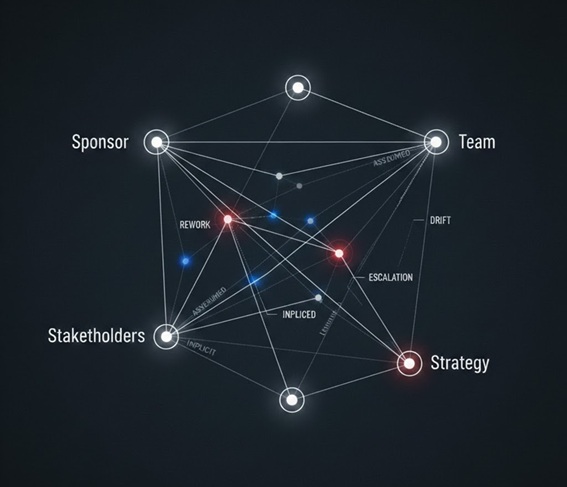 The Silent Driver of Rework, Conflict and Strategic Drift The most expensive waste in a project is rarely found in the schedule or the budget. It lives in assumptions that were never examined. When projects struggle, we tend to diagnose visible symptoms. Scope creep. Stakeholder resistance. Misalignment. Delays. Escalations. Rework. But many of these are not primary causes. They are consequences of beliefs treated as facts without being consciously validated. Unexamined assumptions are latent risk. They silently shape decisions before execution even begins. The Invisible Origin of Inefficiency Most project inefficiencies do not start with poor planning. They start with implicit thinking. Consider how often we hear statements such as:
Now consider the cost when one of them fails. If “the sponsor is aligned” proves false, late scope correction can trigger budget overruns, credibility loss and executive tension. If “the team understands the objective” is inaccurate, execution may be technically correct but strategically misdirected, leading to expensive rework. If “stakeholders will adapt” is optimistic, resistance may surface only after implementation, when change becomes harder and trust more fragile. By the time misalignment becomes visible, the cognitive error is already structural. Rework, conflict and delay are often the downstream cost of upstream assumptions. Assumptions Are Not Risks A risk is acknowledged uncertainty. An assumption is unacknowledged certainty. This distinction matters. Risks are documented, discussed and monitored. Assumptions often remain invisible because they feel obvious. Here is the difference clearly: Risk
Assumptions, when hidden, govern us. Yet assumptions shape:
The longer assumptions remain untested, the more expensive their correction becomes. Transactional Noise as a Symptom In pressured environments, communication often becomes transactional. Updates replace understanding. Reporting replaces reflection. Noise increases. But noise is rarely the root problem. It is a symptom of misaligned mental models. When assumptions differ and remain implicit:
Transactional communication often signals cognitive divergence beneath the surface. Listening as Invisible Risk Mitigation This is where listening becomes strategic. Listening is not courtesy. It is governance. When leaders listen deeply, they are not simply gathering opinions. They are surfacing hidden premises. They are mapping how people interpret reality. They are stress-testing intention before committing to direction. Listening reveals:
Every assumption made explicit reduces future rework. Every divergence clarified early protects alignment. Every perspective genuinely heard strengthens systemic coherence. Listening reduces entropy before entropy becomes cost. The Brain Economy Perspective In an era shaped by artificial intelligence and rapid automation, access to information is no longer the differentiator. The scarce resource is discernment. We are moving from a knowledge economy to a brain economy, where value is created not by accumulating data but by exercising judgment, interpretation and ethical clarity under complexity. AI can process information. It can generate scenarios. It can optimize parameters. But it does not naturally detect the implicit assumptions embedded in human intention unless those assumptions are made explicit. If assumptions remain hidden, even advanced systems will amplify flawed premises. Conscious decision-making begins with assumption awareness. Leadership in the brain economy requires the discipline to question what feels obvious. From Assumption Awareness to Regenerative Leadership Regenerative leadership does not eliminate uncertainty. It creates cognitive transparency. It asks:
Projects do not fail only because of volatility. They often falter because internal assumptions were never surfaced, challenged or aligned. Rework is expensive. Conflict is disruptive. Strategic drift is dangerous. But unexamined assumptions are the silent architects of all three. The greatest waste in a project is not always found in time or cost variance. It is found in the gap between what we think is true and what has never been consciously examined. Leadership begins when we close that gap. When we question before we commit. When we listen before we decide. When we make assumptions visible before they become structural liabilities. In complex environments, clarity is not accidental. It is designed. |
Posted on: February 24, 2026 03:09 PM
| Permalink |
Comments (1)
Seek First to Understand, Then to Be Understood
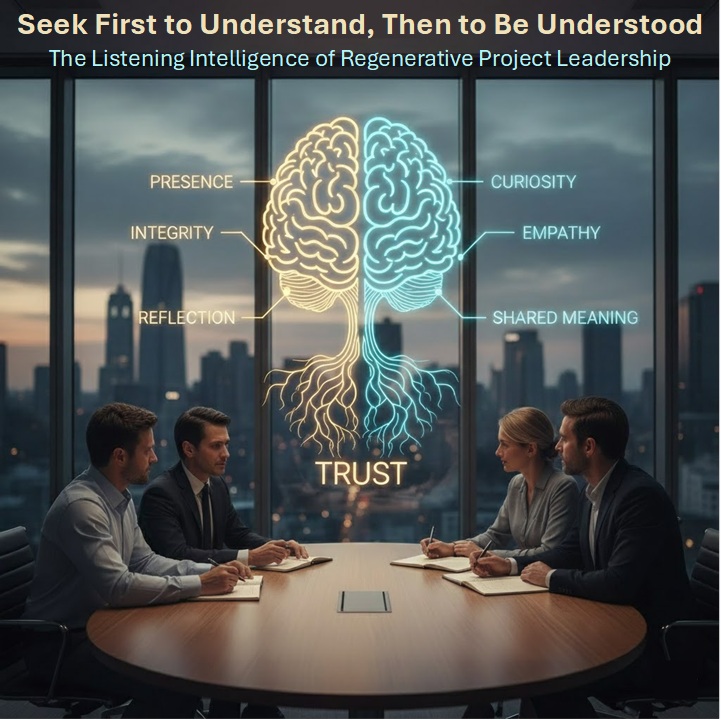 The greatest waste in a project is not found in the schedule, but in the noise of purely transactional communication. Leading regeneratively requires the courage to listen to understand, before responding to execute. The Listening Intelligence of Regenerative Project Leadership “Most people do not listen with the intent to understand; they listen with the intent to reply.” — Stephen R. Covey The Heart of Regenerative Communication In the rush of projects, communication often turns into a transaction, an exchange of updates, not understanding. But true leadership begins when we pause to listen beyond words. To seek first to understand is not weakness, it is wisdom in motion. It is the discipline of empathy, the courage to suspend judgment, and the intelligence to see through another’s lens before defending our own. In project leadership, this habit transforms conversations into connections, and meetings into moments of shared meaning. Listening as a Strategic Advantage A regenerative project leader knows that every misunderstanding has a cost, and every moment of genuine listening is an investment in trust. When we listen to understand:
It turns noise into knowledge and dialogue into design. Empathic Leadership Across the Project Cycle 🔸 Initiation - Understanding the Why Before defining scope or deliverables, the leader listens for the intention behind the request. What problem are we truly solving? What impact matters most? 🔸 Planning - Building Shared Meaning Planning sessions become spaces for collective sensemaking. Listening ensures that risks, expectations, and assumptions are voiced, not hidden. 🔸 Execution - Leading Through Dialogue When pressure rises, empathic leaders slow down to hear before reacting. They transform disagreement into discovery and defense into dialogue. 🔸 Monitoring - Hearing the Signals of the System Reports and metrics tell only part of the story. The rest lives in the tone of voices, the pauses, and the questions not asked. Listening reveals what data alone cannot. 🔸 Closure - Listening for Legacy True lessons learned come not from reports but from reflections. Listening to how people felt during the project uncovers the human insights that fuel regeneration. The Five Dimensions of Regenerative Listening
The Dialogue Room Imagine every project conversation as a Dialogue Room, a living space where perspectives converge to create understanding. Inside that room, listening is design, empathy is architecture, and trust is the invisible structure that holds the system together. It is where a project’s culture is shaped, and where communication becomes creation. Key Insight To seek first to understand is to lead with humility and strength. It is to recognize that comprehension precedes coordination, and that empathy precedes execution. Listening is not what happens before action, it is the first action. Key Message “Leadership begins not when we speak, but when we truly listen. Understanding is the bridge where trust - and every project - begins.” |
Posted on: February 22, 2026 04:48 PM
| Permalink |
Comments (0)


