


From Win-Win to Decision Architecture: Designing Integrity Under Constraint


 Recently, we explored “Think Win-Win” as a strategic discipline for leaders. But in high-complexity environments, we must confront a harder truth: under extreme pressure, system design matters more than individual intention. Under structural power asymmetry, fixed deadlines and political stakes, collaboration is not a personality trait. It is a designed decision environment. The question is no longer: Can we behave collaboratively? The real question is: Is our governance architecture capable of producing balanced decisions under pressure? Win-Win as Capability, Not IntentionIn high-stakes projects, alignment does not emerge from goodwill. It emerges from structure:
This is design, not optimism. Optionality as Governance DisciplineConflict escalates when optionality disappears. When leaders surface trade-offs early, before positions harden and political capital is invested, they preserve degrees of freedom. Optionality is not indecision. It is risk intelligence. By framing alternatives, modeling impact, and preparing a credible BATNA, leaders reduce escalation and protect institutional integrity. In that sense, anticipation is governance. Relational Capital as a Performance MultiplierProjects rarely fail only because of scope or budget. They fail because trust erodes. Relational capital accumulates or deteriorates decision after decision. Every structured Win-Win cycle:
It is a performance multiplier. Decision Architecture Under PressureWhen authority, urgency and risk converge, systems reveal their maturity. Weak architectures produce:
It is governance design. But architecture alone is not enough. If decision architecture is real, it must assume component failure. And in governance, components are human. From Decision Architecture to Decision EngineeringBias, ego, hierarchy, urgency and political exposure are not anomalies. They are structural forces. If we ignore them, architecture collapses into idealism. If we design for them, governance becomes engineering. The objective is not to eliminate failure. It is to contain it. Engineering Governance That Fails SafelyAgainst Criteria Manipulation Decision criteria must be defined before alternatives are presented. Those who define the scale should not know which weights will sit on it. Criteria should be audited against long-term strategy, not short-term pressure. Against Bureaucratic Paralysis Governance must be proportional to exposure and reversibility. Irreversible decisions require full architecture. Reversible decisions require delegated agility. All governance processes must be time-boxed to prevent analysis paralysis. Against Complacent Silence Hierarchy suppresses truth unless dissent is protected. Red teaming and structured pre-mortems institutionalize challenge and reduce blind spots. Against Short-Term Ego Process quality must be audited alongside outcomes. A good result produced by a flawed decision process is risk disguised as success. Relational capital must be embedded in executive evaluation. Against False Win-Win Not all negotiations produce abundance. The system must force explicit exposure mapping. Who loses what? Legitimacy increases when trade-offs are named and managed, not hidden. Final ReflectionIn volatile environments, leaders are not judged only by what they deliver. They are judged by the durability of the decision system they leave behind. When collaboration depends on personality, it is fragile. When it depends on architecture, it is scalable. When architecture anticipates human failure, it becomes resilient. Win-Win is easy when conditions are favorable. The real test is whether your governance system can produce balanced, evidence-based, integrity-driven decisions when power, scarcity and urgency collide. That is the difference between leadership as influence, decision architecture as design, and decision engineering as resilience. |
Posted on: February 20, 2026 04:46 AM
| Permalink |
Comments (1)
Think Win-Win Under Pressure
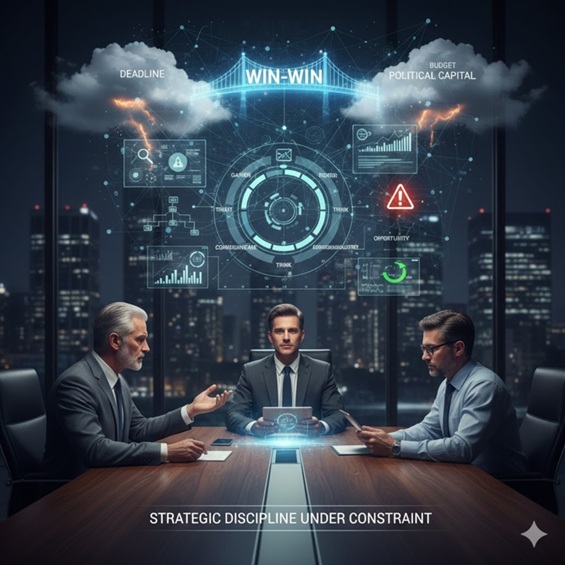 Strategy, Power and Performance in Real Projects Stephen Covey popularized “Think Win-Win” as a principle of character. In real projects, however, character alone is not enough. Projects operate under asymmetry of power, fixed deadlines, constrained budgets and competing agendas. Sponsors hold authority. Teams hold technical truth. Project Managers stand in between, accountable for delivery but rarely sovereign over resources. Under pressure, Win-Win stops being a moral aspiration. It becomes a strategic discipline. The real question is not whether Win-Win is desirable. It is whether it is viable when power, risk and performance collide. Win-Win in Environments of Power In executive settings:
A strategic Win-Win anticipates it. The discipline requires three recognitions:
Scenario: Sponsor Escalation Under Deadline Pressure During execution, a Sponsor demands the addition of a high-visibility feature without extending the deadline. The team warns of schedule risk. Finance signals budget sensitivity. Market pressure is rising. This is not a classroom case. It is a live governance moment. The decision must protect:
1. Gather – Power and Data Clarity Beyond technical effort estimates, the executive layer must be mapped:
Data protects integrity. 2. Consult – Negotiation Based on Interests In asymmetric contexts, positions are loud. Interests are hidden. Instead of debating “add or not add,” surface underlying drivers:
The objective is not to resist authority, but to reframe authority around shared value. Speaking truth to power requires preparation, not emotion. 3. Think – Value, Trade-Offs and Controlled Sacrifice Abundance is not automatic. Trade-offs are real. Executive Win-Win may involve:
Example: If a phased MVP maintains SPI stability while increasing projected business value by 20 percent, the solution is not compromise. It is optimization. Win-Win is credible when it improves the system, not when it pleases individuals. 4. Communicate – Structured Executive Alignment Under power pressure:
Executive Win-Win is not about harmony. It is about disciplined alignment. 5. Verify – Performance and Relational Capital After decision:
It is a performance multiplier. Repeated Lose-Win dynamics erode capacity. Repeated Win-Win cycles build governance maturity. The Role of BATNA in Executive Win-Win Not every negotiation produces abundance. A disciplined leader prepares a Best Alternative to a Negotiated Agreement. If alignment fails:
It prepares for it. Controlled loss is superior to unmanaged conflict. Win-Win as Strategic Advantage In high-pressure projects:
It is governance maturity. Final Reflection Under pressure, leaders reveal their operating philosophy. Some optimize for dominance. Some optimize for compliance. Few optimize for systemic value. Thinking Win-Win in real projects is not about being agreeable. It is about being strategically disciplined under constraint. The true test is not whether we can collaborate when conditions are favorable. It is whether we can preserve value, integrity and performance when authority, risk and urgency converge. Where in your current portfolio is Win-Win being tested not as an idea, but as a governance decision under pressure? |
Posted on: February 18, 2026 06:21 AM
| Permalink |
Comments (1)
Think Win-Win in Projects - Turning Principles into Practice
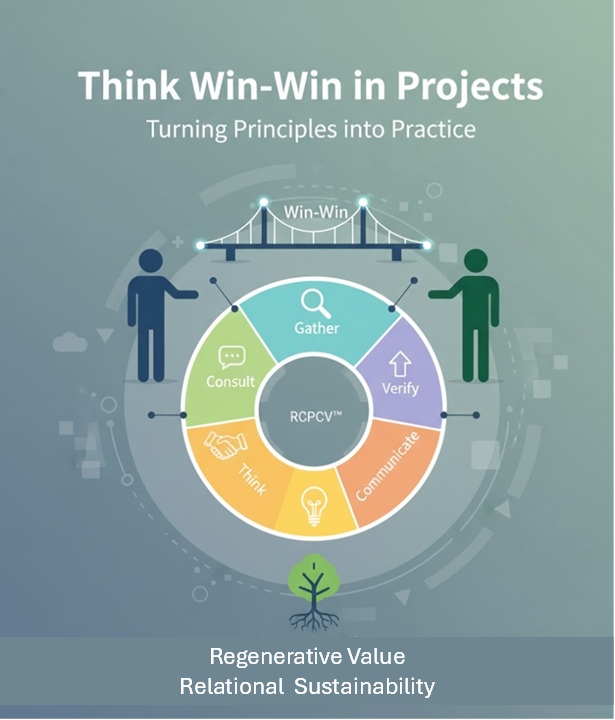 One of Stephen Covey’s timeless principles - Habit 4: Think Win-Win - reminds us that real leadership isn’t about winning arguments, but about creating value that everyone can own. In the world of projects, this mindset changes everything. It transforms negotiations into collaboration and conflict into co-creation. Win-Win doesn’t mean compromise or being “nice.” It means seeking solutions where results, relationships, and purpose grow together. In my own work, I translate this principle into daily practice through the RCPCV™ Ethical Decision Cycle, a regenerative model that turns ethical intent into practical clarity. Here’s how “Think Win-Win” comes alive in a real project situation Context: Project Scope Negotiation Scenario: During project execution, the Sponsor requests a new feature without extending the deadline. The Technical Team warns this would increase effort and risk. The challenge: reach a mutually beneficial agreement that sustains both trust and delivery. 1. Gather — Understand Before Reacting
Focus: understanding before positioning. 2. Consult — Listen to Those Affected
Focus: turn negotiation into collaboration. 3. Think — Explore Ethical and Sustainable Options Possible options:
Focus: find abundant solutions — all sides gain legitimately. 4. Communicate — Negotiate Transparently
Focus: turn understanding into shared decision. 5. Verify — Monitor and Learn from the Decision
Focus: sustain trust as a regenerative asset. The Win-Win Mindset, Regeneratively 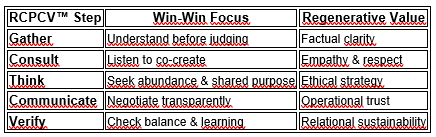 Final Insight “Think Win-Win” becomes tangible when RCPCV™ is practiced as an ethical discipline. Each decision cycle is an opportunity to regenerate trust, align purpose, and transform conflict into collaboration. Where in your projects could a Win-Win mindset shift a recurring tension into collaboration? |
Posted on: February 16, 2026 06:56 AM
| Permalink |
Comments (0)
From Attention Drift To Attention Governance
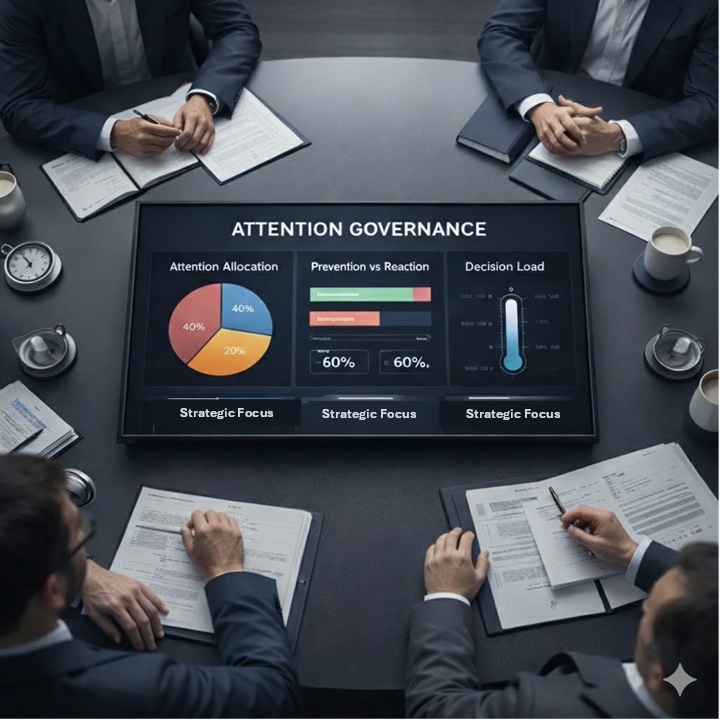 Making the Invisible Visible in Project Leadership In the previous article, I argued that execution rarely fails because of poor intent or lack of effort. It fails because attention quietly drifts. Purpose is often clear at the beginning of a project. What erodes is not commitment, but focus. One small compromise at a time. That diagnosis raises a natural next question. If attention is the real failure point, how do we govern it? Awareness Is Not Enough Recognising attention drift is necessary, but insufficient. Organisations routinely fail not because they ignore problems, but because they notice them too late. By the time execution visibly breaks down, attention has already shifted irreversibly toward urgency, reaction, and noise. Without explicit mechanisms, attention defaults to what is loudest, most visible, and easiest to justify in the moment. Governing attention requires making the invisible observable. Attention as a Systemic Asset In complex projects, attention behaves like a finite resource. It can be:
Attention is shaped by structure, incentives, capacity limits, and decision load. In other words, attention is not managed by motivation. It is governed by system design. Four Pillars of Attention Governance 1. Indicators of Attention Health Traditional project metrics track progress, cost, and delivery. They say little about where attention is actually going. Healthy governance introduces leading indicators, for example:
They are alignment signals. 2. Strategic Slack No system can protect attention at 100% utilisation. When capacity is fully consumed, every disturbance forces attention away from what matters toward what burns. Urgency always wins. Slack is not waste. It is the structural condition that allows prevention, learning, and judgment. Without slack, attention governance is impossible by design. 3. Short Feedback Loops Attention drift is gradual. Correction must be frequent. Rituals such as retrospectives, phase reviews, or steering checkpoints serve a deeper purpose than reporting. They are re-alignment mechanisms. They answer a simple but powerful question: Are we still spending attention on what creates value? The shorter the loop, the smaller the drift. 4. Decision Load and Leadership Fatigue Attention often fails at the top. Leaders under constant decision pressure suffer from fatigue, not incompetence. Fatigued leaders accept “reasonable exceptions” that slowly accumulate into systemic erosion. Governing attention means:
From Reflection to Governance If attention truly determines value, it cannot remain implicit. It must become a formal agenda item in governance forums:
The critical shift is this: Attention is no longer assumed. It is examined. A Practical Next Step One simple move can change the trajectory of a project. Introduce an Attention Check in governance meetings:
They drift because no one was explicitly responsible for guarding attention. Closing Reflection Execution discipline is not about working harder, faster, or longer. It is about designing systems that protect focus, preserve energy, and align decisions with purpose over time. Attention, when governed, compounds value. When left to default, it guarantees entropy. The choice is structural, not personal. |
Posted on: February 13, 2026 05:15 AM
| Permalink |
Comments (2)
When Execution Fails, Attention Has Already Drifted
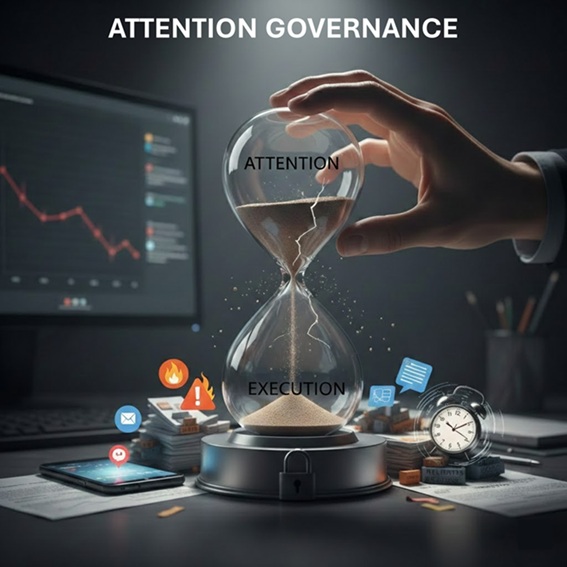 Why Well-Intentioned Projects Lose Direction Without Noticing Most projects do not fail because people lack commitment. They fail because attention slowly drifts. At the start, purpose is usually clear. Objectives are defined, success criteria agreed, and intent is aligned. The erosion does not begin with bad decisions, but with many small, reasonable ones. Each choice makes sense locally. Taken together, they quietly displace what once mattered. Execution rarely collapses. It unravels. The Illusion of Urgency Urgency takes over not because teams lack discipline, but because reaction feels safer than prevention. Responding is visible. Firefighting is noticed. Thinking ahead is easy to postpone. Over time, organisations reward responsiveness and availability, not foresight and prevention. Teams adapt rationally to these signals. Effort increases. Hours stretch. Coordination intensifies. Direction fades. Eventually, exhaustion becomes a substitute for progress. This is not a productivity issue. It is a signalling problem. When Effort Replaces Direction Many teams work longer and harder precisely because they are losing coherence. As attention fragments, more effort is required just to maintain momentum. Plans still exist. Meetings still happen. Reports still flow. Yet the gap between plan and reality grows. Not because people stopped caring, but because attention was never explicitly protected. Busyness fills the void left by absent governance. Execution Is an Attention Problem Disciplined execution is often framed as better planning, tighter controls, or stronger accountability. These help, but they miss the deeper issue. Execution is the result of where attention consistently settles. When attention defaults to urgency, value erodes. When attention is deliberately protected, value compounds. This is why execution discipline is not a personal trait. It is a governance choice. The Silent Role of Leadership Leadership failure in projects is rarely dramatic. It is usually quiet. It shows up when leaders do not:
They react. They respond. They stay busy. And slowly, almost imperceptibly, purpose slips away. Governing Attention Healthy projects treat attention as a scarce, strategic asset. They recognise that:
Left unmanaged, it fragments. When protected, it becomes a force multiplier. Where Value Compounds or Disappears Projects rarely fail because people do not care. They fail when focus erodes quietly, one compromise at a time. Where attention settles, value either compounds or slips away. The question for project leaders is not whether teams are working hard enough. It is whether attention is being deliberately protected, or left to default. Because by the time execution visibly fails, attention has already been lost. |
Posted on: February 11, 2026 04:39 AM
| Permalink |
Comments (3)


