Support to Develop
by Luis Branco
This blog addresses management-related topics and has three areas of focus: 1. Technical skills; 2. Competencies in the field of interpersonal relations and communication (including personal organization and delegation, leadership, teamwork, conflict resolution, conducting meetings, and negotiation); and 3. Strategy (including diagnosis, strategic guidelines, and implementation).4.Technology
Recent Posts
The Self-Reinforcing Organization
What Should Never Be Optimized Away?
What If Organizing Work Is No Longer Primarily a Human Capability?
Where Does Organizational Wisdom Live?
Organizational Wisdom
Categories
Agile,
Career Development,
Career Development,
Career Development,
Career Development,
Career Development,
Career Development,
Career Development,
Career Development,
Career Development,
Career Development,
Career Development,
Career Development,
Career Development,
Career Development,
Career Development,
Career Development,
Career Development,
Career Development,
Career Development,
Career Development,
Career Development,
Career Development,
Career Development,
Career Development,
Career Development,
Career Development,
Career Development,
Career Development,
Career Development,
Career Development,
Career Development,
Career Development,
Career Development,
Career Development,
Career Development,
Career Development,
Career Development,
Career Development,
Career Development,
Career Development,
Career Development,
Career Development,
Career Development,
Career Development,
Career Development,
Career Development,
Career Development,
Career Development,
Career Development,
Career Development,
Career Development,
Career Development,
Career Development,
Career Development,
Career Development,
Career Development,
Career Development,
Career Development,
Career Development,
Career Development,
Career Development,
Career Development,
Career Development,
Career Development,
Career Development,
Career Development,
Career Development,
Career Development,
Career Development,
Career Development,
Career Development,
Career Development,
Career Development,
Career Development,
Career Development,
Career Development,
Career Development,
Career Development,
Career Development,
Career Development,
Career Development,
Career Development,
Career Development,
Career Development,
Career Development,
Career Development,
Career Development,
Career Development,
Career Development,
Career Development,
Career Development,
Career Development,
Career Development,
Career Development,
Career Development,
Career Development,
Interpersonal Skills,
Leadership,
Leadership,
Leadership,
Leadership,
Leadership,
Leadership,
Leadership,
Leadership,
Leadership,
Leadership,
Leadership,
Leadership,
Leadership,
Leadership,
Leadership,
Leadership,
Leadership,
Leadership,
Leadership,
Leadership,
Leadership,
Leadership,
Leadership,
Leadership,
Leadership,
Leadership,
Leadership,
Leadership,
Leadership,
Leadership,
Leadership,
Leadership,
Leadership,
Leadership,
Leadership,
Leadership,
Leadership,
Leadership,
Leadership,
Leadership,
Leadership,
Leadership,
Leadership,
Leadership,
Leadership,
Leadership,
Leadership,
Leadership,
Leadership,
Leadership,
Leadership,
Leadership,
Leadership,
Leadership,
Leadership,
Leadership,
Leadership,
Leadership,
Leadership,
Leadership,
Leadership,
Leadership,
Leadership,
Leadership,
Leadership,
Leadership,
Leadership,
Leadership,
Leadership,
Leadership,
Leadership,
Leadership,
Leadership,
Leadership,
Leadership,
Leadership,
Leadership,
Leadership,
Leadership,
Leadership,
Leadership,
Leadership,
Leadership,
Leadership,
Leadership,
Leadership,
Leadership,
Leadership,
Leadership,
Leadership,
Leadership,
Leadership,
Leadership,
Leadership,
Leadership,
Leadership,
Leadership,
Strategy,
Strategy,
Strategy,
Strategy,
Strategy,
Strategy,
Strategy,
Strategy,
Strategy,
Strategy,
Strategy,
Strategy,
Strategy,
Strategy,
Strategy,
Strategy,
Strategy,
Strategy,
Strategy,
Strategy,
Strategy,
Strategy,
Strategy,
Strategy,
Strategy,
Strategy,
Strategy,
Strategy,
Strategy,
Strategy,
Strategy,
Strategy,
Strategy,
Strategy,
Strategy,
Strategy,
Strategy,
Strategy,
Strategy,
Strategy,
Strategy,
Strategy,
Strategy,
Strategy,
Strategy,
Strategy,
Strategy,
Strategy,
Strategy,
Strategy,
Strategy,
Strategy,
Strategy,
Strategy,
Strategy,
Strategy,
Strategy,
Strategy,
Strategy,
Strategy,
Strategy,
Strategy,
Strategy,
Strategy,
Strategy,
Strategy,
Strategy,
Strategy,
Strategy,
Strategy,
Strategy,
Strategy,
Strategy,
Strategy,
Strategy,
Strategy,
Strategy,
Strategy,
Strategy,
Strategy,
Strategy,
Strategy,
Strategy,
Strategy,
Strategy,
Strategy,
Strategy,
Strategy,
Strategy,
Strategy,
Strategy,
Strategy,
Strategy,
Strategy,
Strategy,
Strategy,
Sustainability,
Talent Management,
Talent Management,
Talent Management,
Talent Management,
Talent Management,
Talent Management,
Talent Management,
Talent Management,
Talent Management,
Talent Management,
Talent Management,
Talent Management,
Talent Management,
Talent Management,
Talent Management,
Talent Management,
Talent Management,
Talent Management,
Talent Management,
Talent Management,
Talent Management,
Talent Management,
Talent Management,
Talent Management,
Talent Management,
Talent Management,
Talent Management,
Talent Management,
Talent Management,
Talent Management,
Talent Management,
Talent Management,
Talent Management,
Talent Management,
Talent Management,
Talent Management,
Talent Management,
Talent Management,
Talent Management,
Talent Management,
Talent Management,
Talent Management,
Talent Management,
Talent Management,
Talent Management,
Talent Management,
Talent Management,
Talent Management,
Talent Management,
Talent Management,
Talent Management,
Talent Management,
Talent Management,
Talent Management,
Talent Management,
Talent Management,
Talent Management,
Talent Management,
Talent Management,
Talent Management,
Talent Management,
Talent Management,
Talent Management,
Talent Management,
Talent Management,
Talent Management,
Talent Management,
Talent Management,
Talent Management,
Talent Management,
Talent Management,
Talent Management,
Talent Management,
Talent Management,
Talent Management,
Talent Management,
Talent Management,
Talent Management,
Talent Management,
Talent Management,
Talent Management,
Talent Management,
Talent Management,
Talent Management,
Talent Management,
Talent Management,
Talent Management,
Talent Management,
Talent Management,
Talent Management,
Talent Management,
Talent Management,
Talent Management,
Talent Management,
Talent Management,
Talent Management
Date

(Advanced complementary post to Pillar 9 – Regenerative Learning and Pillar 10 – Ecosystem Integration)
Not every transformation is immediately visible. But no regeneration becomes real until it can be seen — and seen together.
Because a system only evolves when it learns to observe itself. And people only move in coherence when they perceive the same reality.
As someone recently wrote in this series: “Regenerative progress begins with shared perception.”
That single line captures the heart of regenerative leadership:
Progress gains momentum the moment people interpret the same signals and recognize the value they create together.
Visibility without shared interpretation is just data. Shared interpretation without visibility is just belief. Regeneration begins when seeing + sensemaking + aligning become one movement.
What Shared Perception Unlocks
1. Coherence - When everyone reads the same system Fragmentation happens when teams observe the same facts but assign different meanings. Shared perception:
- Aligns direction,
- Reduces noise,
- Stabilizes collective energy.
It is the antidote to disorientation.
2. Flow - When aligned signals synchronize decisions Progress no longer depends on escalation. Decisions stop getting stuck in competing interpretations. When everyone sees the same map:
- Small contributions compound,
- Work finds rhythm,
- The system moves like a single organism.
3. Value Conversations - When dashboards shift from reporting to sensemaking Dashboards that only summarize create compliance. Dashboards that guide create awareness. The shift happens when indicators:
- Stop concluding and start inviting questions,
- Stop reporting and start orienting,
- Stop monitoring and start making meaning.
That’s the moment reporting becomes sensemaking.
4. Responsibility - When people see how their actions shape the whole Shared perception reveals:
- How my work influences the system,
- How my choices create invisible effects,
- Where i generate value, or noise.
And when people see this, they naturally step into regenerative responsibility.
Practical Example In an industrial innovation network, three companies only shared financial KPIs. Decisions were slow. Trust was fragile. Progress was invisible.
They created a shared perception map, integrating:
- Perceived risks,
- Emerging opportunities,
- Circular value indicators,
- Signals of tension in the system,
- Active learning insights.
Immediately, meetings transformed:
- Less noise,
- More meaning,
- Synchronized decisions,
- Continuous innovation.
The system gained life because, for the first time, it could see itself.
Regenerative Synthesis Regeneration doesn’t begin in structures. It begins in how the system perceives itself.
Because: When everyone sees the same system → coherence emerges. When everyone interprets together → rhythm arises. When everyone owns their impact → culture transforms.
Shared perception is where collective awareness awakens and regeneration stops being theory and becomes a living practice.
And in your organization? Do people see the same system? Or do they operate inside mental maps that collide without ever aligning?
This post is part of the series The 11 Keys of Regenerative Leadership. |
Posted on: November 21, 2025 07:45 AM
|
Permalink |
Comments (1)

Complementary post to Pillar 10 - Integration with the Ecosystem
Not every transformation is visible at first.
But no regeneration can last if it cannot be seen.
Trust begins when the system learns to see itself, when people look in the same direction, share the same purpose, and recognize the value they create together.
As someone recently wrote in this space: “Small shifts only create momentum when progress is visible.”
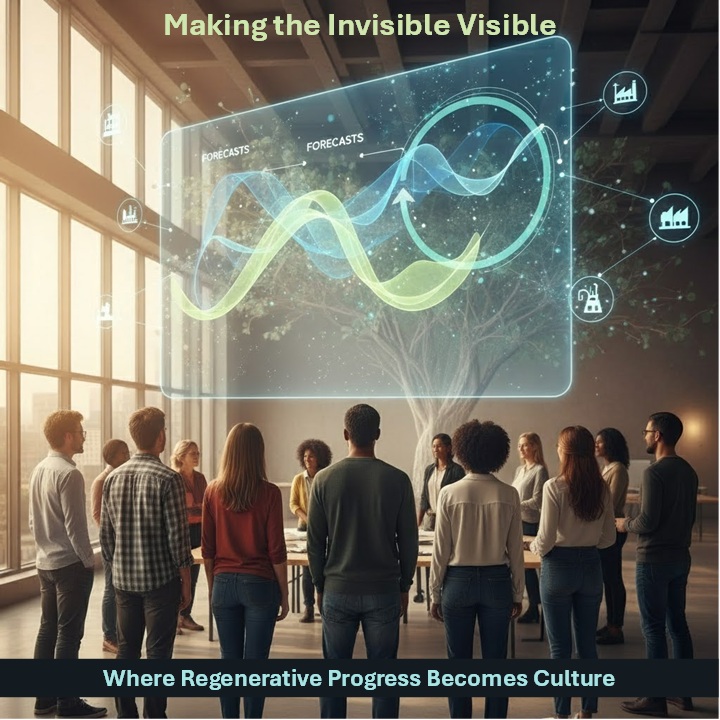
That phrase captures the essence of regenerative leadership: Making the invisible visible, not through control, but through consciousness.
Seeing progress means seeing the system evolve.
It’s when metrics turn into meaning and indicators become conversations.
In practice, this means:
- Creating shared visibility - dashboards and indicators that reveal collective impact;
- Turning value into something transparent and co-authored, not controlled;
- Sustaining decisions through living feedback loops that keep the ecosystem continuously learning.
Practical example: In a circular value chain, several SMEs began sharing forecasts, risks, and opportunities in real time. Reports stopped being audit tools and became maps of collective learning.
The result: less waste, more trust, and a continuous cycle of innovation.
Regenerative Insight A system regenerates when it learns to see itself. Trust grows when progress becomes visible. And culture flourishes when learning turns into shared awareness.
And in your organization: Do your metrics exist to control — or to help you understand the system you are regenerating?
This post is part of the series The 11 Keys of Regenerative Leadership. |
Posted on: November 19, 2025 09:55 AM
|
Permalink |
Comments (2)

(Advanced complementary post to Pillar 10 - Ecosystem Integration)
There is something that never appears in governance frameworks. It’s not in org charts. It’s not in policies. It’s not in dashboards.
Yet it shapes everything.
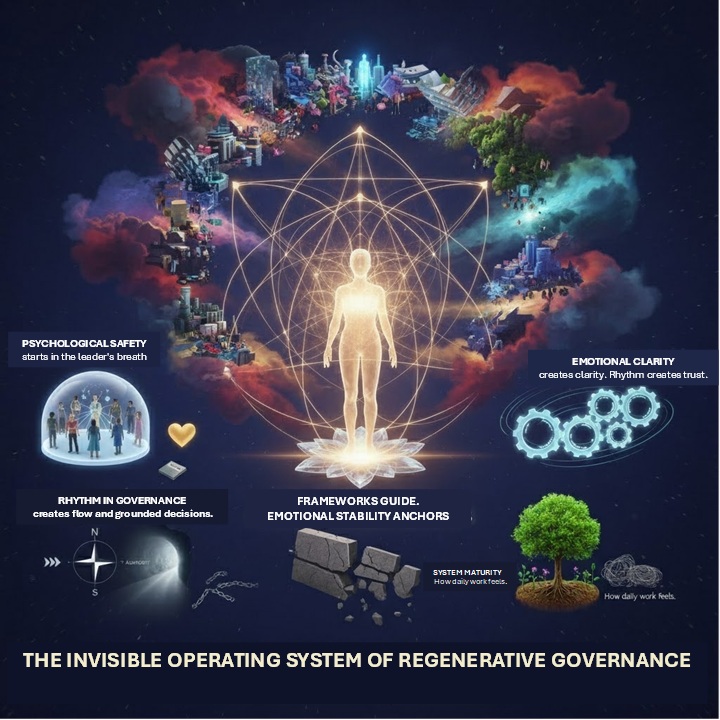
The emotional stability of the leader.
It is the invisible operating system of governance
The quiet force that keeps the ecosystem coherent when tension rises, complexity expands, and risk demands maturity.
As someone beautifully commented in this series: “When trust becomes architecture, governance gains rhythm.”
And that rhythm, that flow, depends on the emotional presence of the leader.
Frameworks guide. But emotional stability anchors.
Why emotional stability is the operating system of governance
1. It builds psychological safety, long before any policy
When pressure rises, teams don’t look for rules. They look for presence.
A leader with emotional stability:
- Lowers systemic anxiety,
- Reduces defensiveness,
- Creates space to think instead of react.
Psychological safety starts in the leader’s breath, not in the manual.
2. It turns risk into clarity, not into threat
Emotional clarity + risk clarity = mature decisions.
A grounded leader:
- Makes risk appetite explicit,
- Defines real boundaries,
- Gives teams the courage to decide without fear.
Emotional stability is what transforms risk into alignment, not escalation.
3. It turns governance into rhythm, not friction
Governance doesn’t live in meetings. It lives in cadence.
And cadence breaks when there is:
- Emotional reactivity,
- Fear of mistakes,
- Constant need for approval.
It accelerates when the leader:
- Stays centered,
- Listens without defence,
- Responds without destabilizing the system.
Emotional stability creates rhythm. Rhythm creates trust.
4. It gives the system maturity, more than any framework can
Frameworks are useful. But frameworks without emotional maturity become noise.
When the leader is stable:
- Collaboration becomes lighter,
- Conversations become honest,
- Conflicts become regenerative,
- Relationships stop draining energy.
Emotional stability is not visible in metrics, but in how daily work feels.
Practical Example In a complex multi-stakeholder programme, governance was stalled: Slow decisions, recurring conflict, growing distrust.
The shift began with one movement: - The leader adopted emotional stability as a daily discipline.
- Reduced artificial urgency
- Introduced sense-making pauses
- Clarified risk appetite and decision rights
- Stayed calm in difficult conversations
What happened?
- Meetings stopped being defensive
- Collaboration began to flow
- Escalations disappeared
- Decisions became faster and safer
- And the system started correcting itself
Governance evolved, not through new processes, but because the operating system changed.
Regenerative Synthesis
A leader’s emotional stability is the silent pillar of regenerative governance. It does not control: it connects. It does not react: it orients. It does not impose rhythm: it creates the rhythm where trust grows. It does not protect rules: it protects relationships.
In the end, the question is simple:
Does your internal operating system create stability… or amplify tension in the ecosystem you lead?
This post is part of the series The 11 Keys to Regenerative Leadership |
Posted on: November 17, 2025 09:15 AM
|
Permalink |
Comments (4)

(Advanced complementary post to Pillar 10 - Ecosystem Integration)
Not all governance creates evolution.
Some controls. Some constrains.
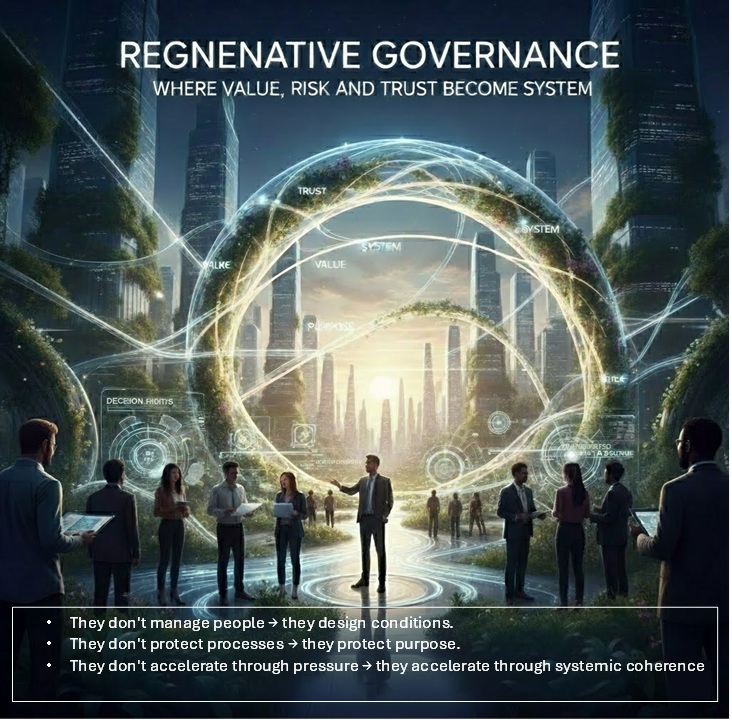
Regenerative governance, however, liberates because it turns trust into architecture, not aspiration.
As someone wrote recently in this space: “Governance is a living system, not a gatekeeper.”
That sentence is a turning point.
Governance stops policing and becomes stewardship: Caring for the ecosystem, orchestrating value, aligning awareness.
In practice, regenerative organizations do something most overlook: They don’t manage people → they design conditions. They don’t protect processes → they protect purpose. They don’t accelerate through pressure → they accelerate through systemic coherence.
What defines Regenerative Governance?
1. Clear Risk Appetite → Courage with Boundaries When risk appetite is explicit, teams stop guessing. Decision-making becomes safe.
And safe becomes fast.
2. Explicit Decision Rights → Alignment Instead of Escalation Who decides what, when, and with which authority. Without this, there is no trust, only friction.
Regenerative governance draws circles of decision, not pyramids of validation.
3. The PMO as a Service → Value Felt, Not Just Reported A regenerative PMO does not police - it serves. It listens to stakeholders, captures real expectations, and measures perceived value, not only delivered value.
This is customer-centric governance.
4. Value-in-Use + Perception of Value → Living Value Regenerative value is not a benefit on paper - it is a benefit in use. How is the value felt? Who experiences it? What changes in the system?
When perception of value enters governance, commitment rises and resistance fades.
5. ESG Integrated into Cadence → Impact as Routine Not an annex. Not a report.
A decision criterion.
ESG becomes a compass: What do we protect? What do we regenerate? Who benefits? Which risks are ethical, not only technical?
6. Governance as Stewardship → Caring for the System, Not the Gate The role of regenerative governance is to strengthen the relationships that hold the ecosystem together.
Stewardship = purpose + care + transparency + shared responsibility.
7. Faster, Safer Decisions → The Result of Systemic Maturity Speed doesn’t come from pressure. It comes from clarity.
When risk, value, trust and transparency align, decisions flow naturally.
Not because someone forces them, but because they make sense.
Practical Example In a multi-stakeholder program, traditional governance was slowing down decisions. The shift began with just three moves:
- Clear risk appetite, distinguishing acceptable from non-negotiable risk.
- Decision rights mapped across each value stream.
- Cadence reviews integrating ESG, perceived value and real benefits.
The result?
Fewer escalations Faster and safer decisions Higher trust between partners A system that evolved while delivering
Regenerative Synthesis Regenerative governance doesn’t control, it connects. It doesn’t impose rhythm, it creates the rhythm where collective intelligence grows.
It doesn’t protect boundaries, it protects relationships.
Because in the end, the essential question remains: Are we extracting from the ecosystem or strengthening the ecosystem that keeps us alive?
This post is part of the series The 11 Keys of Regenerative Leadership. |
Posted on: November 14, 2025 08:28 AM
|
Permalink |
Comments (2)

(Complementary post to Pillar 10 — Ecosystem Integration)
Transparency is not a risk. It’s the structure where collective intelligence grows.
One of the most striking comments in this series said: “Trust gives permission for honesty.”
And that phrase says it all. Because trust is not declared, it’s designed. Designed into the way we decide, measure, and learn.
In regenerative governance, trust is not just a human value, it’s a living architecture.
An invisible infrastructure that keeps the system coherent, even under pressure.
Regenerative leaders and organizations build systems where:
- Information flows freely, reducing fear and accelerating innovation;
- Errors are shared before they become failures;
- Value metrics include learning, transparency, and shared impact.
Practical example: In a multi-stakeholder program, the team adopted flow indicators and psychological-safety agreements for each cycle. Meetings stopped being audits, they became spaces of co-creation.
Over time, control gave way to collective awareness, and performance grew without losing autonomy.
Regenerative Synthesis Regenerative governance is not a rulebook. It’s a system of relationships that learns.
Regenerative growth begins when governance itself learns. Because trust, here, is not belief, it’s the infrastructure of evolution.
And in your organization: Is trust a belief… or has it already become a system?
This post is part of the series The 11 Keys of Regenerative Leadership. |
Posted on: November 12, 2025 09:16 AM
|
Permalink |
Comments (0)

|
"Interestingly, according to modern astronomers, space is finite. This is a very comforting thought--particularly for people who can never remember where they have left things."
- Woody Allen
|