Support to Develop
by Luis Branco

This blog addresses management-related topics and has three areas of focus: 1. Technical skills; 2. Competencies in the field of interpersonal relations and communication (including personal organization and delegation, leadership, teamwork, conflict resolution, conducting meetings, and negotiation); and 3. Strategy (including diagnosis, strategic guidelines, and implementation).4.Technology
Recent Posts
The Self-Reinforcing Organization
What Should Never Be Optimized Away?
What If Organizing Work Is No Longer Primarily a Human Capability?
Where Does Organizational Wisdom Live?
Organizational Wisdom
Categories
Agile,
Career Development,
Career Development,
Career Development,
Career Development,
Career Development,
Career Development,
Career Development,
Career Development,
Career Development,
Career Development,
Career Development,
Career Development,
Career Development,
Career Development,
Career Development,
Career Development,
Career Development,
Career Development,
Career Development,
Career Development,
Career Development,
Career Development,
Career Development,
Career Development,
Career Development,
Career Development,
Career Development,
Career Development,
Career Development,
Career Development,
Career Development,
Career Development,
Career Development,
Career Development,
Career Development,
Career Development,
Career Development,
Career Development,
Career Development,
Career Development,
Career Development,
Career Development,
Career Development,
Career Development,
Career Development,
Career Development,
Career Development,
Career Development,
Career Development,
Career Development,
Career Development,
Career Development,
Career Development,
Career Development,
Career Development,
Career Development,
Career Development,
Career Development,
Career Development,
Career Development,
Career Development,
Career Development,
Career Development,
Career Development,
Career Development,
Career Development,
Career Development,
Career Development,
Career Development,
Career Development,
Career Development,
Career Development,
Career Development,
Career Development,
Career Development,
Career Development,
Career Development,
Career Development,
Career Development,
Career Development,
Career Development,
Career Development,
Career Development,
Career Development,
Career Development,
Career Development,
Career Development,
Career Development,
Career Development,
Career Development,
Career Development,
Career Development,
Career Development,
Career Development,
Career Development,
Career Development,
Interpersonal Skills,
Interpersonal Skills,
Interpersonal Skills,
Interpersonal Skills,
Interpersonal Skills,
Interpersonal Skills,
Interpersonal Skills,
Interpersonal Skills,
Interpersonal Skills,
Interpersonal Skills,
Interpersonal Skills,
Interpersonal Skills,
Interpersonal Skills,
Interpersonal Skills,
Interpersonal Skills,
Interpersonal Skills,
Interpersonal Skills,
Interpersonal Skills,
Interpersonal Skills,
Interpersonal Skills,
Interpersonal Skills,
Interpersonal Skills,
Interpersonal Skills,
Interpersonal Skills,
Interpersonal Skills,
Interpersonal Skills,
Interpersonal Skills,
Interpersonal Skills,
Interpersonal Skills,
Interpersonal Skills,
Interpersonal Skills,
Interpersonal Skills,
Interpersonal Skills,
Interpersonal Skills,
Interpersonal Skills,
Interpersonal Skills,
Interpersonal Skills,
Interpersonal Skills,
Interpersonal Skills,
Interpersonal Skills,
Interpersonal Skills,
Interpersonal Skills,
Interpersonal Skills,
Interpersonal Skills,
Interpersonal Skills,
Interpersonal Skills,
Interpersonal Skills,
Interpersonal Skills,
Interpersonal Skills,
Interpersonal Skills,
Interpersonal Skills,
Interpersonal Skills,
Interpersonal Skills,
Interpersonal Skills,
Interpersonal Skills,
Interpersonal Skills,
Interpersonal Skills,
Interpersonal Skills,
Interpersonal Skills,
Interpersonal Skills,
Interpersonal Skills,
Interpersonal Skills,
Interpersonal Skills,
Interpersonal Skills,
Interpersonal Skills,
Interpersonal Skills,
Interpersonal Skills,
Interpersonal Skills,
Interpersonal Skills,
Interpersonal Skills,
Interpersonal Skills,
Interpersonal Skills,
Interpersonal Skills,
Interpersonal Skills,
Interpersonal Skills,
Interpersonal Skills,
Interpersonal Skills,
Interpersonal Skills,
Interpersonal Skills,
Interpersonal Skills,
Interpersonal Skills,
Interpersonal Skills,
Interpersonal Skills,
Interpersonal Skills,
Interpersonal Skills,
Interpersonal Skills,
Interpersonal Skills,
Interpersonal Skills,
Interpersonal Skills,
Interpersonal Skills,
Interpersonal Skills,
Interpersonal Skills,
Interpersonal Skills,
Interpersonal Skills,
Interpersonal Skills,
Interpersonal Skills,
Leadership,
Leadership,
Leadership,
Leadership,
Leadership,
Leadership,
Leadership,
Leadership,
Leadership,
Leadership,
Leadership,
Leadership,
Leadership,
Leadership,
Leadership,
Leadership,
Leadership,
Leadership,
Leadership,
Leadership,
Leadership,
Leadership,
Leadership,
Leadership,
Leadership,
Leadership,
Leadership,
Leadership,
Leadership,
Leadership,
Leadership,
Leadership,
Leadership,
Leadership,
Leadership,
Leadership,
Leadership,
Leadership,
Leadership,
Leadership,
Leadership,
Leadership,
Leadership,
Leadership,
Leadership,
Leadership,
Leadership,
Leadership,
Leadership,
Leadership,
Leadership,
Leadership,
Leadership,
Leadership,
Leadership,
Leadership,
Leadership,
Leadership,
Leadership,
Leadership,
Leadership,
Leadership,
Leadership,
Leadership,
Leadership,
Leadership,
Leadership,
Leadership,
Leadership,
Leadership,
Leadership,
Leadership,
Leadership,
Leadership,
Leadership,
Leadership,
Leadership,
Leadership,
Leadership,
Leadership,
Leadership,
Leadership,
Leadership,
Leadership,
Leadership,
Leadership,
Leadership,
Leadership,
Leadership,
Leadership,
Leadership,
Leadership,
Leadership,
Leadership,
Leadership,
Leadership,
Leadership,
Strategy,
Strategy,
Strategy,
Strategy,
Strategy,
Strategy,
Strategy,
Strategy,
Strategy,
Strategy,
Strategy,
Strategy,
Strategy,
Strategy,
Strategy,
Strategy,
Strategy,
Strategy,
Strategy,
Strategy,
Strategy,
Strategy,
Strategy,
Strategy,
Strategy,
Strategy,
Strategy,
Strategy,
Strategy,
Strategy,
Strategy,
Strategy,
Strategy,
Strategy,
Strategy,
Strategy,
Strategy,
Strategy,
Strategy,
Strategy,
Strategy,
Strategy,
Strategy,
Strategy,
Strategy,
Strategy,
Strategy,
Strategy,
Strategy,
Strategy,
Strategy,
Strategy,
Strategy,
Strategy,
Strategy,
Strategy,
Strategy,
Strategy,
Strategy,
Strategy,
Strategy,
Strategy,
Strategy,
Strategy,
Strategy,
Strategy,
Strategy,
Strategy,
Strategy,
Strategy,
Strategy,
Strategy,
Strategy,
Strategy,
Strategy,
Strategy,
Strategy,
Strategy,
Strategy,
Strategy,
Strategy,
Strategy,
Strategy,
Strategy,
Strategy,
Strategy,
Strategy,
Strategy,
Strategy,
Strategy,
Strategy,
Strategy,
Strategy,
Strategy,
Strategy,
Strategy,
Sustainability,
Talent Management,
Talent Management,
Talent Management,
Talent Management,
Talent Management,
Talent Management,
Talent Management,
Talent Management,
Talent Management,
Talent Management,
Talent Management,
Talent Management,
Talent Management,
Talent Management,
Talent Management,
Talent Management,
Talent Management,
Talent Management,
Talent Management,
Talent Management,
Talent Management,
Talent Management,
Talent Management,
Talent Management,
Talent Management,
Talent Management,
Talent Management,
Talent Management,
Talent Management,
Talent Management,
Talent Management,
Talent Management,
Talent Management,
Talent Management,
Talent Management,
Talent Management,
Talent Management,
Talent Management,
Talent Management,
Talent Management,
Talent Management,
Talent Management,
Talent Management,
Talent Management,
Talent Management,
Talent Management,
Talent Management,
Talent Management,
Talent Management,
Talent Management,
Talent Management,
Talent Management,
Talent Management,
Talent Management,
Talent Management,
Talent Management,
Talent Management,
Talent Management,
Talent Management,
Talent Management,
Talent Management,
Talent Management,
Talent Management,
Talent Management,
Talent Management,
Talent Management,
Talent Management,
Talent Management,
Talent Management,
Talent Management,
Talent Management,
Talent Management,
Talent Management,
Talent Management,
Talent Management,
Talent Management,
Talent Management,
Talent Management,
Talent Management,
Talent Management,
Talent Management,
Talent Management,
Talent Management,
Talent Management,
Talent Management,
Talent Management,
Talent Management,
Talent Management,
Talent Management,
Talent Management,
Talent Management,
Talent Management,
Talent Management,
Talent Management,
Talent Management,
Talent Management
Date
| 
Complementary post to Pillar 8 - Authenticity & Presence
Not every transformation starts with a new strategy.
Some begin with inner silence.
Because before regenerating systems, a leader must regenerate awareness.
Regenerative leadership doesn’t rely only on frameworks, it thrives on inner growth.
It’s the invisible work that sustains every visible decision.
Regenerative leaders reflect on themselves, share responsibility, and consciously shape their impact within the system.
They don’t react with haste, they respond with presence.
And they know: no external regeneration exists without internal evolution.
The Leader’s Inner Operating System (IOS) - 5 Core Practices:
1. Presence check-in (3 minutes daily) - observe body, heart, mind and spirit before deciding.
A brief pause to align action, emotion, thought, and purpose, the four dimensions that sustain ethical and living decisions.
“The spiritual dimension is your center, your commitment to value and purpose, the source of your drive and vision.”
Stephen R. Covey, The 8th Habit
2. Ethical intention (RCPCV™) - before acting, ask: who is affected and how?
3. Shared-responsibility map - make visible who decides, who contributes, and who validates.
4. Impact journal - record what endures in people and processes beyond KPIs.
5. Reflection cadence - bi-weekly learn–unlearn–relearn sessions with the team.
Field note:
In an organizational transformation, we replaced “status meetings” with short presence + impact reviews.
Within roughly eight weeks, the average time needed to consolidate new team habits, a visible pattern emerged: less defensiveness, stronger alignment, and naturally distributed ownership.
Regenerative Synthesis
Frameworks give structure.
But it’s inner work that gives them life.
Without inner growth, every method is mechanics.
With awareness, it becomes living culture.
In your context: which inner practice could add depth without losing speed?
This post is part of the series “The 11 Keys to Regenerative Leadership.”
|
Posted on: October 29, 2025 02:22 PM
|
Permalink |
Comments (1)
| 
Complementary Post to Pillar 8 – Authenticity & Presence
A reader recently wrote:
“Authenticity only has real impact when it doesn’t have to work against the system.”
That sentence stayed with me.
Because it reveals an essential truth:
Authenticity is not just an individual virtue, it’s a collective construction.
In environments where time dominates, trust is fragile, and mistakes are punished, authenticity becomes resistance.
But in conscious cultures, with psychological safety and shared purpose, it becomes a regenerative force.
Authenticity needs architecture.
It’s not enough to ask people to “be authentic.”
We must design systems that don’t punish truth, that honor listening, and that turn vulnerability into learning.
In regenerative leadership, this means building invisible infrastructures that sustain the human side of the system:
- Meetings that start with presence, not pressure;
- Decisions that include consultation, not just command;
- Cultures that treat mistakes as living data, not moral failures.
Practical Example:
In a company going through cultural transition, the COO decided to close every meeting by asking:
“What wasn’t said, but needed to be heard?”
At first, silence prevailed.
But over time, voices began to emerge honest, human, and constructive.
Decisions became stronger, trust grew, and the atmosphere shifted from defense to contribution.
Authenticity stopped being a riskand, became culture.
Regenerative Synthesis
Authenticity is a human act, but also an organizational design.
Regenerative leaders understand that presence is only sustainable when the system welcomes it.
Because individual coherence flourishes within collective architecture.
Regenerative Outcome
When authenticity is protected by culture, the system becomes more human, and the human, more sustainable.
And in your context:
Does the system you work in protect or punish authenticity?
This post is part of the series “The 11 Keys to Regenerative Leadership.”
|
Posted on: October 27, 2025 10:31 AM
|
Permalink |
Comments (1)
| 
Complementary post to Pillar 8 - Authenticity & Presence
Inspired by a reflection from the community:
“What often goes unnoticed is how authenticity sharpens decision-making.
When leaders are grounded in who they are, they see complexity with greater clarity.”
Not all leadership is measured by voice.
Sometimes, what transforms a decision is the pause between what we hear and what we say.
In regenerative leadership, decisional presence is the ability to hold silence until the essential reveals itself.
It is not inaction, It is action with awareness.
A leader who decides from presence:
- Listens before responding,
- Observes before judging,
- Integrates before acting.
In this context, silence is not emptiness
It is intelligence in incubation.
It is the space where the ego quiets down, and the system begins to speak.
Practical example:
During a critical meeting, a director was pressured to choose between two opposing strategic paths.
Instead of responding immediately, he asked for a minute of silence and listened to what wasn’t being said.
He realized the tension wasn’t about the options, but about a lack of trust between teams.
He chose to first bring both leadership groups together, rebuild dialogue, and align intentions.
Two weeks later, the decision emerged naturally and was approved by consensus.
Trust between teams increased visibly, conflicts subsided, and the plan moved forward with greater clarity and cohesion.
Silence didn’t delay the decision.
It made it clearer, more ethical, and more effective.
The true power of decision doesn’t come from the urge to solve, but from the courage to understand.
Presence is thinking with your whole being, not just your mind.
And in your context - what might silence reveal if there were space to listen before deciding?
This post is part of the series The 11 Keys to Regenerative Leadership
|
Posted on: October 24, 2025 09:07 AM
|
Permalink |
Comments (2)
| 
Complementary Post to Pillar 8 – Authenticity & Presence
Inspired by a reflection from the community:
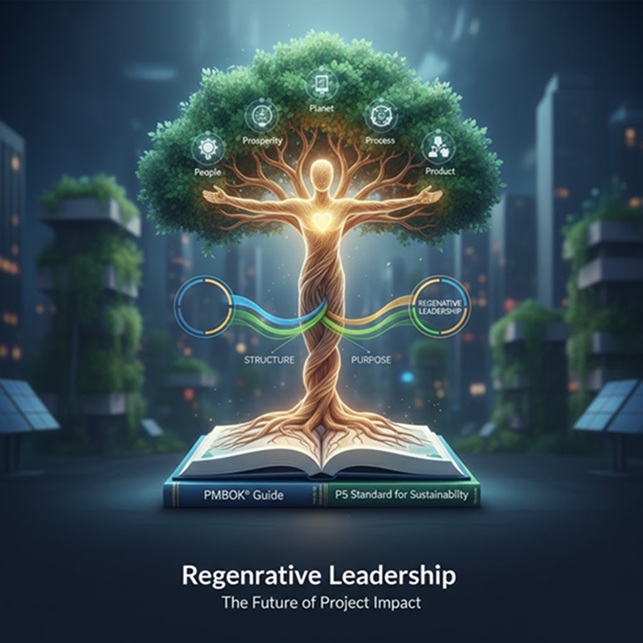
“In my own experience leading digital and construction projects, I’ve observed how genuine presence, rooted in servant leadership and supported by frameworks such as PMI’s PMBOK® Guide and the P5 Standard for Sustainability, creates environments where collaboration, ethical decisions, and value truly thrive.”
In project management, we learn that every project is an instrument of value:
- It creates results, impact, and change.
But in today’s world, delivering value is no longer enough.
We must regenerate value, rebuilding trust, purpose, and future across teams, organizations, and ecosystems.
Regenerative Leadership emerges precisely from this convergence:
Between the structure of the PMBOK® Guide, the awareness of the P5 Standard for Sustainability, and the human presence that gives meaning to execution.
1. From Process to Consciousness
The PMBOK® Guide defines processes, inputs, and outputs and that structure is essential.
Yet regenerative leadership adds something invisible:
- The quality of the energy with which each process is lived.
Inspired by Servant Leadership, Emotional Intelligence, and Positive Psychology, this approach views the leader’s presence as a tangible manifestation of awareness, empathy, and purpose.
It is not enough to follow the flow, we must feel the system.
As Systems Thinking teaches, understanding the feedback loops and interdependencies that sustain (or erode) trust and culture is essential to build learning and coherence.
Every meeting, decision, or delivery becomes a space for ethical awareness and collective growth.
2. From Delivered Value to Regenerated Value
The P5 Standard for Sustainability expanded the concept of value by integrating People, Planet, Prosperity, Processes, and Products.
Regenerative leadership strengthens this foundation, reminding us that:
- Prosperity without purpose is unsustainable.
- Process without presence is mechanical.
- Product without ethics is empty.
To regenerate is to go beyond compliance, it is to lead with systemic awareness.
And while the traditional leader measures ROI (Return on Investment),
the regenerative leader also considers SROI (Social Return on Investment) and ROE (Return on Ecosystem), metrics that evaluate how much healthier, more resilient, and more connected the system becomes after a project.
Because regeneration is not just an ethical stance.
It is a strategic advantage, building organizational resilience and ensuring enduring impact.
3. Practical Example
In an industrial project transitioning to the P5 Standard, the project manager realized that the main challenge was not technical, but cultural: the team was executing without a shared sense of purpose.
He decided to apply RCPCV™ (Gather, Consult, Think, Communicate, and Verify) a structured reflective process that promotes dialogue, clarity, and ethical validation before decision-making.
The result was a collaborative redesign of the scope, integrating environmental and social objectives without delaying the schedule.
- The PMBOK® Guide brought rigor.
- The P5 Standard brought purpose.
- Regenerative Leadership brought meaning.
This approach aligns with recognized practices such as Design Thinking and Stakeholder Analysis, yet adds an essential step: ethical verification, which reinforces trust and transparency throughout the process.
4. From Manager to Ecosystem
The traditional manager measures time, cost, and risk.
The regenerative leader also measures energy, coherence, and culture.
They understand that the true delivery of a project is the state in which it leaves the human system after execution.
Delivering the project is important.
Leaving the system healthier, more conscious, and more confident than before, that is regenerative leadership.
Managing time, cost, and risk is the minimum requirement.
Regenerating impact is the new condition for survival and the true competitive advantage.
In my view, the future of the profession is not merely to manage projects,
but to regenerate trust, purpose, and impact in every delivery, decision, and relationship.
This post is part of the series “The 11 Keys to Regenerative Leadership.”
Note: This text reflects the author’s personal vision and does not represent PMI®.
|
Posted on: October 22, 2025 09:17 AM
|
Permalink |
Comments (3)
| 
This is the eighth post in the series “The 11 Keys to Regenerative Leadership”
In a time of hyper-exposure and professional masks, authenticity has become a transformational force.
But it’s not enough to “be authentic”
Leaders must lead from who they are, with real and responsible presence.
In regenerative leadership, presence is not just being in the room.
- It means listening truthfully.
- Showing vulnerability without losing clarity.
- Being consistent between words, actions and decisions.
When a leader is truly present:
- People relax into contribution, not into defense
- Conflict becomes a space for learning, not punishment
- Trust grows from congruence, not from authority
Practical example:
In an organization undergoing transition, the CEO began each critical meeting with a personal check-in.
Brief. Genuine. Never imposed.
The result?
The team began to trust decisions more, because they could see who was making them.
Performance improved - not through control, but through presence.
Regenerative authenticity is not about saying everything.
It’s about not hiding who we are in what we do.
And in your context: is leadership presence a source of coherence — or a performance mask?
This post is part of the series The 11 Keys to Regenerative Leadership
|
Posted on: October 20, 2025 09:30 AM
|
Permalink |
Comments (4)
|
I watched the Indy 500, and I was thinking that if they left earlier they wouldn't have to go so fast.
- Steven Wright
|




