





.jpg)





Guessing is not a strategy: How to build decision velocity with AI and real-time data
June 10, 2026 | Live Webinar

The Emerging Tensions of Adaptive Governance
From Statistical Patterns to Operational Judgment
ORGANIZATIONAL MEMORY & DECISION CONTINUITY
RESPONSIBLE DECISION ARCHITECTURE™
Decision Architecture Under Pressure
Agile, Career Development, Career Development, Career Development, Career Development, Career Development, Career Development, Career Development, Career Development, Career Development, Career Development, Career Development, Career Development, Career Development, Career Development, Career Development, Career Development, Career Development, Career Development, Career Development, Career Development, Career Development, Career Development, Career Development, Career Development, Career Development, Career Development, Career Development, Career Development, Career Development, Career Development, Career Development, Career Development, Career Development, Career Development, Career Development, Career Development, Career Development, Career Development, Career Development, Career Development, Career Development, Career Development, Career Development, Career Development, Career Development, Career Development, Career Development, Career Development, Career Development, Career Development, Career Development, Career Development, Career Development, Career Development, Career Development, Career Development, Career Development, Career Development, Career Development, Career Development, Career Development, Career Development, Career Development, Career Development, Career Development, Career Development, Career Development, Career Development, Career Development, Career Development, Career Development, Career Development, Career Development, Career Development, Career Development, Career Development, Interpersonal Skills, Interpersonal Skills, Interpersonal Skills, Interpersonal Skills, Interpersonal Skills, Interpersonal Skills, Interpersonal Skills, Interpersonal Skills, Interpersonal Skills, Interpersonal Skills, Interpersonal Skills, Interpersonal Skills, Interpersonal Skills, Interpersonal Skills, Interpersonal Skills, Interpersonal Skills, Interpersonal Skills, Interpersonal Skills, Interpersonal Skills, Interpersonal Skills, Interpersonal Skills, Interpersonal Skills, Interpersonal Skills, Interpersonal Skills, Interpersonal Skills, Interpersonal Skills, Interpersonal Skills, Interpersonal Skills, Interpersonal Skills, Interpersonal Skills, Interpersonal Skills, Interpersonal Skills, Interpersonal Skills, Interpersonal Skills, Interpersonal Skills, Interpersonal Skills, Interpersonal Skills, Interpersonal Skills, Interpersonal Skills, Interpersonal Skills, Interpersonal Skills, Interpersonal Skills, Interpersonal Skills, Interpersonal Skills, Interpersonal Skills, Interpersonal Skills, Interpersonal Skills, Interpersonal Skills, Interpersonal Skills, Interpersonal Skills, Interpersonal Skills, Interpersonal Skills, Interpersonal Skills, Interpersonal Skills, Interpersonal Skills, Interpersonal Skills, Interpersonal Skills, Interpersonal Skills, Interpersonal Skills, Interpersonal Skills, Interpersonal Skills, Interpersonal Skills, Interpersonal Skills, Interpersonal Skills, Interpersonal Skills, Interpersonal Skills, Interpersonal Skills, Interpersonal Skills, Interpersonal Skills, Interpersonal Skills, Interpersonal Skills, Interpersonal Skills, Interpersonal Skills, Interpersonal Skills, Interpersonal Skills, Interpersonal Skills, Leadership, Leadership, Leadership, Leadership, Leadership, Leadership, Leadership, Leadership, Leadership, Leadership, Leadership, Leadership, Leadership, Leadership, Leadership, Leadership, Leadership, Leadership, Leadership, Leadership, Leadership, Leadership, Leadership, Leadership, Leadership, Leadership, Leadership, Leadership, Leadership, Leadership, Leadership, Leadership, Leadership, Leadership, Leadership, Leadership, Leadership, Leadership, Leadership, Leadership, Leadership, Leadership, Leadership, Leadership, Leadership, Leadership, Leadership, Leadership, Leadership, Leadership, Leadership, Leadership, Leadership, Leadership, Leadership, Leadership, Leadership, Leadership, Leadership, Leadership, Leadership, Leadership, Leadership, Leadership, Leadership, Leadership, Leadership, Leadership, Leadership, Leadership, Leadership, Leadership, Leadership, Leadership, Leadership, Leadership, Leadership, Strategy, Strategy, Strategy, Strategy, Strategy, Strategy, Strategy, Strategy, Strategy, Strategy, Strategy, Strategy, Strategy, Strategy, Strategy, Strategy, Strategy, Strategy, Strategy, Strategy, Strategy, Strategy, Strategy, Strategy, Strategy, Strategy, Strategy, Strategy, Strategy, Strategy, Strategy, Strategy, Strategy, Strategy, Strategy, Strategy, Strategy, Strategy, Strategy, Strategy, Strategy, Strategy, Strategy, Strategy, Strategy, Strategy, Strategy, Strategy, Strategy, Strategy, Strategy, Strategy, Strategy, Strategy, Strategy, Strategy, Strategy, Strategy, Strategy, Strategy, Strategy, Strategy, Strategy, Strategy, Strategy, Strategy, Strategy, Strategy, Strategy, Strategy, Strategy, Strategy, Strategy, Strategy, Strategy, Strategy, Sustainability, Talent Management, Talent Management, Talent Management, Talent Management, Talent Management, Talent Management, Talent Management, Talent Management, Talent Management, Talent Management, Talent Management, Talent Management, Talent Management, Talent Management, Talent Management, Talent Management, Talent Management, Talent Management, Talent Management, Talent Management, Talent Management, Talent Management, Talent Management, Talent Management, Talent Management, Talent Management, Talent Management, Talent Management, Talent Management, Talent Management, Talent Management, Talent Management, Talent Management, Talent Management, Talent Management, Talent Management, Talent Management, Talent Management, Talent Management, Talent Management, Talent Management, Talent Management, Talent Management, Talent Management, Talent Management, Talent Management, Talent Management, Talent Management, Talent Management, Talent Management, Talent Management, Talent Management, Talent Management, Talent Management, Talent Management, Talent Management, Talent Management, Talent Management, Talent Management, Talent Management, Talent Management, Talent Management, Talent Management, Talent Management, Talent Management, Talent Management, Talent Management, Talent Management, Talent Management, Talent Management, Talent Management, Talent Management, Talent Management, Talent Management, Talent Management, Talent Management


|
In the last article, entitled: "The paradigm of people as a whole", was suggested a simple way of thinking about life, addressing the 4 dimensions of the person as a whole, his needs, intelligences and attributes and how to ignite the inner fire and we find our voice. Today we are going to reflect on what people expect from their work, the main chronic and acute problems and the response of companies and organizations of the industrial era to solve these problems People and work People make choices. Consciously or unconsciously, people decide how much of themselves they will dedicate to work, according to the way they are treated and the opportunities to use the 4 parts of their nature.
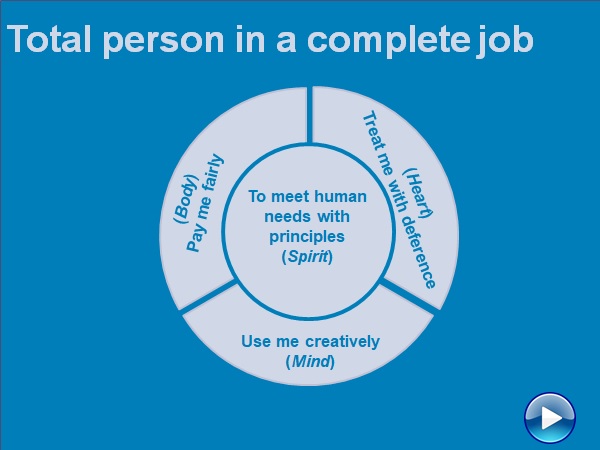
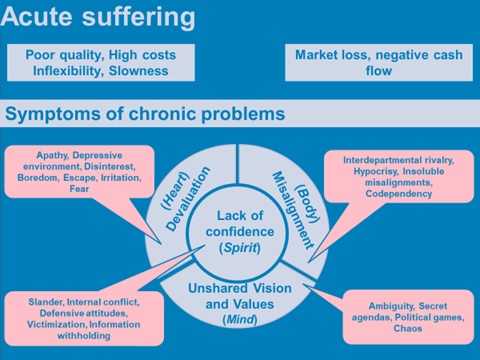
Only someone who is respected as a total person in a full-time job - who receives a fair wage, is neither treated, is used creatively and has opportunities to satisfy human needs with principles makes choices for lively cooperation, deep dedication or creative enthusiasm. Chronic and acute problems There are, in our body and in organizations, two types of chronic and acute problems. Chronic means underlying, causal, continued. Acute means painful, symptomatic, debilitating. Organizations like people have chronic problems that are not yet acute. Treating acute problems can mask the underlying chronic disease Not all chronic diseases have acute symptoms. Before these appear there are diseases (like cancer) that spread until it’s too late. Just because we don't see the superficial symptoms does not mean that the underlying problems are not present. The same applies to organizations. There can be serious chronic problems in an organization that does not show acute signs, because some organizations do not compete in tough, global markets: they compete in local or protected markets. If body, mind, heart or spirit are neglected, we will have four chronic problems in an organization - lack of confidence, lack of vision and shared values, misalignment and weakness - and all the acute symptoms that accompany them.
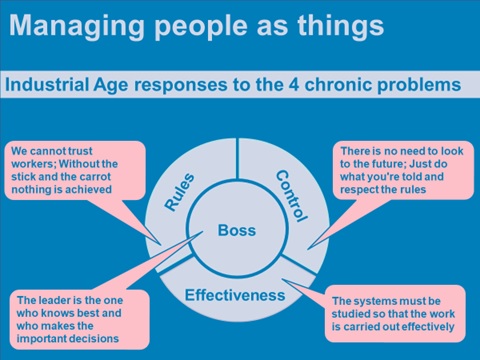
The joint results of these chronic problems and their symptoms are acute suffering from failure in the market, negative cash flow, low quality, inflated costs, inflexibility, slowness and many mutual accusations: a culture of blame, rather than a culture of responsibility. Industrial-era response What would be the reaction in the industrial age to these four chronic problems? If there is little trust and no moral authority, the boss is at the center - the leader knows what is best and makes all the decisions. “Do it MY way or get out. The rules will take the place of vision and mission. Misalignment? Make things more efficient: the machines, the standards, the people, everything. Efficiency matters. Weakening? You need to maintain control. We cannot trust people. The only way to get people to surrender is to use the carrot and the whip - show them the carrot (the rewards) to motivate performance and maintain a healthy level of fear with the whip (punishment or job loss) if the performance leave something to be desired.
Questions for reflection Are there any of these problems in your company and / or organization? In your opinion are they acute or chronic? What was the answer found in your organization to solve these problems? Are there other answers, different from those of the industrial age, that can be considered?
Fonte: O 8º Hábito - Da Eficácia à Grandeza Stephen R. Covey |
|
The paradigm of people as a whole If we study philosophies and religions (Western or Eastern), from the earliest historical records we find the four dimensions of human beings: physical / economic, mental, socio / emotional and spiritual. The fundamental reality is that human beings are not things that need to be motivated and controlled. They are beings with four dimensions: Body, Mind, Heart and Spirit.
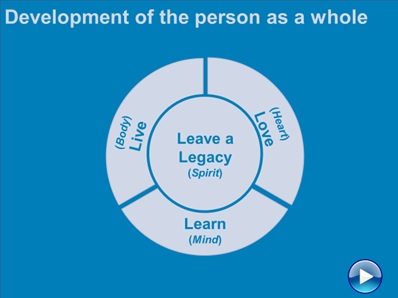
They also represent the 4 basic needs and motivations of all people: Live (survival), Love (Relationships), Learn (Growth and Development), Leave a Legacy (Meaning and Contribution).
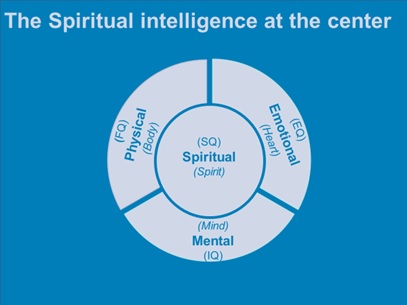
The intelligences of human nature The 4 magnificent parts of our nature are body, mind, heart and spirit. Each of these parts corresponds to a capacity, or intelligence that we all have. Our physical or bodily intelligence (FQ), our mental intelligence (IQ), our emotional intelligence (EQ) and our spiritual intelligence (SQ). Physical Intelligence (FQ) Physical Intelligence (FQ) is another type of intelligence. Just think about what our body does without any conscious effort It directs our respiratory, circulatory, nervous and other vitally important systems. It is constantly analyzing the environment, destroying diseased cells and fighting for survival. Mental Intelligence (IQ) When we talk about intelligence, we usually think in terms of Mental Intelligence (IQ), that is, our ability to analyze, reason, think in an abstract way, use language, visualize and understand. Emotional Intelligence (EQ) Emotional intelligence (EQ) is self-knowledge, self-awareness, social sensitivity, empathy and the ability to communicate satisfactorily with other people. It is a sense of opportunity for social adequacy and courage to recognize weaknesses and express and respect differences. Spiritual Intelligence (SQ) Spiritual Intelligence is the central and most fundamental intelligence of all, because it is the source of guidance for the other three. It represents our impulse towards the direction and the connection with the infinite. Spiritual intelligence also helps us to discern the true principles that are part of our conscience and are symbolized by the compass.
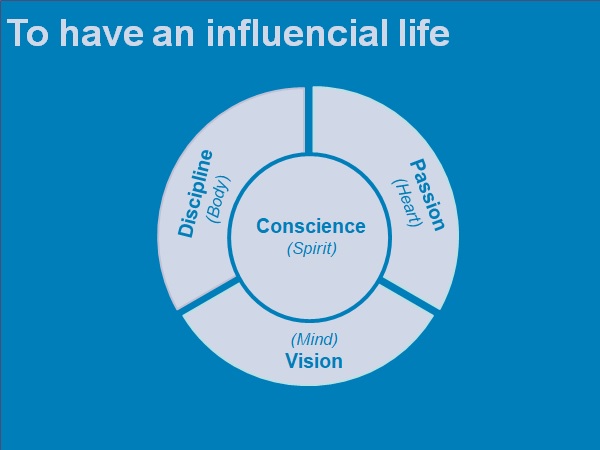
People with high influence When we study the lives of all the people who have achieved great things - those who have had the most influence on other people, those who have made major contributions, those who have simply made things happen - we find a pattern. With persistent effort and inner struggle, these people greatly expanded their four human intelligences or capabilities. The highest manifestations of these four intelligences are:
These manifestations also represent our highest means of expressing our own voice. The Vision is to see with the eyes of the mind what is possible in people, in projects, in causes, in enterprises. Vision occurs when our mind joins need with possibility. Discipline consists of paying the price of turning vision into reality. It is dealing with the difficult, pragmatic, brutal facts of reality and doing whatever is necessary to make things happen. Discipline arises when vision is combined with dedication. Passion is the fire, the desire, the strength of conviction and the impulse that sustain the discipline to achieve the vision. Passion arises when human needs overlap with unique human talent. In the context of relationships and organization, passion includes compassion. Conscience is the inner moral sense of right and wrong, the impulse to seek meaning and to contribute. It is the guiding force of vision, discipline and passion.
A simple way of thinking about life I recommend this simple way of thinking about life: A total person (body, mind, heart and spirit) with four basic needs (Living, Learning, Loving and Leaving a Legacy) and four Intelligences or Capabilities (Physical, Mental, Emotional and Spiritual) and their highest manifestations (Discipline, Vision, Passion and Conscience), which together represent our four dimensions:
As we respect, develop, integrate and balance these four intelligences and their highest manifestations, the synergy between them ignites our inner fire and we find our voice. Fonte: O 8º Hábito - Da Eficácia à Grandeza Stephen R. Covey |
|
Introduction The PMBOK Guide 6th edition has an appendix dedicated to the techniques and tools that are grouped together for their objectives. In a total of 132 techniques and tools, 72 of which are grouped into 6 groups according to the intention of what should be done and the different methods to achieve that intention. The remaining 60 tools and techniques are not grouped This grouping is performed in a table that crosses the process and area of knowledge with the techniques and tools Groups of tools and techniques The groups integrate a set of tools and techniques and have the following designations:
One of the techniques and tools used in Communication skills is presentations Show me your PowerPoint The use of audiovisual media was generalized to support the presentations Many people just read what they write and project when presenting To be more effective in presentations supported by PowerPoint (or any other program), I share some suggestions: 1. Only one message per slide 2. To guide the attention of recipients, resort to: - Contrast - Size of images and body of letters 3. Avoid using phrases while speaking 4. The background of the slides must be dark or black 5. Use 6 objects (maximum) per slide I share this video by David J.P. Philips on the topic:
Make your point...Show me your power! In order to have an impact on the audience, presentations must have 3 essential ingredients. To provoke reactions, to captivate, a presentation has to be:
Emotive Great communicators appeal to the mind and heart, but most people who make presentations forget to attend to the "heart" Singular Originality is the most effective attribute to capture someone's attention Memorable There is little point in presenting memorable ideas if the audience is unable to remember what was said Some tips to have more impact For a presentation to have a great impact, use the following structure
I share this video by Dananjaya Hettiarachchi where you can see how the presentation is structured and check the impact it causes
Conclusion This article addresses how to integrate the elements that distinguish inspiring presentations and the way we see ourselves as leaders and communicators
|
|
Introduction The PMBOK Guide 6th edition has an appendix dedicated to the techniques and tools that are grouped together for their objectives. In a total of 132 techniques and tools, 72 of which are grouped into 6 groups according to the intention of what should be done and the different methods to achieve that intention. The remaining 60 tools and techniques are not grouped This grouping is performed in a table that crosses the process and area of knowledge with the techniques and tools Groups of tools and techniques The groups integrate a set of tools and techniques and have the following designations - Data collection techniques - 9 tools and techniques - Data analysis techniques - 27 tools and techniques - Data representation techniques - 15 tools and techniques - Decision making techniques - 2 tools and techniques - Communication skills - 2 tools and techniques - Interpersonal and team skills - 17 tools and techniques As mentioned, there are 60 techniques and tools not grouped One of the techniques and tools not grouped, but used in all processes and areas of knowledge is meetings. "Chronic reunit": a disease that affects many organizations There are companies and, therefore, project managers who suffer from “chronic reunit”. Some symptoms of “chronic reunit”: - Meetings scheduled at the last minute - Meetings on everything and nothing - Meetings without a previously defined and distributed agenda - Meetings without support information - Meetings where no decisions are made - Meetings that last for hours It is important to combat this "disease" as it affects proficiency in project management and, consequently, the results Aspects to consider about the meetings Before scheduling and / or organizing a meeting, check if it is essential to hold it. If you think it is essential, organize it taking into account the following activities - Before the meeting - During the meeting - After the meeting Let us analyze each aspect in detail - Before the meeting Before organizing the meeting, it is important to:
- During the meeting Ensure that:
- After the meeting Remember of:
Today, with technology at our disposal, it is possible to:
Conclusion Proficiency in the exercise of the Project Management profession depends on the approach chosen in relation to some techniques and tools. What is your opinion about the suggestions covered in this article?
|
|
7 Habits of Highly Effective People (image source) Emotional intelligence (image source) In the first article in this series of 3 on the topic "Who practices the 7 Habits is Emotionally Intelligent?" I had the opportunity to write about Emotional Intelligence and the five elements of emotional intelligence Recalling the five important elements to emotional intelligence: 1. Self-awareness 2. Self-regulation 3. Motivation 4. Empathy 5. Social skills In the second article, I had the opportunity to write about the 7 Habits of Highly Effective People Recalling the 7 Habits of Highly Effective People: 1. Be proactive 2. Begin with the end in mind 3. First things first 4 - Think win-win 5 - Seek first to understand, then to be understood 6- Synergize 7- Sharpen the Saw; Growth Principles contained in the 7 Habits of Highly Effective People In the table below I will present the underlying Principles or the essence of the 7 Habits
Emotional Intelligence and 7 Habits of Highly Effective People In the table below I will present the relationship between Emotional Intelligence and the 7 Habits
Conclusion I recommend anyone who is interested in increasing their EQ to study and apply the principles contained in the 7 Habits of Highly Effective People Question A few years ago, the PMBOK Guide recommended that project managers practice the 7 Habits of Highly Effective People Why was this recommendation withdrawn and replaced by Emotional Intelligence?
Fontes: Inteligência Emocional - O livro que mudou o conceito de Inteligência- Daniel Goleman Os 7 Hábitos das Pessoas Altamente Eficazes - Stephen Covey | ||||||||||||||||||||||||||||||
|
"One man alone can be pretty dumb sometimes, but for real bona fide stupidity there ain't nothing can beat teamwork." - Mark Twain |