People and Work
From the Support to Develop Blog
by Luis Branco

This blog addresses management-related topics and has three areas of focus: 1. Technical skills; 2. Competencies in the field of interpersonal relations and communication (including personal organization and delegation, leadership, teamwork, conflict resolution, conducting meetings, and negotiation); and 3. Strategy (including diagnosis, strategic guidelines, and implementation).4.Technology
Recent Posts
Delegation with Purpose: Building Autonomy and Developing Capability
RCPCV™: A Method for Decision-Making and Continuous Improvement
The Same Change Can Succeed and Fail at the Same Time
What Must Exist Even When No Single Role Owns the Whole?
PHASE 4 – THE EMERGENCE
Categories
Agile,
Career Development,
Career Development,
Career Development,
Career Development,
Career Development,
Career Development,
Career Development,
Career Development,
Career Development,
Career Development,
Career Development,
Career Development,
Career Development,
Career Development,
Career Development,
Career Development,
Career Development,
Career Development,
Career Development,
Career Development,
Career Development,
Career Development,
Career Development,
Career Development,
Career Development,
Career Development,
Career Development,
Career Development,
Career Development,
Career Development,
Career Development,
Career Development,
Career Development,
Career Development,
Career Development,
Career Development,
Career Development,
Career Development,
Career Development,
Career Development,
Career Development,
Career Development,
Career Development,
Career Development,
Career Development,
Career Development,
Career Development,
Career Development,
Career Development,
Career Development,
Career Development,
Career Development,
Career Development,
Career Development,
Career Development,
Career Development,
Career Development,
Career Development,
Career Development,
Career Development,
Career Development,
Career Development,
Career Development,
Career Development,
Career Development,
Career Development,
Career Development,
Career Development,
Career Development,
Career Development,
Career Development,
Career Development,
Career Development,
Career Development,
Career Development,
Career Development,
Career Development,
Career Development,
Career Development,
Career Development,
Career Development,
Career Development,
Career Development,
Career Development,
Career Development,
Career Development,
Career Development,
Career Development,
Career Development,
Career Development,
Career Development,
Career Development,
Career Development,
Career Development,
Career Development,
Career Development,
Career Development,
Career Development,
Career Development,
Career Development,
Career Development,
Career Development,
Career Development,
Career Development,
Career Development,
Career Development,
Career Development,
Career Development,
Career Development,
Career Development,
Career Development,
Career Development,
Career Development,
Career Development,
Career Development,
Career Development,
Career Development,
Career Development,
Career Development,
Career Development,
Career Development,
Career Development,
Education,
Governance,
Governance,
Governance,
Governance,
Governance,
Governance,
Governance,
Governance,
Governance,
Governance,
Governance,
Governance,
Governance,
Governance,
Governance,
Governance,
Governance,
Governance,
Governance,
Governance,
Governance,
Governance,
In,
Integration Management,
Interpersonal Skills,
Interpersonal Skills,
Interpersonal Skills,
Interpersonal Skills,
Interpersonal Skills,
Interpersonal Skills,
Interpersonal Skills,
Interpersonal Skills,
Interpersonal Skills,
Interpersonal Skills,
Interpersonal Skills,
Interpersonal Skills,
Interpersonal Skills,
Interpersonal Skills,
Interpersonal Skills,
Interpersonal Skills,
Interpersonal Skills,
Interpersonal Skills,
Interpersonal Skills,
Interpersonal Skills,
Interpersonal Skills,
Interpersonal Skills,
Interpersonal Skills,
Interpersonal Skills,
Interpersonal Skills,
Interpersonal Skills,
Interpersonal Skills,
Interpersonal Skills,
Interpersonal Skills,
Interpersonal Skills,
Interpersonal Skills,
Interpersonal Skills,
Interpersonal Skills,
Interpersonal Skills,
Interpersonal Skills,
Interpersonal Skills,
Interpersonal Skills,
Interpersonal Skills,
Interpersonal Skills,
Interpersonal Skills,
Interpersonal Skills,
Interpersonal Skills,
Interpersonal Skills,
Interpersonal Skills,
Interpersonal Skills,
Interpersonal Skills,
Interpersonal Skills,
Interpersonal Skills,
Interpersonal Skills,
Interpersonal Skills,
Interpersonal Skills,
Interpersonal Skills,
Interpersonal Skills,
Interpersonal Skills,
Interpersonal Skills,
Interpersonal Skills,
Interpersonal Skills,
Interpersonal Skills,
Interpersonal Skills,
Interpersonal Skills,
Interpersonal Skills,
Interpersonal Skills,
Interpersonal Skills,
Interpersonal Skills,
Interpersonal Skills,
Interpersonal Skills,
Interpersonal Skills,
Interpersonal Skills,
Interpersonal Skills,
Interpersonal Skills,
Interpersonal Skills,
Interpersonal Skills,
Interpersonal Skills,
Interpersonal Skills,
Interpersonal Skills,
Interpersonal Skills,
Interpersonal Skills,
Interpersonal Skills,
Interpersonal Skills,
Interpersonal Skills,
Interpersonal Skills,
Interpersonal Skills,
Interpersonal Skills,
Interpersonal Skills,
Interpersonal Skills,
Interpersonal Skills,
Interpersonal Skills,
Interpersonal Skills,
Interpersonal Skills,
Interpersonal Skills,
Interpersonal Skills,
Interpersonal Skills,
Interpersonal Skills,
Interpersonal Skills,
Interpersonal Skills,
Interpersonal Skills,
Interpersonal Skills,
Interpersonal Skills,
Interpersonal Skills,
Interpersonal Skills,
Interpersonal Skills,
Interpersonal Skills,
Interpersonal Skills,
Interpersonal Skills,
Interpersonal Skills,
Interpersonal Skills,
Interpersonal Skills,
Interpersonal Skills,
Interpersonal Skills,
Interpersonal Skills,
Interpersonal Skills,
Interpersonal Skills,
Interpersonal Skills,
Interpersonal Skills,
Interpersonal Skills,
Interpersonal Skills,
Interpersonal Skills,
Interpersonal Skills,
Interpersonal Skills,
Interpersonal Skills,
Interpersonal Skills,
Interpersonal Skills,
Knowledge Management,
le,
lea,
Leadership,
Leadership,
Leadership,
Leadership,
Leadership,
Leadership,
Leadership,
Leadership,
Leadership,
Leadership,
Leadership,
Leadership,
Leadership,
Leadership,
Leadership,
Leadership,
Leadership,
Leadership,
Leadership,
Leadership,
Leadership,
Leadership,
Leadership,
Leadership,
Leadership,
Leadership,
Leadership,
Leadership,
Leadership,
Leadership,
Leadership,
Leadership,
Leadership,
Leadership,
Leadership,
Leadership,
Leadership,
Leadership,
Leadership,
Leadership,
Leadership,
Leadership,
Leadership,
Leadership,
Leadership,
Leadership,
Leadership,
Leadership,
Leadership,
Leadership,
Leadership,
Leadership,
Leadership,
Leadership,
Leadership,
Leadership,
Leadership,
Leadership,
Leadership,
Leadership,
Leadership,
Leadership,
Leadership,
Leadership,
Leadership,
Leadership,
Leadership,
Leadership,
Leadership,
Leadership,
Leadership,
Leadership,
Leadership,
Leadership,
Leadership,
Leadership,
Leadership,
Leadership,
Leadership,
Leadership,
Leadership,
Leadership,
Leadership,
Leadership,
Leadership,
Leadership,
Leadership,
Leadership,
Leadership,
Leadership,
Leadership,
Leadership,
Leadership,
Leadership,
Leadership,
Leadership,
Leadership,
Leadership,
Leadership,
Leadership,
Leadership,
Leadership,
Leadership,
Leadership,
Leadership,
Leadership,
Leadership,
Leadership,
Leadership,
Leadership,
Leadership,
Leadership,
Leadership,
Leadership,
Leadership,
Leadership,
Leadership,
Leadership,
Leadership,
Leadership,
Leadership,
Leadership,
Leadership,
or,
Organizational Project Management,
Portfolio Management,
Program,
Program Management,
Strategy,
Strategy,
Strategy,
Strategy,
Strategy,
Strategy,
Strategy,
Strategy,
Strategy,
Strategy,
Strategy,
Strategy,
Strategy,
Strategy,
Strategy,
Strategy,
Strategy,
Strategy,
Strategy,
Strategy,
Strategy,
Strategy,
Strategy,
Strategy,
Strategy,
Strategy,
Strategy,
Strategy,
Strategy,
Strategy,
Strategy,
Strategy,
Strategy,
Strategy,
Strategy,
Strategy,
Strategy,
Strategy,
Strategy,
Strategy,
Strategy,
Strategy,
Strategy,
Strategy,
Strategy,
Strategy,
Strategy,
Strategy,
Strategy,
Strategy,
Strategy,
Strategy,
Strategy,
Strategy,
Strategy,
Strategy,
Strategy,
Strategy,
Strategy,
Strategy,
Strategy,
Strategy,
Strategy,
Strategy,
Strategy,
Strategy,
Strategy,
Strategy,
Strategy,
Strategy,
Strategy,
Strategy,
Strategy,
Strategy,
Strategy,
Strategy,
Strategy,
Strategy,
Strategy,
Strategy,
Strategy,
Strategy,
Strategy,
Strategy,
Strategy,
Strategy,
Strategy,
Strategy,
Strategy,
Strategy,
Strategy,
Strategy,
Strategy,
Strategy,
Strategy,
Strategy,
Strategy,
Strategy,
Strategy,
Strategy,
Strategy,
Strategy,
Strategy,
Strategy,
Strategy,
Strategy,
Strategy,
Strategy,
Strategy,
Strategy,
Strategy,
Strategy,
Strategy,
Strategy,
Strategy,
Strategy,
Strategy,
Strategy,
Strategy,
Strategy,
Strategy,
Strategy,
Strategy,
Sustainability,
Talent Management,
Talent Management,
Talent Management,
Talent Management,
Talent Management,
Talent Management,
Talent Management,
Talent Management,
Talent Management,
Talent Management,
Talent Management,
Talent Management,
Talent Management,
Talent Management,
Talent Management,
Talent Management,
Talent Management,
Talent Management,
Talent Management,
Talent Management,
Talent Management,
Talent Management,
Talent Management,
Talent Management,
Talent Management,
Talent Management,
Talent Management,
Talent Management,
Talent Management,
Talent Management,
Talent Management,
Talent Management,
Talent Management,
Talent Management,
Talent Management,
Talent Management,
Talent Management,
Talent Management,
Talent Management,
Talent Management,
Talent Management,
Talent Management,
Talent Management,
Talent Management,
Talent Management,
Talent Management,
Talent Management,
Talent Management,
Talent Management,
Talent Management,
Talent Management,
Talent Management,
Talent Management,
Talent Management,
Talent Management,
Talent Management,
Talent Management,
Talent Management,
Talent Management,
Talent Management,
Talent Management,
Talent Management,
Talent Management,
Talent Management,
Talent Management,
Talent Management,
Talent Management,
Talent Management,
Talent Management,
Talent Management,
Talent Management,
Talent Management,
Talent Management,
Talent Management,
Talent Management,
Talent Management,
Talent Management,
Talent Management,
Talent Management,
Talent Management,
Talent Management,
Talent Management,
Talent Management,
Talent Management,
Talent Management,
Talent Management,
Talent Management,
Talent Management,
Talent Management,
Talent Management,
Talent Management,
Talent Management,
Talent Management,
Talent Management,
Talent Management,
Talent Management,
Talent Management,
Talent Management,
Talent Management,
Talent Management,
Talent Management,
Talent Management,
Talent Management,
Talent Management,
Talent Management,
Talent Management,
Talent Management,
Talent Management,
Talent Management,
Talent Management,
Talent Management,
Talent Management,
Talent Management,
Talent Management,
Talent Management,
Talent Management,
Talent Management,
Talent Management,
Talent Management,
Talent Management,
Talent Management,
Talent Management,
Talent Management
Date

In the last article, entitled: "The paradigm of people as a whole", was suggested a simple way of thinking about life, addressing the 4 dimensions of the person as a whole, his needs, intelligences and attributes and how to ignite the inner fire and we find our voice.
Today we are going to reflect on what people expect from their work, the main chronic and acute problems and the response of companies and organizations of the industrial era to solve these problems
People and work
People make choices. Consciously or unconsciously, people decide how much of themselves they will dedicate to work, according to the way they are treated and the opportunities to use the 4 parts of their nature.
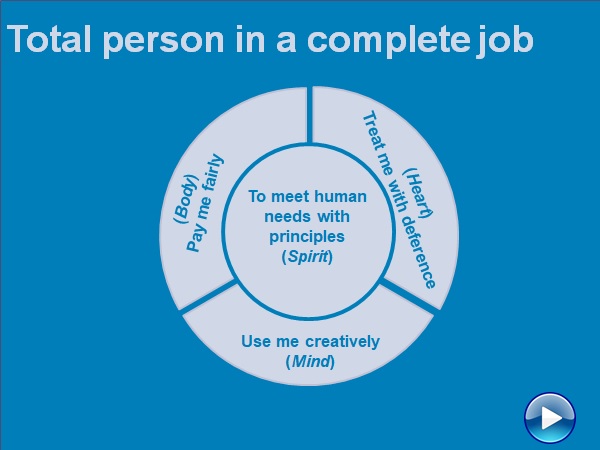
Only someone who is respected as a total person in a full-time job - who receives a fair wage, is neither treated, is used creatively and has opportunities to satisfy human needs with principles makes choices for lively cooperation, deep dedication or creative enthusiasm.
Chronic and acute problems
There are, in our body and in organizations, two types of chronic and acute problems.
Chronic means underlying, causal, continued.
Acute means painful, symptomatic, debilitating.
Organizations like people have chronic problems that are not yet acute.
Treating acute problems can mask the underlying chronic disease
Not all chronic diseases have acute symptoms.
Before these appear there are diseases (like cancer) that spread until it’s too late.
Just because we don't see the superficial symptoms does not mean that the underlying problems are not present.
The same applies to organizations.
There can be serious chronic problems in an organization that does not show acute signs, because some organizations do not compete in tough, global markets: they compete in local or protected markets.
If body, mind, heart or spirit are neglected, we will have four chronic problems in an organization - lack of confidence, lack of vision and shared values, misalignment and weakness - and all the acute symptoms that accompany them.
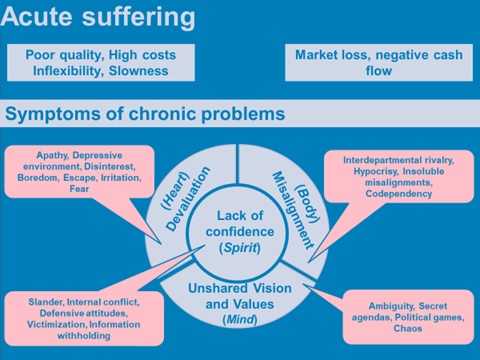
The joint results of these chronic problems and their symptoms are acute suffering from failure in the market, negative cash flow, low quality, inflated costs, inflexibility, slowness and many mutual accusations: a culture of blame, rather than a culture of responsibility.
Industrial-era response
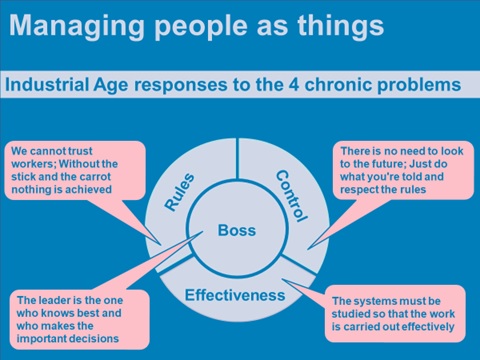
What would be the reaction in the industrial age to these four chronic problems?
If there is little trust and no moral authority, the boss is at the center - the leader knows what is best and makes all the decisions. “Do it MY way or get out.
The rules will take the place of vision and mission.
Misalignment? Make things more efficient: the machines, the standards, the people, everything. Efficiency matters.
Weakening? You need to maintain control. We cannot trust people. The only way to get people to surrender is to use the carrot and the whip - show them the carrot (the rewards) to motivate performance and maintain a healthy level of fear with the whip (punishment or job loss) if the performance leave something to be desired.
Questions for reflection
Are there any of these problems in your company and / or organization? In your opinion are they acute or chronic?
What was the answer found in your organization to solve these problems?
Are there other answers, different from those of the industrial age, that can be considered?
Fonte: O 8º Hábito - Da Eficácia à Grandeza
Stephen R. Covey
Posted on: March 14, 2020 07:03 AM |
Permalink
Comments (11)
Please login or join to subscribe to this item

Alexandre Costa
Scrum Master| Integer Consulting - Pictet technologies
Loures, Portugal
Dear Luis,
To be complete sincere, many of this problems still persist in our companies contrary to what they want us to believe. Many autocratic behaviors are still installed in dominant and powerful positions, sometimes a lot of them in middle management mining the company innovation.
I guess this problem can be more severe or not depending of the culture of the company, country and persons, most of the start ups are aware of this disease and are formed believing in cooperation, shared responsibilities, but a lot of old established organizations maintain in their corporations people and managers that that are a brake on these thoughts in order to maintain the status.
Alexandre

Luis Branco
CEO| Business Insight, Consultores de Gestão, Ldª
Carcavelos, Lisboa, Portugal
Dear Alexandre
Thank you for participating in this reflection and for your opinion
There are "traditional" organizations and / or companies that address chronic and acute problems through responses according to the expectations of their employees
Just as there are start ups looking for answers from the industrial age
It is difficult to generalize although I consider that the response of the industrial age is not the most appropriate

Edgar Simões
Project Leader| Aurecon Group
Parede, Parede, Portugal
Dear Luis,
Very interesting topic, congrats!
Reflecting on your questions I don’t think there is a simple and direct “medical prescription” that organizations can apply. Nowadays topics as continued performance appraisals with constant monitoring and periodic reviews at the same time having individual development plans can make a difference if all the organization structure is aligned and committed.
Its important that organizations continue to invest in human capital management!
Best Regards,
Edgar
Luis Branco
CEO| Business Insight, Consultores de Gestão, Ldª
Carcavelos, Lisboa, Portugal
Dear Edgar
Thank you for reading this article and for your opinion
Changing the response of the industrial era, taking into account the 4 dimensions of human beings and their needs, is a great challenge
Dear Luis,
Your article is very timely.
Most organizations try to mask their "chronic illnesses" with "drugs" that mask the symptom.
Organizations at this level need to invest and step up their maturity.
All organizations (countries, companies, associations) with a high level of performance have gone through these struggles and I believe that they have overcome with valid solutions that can be applied in the new industrial era.
In my organization, we identified that we need to increase our organizational maturity and we are already moving in this direction. It will take some time but we will get there!
Congratulations on the great content and please continue to share!
Luis Branco
CEO| Business Insight, Consultores de Gestão, Ldª
Carcavelos, Lisboa, Portugal
Dear Carlos
Thank you for reading this article and for your opinion
Becoming aware that change is necessary is the first step towards change

Marcos Silva
Program Manager / Release Train Engineer| Philips
Campinas, Sao Paulo, Brazil
Great article, content is totally aligned with current scenario. Thanks
Luis Branco
CEO| Business Insight, Consultores de Gestão, Ldª
Carcavelos, Lisboa, Portugal
Dear Marcos
Thank you for reading this article and for your opinion

MARCELO GRANADO
CEO & Business Director| Smart Management Negócios Inteligentes
Ribeirao Preto, São Paulo, Brazil
Luis congratulations on the article.
We have been developing a program in the company since 2017 on the impacts on projects in a number of areas of personal and professional life. The CEU - Chief Expert Unique Program, which provides for the general assessment of senior management and the impacts of the work environment and professional lifestyle. Your article only translates this purpose clearly. Let's talk more about it.
Luis Branco
CEO| Business Insight, Consultores de Gestão, Ldª
Carcavelos, Lisboa, Portugal
Dear Marcelo
Thank you for reading the article I wrote and for your comment
CEU must be very interesting
Great article Luis.
I have witnessed some of the chronic symptoms here described within a work environment and have heard multiple testimonies from employees in various organisations or industries. Symptoms such as disinterest, fear, withholding information, internal conflict are common and have led to acute suffering, poor quality and slowness within teams.
To go around such issues and that I found effective within the organisation, was to make leaders/supervisors and followers more accountable not only for team results but as well on individual performances. Leaders and teams were encouraged to embrace constant knowledge sharing, shadowing, as a way to have teams 100% capable of addressing any challenges, not leaving people behind with their knowledge progression, contributions and growth which would directly have an impact on the overall objectives of the organisation, more jobs done, with more quality, more sales, more rewards. We also had quarterly reviews / feedback sessions, which reinforced the monitoring of leaders and their teams performances, keeping people aligned with the organisations key objectives and overall interested in their individual contributions to the growth of the organisation.
Please Login/Register to leave a comment.
|
"Work is what you do for others . . . art is what you do for yourself."
- Stephen Sondheim
|




