


Culture as a Decision Filter


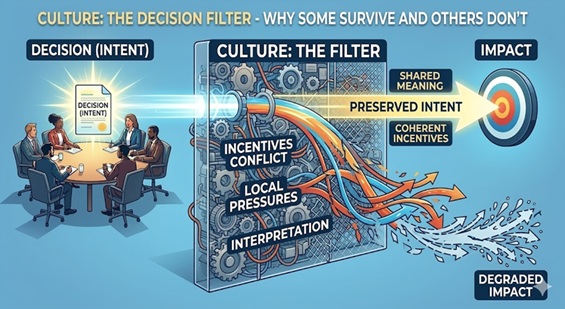 Why Some Decisions Survive and Others Don’t Decisions do not enter neutral systems. They enter environments shaped by: • Incentives • Pressures • Habits • Interpretations What happens next is not execution. It is selection. 1. The System Does Not Execute Decisions Organizations often assume that once a decision is made, the system will execute it. This is rarely the case. Decisions do not move unchanged. They are: • Interpreted • Adapted • Reshaped Not necessarily because people disagree. But because the system filters what it receives. 2. Culture Is Not Background. It Is Mechanism Culture is often described as values, behaviors, or norms. In practice, it operates as a decision filter. It determines: • What Is Accepted • What Is Resisted • What Is Reshaped • What Is Ignored A decision does not pass through culture. It is processed by it. Culture does not just influence decisions. It determines how they are transformed. 3. The Forces That Distort Decisions Decisions rarely fail because they are unclear. They fail because they collide with competing forces. A. Incentives People optimize for what is measured. If the decision conflicts with local incentives, it will be adjusted. Not openly. Gradually. Incentives do not only distort decisions. They define what the system is able to sustain. When redesigned, they become one of the most effective levers to align local behavior with intended direction. B. Local Pressures Teams operate under constraints. Deadlines, targets, and operational realities reshape priorities. The decision is adapted to fit the context. C. Contextual Interpretation Every layer interprets the decision differently. Alignment becomes approximation. Meaning drifts. D. Structural Survival In some systems, adaptation is not optional. It is necessary for survival. Decisions are reshaped to fit what the system can absorb. 4. The Forces That Preserve Decisions Not all decisions degrade. Some survive. Not because they are enforced. But because they are carried. A. Shared Meaning When people understand the intent, not just the instruction, the decision becomes meaningful. Meaning travels better than directives. B. Relational Ownership Decisions that create connection are sustained. Not only owned by one. But supported by many. C. Learning Capacity Systems that allow learning adapt without losing direction. They evolve the decision while preserving its core. D. Coherent Incentives When incentives align with the decision, preservation becomes natural. The system reinforces direction instead of distorting it. 5. Resistance Is Not Always Opposition Resistance is often misunderstood. It is not always disagreement. It is frequently: • Misalignment • Overload • Competing Priorities • Structural Tension What looks like resistance is often the system revealing its constraints. 6. The Real Tension Decisions do not compete with ignorance. They compete with: • Incentives • Embedded Behaviors • Local Realities This is where many decisions fail. Not because they are wrong. But because they are not compatible with the system they enter. This is why many strategic decisions lose strength in execution. For example, a decision to prioritize long-term value often fades when local teams are measured on short-term targets. The decision remains visible, but the system moves in a different direction. 7. From Decision Integrity to Cultural Compatibility Decision integrity ensures that a decision holds its shape. Culture determines whether that shape can be sustained. Without alignment between the two: • Integrity Breaks • Direction Fragments • Execution Drifts 8. Final Insight Culture does not execute decisions. Culture decides what survives. Closing Statement A strong organization is not the one that makes better decisions. It is the one where: Decisions align with incentives, make sense to those who carry them, and can survive the system they enter. Because in the end, decisions do not fail because they are made poorly. They fail because the system reshapes them until they no longer resemble what was originally intended. |
Posted on: May 01, 2026 07:30 AM
| Permalink |
Comments (0)
Decision Integrity: Why Decisions Fail After They Are Made
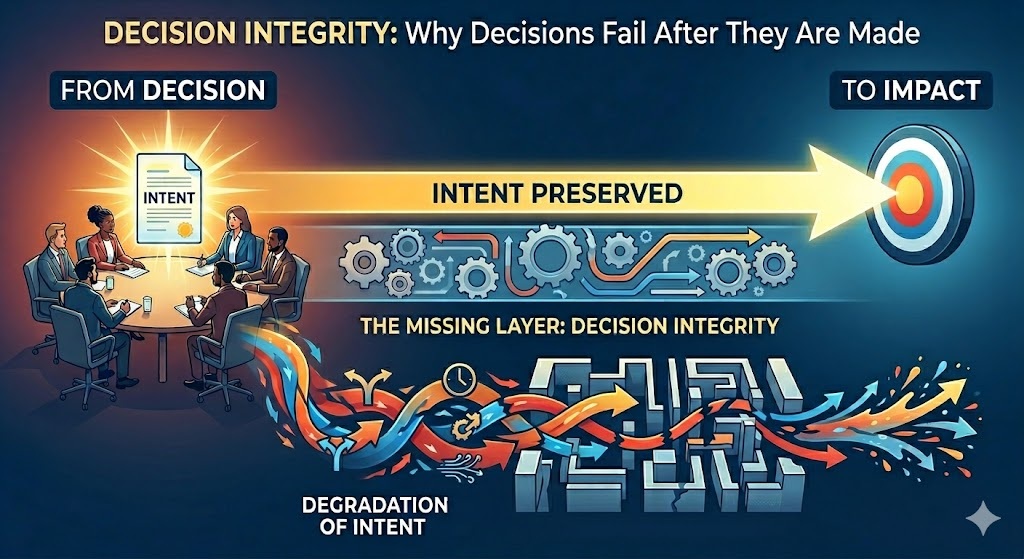 The Missing Layer Between Decision and Impact Organizations invest heavily in making better decisions. They improve data. They refine analysis. They design governance. They clarify accountability. And still, something fails. Not at the moment of decision. After it. 1. The Invisible Breakdown Most decisions do not fail when they are made. They fail when they move. As decisions travel across: • Teams • Functions • Timelines • Operational Pressures they are: • Reinterpreted • Delayed • Adapted • Diluted Over time, the original intent weakens. Direction fragments. And impact diverges from the decision. 2. The False Assumption There is a hidden assumption in most organizations: If a decision is clear, it will be executed as intended. This is rarely true. Clarity at the point of decision does not guarantee coherence in execution. Between decision and impact, there is a missing layer: Decision integrity. 3. What Is Decision Integrity Decision integrity is the ability of a decision to: • Maintain Its Meaning • Preserve Its Direction • Sustain Its Intent as it moves through the system. It is not about rigidity. It is about coherent propagation under real conditions. Without it: • Alignment Erodes • Ownership Weakens • Execution Diverges 4. Why Decisions Degrade Decisions degrade for structural reasons. Not because people are careless. But because systems behave in predictable ways. A. Local Interpretation Teams translate decisions to fit local context. Alignment becomes approximation. B. Competing Priorities New inputs emerge. Focus shifts. Original decisions lose priority without being formally revisited. C. Temporal Drift Time passes. Assumptions change. What appears as delay often creates an illusion of control, while quietly increasing complexity and reducing real options. A decision left open does not remain stable. It evolves without being consciously redefined. D. Diffused Ownership The decision had an owner. Execution does not. Responsibility dissolves across layers. 5. The Propagation Problem Execution is not just action. It is propagation of intent. A decision must travel through the organization without losing: • Clarity • Priority • Ownership If the system cannot carry the decision intact, execution will fragment. This is not an execution failure. It is a propagation failure. 6. The Hidden Layer: Implicit Decisions When decisions are delayed, the system does not wait. It interprets. Teams begin to read hesitation as direction. Ambiguity becomes the default. What looks like caution at the top turns into drift across the system. Over time, absence of decision becomes a form of decision. Not explicit. Not owned. But real in its consequences. Organizations are not only shaped by the decisions they make. They are shaped by the decisions they fail to make. 7. From Decision to System Behavior At scale, organizations do not execute decisions. They execute interpretations of decisions. That is where distortion happens. The question is no longer: Was the decision correct? It becomes: Was the decision preserved? 8. Designing for Decision Integrity If decisions degrade by default, integrity must be designed. This requires extending governance beyond the point of commitment. Not to control execution. But to protect direction. Three conditions become critical: A. Persistent Ownership The owner of the decision remains accountable beyond the decision moment. Not only for the choice. But for its continuity. B. Explicit Reconfirmation Points Decisions must be revisited intentionally. Not passively drift. Reconfirmation maintains relevance and prevents silent erosion. C. Alignment Through Transmission Communication is not enough. Decisions must be translated without distortion. This requires clarity of intent, not only clarity of content. 9. The Link to Governance and Courage Decision integrity connects directly to the previous layers: • Governance enables the decision • Courage commits to it • The system must sustain it Without integrity: • Governance Creates Decisions That Do Not Hold • Courage Produces Commitments That Do Not Survive 10. Final Insight Organizations do not fail only because they decide poorly. They fail because their decisions do not survive contact with reality. Closing Statement Making a decision is not the end of the process. It is the beginning of its exposure to the system. A strong organization is not the one that decides more. It is the one where decisions: Hold their shape, retain their meaning, and produce the impact they were intended to create. |
Posted on: April 29, 2026 04:23 AM
| Permalink |
Comments (1)
The Scarcest Resource: Courage to Commit
 Why Leadership Is Defined at the Point of Decision In a world of abundant knowledge, fast analysis, and AI-generated insight, one constraint remains. Not technological. Not informational. Human. The ability to commit under uncertainty. 1. The Illusion of Preparedness Organizations believe that better decisions come from: • More data • More analysis • More alignment But at some point, preparation stops improving the decision. It starts delaying it. And beyond a certain point, delay does not reduce risk. It reshapes it. The transition from knowing to deciding is not incremental. It is a shift. 2. The Nature of Commitment Decision is not a technical act. It is a human one. To decide is to: • Close alternatives • Accept incompleteness • Take on risk • Assume consequences This moment cannot be automated. It cannot be optimized away. It must be owned. 3. Why Courage Becomes Scarce In modern organizations: • Exposure is visible • Mistakes are remembered • Responsibility is personal At the same time: • Analysis is safe • Alignment is rewarded • Delay is tolerated Over time, systems shape behavior. People do not avoid decisions because they lack capability. They avoid decisions because the system makes avoidance rational. 4. Courage as a System Property Courage is often framed as an individual trait. In practice, it is a systemic outcome. It emerges when: • Decision rights are clear • Accountability is protected • Challenge is structured • Failure is treated as learning These conditions do not emerge by chance. They are designed through governance. Without them, courage erodes. Not because people are weak. But because the system rewards hesitation more than commitment. 5. The Cost of Not Committing The greatest risk is not a wrong decision. It is the absence of decision. When decisions are postponed: • Context evolves • Options disappear • Consequences accumulate Individually, delays seem harmless. Collectively, they reshape the organization. What is not decided today becomes: • Constraint tomorrow • Outcome the day after 6. Leadership at the Point of Commitment Leadership is not defined by knowledge. It is defined at the moment of commitment. Not in analysis. Not in interpretation. But in the willingness to say: This is the direction This is the risk This is what we stand behind Even when decisions are shaped collectively, commitment requires a point of ownership. Without it, responsibility dissolves before impact is created. And ensuring that this decision holds its shape as it moves through the system. 7. The Brain Economy Revisited In the Brain Economy: • Intelligence is abundant • Insight is scalable • Analysis is accelerated But courage does not scale. It remains human. It remains scarce. And it remains decisive. 8. Final Insight AI expands what we can consider. Governance enables what we can decide. But only courage determines what we actually commit to. Closing Statement Knowledge creates possibility. Decision creates direction. But courage creates movement. In the end, organizations are not limited by what they know. They are limited by what they are willing to decide, commit to, and stand behind under real conditions. |
Posted on: April 27, 2026 02:54 AM
| Permalink |
Comments (0)
Governance as Decision Architecture
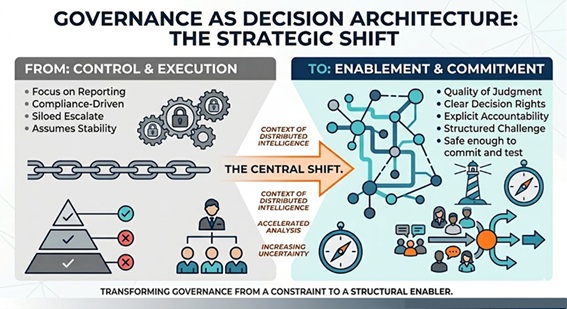 From Control to Enabling Responsible Commitment For decades, governance was designed to control execution. Today, that is no longer enough. In a context of distributed intelligence, accelerated analysis, and increasing uncertainty, the central challenge is not execution discipline. It is decision quality under real conditions. The question is no longer: How do we control what is done? It is: How do we ensure that what is decided is clear, owned, and actionable? 1. The Limits of Traditional Governance Traditional governance is built around: • Control • Reporting • Compliance • Escalation These mechanisms assume that: • Decisions are already clear • Direction is stable • Execution is the main risk But this assumption no longer holds. Today, the primary failure mode is not poor execution. It is: • Delayed decisions • Diluted accountability • Fragmented alignment Governance does not fail at control. It fails at decision enablement. 2. Governance as Decision Infrastructure If decision is the critical layer, governance must be redesigned accordingly. Governance becomes: The architecture that enables responsible decision-making. This does not mean eliminating constraints. It means defining them clearly. Decisions are not made in a vacuum. They operate within boundaries of: • Risk • Ethics • Strategic intent The role of governance is not to control how decisions are made. It is to make explicit the space within which they can be made responsibly. This means creating conditions where: • Decisions are made at the right level • Ownership is explicit • Trade-offs are visible • Alignment is produced during the decision, not after Governance is not a constraint. It is a structural enabler of commitment. 3. The Core Components of Decision Architecture Not all decisions require the same level of governance. The depth of decision architecture should reflect: • Reversibility • Impact • Level of uncertainty Without this distinction, governance becomes excessive and slows decision-making. A governance system designed for decision must include: A. Clear Decision Rights Who decides must be explicit. Not assumed. Not negotiated in real time. Not diffused across groups. Without clarity, decisions are delayed or avoided. B. Explicit Accountability Every decision must have an owner. Not a group. Not a consensus. Not a shared abstraction. Execution can be distributed. Responsibility for the decision cannot. Ownership concentrates responsibility and enables action. C. Structured Challenge Decisions must be tested before they are made. Not through endless debate, but through focused, relevant challenge. The objective is not consensus. Consensus often delays decision by requiring agreement. Decision requires commitment, not unanimity. The relevant threshold is different: Whether a decision is sound enough to be taken and safe enough to be tested. One effective mechanism is to anticipate failure before commitment. Asking what would cause this decision to fail strengthens judgment and improves the quality of the decision before execution. The goal is not alignment. It is quality of judgment under constraint. D. Convergence Mechanisms Exploration must lead to closure. Without convergence, systems remain in: • Analysis • Optionality • Hesitation Governance must define: • When a decision is required • What constitutes sufficient clarity to commit E. Integrated Learning Loops Decisions must generate learning. Not as a post-mortem ritual, but as a continuous recalibration of judgment. Error is not only a failure. It is a signal. It informs: • Context interpretation • Ethical filters • Future decisions 4. The Risk of Distributed Accountability Modern organizations emphasize collaboration and participation. This creates value. But it also introduces a risk: Accountability dilution. When: • Everyone contributes • Multiple perspectives are integrated • Decisions emerge implicitly Ownership becomes unclear. And without ownership: • Action slows • Responsibility diffuses • Consequences are not fully assumed Decision architecture must preserve collaboration. But it must protect accountability. 5. Alignment Is Designed, Not Achieved Alignment is often treated as a goal. In reality, it is an outcome of how decisions are made. When decisions are: • Explicit • Owned • Clearly communicated Alignment emerges naturally. When decisions are: • Implicit • Delayed • Negotiated endlessly Alignment fragments. Governance does not enforce alignment. It designs for it. 6. From Control to Commitment This is the fundamental shift. From: Control of execution To: Enablement of commitment The role of governance is no longer to ensure compliance. It is to ensure that: • Decisions are made • Direction is clear • Ownership is explicit • Action is coordinated 7. Final Insight Organizations do not become effective because they control more. They become effective because they decide better. Governance is the system that makes that possible. Closing Statement Without decision architecture, intelligence does not translate into action. Without accountability, decisions do not translate into impact. Governance is not the system that controls the organization. It is the system that enables it to commit, act, and learn responsibly. |
Posted on: April 24, 2026 07:53 AM
| Permalink |
Comments (0)
AI Expands Possibility. Humans Own the Consequences
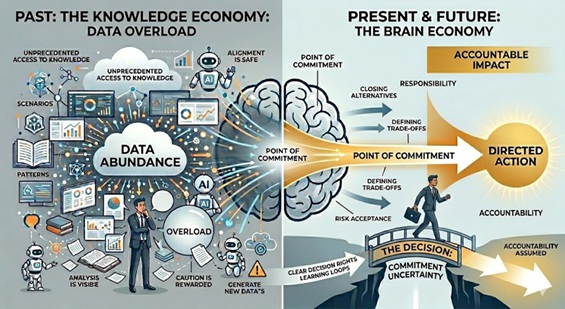 Why Intelligence Scales but Decision Does Not Organizations are becoming more intelligent. Not because individuals know more, but because intelligence is now distributed across systems, tools, and teams. AI generates insights. Platforms connect information. Teams operate with unprecedented access to knowledge. On the surface, this should make decision-making easier. In practice, it often does the opposite. 1. The Illusion of Intelligent Systems As intelligence scales, so do possibilities. AI can: • Generate scenarios • Identify patterns • Simulate outcomes • Expand alternatives But this creates a paradox. The more options available, the harder it becomes to commit to one. What increases is not clarity. It is decisional load. 2. The Misdiagnosed Problem Many organizations assume that better tools will solve decision-making. They invest in: • More data • More analytics • More dashboards • More AI But the issue is not technological. It is structural. The real constraint is not the ability to generate insight. It is the ability to converge on a decision and act. 3. Systems Shape Decisions Decision-making does not happen in isolation. It is shaped by how systems reward behavior. In many organizations: • Analysis is visible • Alignment is safe • Caution is rewarded Decision, by contrast: • Concentrates exposure • Makes trade-offs explicit • Assigns ownership Over time, this creates a predictable pattern. People do not move toward commitment. They move toward what is validated by the system. Indecision does not appear as failure. It appears as thoroughness. 4. The Timing Dimension Decisional capacity is not only about clarity. It is about timing. A delayed decision does not remain neutral. It reshapes the context. What could have been a choice becomes a consequence. As time passes: • Options narrow • Constraints increase • Outcomes are pre-shaped The system adapts around hesitation. And the decision, when it finally occurs, is no longer the same decision. 5. Alignment Is Not an Outcome A common assumption is that alignment follows decision. In reality, alignment is created within the decision process itself. When decisions are: • Implicit • Delayed • Distributed without ownership Alignment fragments before action begins. Execution does not fail because people disagree. It fails because direction was never made explicit. 6. The Accumulation Effect The greatest risk is not a wrong decision. It is the accumulation of unmade decisions. Individually, each delay seems rational. Collectively, they produce: • Drift • Fragmentation • Loss of coherence • Hidden consequences Organizations are not only shaped by what they decide. They are shaped by what they keep postponing. 7. The Role of AI Revisited AI amplifies this dynamic. It: • Increases available options • Accelerates analysis • Expands perspectives But it does not: • Assume responsibility • Commit to direction • Own consequences Without a decision architecture, AI does not reduce uncertainty. It increases decisional entropy. 8. Human Accountability in a Distributed System In a distributed intelligence environment, the human role becomes clearer. Not as the primary source of knowledge. But as the point of commitment. Humans are responsible for: • Closing alternatives • Defining direction • Accepting exposure • Owning consequences This is not a limitation. It is where value is created. 9. Governance as Decision Architecture If systems shape behavior, governance becomes critical. Not as control. But as decision architecture. This means: • Making decision rights explicit • Defining accountability clearly • Creating structured challenge • Enabling convergence, not just exploration The goal is not more participation. It is clear, owned, and actionable decisions. 10. Final Insight Distributed intelligence expands what is possible. Human accountability defines what becomes real. The challenge is not to think more. It is to decide under uncertainty, at the right time, with ownership. Closing Statement AI can expand the field of possibilities. But it cannot choose the path. Organizations do not fail because they lack intelligence. They fail because they do not convert intelligence into commitment. In the end, the differentiator is not what we can analyze. It is what we are willing to decide, commit to, and be accountable for. |
Posted on: April 22, 2026 07:58 AM
| Permalink |
Comments (1)


