




 There are several strategies that you can choose to employ with vertically slicing the requirements for a DW/BI solution. These strategies are described in the following table. There are example stories for each strategy as well as some advice for when to apply each strategy.


Guessing is not a strategy: How to build decision velocity with AI and real-time data
June 10, 2026 | Live Webinar

Disciplined Agile 5.5 Released
Choose Your WoW! Second Edition Is Now Available
Requisite Agility applied in Project Management
Disciplined Agile and PMBoK Guide 7th Edition
#ChoiceIsGood, #ChooseYourWoW, #ConsumableSolution, #ContinuousImprovement, #CoreAgilePractices, #experiment, #Experimentation, #GuidedContinuousImprovement, #Kaizen, #LifeCycles, #ProcessImprovement, #TealOrganizations, Adoption, agile, agile adoption, Agile Alliance, Agile Business Analyst, Agile certification, agile data, agile governance, agile lifecycle, agile metrics, agile principles, agile transformation, Agile2018, Agile2019, Agile20Reflect, AgileData, Analogy, announcement, Architecture, architecture, architecture owner, Articles and publications, Asset Management, Atari, Backlog, Barclays, being agile, benefits, bi, blades, book, Branching strategies, Browser, Business Agility, business intelligence, business operations, capex, Case Study, Certification, certification, charity, Choose your WoW, CMMI, cmmi, Coaching, Collaboration, Communications Management, Compliance, Compliancy, Conference, Construction, Construction phase, Context, Continuous Improvement, coordination, COVID-19, Culture, culture, Cutter, DA, DAD, DAD Book, DAD discussions, DAD press, DAD roles, DAD supporters, DAD webcast, DADay2019, Data Management, database, dependencies, Deployment, Development Strategies, DevOps, disaster, Discipline, discipline, Disciplined Agile, disciplined agile delivery, disciplined agile delivery blog, Disciplined Agile Enterprise, disciplined devops, Documentation, Domain complexity, dw, DW/BI, Energy Healing, Enterprise Agile, Enterprise Architecture, Enterprise Awareness, enterprise awareness, Essence, estimation, Evolving DA, Executive, Experiment, facilitation, FailureBow, feedback-cycle, finance, Financial, FLEX, Flow, foundation layer, Funding, GCI, GDD, Geographic Distribution, gladwell, global development, Goal-Driven, goal-driven, goals, Governance, GQM, Guideline, Hybrid, Improvement, inception, Inception phase, India, information technology, infosec, Introduction, iterations, Kanban, large teams, layer, lean, Lean Startup, learning, Legal Project Management, LeSS, Lifecycle, lifecycle, Manifesto, mark lines, marketing, MBI, Metaphor, Metrics, metrics, mindset, Miscellaneous, MVP, News, News and events, Non-Functional Requirements, non-functional requirements, Non-solo development, offshoring, Operations, opex, Organization, Outsourcing, outsourcing, paired programming, pairing, paper, People, People Management, phases, Philosophies, Planning, PMBoK, PMI, PMI and DA, PMI Chapter, Portfolio Management, post-format-quote, Practices, practices, Principle, Process, process improvement, process tailoring, Product Management, product owner, Product Owners, productivity, Program Management, Project Management, project-initiation, Promise, Quality, quality, rational unified process, Refactoring, Reiki, Release Management, release management, Remote Training, Remote Work, repeatability, requirements, Requirements Management, research&development, responsibilities, retrospectives, Reuse, Reuse Engineering, ride for heart, rights, Risk Management, Risk Management, Risk management, Roles, RUP, SAFe, sales, Scaling, scaling, scaling agile, Scheduled Workshops, SCM, scorecard, Scrum, ScrumMaster, SDLC, Security, security, self-organization, SEMAT, serial, skill, solutions software consumable shippable, Stakeholder Management, strategy, Support, Surveys, Teal organizations, team development, Team Lead, team lead, Teams, Technical Debt, Teleconferencing, Terminology, terraforming, test strategy, testing, time tracking, Tool kit, Toolkit, tools, traditional, Transformation, Transition iteration, transition phase, Uncategorized, Upmentors, Using PMI Standards, value stream, velocity, vendor management, Virtual Training, Workflow, workflow, workspaces


| We often hear that agile software development is fine for small co-located teams, but that you couldn’t possibly take an outsourcing approach with agile. The customer organizations would love to do agile but are convinced that vendors are unable to do so, and the vendor organizations typically say they’d love to be agile but that the customers don’t ask them to work that way. It’s a fair question to ask if agile and outsourcing are being combined in practice, so we decided to look into this issue. The following diagram summarizes the responses to our question from our 2016 Agility at Scale study around whether agile teams were organizationally distributed (one of the tactical scaling factors potentially faced by agile teams). As you can see, over half of agile teams are organizationally distributed in some way, with 58% of agile teams including contractors, consultants, or outsourcers in some way. Interestingly, about one agile team in six includes outsourcing.
Answering the question of how to be successful at agile and outsourcing is worthy of a detailed article in its own right, something we’ll do in the near future. Until then, here are some initial thoughts based on our observations at multiple organizations around the world:
We will write a more detailed article that expands on these points in the near future. Stay tuned! Related Posts
|
| We often hear that agile software development is fine when you face a simple problem, but that agile isn’t sufficient for more difficult problems. Of course this falsehood is promoted by people who have little or no agile experience, or who have been involved with a failed “agile adoption” (usually these teams adopted ad hoc strategies thinking they were agile). Anyway, we decided to look into whether agile teams are taking on hard domain problems in practice. The following diagram summarizes the responses to our question around agile teams and compliance from our 2016 Agility at Scale study. As you can see, 40% of respondents indicated that their agile team faced either complex or very complex problems, and that a further 38% faced medium complexity. Interestingly, only one in eight respondents said that their team faced a straight forward problem.
The bottom line is that agile strategies, and in particular disciplined agile strategies, are in fact applicable for taking on complex problems. More importantly, this is happening in practice around the world on a regular basis. Related Posts |
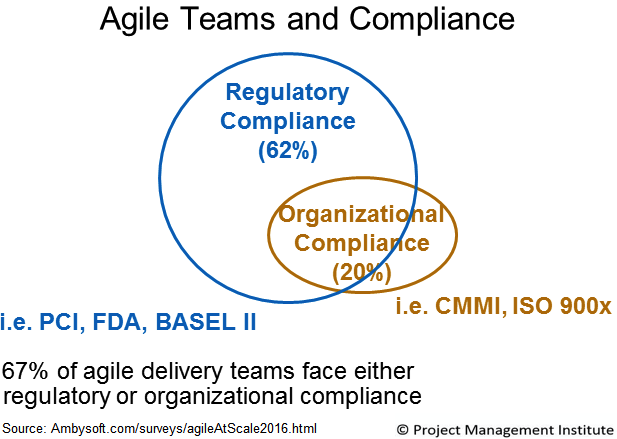
| We often hear that agile is great for simple situations but as soon as you face compliancy issues that it doesn’t work. Is it possible to be agile when you face regulatory compliance, such as PCI and FDA compliancy? Is it possible to be agile when you face organizational compliance, such as working in a CMMI regime? Important questions that we decided to look into. The following diagram summarizes the responses to our question around agile teams and compliance from our 2016 Agility at Scale study. As you can see, 62% of respondents indicated that their agile team faced some form of regulatory compliance, 20% some form of organizational compliance, and 15% said both. In fact, two-thirds of agile teams operate under one or more compliancy requirements.
For further reading about compliancy, please read our detailed blog posting Agile and Regulatory Compliance. Related Posts |
| We are often told that agile teams should be whole, that they should have sufficient people, funding, and skills to fulfill their mission. The idea is that this reduces the dependencies that your team has on others, enabling them to make decisions and to collaborate more effectively. But, is this actually happening in practice? Are agile teams truly whole, or do they still need to collaborate with other teams (hopefully productively) to get the job done? Being strong believers in empiricism over rhetoric we decided to look into this issue. In November of 2016 we ran the 2016 Agility at Scale survey. It was targeted at people who were currently working on agile teams, or who had recently worked on agile teams, and we asked them straightforward questions around the size of the team, how distributed it was, what complexities they faced, an so on. The following infographic summarizes the findings from the question that explored whether agile delivery teams need to work with external teams or groups to get their work done – in other words, are agile teams truly whole or do they rely on others? As you can see, 96% of respondents indicated that in practice their team had to work with one or more other teams, leading to the conclusion that very few agile teams appear to be truly whole.
One of the fundamental principles underlying the Disciplined Agile (DA) toolkit is that disciplined agilists should be enterprise aware – they should recognize that they need to collaborate with others outside of their team, that they should work towards a common organizational vision, and that they should strive to do what is best for the organization and not just what is convenient for them. Given that agile teams are collaborating with others in practice, it is clear that this philosophy of being enterprise aware is important. The following diagram presents the results from the survey question in greater detail. You can obtain the source data, a copy of the original questions, and a slide deck key diagrams at the 2016 Agility at Scale survey page.
Related Posts: |
|
Table 1. Vertical slicing strategies for a DW/BI solution.
There are several interesting things about the stories in the table:
I’ve written a detailed explanation of vertical slicing for a DW/BI solution, and of course there is a wealth of information about agile database techniques in general for those of you interested in greater detail. |
|
"There is one way to find out if a man is honest: Ask him! If he says yes, you know he's crooked." - Groucho Marx |