Disciplined Agile
by Tatsiana Balshakova,
Mark Lines, Mike Griffiths, Scott Ambler, Bjorn Gustafsson, Curtis Hibbs, James Trott

This blog contains details about various aspects of PMI's Disciplined Agile (DA) tool kit, including new and upcoming topics.
View Posts By:
Tatsiana Balshakova
Mark Lines
Mike Griffiths
Scott Ambler
Bjorn Gustafsson
Curtis Hibbs
James Trott
Past Contributors:
Joshua Barnes
Michael Richardson
Daniel Gagnon
Valentin Tudor Mocanu
Kashmir Birk
Glen Little
Klaus Boedker
Recent Posts
DA 5.6 is released
Disciplined Agile 5.5 Released
Choose Your WoW! Second Edition Is Now Available
Requisite Agility applied in Project Management
Disciplined Agile and PMBoK Guide 7th Edition
Categories
#ChoiceIsGood,
#ChooseYourWoW,
#ConsumableSolution,
#ContinuousImprovement,
#CoreAgilePractices,
#experiment,
#Experimentation,
#GuidedContinuousImprovement,
#Kaizen,
#LifeCycles,
#ProcessImprovement,
#TealOrganizations,
Adoption,
agile,
agile adoption,
Agile Alliance,
Agile Business Analyst,
Agile certification,
agile data,
agile governance,
agile lifecycle,
agile metrics,
agile principles,
agile transformation,
Agile2018,
Agile2019,
Agile20Reflect,
AgileData,
Analogy,
announcement,
Architecture,
architecture,
architecture owner,
Articles and publications,
Asset Management,
Atari,
Backlog,
Barclays,
being agile,
benefits,
bi,
blades,
book,
Branching strategies,
Browser,
Business Agility,
business intelligence,
business operations,
capex,
Case Study,
Certification,
certification,
charity,
Choose your WoW,
CMMI,
cmmi,
Coaching,
Collaboration,
Communications Management,
Compliance,
Compliancy,
Conference,
Construction,
Construction phase,
Context,
Continuous Improvement,
coordination,
COVID-19,
Culture,
culture,
Cutter,
DA,
DAD,
DAD Book,
DAD discussions,
DAD press,
DAD roles,
DAD supporters,
DAD webcast,
DADay2019,
Data Management,
database,
dependencies,
Deployment,
Development Strategies,
DevOps,
disaster,
Discipline,
discipline,
Disciplined Agile,
disciplined agile delivery,
disciplined agile delivery blog,
Disciplined Agile Enterprise,
disciplined devops,
Documentation,
Domain complexity,
dw,
DW/BI,
Energy Healing,
Enterprise Agile,
Enterprise Architecture,
Enterprise Awareness,
enterprise awareness,
Essence,
estimation,
Evolving DA,
Executive,
Experiment,
facilitation,
FailureBow,
feedback-cycle,
finance,
Financial,
FLEX,
Flow,
foundation layer,
Funding,
GCI,
GDD,
Geographic Distribution,
gladwell,
global development,
Goal-Driven,
goal-driven,
goals,
Governance,
GQM,
Guideline,
Hybrid,
Improvement,
inception,
Inception phase,
India,
information technology,
infosec,
Introduction,
iterations,
Kanban,
large teams,
layer,
lean,
Lean Startup,
learning,
Legal Project Management,
LeSS,
Lifecycle,
lifecycle,
Manifesto,
mark lines,
marketing,
MBI,
Metaphor,
Metrics,
metrics,
mindset,
Miscellaneous,
MVP,
News,
News and events,
Non-Functional Requirements,
non-functional requirements,
Non-solo development,
offshoring,
Operations,
opex,
Organization,
Outsourcing,
outsourcing,
paired programming,
pairing,
paper,
People,
People Management,
phases,
Philosophies,
Planning,
PMBoK,
PMI,
PMI and DA,
PMI Chapter,
Portfolio Management,
post-format-quote,
Practices,
practices,
Principle,
Process,
process improvement,
process tailoring,
Product Management,
product owner,
Product Owners,
productivity,
Program Management,
Project Management,
project-initiation,
Promise,
Quality,
quality,
rational unified process,
Refactoring,
Reiki,
Release Management,
release management,
Remote Training,
Remote Work,
repeatability,
requirements,
Requirements Management,
research&development,
responsibilities,
retrospectives,
Reuse,
Reuse Engineering,
ride for heart,
rights,
Risk Management,
Risk Management,
Risk management,
Roles,
RUP,
SAFe,
sales,
Scaling,
scaling,
scaling agile,
Scheduled Workshops,
SCM,
scorecard,
Scrum,
ScrumMaster,
SDLC,
Security,
security,
self-organization,
SEMAT,
serial,
skill,
solutions software consumable shippable,
Stakeholder Management,
strategy,
Support,
Surveys,
Teal organizations,
team development,
Team Lead,
team lead,
Teams,
Technical Debt,
Teleconferencing,
Terminology,
terraforming,
test strategy,
testing,
time tracking,
Tool kit,
Toolkit,
tools,
traditional,
Transformation,
Transition iteration,
transition phase,
Uncategorized,
Upmentors,
Using PMI Standards,
value stream,
velocity,
vendor management,
Virtual Training,
Workflow,
workflow,
workspaces
Date
| The contrite answer is that they’re as large as they need to be, and the contrite agile answer is that they’re as small as they can be. Now that we’ve gotten the contrite answers out of the way, how large are agile teams in practice?
In November of 2016 we ran the 2016 Agility at Scale survey. It was targeted at people who were currently working on agile teams, or who had recently worked on agile teams, and we asked them straightforward questions around the size of the team, how distributed it was, what complexities they faced, an so on. The following graph summarizes the responses around team size.

This year’s survey found that roughly half (48%) of agile teams are more than 10 people in size and one-quarter are more than 20 people in size. These findings are similar to what we’ve found in the past with both the 2012 Agility at Scale survey and the 2009 Agility at Scale survey.
In short, don’t let anyone tell you that you can’t do agile with a large team because others are clearly doing so in practice. Yes, large team agile is different than small team agile, which is one of the reasons why you need to take a pragmatic, context-sensitive approach to agile solution delivery. The Disciplined Agile (DA) toolkit provides the foundation from which to scale your approach to solution delivery to address a range of scaling factors, including team size. In fact, you may find our article around large agile teams to be of interest.
Related Posts:
|
Posted
by
Scott Ambler
on: January 31, 2017 11:00 AM
|
Permalink |
Comments (0)
| 
We have recently published a new Inception process goal, Develop Initial Test Strategy. The potential need for this goal was identified a little over a year ago by an organization that we were actively working with and since then we have worked with several other organizations where it was also clear that this process goal was needed.
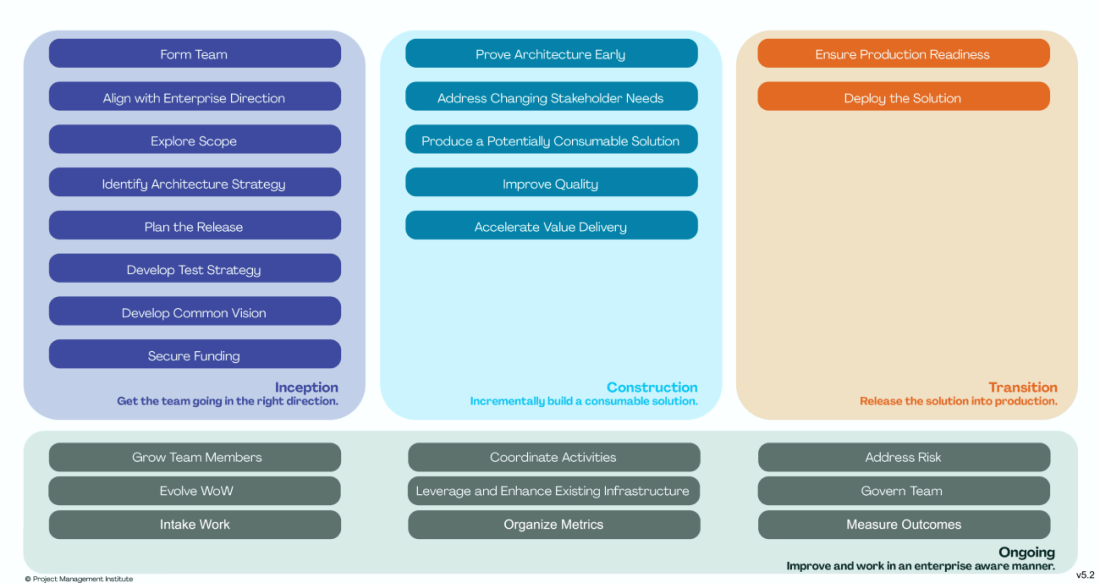
The basic idea is that during the Inception phase the team should consider developing an initial test strategy so as to identify how they will approach verification and validation. This includes thinking about how you intend to staff your team, organize your team, capture your plan, approach testing, approach development/programming, choose a platform for test environment(s) platform, choose a platform equivalency strategy, test non-functional requirements, automate test suites, obtain test data, automate builds, report defects, and govern your quality efforts. The goal diagram is depicted in Figure 1 and the update goals overview for Disciplined Agile Delivery (DAD) is shown in Figure 2.
Figure 1. The goal diagram for Develop Initial Test Strategy.

Figure 2. The process goals diagram for DAD.
|
Posted
by
Scott Ambler
on: January 30, 2017 01:02 PM
|
Permalink |
Comments (0)
|

The Agile manifesto is only 4 lines, there are only 12 principles for agile software and the original Scrum Guide was less than 20 pages, so how hard can Agile be?
Chess has only a couple of dozen basic moves so how hard can it be to get to checkmate?
How many times have you heard?
- All you need to be Agile is to get the team doing a few funky ceremonies
Or the approach to evolving a team from forming to performing:
- If the team isn’t performing after a month then the manager is not effective.
Despite the apparent simplicity of Agile, transforming to Agile is hard and the learning curve is very steep. Depending on the team and the individuals, a transformation from waterfall to a high performing Agile team can take anywhere from 6 months to a year or more. That’s not to say that they won’t be productive over that period of time. In fact, they will start delivering business value at the end of the first iteration, but the team will be in constant growth and development over that period of time because not only do the people have to learn a new process, they also need to learn a new way of thinking as well as a new way of working as a team.
1.0 A new process
Aside from being excited to work with the thought leaders in the agile world, the reason I joined with SA+A is because of the Discipline Agile Delivery (DAD) decision framework and the way it captured all the tough stuff that I had been wrestling with for years. With many years of experience building agile teams, I considered myself somewhat of an expert with answers to a lot of the difficult questions. When I reviewed DAD I realized that the answers I had gained from my own personal experience would not apply in all circumstances or for all teams. Context counts. The DAD Agile/Basic and Lean/Advanced project lifecycles have three phases: inception, construction and transition. Each phase has a collection of process goals, and each goal encompasses several process decision points. And, each decision point has a collection of options to choose from. These process goals, decision points and options have been empirically assembled by analyzing many agile teams to see what makes an agile team successful. This framework gives a team the ability to define a process that works for them. Is this difficult to do? Absolutely! Defining a process to use is always difficult. BUT….. The framework provides some guidance. Each goal option has default options that the team can use to get started and the options are listed in preference order so the team can easily pick an initial option. As the team evolves and matures they can chose the more advanced options and evolve and mature their process. Does the toolkit include all possible options? Definitely not, but the options are certainly extensive. The framework has evolved over time and continues to evolve as the coaches and thought leaders gain more experience and work with more diverse teams.
No matter which lifecycle the team has chosen to use; whether the team is using classic Scrum (Basic/Agile) or Kanban (Advanced/Lean) or a tailored process created using a toolkit such as DAD, the team is going to need practice and discipline to get it right. That means, executing the lifecycle, doing periodic retrospectives, updating the process and then repeating again and again until they get it right. Changing behaviors is hard and the team will struggle to be successful.
2.0 A new way of thinking
No matter how you cut it, transforming to Agile is a cultural change and culture changes are hard. Not only is it hard for those who want to make the change but almost inevitably there will be pockets of resistance from people are happy with “the way we’ve always done it”. Unfortunately, political infighting is the biggest risk to innovation. It is going to happen, you may as well brace yourself for it.
The roles are changing from traditional roles (such as: developer, business analyst (BA), system analyst (SA), quality assurance (QA) and project manager (PM), to new unfamiliar roles (such as: product owner (PO), team lead (TL), architecture owner (AO) and team member). The traditional roles may be deeply embedded in your HR hiring and performance review processes. Transitioning to the new roles will require a realignment of skills and abilities that is bound to cause great consternation amongst the team members. Often this is a very difficult transition for project managers, in particular, because they find that a lot of the traditional tasks (i.e. work breakdown structures, planning, estimating, etc.) are now the responsibility of the whole team.
The team needs to start thinking in smaller deliverable pieces. The concept of delivering a complete system from known specifications at the beginning of the project has been the fallacy of traditional development. The cost of delaying delivery to the very end of the project and the lack of ability to meet actual customer needs can be eliminated by delivering minimum functionality early and augmenting with new and improved functionality iteration after iteration in close collaboration with the end customer. But moving to this model of continuously delivering can be a tough adjustment for developers. Even (or maybe especially) for seasoned developers, the concept of starting to build and deliver not knowing all the detailed specifications up front can be very unsettling. Getting comfortable with this model takes time and experience before developers cease to fall back on old behaviors.
One of the pillars of agile is complete transparency with the business and the stakeholders into the team, the process they are using and the delivery of the business functionality. With the business embedded in the team on a day to day basis and iteration reviews to demonstration and approve all the deliverables from each iteration, there is no hiding problems when they occur and no hiding late deliveries or failed iterations. On the flip side, the business is there to celebrate the wins and recognize the deliveries at the end of each iterations and they are part of determining the velocity of the team and adjusting the schedule to match the velocity.
The new way of thinking also requires new tools. Tools that can build dashboards to automate and display the development intelligence metrics that provide transparency into the team’s performance. Tools that automate configuration management, continuous integration and continuous integration as well as automated testing. All of these endeavors are hard and required skilled individuals to lead; none of these comes for free.
3. A new way of working with others
More people skills are required by everyone. People are now going to be working much closer together physically and will be interacting and collaborating on a much more frequent basis. Experience working together (often for many years) may give an advantage to some team members, however, they still need to learn how to work together as a team.
3.1 Team Development Phases
Tuckman’s team development model includes the phases: forming, storming, norming, and performing. These phases are all necessary and inevitable in order for the team to grow, to face up to challenges, to tackle problems, to find solutions, to plan work, and to deliver results. The number of iterations required to move through the phases will vary by team depending on factors such as: company culture, skills, experience, familiarity with each other, leadership (or lack thereof), external influences and coaching etc. Teams may also plateau in a phase before entering the next phase.
Agile teams will go through the four Tuckman phases:
- Forming. All teams will go through the forming phase. Typically this take 4 to 6 iterations for the team to: understand the lifecycle process, understand how to work together, understand what the team goal is, and most importantly to get comfortable enough with each other to risk the possibility of conflict. During this phase, the team’s velocity will vary considerably especially for the expected failed iterations although there should generally be a trend upward in the velocity. Retrospectives in this phase tend to be very cordial and factual because everyone is avoiding conflict.
- Storming. The storming phase can be very upsetting to both the team members and team managers. Often managers will step in to solve the storming issues without realizing that it is a necessary phase for the team to work through on their own. Conflict, disagreements and personality clashes must get resolved before the team can move to the next phase. Unfortunately, this phase is a make or break phase and it is hard to predict just how many iterations it will take but it is not usual to expect 3 or 4 pretty rough iterations. Some teams will completely disintegrate during this phase and it is certainly not unusual to have a decrease in velocity during this phase. Some members of the team may find they have basic incompatibilities and need to move to another team and this change in team membership can revert the team back to the forming phase. The retrospectives tend to be very interesting and intense during this phase as they deal with the inter-personal issues of the team. You can pretty much expect that there are going to be some hurt feelings no matter how safe an environment you have.
- Norming. The norming phase is when the team comes back together stronger and more cohesive for having weathered the storming phase. They have resolved their issues and have developed a new synergy where the team just “works well together” and it is fun to be part of the team. The team velocity should trend upward and then level off as the team hits its capacity consistently. With the new-found synergy of the team, the retrospectives can focus on process improvement and optimizing the operation of the team with the hope of transitioning to the performing phase.
- Performing. The performing phase is the goal for all teams but very few actually get to this phase. Not all teams can get to the high level of performance of a Special Ops team where each member knows exactly what their team mates are doing and what they need to do to work as a cohesive unit. A team in performing phase no longer needs a coach or supervision but can operate autonomously and efficiently.
3.2 Team changes everything
With self-organizing teams, decisions are now made at the team level rather than at the PM or manager levels. This can be a difficult transition for both the team members and the managers. Team members are often use to others making the decisions for them and wait for decisions or are reluctant to make decisions. Managers often feel disempowered when decisions are no longer in their hands because the decisions are made by the team.
The team still has the responsibility to do the traditional activities such as; analysis, design, development testing and deployment. However, under the new model, the team also takes on the inception responsibilities of: developing user stories, sizing the stories, estimating the stories, creating the product and architectural vision, and developing the release plan. During construction the team also has to: plan the iteration, do look ahead planning, and have an iteration review (i.e. demo) with the stakeholders. To keep the team working together they need to have the daily coordination meeting (i.e. Scrum) and to keep the team growing and evolving of course they need to do the retrospective at the end of each iteration.
Thinking, analyzing, planning and building just-in-time is a new way of thinking for a traditional team. The inception phase in particular can be a difficult adjustment. Designers and developers are used to doing all the analysis and design upfront. Doing just enough analysis to be confident of a solution and then writing the user stories to do the work and build the plan is a difficult transition. Writing user stories so they can get started and learn as they go is a very difficult transition. Building just the simplest framework and then adding required features and functionality as needed requires practice, training and reinforcement.
There is much more focus on delivering quality because the team is responsible for development, delivery as well as product support.
4.0 The Bottom Line
Chess has only a couple of dozen basic moves and so it is simple to learn the basics. However, after 3 moves there can be several billion moves available making it so complex that it can take a lifetime to master. Transforming to Agile is a lot like that. It looks very simple on the surface but under the covers it can get very complex very quickly. That’s where the value of a good coach comes in. You need a coach who brings a lot of experience to the table who will be open and honest with you about what needs to be done and how to get a successful transformation.
|
Posted
by
Glen Little
on: January 26, 2017 11:00 PM
|
Permalink |
Comments (0)
| Reuse engineering is an important, and arguably advanced, aspect of the Disciplined Agile toolkit. The challenge is that reuse engineering requires significant discipline and organizational maturity to be successful, hence we tend to run into far more talk about reuse than action. Having said that, many organizations have been very successful with reuse. The following diagram overviews the internal workflow of a reuse engineering team, capturing key activities (the blue bubbles) that the team performs. This blog posting explores what reuse engineers do in practice.
.jpg)
Let’s work through the primary activities performed by reuse engineers:
- Guide teams in reuse. An important activity for reuse engineers is to provide guidance to delivery teams regarding what is available for reuse, how to go about accessing and applying the reusable artifacts, and educating teams in why reuse is important to both the team and to your organization. Very often a team’s architecture owner will collaborate with the reuse engineering team to bring a reuse engineer into the team at the right time.
- Obtain assets. Reuse engineers will obtain reusable assets from a variety of sources, including from the marketplace and from internal delivery teams. Based on the various organizational roadmaps, and the needs of the delivery teams that they’re working with, the reuse engineering team will often work with delivery teams to identify and obtain the appropriate assets from the marketplace. The goal is to find assets that fit the needs of individual teams in a way that aligns with the direction of the organization. Furthermore, reuse engineers tend to monitor what delivery teams are doing, often by working closely with the organization’s enterprise architecture team and the architecture owners on delivery teams, to help them identify potentially reusable assets. When a team believes it has built something that is potentially reusable by others, or when the reuse engineers believe they have done so, then the reuse engineers will work with the team to understand and harvest that asset.
- Publish reusable assets. An asset is potentially reusable when it is of high quality, it is appropriately documented, one or more examples exist of how to use it, and it is findable by others. The publishing process ensures that all of these criteria are true. The reuse engineers will do the work to publish the asset, refactoring and documenting it as needed and harvesting any usage examples if available (and creating some when not). After doing so, they will save the asset and its related supporting artifacts into your organization’s reuse repository, announcing the availability of the new asset after doing so. Note that reuse repositories, also called asset managers, have fallen out of favor in the past few years due to the complexity of the available products on the market and the propensity of organizations to use products like Git or Microsoft SharePoint as repositories.
- Configure asset for specific use. Reuse engineers will often work with a team to help them to configure an asset for specific use. The goal is to make it as easy as possible for others to reuse existing assets, thereby increasing the chance of rate of successful reuse within your organization.
- Integrate reusable assets into a solution. Reuse engineers will often work with delivery teams to integrate a reusable asset into their solution, once again to make it as easy as possible for teams to reuse existing assets. Interestingly, an important aspect of harvesting an asset for reuse is to help the source team to integrate the improved version of the asset back into their solution. This helps to increase the likelihood that teams will offer up potential assets for harvesting and publishing.
- Evolve reusable assets. Assets need to evolve over time to reflect changing requirements and implementation technologies. The implication is that the owners of the assets, often the reuse engineering team, will need to evolve their assets, publish new versions, and deprecate old versions. This is work that must be funded and supported properly.
If your organization is serious about reuse engineering then they will explicitly fund a reuse engineering team and enable them to work in the manner that we’ve described here. For more information, you will find the article Reuse Engineering to be of value.
|
Posted
by
Scott Ambler
on: January 24, 2017 10:41 AM
|
Permalink |
Comments (0)
| IT Portfolio Management addresses how an IT organization goes about identifying, prioritizing, organizing, and governing their various IT endeavors. Disciplined Agile Portfolio Management seeks to do this in a lightweight and streamlined manner that maximizes the creation of business value in a long-term sustainable manner. IT endeavors typically include solution delivery initiatives/projects, stable product development teams, business experiments (along the lines of a lean startup strategy), and the operation of existing IT-based solutions.
Being agile, having an agile mindset, is foundational to working in an agile manner. The Disciplined Agile Manifesto and the principles of lean software development provide an important start at this mindset. In this blog we explore similar agile philosophies that are specific to successful portfolio management. These philosophies are:
- Keep it simple. Keep your portfolio management activities as streamlined and lightweight as can be. Your goal should be to focus on making good decisions and providing guidance to people, not on maintaining extensive documentation or reviewing documentation. You still may choose to maintain artifacts such as a portfolio roadmap and portfolio budget, but those too should be as lightweight and concise as possible.
- Focus on value over cost. Shifting your mindset from “what is this going to cost?” to “what value will this generate?” is critical to your success because it helps you to focus making better IT investments. You want to invest in IT endeavors that enhance your organization’s ability to produce value for your customers. This in turn provides the profits required for further investment.
- Reduce the cost of delay. One of the strategies for maximizing stakeholder value is to invest in developing functionality that will provide value to the organization soonest. For example, if you delay developing functionality that will generate annual revenue of $10 million for six months you have an effective cost of delay of $5 million because you missed out on half a year of revenue. Disciplined agile portfolio managers consider the cost of developing a solution, the cost of delay that results from putting off said development, and the revenue generated (or cost savings) when calculating the overall value of a solution.
- Invest in streamlining the creation of value. Not only do we want to produce value for our customers, we also want to be good at doing so. The implication is that we sometimes need to invest in ourselves through process or environment improvements.
- Prefer stable teams over project teams. Although portfolio management is often believed to be the oversight of project teams, it really is more about the coordination and oversight of teams in general. In Disciplined Agile we recognize that an initiative is seldom finished at the end of a “project”. There are usually subsequent changes required over time requiring future releases of the solution. The agile community has discovered that long-lived stable teams, whose membership evolves over time, have significant advantages over short-lived project teams. A significant productivity improvement occurs when IT organizations shift away from the project mindset of bringing people to the work and instead decide to bring work to the people (the stable teams).
- Align teams to value streams. These stable teams should be aligned long-term to value streams or lines of business (LOBs). High performing agile teams reliably deliver value frequently to their business stakeholders. As a result the business learns to trust the teams aligned to their areas. This positive feedback cycle maximizes the effectiveness of your agile teams. Additionally, over time they learn more about the business adding to their effectiveness.
- Enable diversity. Every person, every team, and every organization is unique. Every team faces a unique situation that evolves over time. The implication is that teams must be allowed to organize themselves and to tailor their process to meet the context of the situation that they face. This is why the Disciplined Agile (DA) toolkit focuses on providing, and comparing and contrasting, a wealth of process choices. The implication for portfolio managers is that they need to be flexible in their approach. They will work differently with each team because each team works differently, yet they must still provide good guidance to these teams and monitor the effectiveness of each team appropriately.
- Trust but verify. Effective governance is based on enabling and then trusting your teams to do the right thing. However, effective teams monitor themselves through the use of automated dashboard technology and close collaboration, and the metrics that teams collect should be made visible to senior management and other stakeholders so that they may monitor what is happening.
- Govern by risk not by artifacts. Traditional governance often focuses on the review of common artifacts such as requirement documents, architecture models, and test results. Because it is relatively easy for teams to create the documentation that you want to see, in practice there is very little governance value in reviewing these artifacts. Agile governance instead focuses on addressing common risks such as ensuring there is an agree to vision for what the team should accomplish, that the architectural strategy has been proven to be viable early in the lifecycle, and that the team has produced sufficient business value for their stakeholders.
- Rolling wave over annual planning. Annual planning often begins in earnest mid-year which means that prioritized initiatives may not be actually delivered for up to 18 months in the following year. This is not business agility. Make your planning a continuous “rolling wave” activity year round with more detail devoted to planning initiatives no longer than 6 months out. Initiatives planned beyond 6 months should be described at a very high level.
- Prefer small initiatives over large initiatives. It is a proven fact that the larger the initiative the greater the chance of failure. Smaller initiatives are easier to plan and are lower risk to execute. Keep your initiatives small to allow for more frequent delivery of value with less investment in work in progress (WIP).
- Invest in quality. Ensuring that IT delivery teams produce new business value for your organization is clearly important. But so is ensuring that you will still be able to continue doing so a few years from now. To ensure the long-term sustainability of your IT teams you must allow them to make investments in quality. These investments include building high quality assets in the first place but also fixing low quality assets, what agilists refer to as paying down technical debt, as well.
- Optimize the whole. Disciplined agilists are enterprise aware. We choose to optimize the whole instead of locally optimizing a single activity. The implication is that you cannot consider portfolio management on its own but instead must consider it in the context of the other parts of your organization that it affects. A strategy that may make things easier to manage your portfolio, such as having a single way to fund IT delivery teams, may make it easier for your portfolio management efforts but could inflict undue costs and bureaucracy on the teams that you’re funding. For example, does it really make sense for a team asking for $50,000 in funding to go through the same level of rigor as a team asking for $5,000,000? Likely not. Context counts.
Our experience is that the philosophies describe above enable portfolio managers to be more effective in practice. We hope you have found this blog of value and we welcome your feedback.
|
Posted
by
Scott Ambler
on: December 11, 2016 05:44 PM
|
Permalink |
Comments (0)




