








Guessing is not a strategy: How to build decision velocity with AI and real-time data
June 10, 2026 | Live Webinar

Disciplined Agile 5.5 Released
Choose Your WoW! Second Edition Is Now Available
Requisite Agility applied in Project Management
Disciplined Agile and PMBoK Guide 7th Edition
#ChoiceIsGood, #ChooseYourWoW, #ConsumableSolution, #ContinuousImprovement, #CoreAgilePractices, #experiment, #Experimentation, #GuidedContinuousImprovement, #Kaizen, #LifeCycles, #ProcessImprovement, #TealOrganizations, Adoption, agile, agile adoption, Agile Alliance, Agile Business Analyst, Agile certification, agile data, agile governance, agile lifecycle, agile metrics, agile principles, agile transformation, Agile2018, Agile2019, Agile20Reflect, AgileData, Analogy, announcement, Architecture, architecture, architecture owner, Articles and publications, Asset Management, Atari, Backlog, Barclays, being agile, benefits, bi, blades, book, Branching strategies, Browser, Business Agility, business intelligence, business operations, capex, Case Study, Certification, certification, charity, Choose your WoW, CMMI, cmmi, Coaching, Collaboration, Communications Management, Compliance, Compliancy, Conference, Construction, Construction phase, Context, Continuous Improvement, coordination, COVID-19, Culture, culture, Cutter, DA, DAD, DAD Book, DAD discussions, DAD press, DAD roles, DAD supporters, DAD webcast, DADay2019, Data Management, database, dependencies, Deployment, Development Strategies, DevOps, disaster, Discipline, discipline, Disciplined Agile, disciplined agile delivery, disciplined agile delivery blog, Disciplined Agile Enterprise, disciplined devops, Documentation, Domain complexity, dw, DW/BI, Energy Healing, Enterprise Agile, Enterprise Architecture, Enterprise Awareness, enterprise awareness, Essence, estimation, Evolving DA, Executive, Experiment, facilitation, FailureBow, feedback-cycle, finance, Financial, FLEX, Flow, foundation layer, Funding, GCI, GDD, Geographic Distribution, gladwell, global development, Goal-Driven, goal-driven, goals, Governance, GQM, Guideline, Hybrid, Improvement, inception, Inception phase, India, information technology, infosec, Introduction, iterations, Kanban, large teams, layer, lean, Lean Startup, learning, Legal Project Management, LeSS, Lifecycle, lifecycle, Manifesto, mark lines, marketing, MBI, Metaphor, Metrics, metrics, mindset, Miscellaneous, MVP, News, News and events, Non-Functional Requirements, non-functional requirements, Non-solo development, offshoring, Operations, opex, Organization, Outsourcing, outsourcing, paired programming, pairing, paper, People, People Management, phases, Philosophies, Planning, PMBoK, PMI, PMI and DA, PMI Chapter, Portfolio Management, post-format-quote, Practices, practices, Principle, Process, process improvement, process tailoring, Product Management, product owner, Product Owners, productivity, Program Management, Project Management, project-initiation, Promise, Quality, quality, rational unified process, Refactoring, Reiki, Release Management, release management, Remote Training, Remote Work, repeatability, requirements, Requirements Management, research&development, responsibilities, retrospectives, Reuse, Reuse Engineering, ride for heart, rights, Risk Management, Risk Management, Risk management, Roles, RUP, SAFe, sales, Scaling, scaling, scaling agile, Scheduled Workshops, SCM, scorecard, Scrum, ScrumMaster, SDLC, Security, security, self-organization, SEMAT, serial, skill, solutions software consumable shippable, Stakeholder Management, strategy, Support, Surveys, Teal organizations, team development, Team Lead, team lead, Teams, Technical Debt, Teleconferencing, Terminology, terraforming, test strategy, testing, time tracking, Tool kit, Toolkit, tools, traditional, Transformation, Transition iteration, transition phase, Uncategorized, Upmentors, Using PMI Standards, value stream, velocity, vendor management, Virtual Training, Workflow, workflow, workspaces


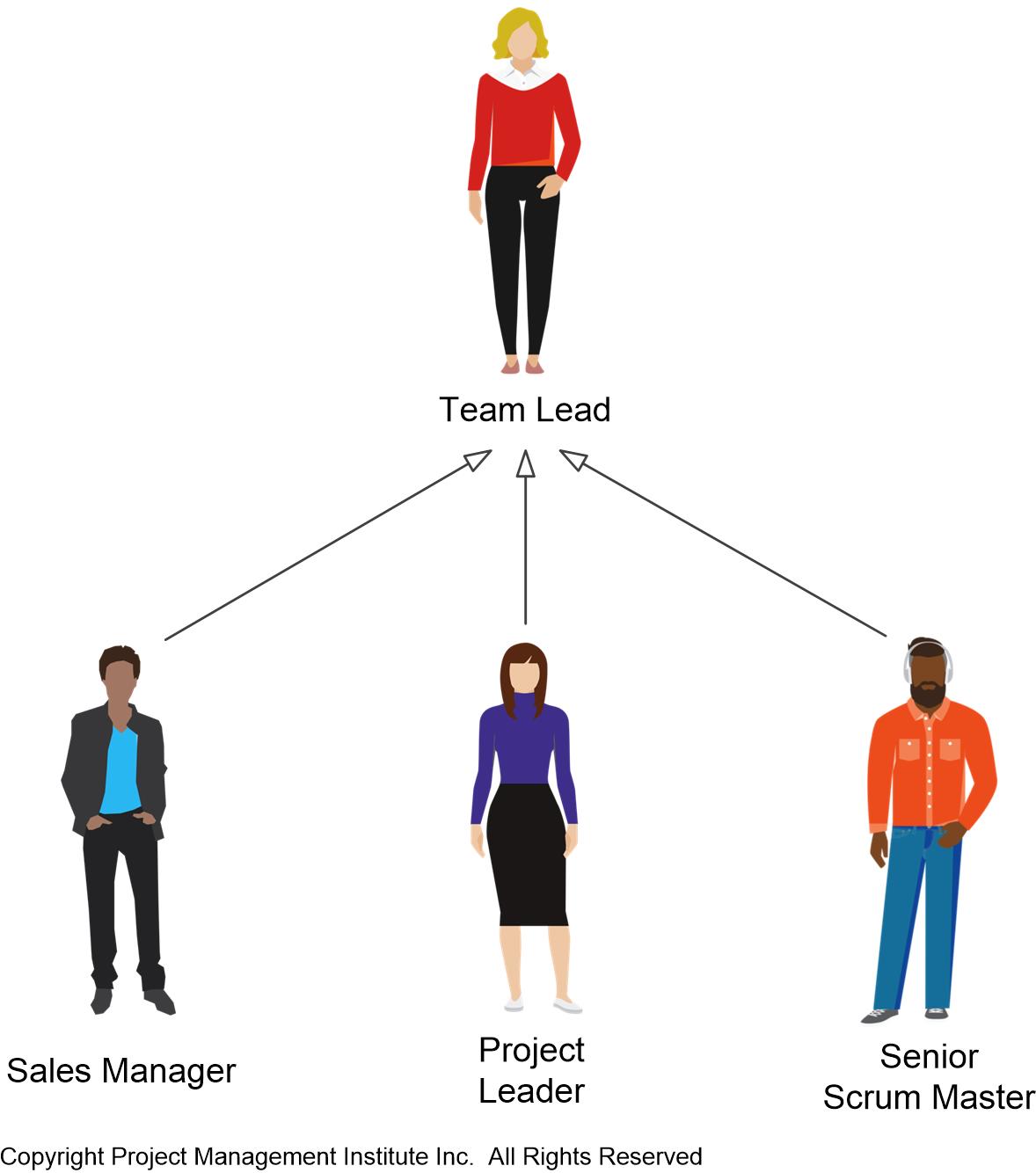
| We are often asked why Disciplined Agile (DA) has a team lead role instead of Scrum master or project manager. The answer is three-fold: different types of teams require different types of leaders, leadership responsibilities vary based on the type of team they are leading, and DA strives to be agnostic wherever possible. Let's explore the implications of this strategy. Team lead is what is known as a meta role. What we mean by this is that there are different types of team lead depending on the situation, as depicted in Figure 1. Think of team lead as a place holder for a more specific type of lead. So, a scrum master is a team lead of a Scrum team, a project leader is a team lead of a project team, a sales manager is a team lead of a sales team. At times, the team will choose to stick with the name “team lead” for the role due to their way of working best fitting that description. Figure 1. Types of team leads.
As I said above, there are three reasons for taking this approach with the team lead role:
The end result is that you may see some DA teams with a senior scrum master as the team lead, some DA teams with a project leader as a team lead, some DA teams with a functional leader in the role of team lead, and some teams with someone who is simply the team lead. Just like your way of working (WoW) should be fit for purpose, so should your approach to roles and responsibilities. |
| The Disciplined Agile (DA) tool kit has always been a hybrid of great strategies from the very beginning, with the focus being on how all of these strategies fit together in practice. In the current release of DA we made its hybrid nature explicit when we refactored the foundation, depicted in Figure 1, into its own layer. You can see this in that we clearly indicate that Agile, Lean, and Serial (traditional) strategies are all foundational aspects of DA. Figure 1. The foundation of DA is fundamentally hybrid in nature.
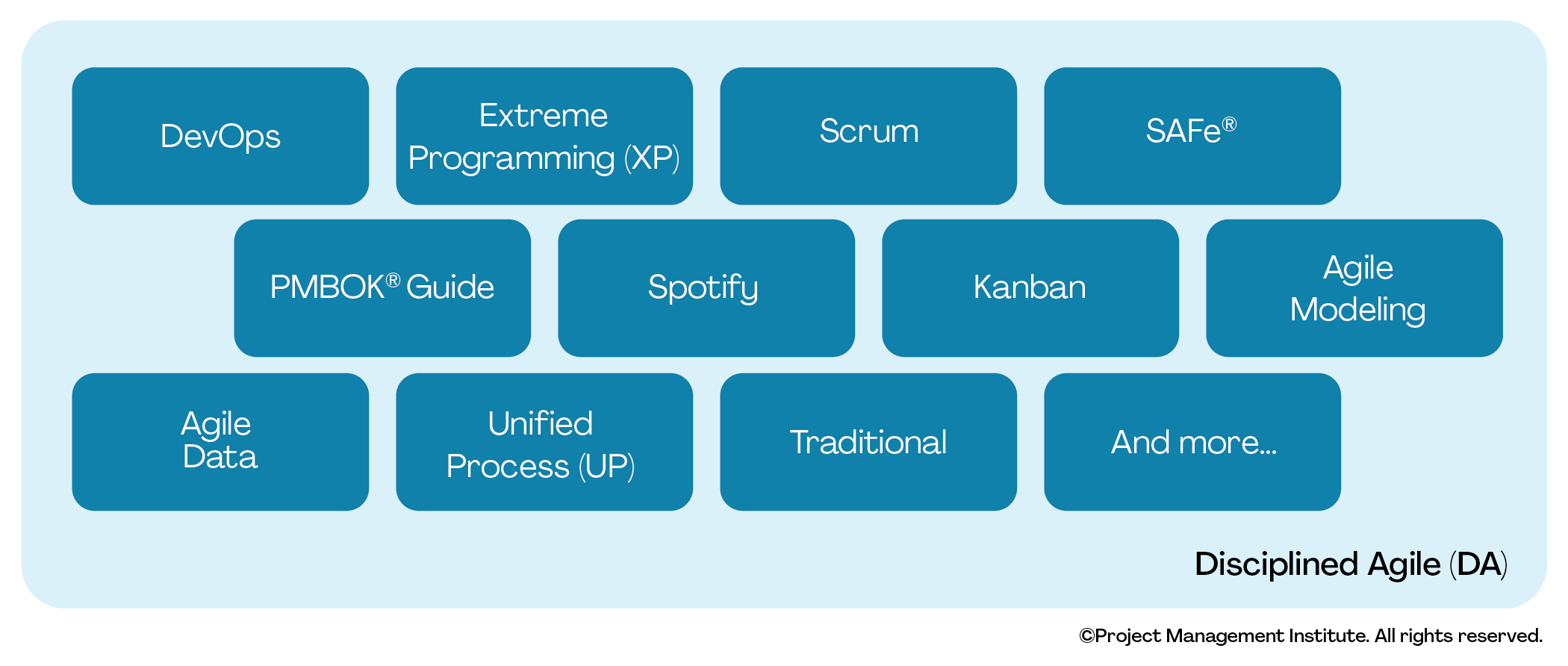
We like to say that DA does the heavy process lifting so that you don’t have to. We’ve mined the various methods, frameworks, and other sources to identify potential practices and strategies that your team may want to experiment with and adopt. DA puts these techniques into context, exploring fundamental concepts such as what are the advantages and disadvantages of the technique, when would you apply the technique, when wouldn’t you apply the technique, and to what extent would you apply it? Answers to these questions are critical when a team is choosing its way of working (WoW). Figure 2 shows that DA is a hybrid tool kit that puts great ideas from PMBOK Guide, Scrum, SAFe, Spotify, Agile Modeling (AM), Kanban, and several other methods into context.
DA has taken this approach because no framework, no book of knowledge (BoK), is complete. For example, XP is the source of technical practices such as test-driven development (TDD), refactoring, and pair programming but has nothing to say about project management. The PMBoK Guide has great strategies for project managers, but has nothing to say about data analytics. The Agile Data (AD) method has great strategies for creating and evolving data sources but has nothing to say about organizing agile teams. Scrum offers great strategies such as product backlogs, sprint/iteration planning, and daily coordination meetings for organizing agile teams but has nothing to say about documentation strategies. Agile Modeling gives us model storming, architecture envisioning, and continuous documentation strategies but has nothing to say about governance. You get the point. Each framework, each BoK, has its specific focus and thus is not sufficient on its own. The upside is that there are great strategies presented by each, often in great detail. The downside is that each source is locally optimize, they are inconsistent with one another, and there is very little advice for how to integrate these sources. This is where DA steps in - DA is hybrid that combines and puts these great ideas into context, providing advice for how to apply them effectively when you choose your WoW. |
|
One of the principles of the Disciplined Agile (DA) mindset is to "Be Awesome." Who doesn’t want to be awesome? Who doesn’t want to be part of an awesome team doing awesome things while working for an awesome organization? We all want these things. Recently, Joshua Kerievsky has popularized the concept that modern agile teams make people awesome, and, of course, it isn’t much of a leap that we want awesome teams and awesome organizations too. Similarly, Mary and Tom Poppendieck observe that sustainable advantage is gained from engaged, thinking people, as does Richard Sheridan in Joy Inc. Helping people to be awesome is important because, as Richard Branson of the Virgin Group says, “Take care of your employees and they’ll take care of your business.” There are several things that we, as individuals, can do to be awesome:
Awesome teams also choose to build quality in from the very beginning. Lean tells us to fix any quality issues and the way we worked that caused them. Instead of debating which bugs we can skip over for later, we want to learn how to avoid them completely. As we’re working toward this, we work in such a way that we do a bit of work, validate it, fix any issues that we find, and then iterate. The Agile Manifesto is clear that continuous attention to technical excellence and good design enhances agility. Senior leadership within our organization can enable staff to be awesome individuals working on awesome teams by providing them with the authority and resources required for them to do their jobs, by building a safe culture and environment, and by motivating them to excel. People are motivated by being provided with the autonomy to do their work, having opportunities to master their craft, and to do something that has purpose. What would you rather have, staff who are motivated or demotivated? |
| An important part of agile culture is to be honest and forthcoming about your mistakes, so I'd like to share one that I've made in a key diagram that exists in both our courseware and in the book Choose Your WoW! This blog posting is my "failure bow" regarding mistakes that I made in the flowchart for how to choose between DA life cycles. Figure 1 presents the original flowchart as it currently appears in the book and courseware. Don't worry, we're in the process of updating both. I'm writing this blog now because I want to make this update publicly available as quickly as possible to support people's learning journeys. There are two problems in Figure 1:
Figure 1. Choosing a DA lifecycle (original diagram).
The update to the diagram is presented in Figure 2. You can see that we've changed one of the Yes options to be No. More importantly, we've reworded the decision point so that it's clearer. We had several people point out that they didn't understand the original wording of the question about potential disruption. I had written that question from the point of view of a team composed of people with a traditional background. But, many teams now have an agile background, having gotten started with a framework like Scrum only to find it insufficient for their needs. Such teams wouldn't be disrupted, at least not very much, by adopting the Agile lifecycle. Thus we've reworked the question to instead ask about the team's agile background. Figure 2. How to choose a DA life cycle (updated).
An important point that I would like to make about the flowchart of Figure 2 is that this is the logic that we suggest you follow, but you may still decide to make other decisions. For example, consider the decision point in the bottom-right corner. You may be working with a team that is new to agile but still decide to adopt the agile lifecycle over the lean lifecycle because you're willing to invest in the time and expense of training and coaching them in agile ways of working (WoW). Fair enough, that's your call. I hope that this update has cleared up any confusion you may have had around this diagram. |
|
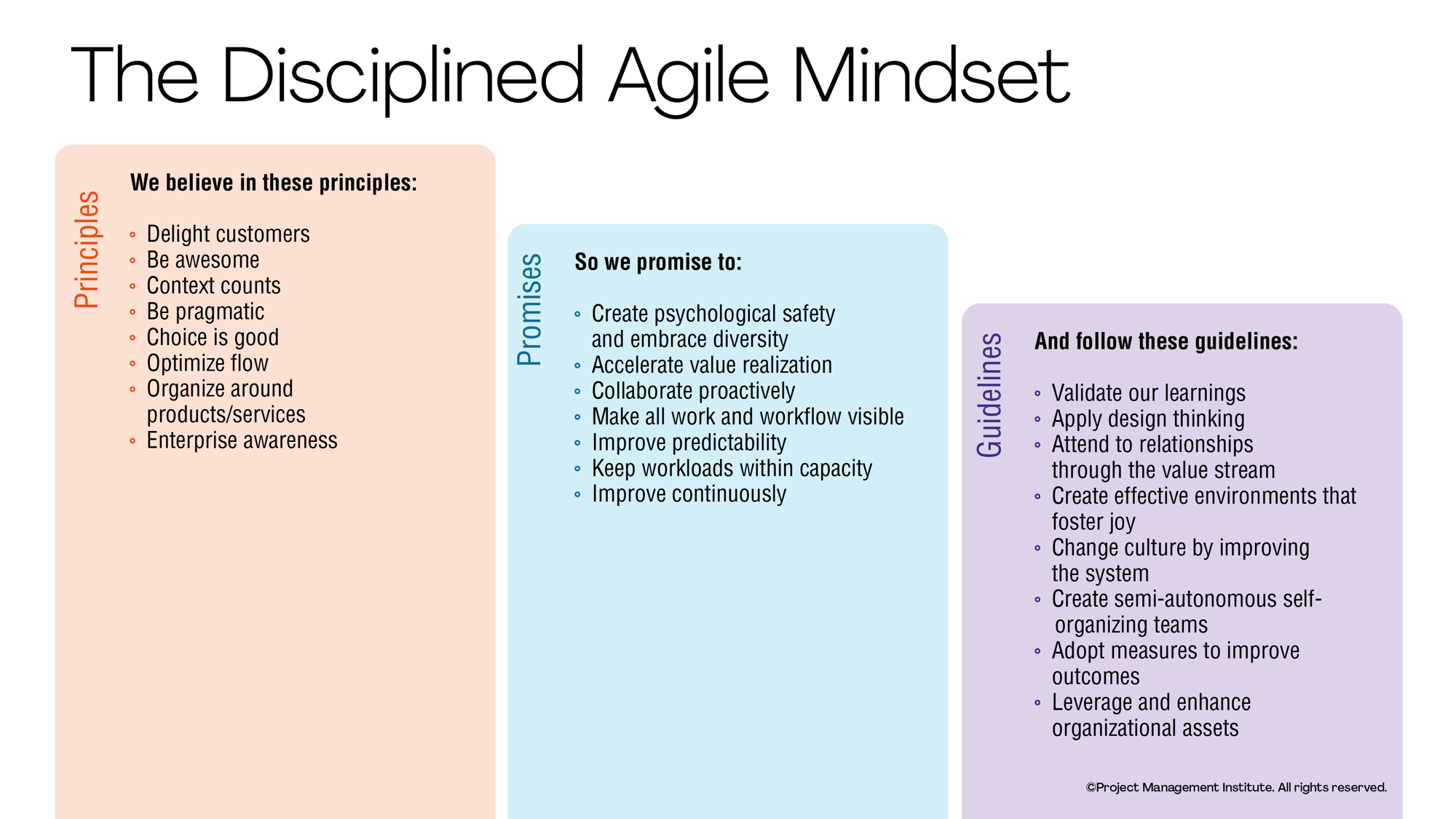
In the recent release of Choose Your WoW! we have evolved some aspects of the Disciplined Agile (DA) tool kit. One of the things we evolved is how we communicate the DA mindset (pictured above). The guidelines help us to be more effective in our way of working (WoW) and in improving our WoW over time. In this blog posting we explore the eight guidelines:
These guidelines are described in greater detail in chapter 2 of Choose Your WoW!.
Free DownloadsWe have made several Disciplined Agile (DA) posters available to you for free download, including a Disciplined Agile Mindset poster. |
|
"It is a waste of energy to be angry with a man who behaves badly, just as it is to be angry with a car that won't go." - Bertrand Russell |