Disciplined Agile
by Tatsiana Balshakova,
Mark Lines, Mike Griffiths, Scott Ambler, Bjorn Gustafsson, Curtis Hibbs, James Trott

This blog contains details about various aspects of PMI's Disciplined Agile (DA) tool kit, including new and upcoming topics.
View Posts By:
Tatsiana Balshakova
Mark Lines
Mike Griffiths
Scott Ambler
Bjorn Gustafsson
Curtis Hibbs
James Trott
Past Contributors:
Joshua Barnes
Michael Richardson
Daniel Gagnon
Valentin Tudor Mocanu
Kashmir Birk
Glen Little
Klaus Boedker
Recent Posts
DA 5.6 is released
Disciplined Agile 5.5 Released
Choose Your WoW! Second Edition Is Now Available
Requisite Agility applied in Project Management
Disciplined Agile and PMBoK Guide 7th Edition
Categories
#ChoiceIsGood,
#ChooseYourWoW,
#ConsumableSolution,
#ContinuousImprovement,
#CoreAgilePractices,
#experiment,
#Experimentation,
#GuidedContinuousImprovement,
#Kaizen,
#LifeCycles,
#ProcessImprovement,
#TealOrganizations,
Adoption,
agile,
agile adoption,
Agile Alliance,
Agile Business Analyst,
Agile certification,
agile data,
agile governance,
agile lifecycle,
agile metrics,
agile principles,
agile transformation,
Agile2018,
Agile2019,
Agile20Reflect,
AgileData,
Analogy,
announcement,
Architecture,
architecture,
architecture owner,
Articles and publications,
Asset Management,
Atari,
Backlog,
Barclays,
being agile,
benefits,
bi,
blades,
book,
Branching strategies,
Browser,
Business Agility,
business intelligence,
business operations,
capex,
Case Study,
Certification,
certification,
charity,
Choose your WoW,
CMMI,
cmmi,
Coaching,
Collaboration,
Communications Management,
Compliance,
Compliancy,
Conference,
Construction,
Construction phase,
Context,
Continuous Improvement,
coordination,
COVID-19,
Culture,
culture,
Cutter,
DA,
DAD,
DAD Book,
DAD discussions,
DAD press,
DAD roles,
DAD supporters,
DAD webcast,
DADay2019,
Data Management,
database,
dependencies,
Deployment,
Development Strategies,
DevOps,
disaster,
Discipline,
discipline,
Disciplined Agile,
disciplined agile delivery,
disciplined agile delivery blog,
Disciplined Agile Enterprise,
disciplined devops,
Documentation,
Domain complexity,
dw,
DW/BI,
Energy Healing,
Enterprise Agile,
Enterprise Architecture,
Enterprise Awareness,
enterprise awareness,
Essence,
estimation,
Evolving DA,
Executive,
Experiment,
facilitation,
FailureBow,
feedback-cycle,
finance,
Financial,
FLEX,
Flow,
foundation layer,
Funding,
GCI,
GDD,
Geographic Distribution,
gladwell,
global development,
Goal-Driven,
goal-driven,
goals,
Governance,
GQM,
Guideline,
Hybrid,
Improvement,
inception,
Inception phase,
India,
information technology,
infosec,
Introduction,
iterations,
Kanban,
large teams,
layer,
lean,
Lean Startup,
learning,
Legal Project Management,
LeSS,
Lifecycle,
lifecycle,
Manifesto,
mark lines,
marketing,
MBI,
Metaphor,
Metrics,
metrics,
mindset,
Miscellaneous,
MVP,
News,
News and events,
Non-Functional Requirements,
non-functional requirements,
Non-solo development,
offshoring,
Operations,
opex,
Organization,
Outsourcing,
outsourcing,
paired programming,
pairing,
paper,
People,
People Management,
phases,
Philosophies,
Planning,
PMBoK,
PMI,
PMI and DA,
PMI Chapter,
Portfolio Management,
post-format-quote,
Practices,
practices,
Principle,
Process,
process improvement,
process tailoring,
Product Management,
product owner,
Product Owners,
productivity,
Program Management,
Project Management,
project-initiation,
Promise,
Quality,
quality,
rational unified process,
Refactoring,
Reiki,
Release Management,
release management,
Remote Training,
Remote Work,
repeatability,
requirements,
Requirements Management,
research&development,
responsibilities,
retrospectives,
Reuse,
Reuse Engineering,
ride for heart,
rights,
Risk Management,
Risk Management,
Risk management,
Roles,
RUP,
SAFe,
sales,
Scaling,
scaling,
scaling agile,
Scheduled Workshops,
SCM,
scorecard,
Scrum,
ScrumMaster,
SDLC,
Security,
security,
self-organization,
SEMAT,
serial,
skill,
solutions software consumable shippable,
Stakeholder Management,
strategy,
Support,
Surveys,
Teal organizations,
team development,
Team Lead,
team lead,
Teams,
Technical Debt,
Teleconferencing,
Terminology,
terraforming,
test strategy,
testing,
time tracking,
Tool kit,
Toolkit,
tools,
traditional,
Transformation,
Transition iteration,
transition phase,
Uncategorized,
Upmentors,
Using PMI Standards,
value stream,
velocity,
vendor management,
Virtual Training,
Workflow,
workflow,
workspaces
Date
Viewing Posts by Scott Ambler
| 
One of the principles of the Disciplined Agile (DA) mindset is to "Be Awesome." Who doesn’t want to be awesome? Who doesn’t want to be part of an awesome team doing awesome things while working for an awesome organization? We all want these things. Recently, Joshua Kerievsky has popularized the concept that modern agile teams make people awesome, and, of course, it isn’t much of a leap that we want awesome teams and awesome organizations too. Similarly, Mary and Tom Poppendieck observe that sustainable advantage is gained from engaged, thinking people, as does Richard Sheridan in Joy Inc. Helping people to be awesome is important because, as Richard Branson of the Virgin Group says, “Take care of your employees and they’ll take care of your business.”
There are several things that we, as individuals, can do to be awesome:
- Act in such a way that we earn the respect and trust of our colleagues. Be reliable, be honest, be open, be ethical, and treat them with respect.
- Willingly collaborate with others. Share information with them when asked, even if it is a work in progress. Offer help when it’s needed and, just as important, reach out for help yourself.
- Be an active learner. We should seek to master our craft, always being on the lookout for opportunities to experiment and learn. Go beyond our specialty and learn about the broader software process and business environment. By becoming a T-skilled, “generalizing specialist” we will be able to better appreciate where others are coming from and thereby interact with them more effectively.
- Seek to never let the team down. Yes, it will happen sometimes, and good teams understand and forgive that.
- Be willing to improve and manage our emotional responses to difficult situations. Innovation requires diversity, and by their very nature diverse opinions may cause emotional reactions. We must all work on making our workplace psychologically safe.
Awesome teams also choose to build quality in from the very beginning. Lean tells us to fix any quality issues and the way we worked that caused them. Instead of debating which bugs we can skip over for later, we want to learn how to avoid them completely. As we’re working toward this, we work in such a way that we do a bit of work, validate it, fix any issues that we find, and then iterate. The Agile Manifesto is clear that continuous attention to technical excellence and good design enhances agility.
Senior leadership within our organization can enable staff to be awesome individuals working on awesome teams by providing them with the authority and resources required for them to do their jobs, by building a safe culture and environment, and by motivating them to excel. People are motivated by being provided with the autonomy to do their work, having opportunities to master their craft, and to do something that has purpose. What would you rather have, staff who are motivated or demotivated?
|
Posted
by
Scott Ambler
on: May 28, 2020 06:03 AM
|
Permalink |
Comments (11)
| An important part of agile culture is to be honest and forthcoming about your mistakes, so I'd like to share one that I've made in a key diagram that exists in both our courseware and in the book Choose Your WoW! This blog posting is my "failure bow" regarding mistakes that I made in the flowchart for how to choose between DA life cycles.
Figure 1 presents the original flowchart as it currently appears in the book and courseware. Don't worry, we're in the process of updating both. I'm writing this blog now because I want to make this update publicly available as quickly as possible to support people's learning journeys. There are two problems in Figure 1:
- The decision in the bottom right corner has two "yes" options coming out of it.
- The decision in the bottom-right corner is poorly worded.
Figure 1. Choosing a DA lifecycle (original diagram).

The update to the diagram is presented in Figure 2. You can see that we've changed one of the Yes options to be No. More importantly, we've reworded the decision point so that it's clearer. We had several people point out that they didn't understand the original wording of the question about potential disruption. I had written that question from the point of view of a team composed of people with a traditional background. But, many teams now have an agile background, having gotten started with a framework like Scrum only to find it insufficient for their needs. Such teams wouldn't be disrupted, at least not very much, by adopting the Agile lifecycle. Thus we've reworked the question to instead ask about the team's agile background.
Figure 2. How to choose a DA life cycle (updated).

An important point that I would like to make about the flowchart of Figure 2 is that this is the logic that we suggest you follow, but you may still decide to make other decisions. For example, consider the decision point in the bottom-right corner. You may be working with a team that is new to agile but still decide to adopt the agile lifecycle over the lean lifecycle because you're willing to invest in the time and expense of training and coaching them in agile ways of working (WoW). Fair enough, that's your call.
I hope that this update has cleared up any confusion you may have had around this diagram.
|
Posted
by
Scott Ambler
on: May 21, 2020 07:10 AM
|
Permalink |
Comments (12)
| 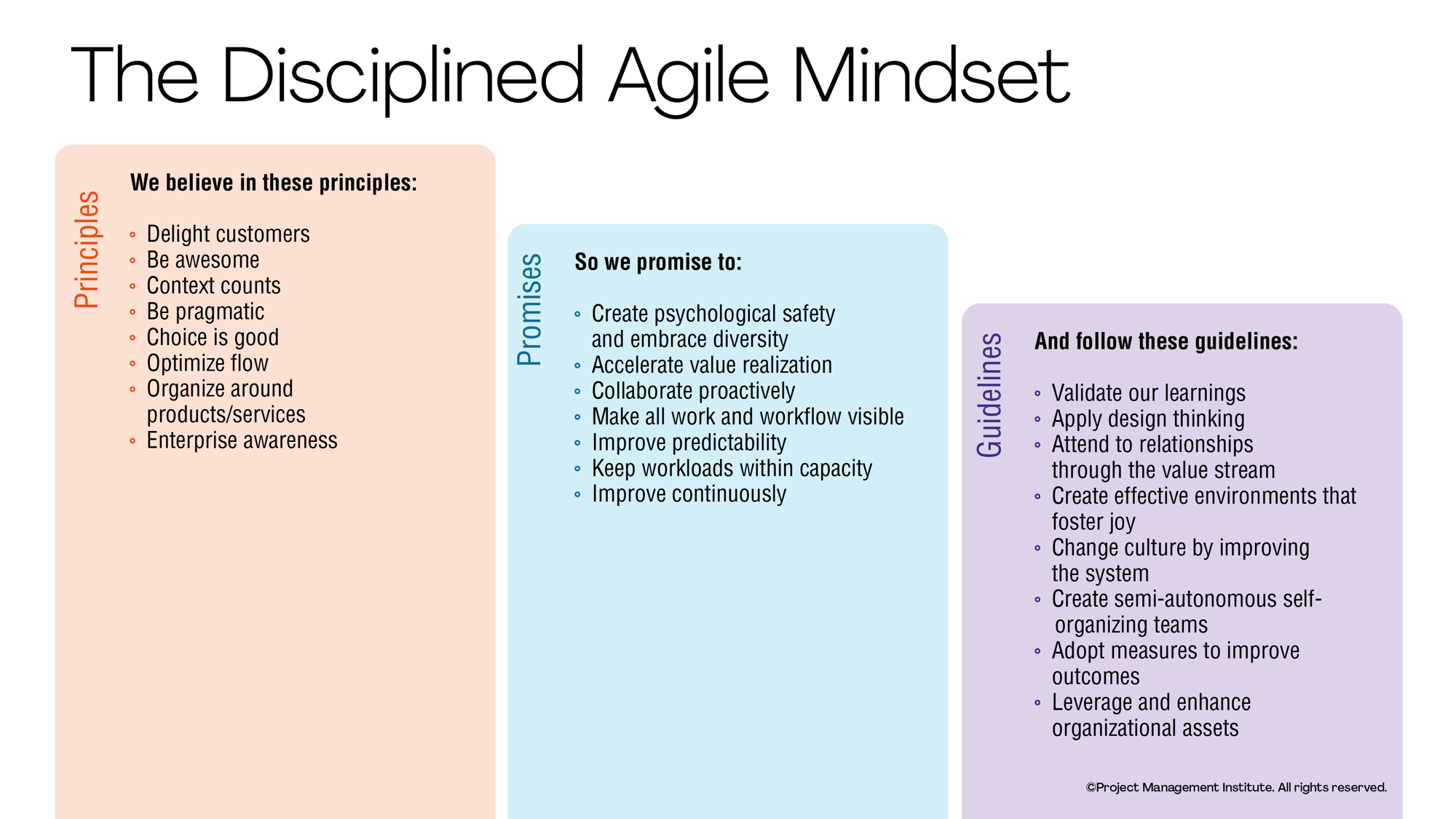
In the recent release of Choose Your WoW! we have evolved some aspects of the Disciplined Agile (DA) tool kit. One of the things we evolved is how we communicate the DA mindset (pictured above). The guidelines help us to be more effective in our way of working (WoW) and in improving our WoW over time. In this blog posting we explore the eight guidelines:
- Validate our learnings. The only way to become awesome is to experiment with, and then adopt where appropriate, a new WoW. In guided continuous improvement (GCI) we experiment with a new way of working and then we assess how well it worked, an approach called validated learning. Being willing and able to experiment is critical to our process-improvement efforts.
- Apply design thinking. Delighting customers requires us to recognize that our aim is to create operational value streams that are designed with our customers in mind. This requires design thinking on our part. Design thinking means to be empathetic to the customer, to first try to understand their environment and their needs before developing a solution.
- Attend to relationships through the value stream. The interactions between the people doing the work are what is key, regardless of whether or not they are part of the team. For example, when a product manager needs to work closely with our organization’s data analytics team to gain a better understanding of what is going on in the marketplace, and with our strategy team to help put those observations into context, then we want to ensure that these interactions are effective.
- Create effective environments that foster joy. Part of being awesome is having fun and being joyful. We want working in our company to be a great experience so we can attract and keep the best people. Done right, work is play. We can make our work more joyful by creating an environment that allows us to work together well.
- Change culture by improving the system. While culture is important, and culture change is a critical component of any organization’s agile transformation, the unfortunate reality is that we can't change it directly. This is because culture is a reflection of the management system in place, so to change our culture we need to evolve our overall system.
- Create semi-autonomous self-organizing teams. Organizations are complex adaptive systems (CASs) made up of a network of teams or, if you will, a team of teams. Although mainstream agile implores us to create “whole teams” that have all of the skills and resources required to achieve the outcomes that they’ve been tasked with, the reality is that no team is an island unto itself. Autonomous teams would be ideal but there are always dependencies on other teams upstream that we are part of, as well as downstream from us. And, of course, there are dependencies between offerings (products or services) that necessitate the teams responsible for them to collaborate.
- Adopt measures to improve outcomes. When it comes to measurement, context counts. What are we hoping to improve? Quality? Time to market? Staff morale? Customer satisfaction? Combinations thereof? Every person, team, and organization has their own improvement priorities, and their own ways of working, so they will have their own set of measures that they gather to provide insight into how they’re doing and, more importantly, how to proceed. And these measures evolve over time as their situation and priorities evolve. The implication is that our measurement strategy must be flexible and fit for purpose, and it will vary across teams.
- Leverage and enhance organizational assets. Our organization has many assets—information systems, information sources, tools, templates, procedures, learnings, and other things—that our team could adopt to improve our effectiveness. We may not only choose to adopt these assets, we may also find that we can improve them to make them better for us as well as other teams who also choose to work with these assets.
These guidelines are described in greater detail in chapter 2 of Choose Your WoW!.
Free Downloads
We have made several Disciplined Agile (DA) posters available to you for free download, including a Disciplined Agile Mindset poster.
|
Posted
by
Scott Ambler
on: April 30, 2020 10:04 AM
|
Permalink |
Comments (7)
|
In the recent release of Choose Your WoW! we have evolved some aspects of the Disciplined Agile (DA) tool kit. One of the things we evolved is how we communicate the DA mindset (pictured above). The promises are agreements that we make with our fellow teammates, our stakeholders, and other people within our organization whom we interact with. The promises define a collection of disciplined behaviours that enable us to collaborate effectively and professionally. In this blog posting we explore the seven promises:
- Create psychological safety and embrace diversity. Psychological safety means being able to show and apply oneself without fear of negative consequences of status, career, or self-worth—we should be comfortable being ourselves in our work setting. Psychological safety goes hand-in-hand with diversity, which is the recognition that everyone is unique and can add value in different ways. The dimensions of personal uniqueness include, but are not limited to, race, ethnicity, gender, sexual orientation, physical abilities, socioeconomic status, religious beliefs, political beliefs, and other ideological beliefs. Diversity is critical to a team’s success because it enables greater innovation. The more diverse our team, the better our ideas will be, the better our work will be, and the more we’ll learn from each other.
- Accelerate value realization. In DA we use the term value to refer to both customer and business value. Customer value, something that benefits the end customer who consumes the product/service that our team helps to provide, is what agilists typically focus on. This is clearly important, but in Disciplined Agile we’re very clear that teams have a range of stakeholders, including external end customers. Business value addresses the issue that some things are of benefit to our organization and perhaps only indirectly to our customers. For example, investing in enterprise architecture, in reusable infrastructure, and in sharing innovations across our organization offer the potential to improve consistency, quality, reliability, and reduce cost over the long term.
- Collaborate proactively. Disciplined agilists strive to add value to the whole, not just to their individual work or to the team’s work. The implication is that we want to collaborate both within our team and with others outside our team, and we also want to be proactive doing so. Waiting to be asked is passive, observing that someone needs help and then volunteering to do so is proactive.
- Make all work and workflow visible. DA teams will often make their work visible at both the individual level as well as the team level. It is critical to focus on our work in process, which is our work in progress plus any work that is queued up waiting for us to get to it. Furthermore, DA teams make their workflow visible, and thus have explicit workflow policies, so that everyone knows how everyone else is working.
- Improve predictability. DA teams strive to improve their predictability to enable them to collaborate and self-organize more effectively, and thereby to increase the chance that they will fulfill any commitments that they make to their stakeholders. Many of the earlier promises we have made work toward improving predictability.
- Keep workloads within capacity. Going beyond capacity is problematic from both a personal and a productivity point of view. At the personal level, overloading a person or team will often increase the frustration of the people involved. Although it may motivate some people to work harder in the short term, it will cause burnout in the long term, and it may even motivate people to give up and leave because the situation seems hopeless to them. From a productivity point of view, overloading causes multitasking, which increases overall overhead.
- Improve continuously. The really successful organizations—Apple, Amazon, eBay, Facebook, Google, and more—got that way through continuous improvement. They realized that to remain competitive they needed to constantly look for ways to improve their processes, the outcomes that they were delivering to their customers, and their organizational structures.
These promises are described in greater detail in chapter 2 of Choose Your WoW!. In the next blog in this series we will explore the guidelines of the DA mindset. Stay tuned!
Free Downloads
We have made several Disciplined Agile (DA) posters available to you for free download, including a Disciplined Agile Mindset poster.
|
Posted
by
Scott Ambler
on: April 27, 2020 12:00 AM
|
Permalink |
Comments (7)
|
In the recent release of Choose Your WoW! we have evolved some aspects of the Disciplined Agile (DA) tool kit. One of the things we evolved is how we communicate the DA mindset (pictured above). The principles provide a philosophical foundation for business agility. They are based on both lean and flow concepts. In this blog posting we explore the eight principles.
- Delight customers. We need to go beyond satisfying our customers' needs, beyond meeting their expectations, and strive to delight them. If we don't then someone else will delight them and steal our customers away from us. This applies to both external customers as well as internal customers.
- Be awesome. We should always strive to be the best that we can, and to always get better. Who wouldn't want to work with awesome people, on an awesome team for an awesome organization?
- Context counts. Every person, every team, every organization is unique. We face unique situations that evolve over time. The implication is that we must choose our way of working (WoW) to reflect the context that we face, and then evolve our WoW as the situation evolves.
- Be pragmatic (reworded from Pragmatism). Our aim isn't to be agile, it's to be as effective as we can be and to improve from there. To do this we need to be pragmatic and adopt agile, lean, or even traditional strategies when they make the most sense for our context.
- Choice is good. To choose our WoW in a context-driven, pragmatic manner we need to select the best-fit technique given our situation. Having choices, and knowing the trade-offs associated with those choices, is critical to choosing our WoW that is best fit for our context.
- Optimize flow. We want to optimize flow across the value stream that we are part of, and better yet across our organization, and not just locally optimize our WoW within our team. Sometimes this will be a bit inconvenient for us, but overall we will be able to more effectively respond to our customers.
- Organize around products/services (new). To delight our customers we need to organize ourselves around producing the offerings, the products and services, that they need. We are in effect organizing around value streams because value streams produce value for customers, both external and internal, in the form of products and services. We chose to say organize around products/services, rather than offerings or value streams, as we felt this was more explicit.
- Enterprise awareness. Disciplined agilists look beyond the needs of their team to take the long-term needs of their organization into account. They adopt, and sometimes tailor, organizational guidance. They follow, and provide feedback too, organizational roadmaps. The leverage, and sometimes enhance, existing organizational assets. In short, they do what's best for the organization and not just what's convenient for them.
These principles are described in greater detail in chapter 2 of Choose Your WoW!. In the next blog in this series we will explore the promises of the DA mindset. Stay tuned!
Free Downloads
We have made several Disciplined Agile (DA) posters available to you for free download, including a Disciplined Agile Mindset poster.
|
Posted
by
Scott Ambler
on: April 24, 2020 12:00 AM
|
Permalink |
Comments (8)
|
"The brain is a wonderful organ. It starts the moment you get up and doesn't stop until you get into the office."
- Robert Frost
|







