Disciplined Agile
by Tatsiana Balshakova,
Mark Lines, Mike Griffiths, Scott Ambler, Bjorn Gustafsson, Curtis Hibbs, James Trott

This blog contains details about various aspects of PMI's Disciplined Agile (DA) tool kit, including new and upcoming topics.
View Posts By:
Tatsiana Balshakova
Mark Lines
Mike Griffiths
Scott Ambler
Bjorn Gustafsson
Curtis Hibbs
James Trott
Past Contributors:
Joshua Barnes
Michael Richardson
Daniel Gagnon
Valentin Tudor Mocanu
Kashmir Birk
Glen Little
Klaus Boedker
Recent Posts
DA 5.6 is released
Disciplined Agile 5.5 Released
Choose Your WoW! Second Edition Is Now Available
Requisite Agility applied in Project Management
Disciplined Agile and PMBoK Guide 7th Edition
Categories
#ChoiceIsGood,
#ChooseYourWoW,
#ConsumableSolution,
#ContinuousImprovement,
#CoreAgilePractices,
#experiment,
#Experimentation,
#GuidedContinuousImprovement,
#Kaizen,
#LifeCycles,
#ProcessImprovement,
#TealOrganizations,
Adoption,
agile,
agile adoption,
Agile Alliance,
Agile Business Analyst,
Agile certification,
agile data,
agile governance,
agile lifecycle,
agile metrics,
agile principles,
agile transformation,
Agile2018,
Agile2019,
Agile20Reflect,
AgileData,
Analogy,
announcement,
Architecture,
architecture,
architecture owner,
Articles and publications,
Asset Management,
Atari,
Backlog,
Barclays,
being agile,
benefits,
bi,
blades,
book,
Branching strategies,
Browser,
Business Agility,
business intelligence,
business operations,
capex,
Case Study,
Certification,
certification,
charity,
Choose your WoW,
CMMI,
cmmi,
Coaching,
Collaboration,
Communications Management,
Compliance,
Compliancy,
Conference,
Construction,
Construction phase,
Context,
Continuous Improvement,
coordination,
COVID-19,
Culture,
culture,
Cutter,
DA,
DAD,
DAD Book,
DAD discussions,
DAD press,
DAD roles,
DAD supporters,
DAD webcast,
DADay2019,
Data Management,
database,
dependencies,
Deployment,
Development Strategies,
DevOps,
disaster,
Discipline,
discipline,
Disciplined Agile,
disciplined agile delivery,
disciplined agile delivery blog,
Disciplined Agile Enterprise,
disciplined devops,
Documentation,
Domain complexity,
dw,
DW/BI,
Energy Healing,
Enterprise Agile,
Enterprise Architecture,
Enterprise Awareness,
enterprise awareness,
Essence,
estimation,
Evolving DA,
Executive,
Experiment,
facilitation,
FailureBow,
feedback-cycle,
finance,
Financial,
FLEX,
Flow,
foundation layer,
Funding,
GCI,
GDD,
Geographic Distribution,
gladwell,
global development,
Goal-Driven,
goal-driven,
goals,
Governance,
GQM,
Guideline,
Hybrid,
Improvement,
inception,
Inception phase,
India,
information technology,
infosec,
Introduction,
iterations,
Kanban,
large teams,
layer,
lean,
Lean Startup,
learning,
Legal Project Management,
LeSS,
Lifecycle,
lifecycle,
Manifesto,
mark lines,
marketing,
MBI,
Metaphor,
Metrics,
metrics,
mindset,
Miscellaneous,
MVP,
News,
News and events,
Non-Functional Requirements,
non-functional requirements,
Non-solo development,
offshoring,
Operations,
opex,
Organization,
Outsourcing,
outsourcing,
paired programming,
pairing,
paper,
People,
People Management,
phases,
Philosophies,
Planning,
PMBoK,
PMI,
PMI and DA,
PMI Chapter,
Portfolio Management,
post-format-quote,
Practices,
practices,
Principle,
Process,
process improvement,
process tailoring,
Product Management,
product owner,
Product Owners,
productivity,
Program Management,
Project Management,
project-initiation,
Promise,
Quality,
quality,
rational unified process,
Refactoring,
Reiki,
Release Management,
release management,
Remote Training,
Remote Work,
repeatability,
requirements,
Requirements Management,
research&development,
responsibilities,
retrospectives,
Reuse,
Reuse Engineering,
ride for heart,
rights,
Risk Management,
Risk Management,
Risk management,
Roles,
RUP,
SAFe,
sales,
Scaling,
scaling,
scaling agile,
Scheduled Workshops,
SCM,
scorecard,
Scrum,
ScrumMaster,
SDLC,
Security,
security,
self-organization,
SEMAT,
serial,
skill,
solutions software consumable shippable,
Stakeholder Management,
strategy,
Support,
Surveys,
Teal organizations,
team development,
Team Lead,
team lead,
Teams,
Technical Debt,
Teleconferencing,
Terminology,
terraforming,
test strategy,
testing,
time tracking,
Tool kit,
Toolkit,
tools,
traditional,
Transformation,
Transition iteration,
transition phase,
Uncategorized,
Upmentors,
Using PMI Standards,
value stream,
velocity,
vendor management,
Virtual Training,
Workflow,
workflow,
workspaces
Date
| The Disciplined Agile (DA) toolkit suggests a robust set of roles for agile solution delivery. These roles are overviewed in the following figure:
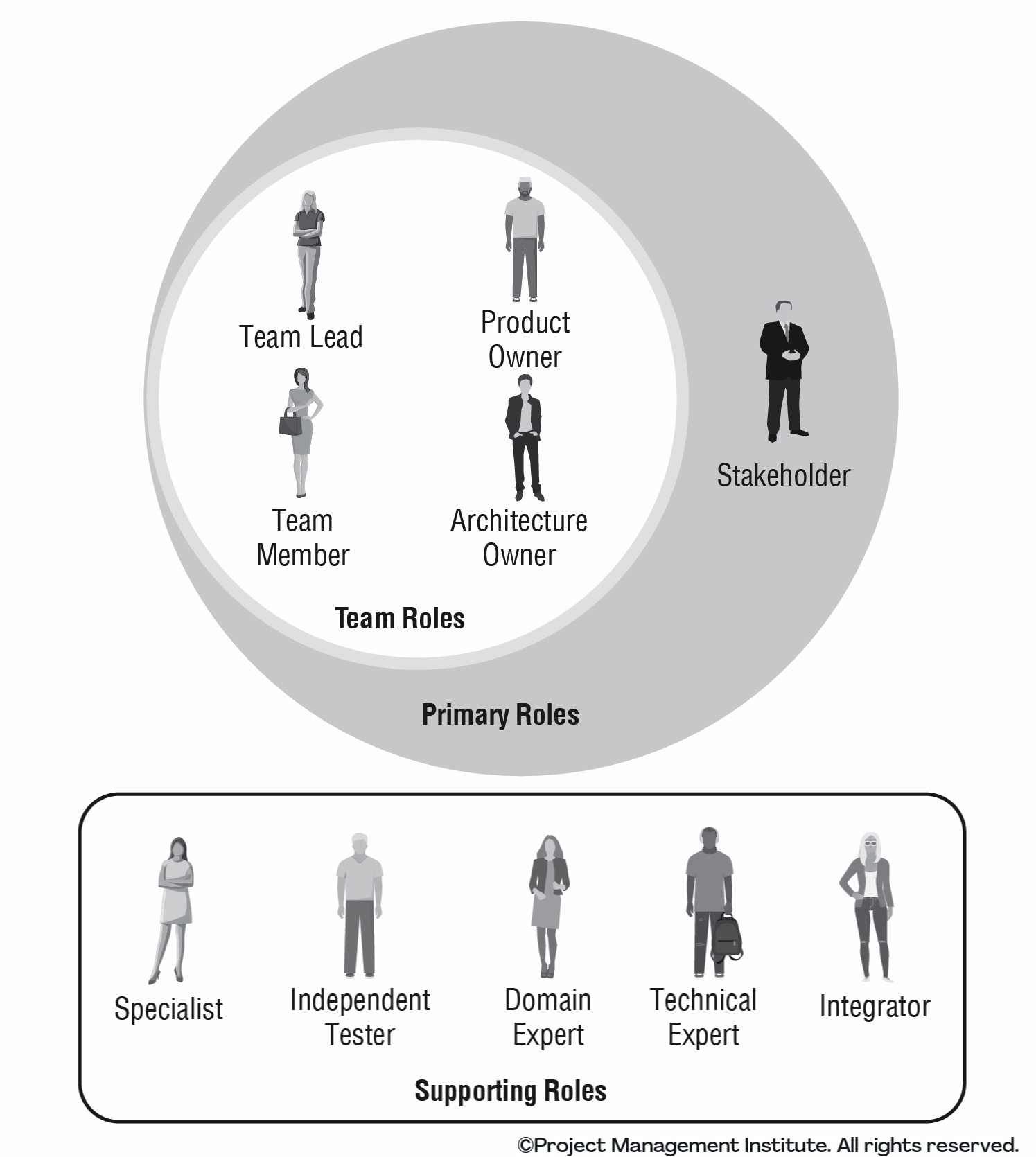
For a detailed description of these roles, please visit the page Roles on DAD Teams.
|
Posted
by
Scott Ambler
on: December 18, 2012 01:18 PM
|
Permalink |
Comments (0)
| Governance establishes chains of responsibility, authority and communication in support of the overall enterprise’s goals and strategy. It also establishes measurements, policies, standards and control mechanisms to enable people to carry out their roles and responsibilities effectively. You do this by balancing risk versus return on investment (ROI), setting in place effective processes and practices, defining the direction and goals for the department, and defining the roles that people play with and within the department.
Governance and management are two different things. Governance looks at a team from the outside, treating it as a system that needs to have the appropriate structure and processes in place to provide a stream of value. Management, on the other hand, occurs inside the team and ensures that the structure and processes are implemented effectively. The Disciplined Agile Delivery (DAD) process framework characterizes governance as an element of enterprise awareness from the team’s point of view because governance looks at the team from the outside.
It is easier to avoid your traditional governance and tell management that “agile is different” than it is to work with your governors to adapt your governance to properly guide the delivery of your agile teams. As we described in the book every organization has a necessary degree of governance and there are ways to make it especially effective on agile initiatives. It takes discipline to work with your governors to help them understand how disciplined agile teams operate and then discipline to accept and conform to the resulting governance process.
Our experience is that the most effective way to govern agile teams is to focus on collaborative strategies that strive to enable and motivate team members implicitly. For example, the traditional approach to motivating a team to provide good ROI would be to force them to develop and commit to an “accurate” project budget, and then periodically review their spending to ensure they’re on track. An agile approach would be to ask the team to provide a ranged estimate of what they believe the cost will be so as to set expectations about future funding requirements. Then the team works in priority order as defined by their stakeholders, visibly providing real business value through the incremental delivery of a potentially consumable solution. Costs are tracked via the team’s burn rate (the fully burdened cost of the people on the team plus any capital outlays for equipment or facilities) and value is tracked by the stakeholders’ continuing satisfaction (hopefully) with what the team is delivering for that cost. In short, a traditional approach often measures financial progress against a budget whereas an agile approach seeks to maximize stakeholder value for their investment by always working on the most valuable functionality at the time.
The DA toolkit includes several important agile governance strategies:
- Adopting a risk-value driven lifecycle
- Explicit, light-weight milestone reviews
- Agile enterprise teams that work closely with agile teams
- Regular coordination meetings (daily standups in Scrum)
- Iteration/sprint demos
- All-hands demos
- Follow enterprise guidelines (coding standards, UI standards, data conventions, …)
- Retrospectives, and better yet measured improvement
- Increased stakeholder visibility
- Development intelligences (BI for IT)
- Aligning agile team governance with other governance (operations, security, data, …) strategies
- Agile measurement/metrics programs
- Active risk mitigation
- Named phases
- Robust role definitions
Many of the strategies described above are “standard” agile governance strategies, and a few are unique to DAD. It requires discipline to adopt and then execute on effective governance strategies, particularly in organizations where you already have a strong traditional governance program in place.
|
Posted
by
Scott Ambler
on: November 30, 2012 07:50 AM
|
Permalink |
Comments (6)
| This post is a follow-up to Comparing DAD to the Rational Unified Process (RUP) – Part 1. In that post I described in some detail why Disciplined Agile Delivery (DAD) is not “Agile RUP”. DAD is quite different in both approach and content. There are however some very good principles that the Unified Process (UP) incorporates that are not part of mainstream agile methods. This post describes what parts of the UP made it into the DA toolkit.
DAD suggests a full delivery lifecycle approach similar to RUP. DAD recognizes that despite some agile rhetoric projects do indeed go through specific phases. RUP explicitly has four phases for Inception, Elaboration, Construction, and Transition. For reasons that I described in the last post, DAD does not include an explicit Elaboration phase. However the milestone for Elaboration is still in DAD which I will describe shortly. As the DAD basic lifecycle diagram shows, DAD has three of the four RUP phases.
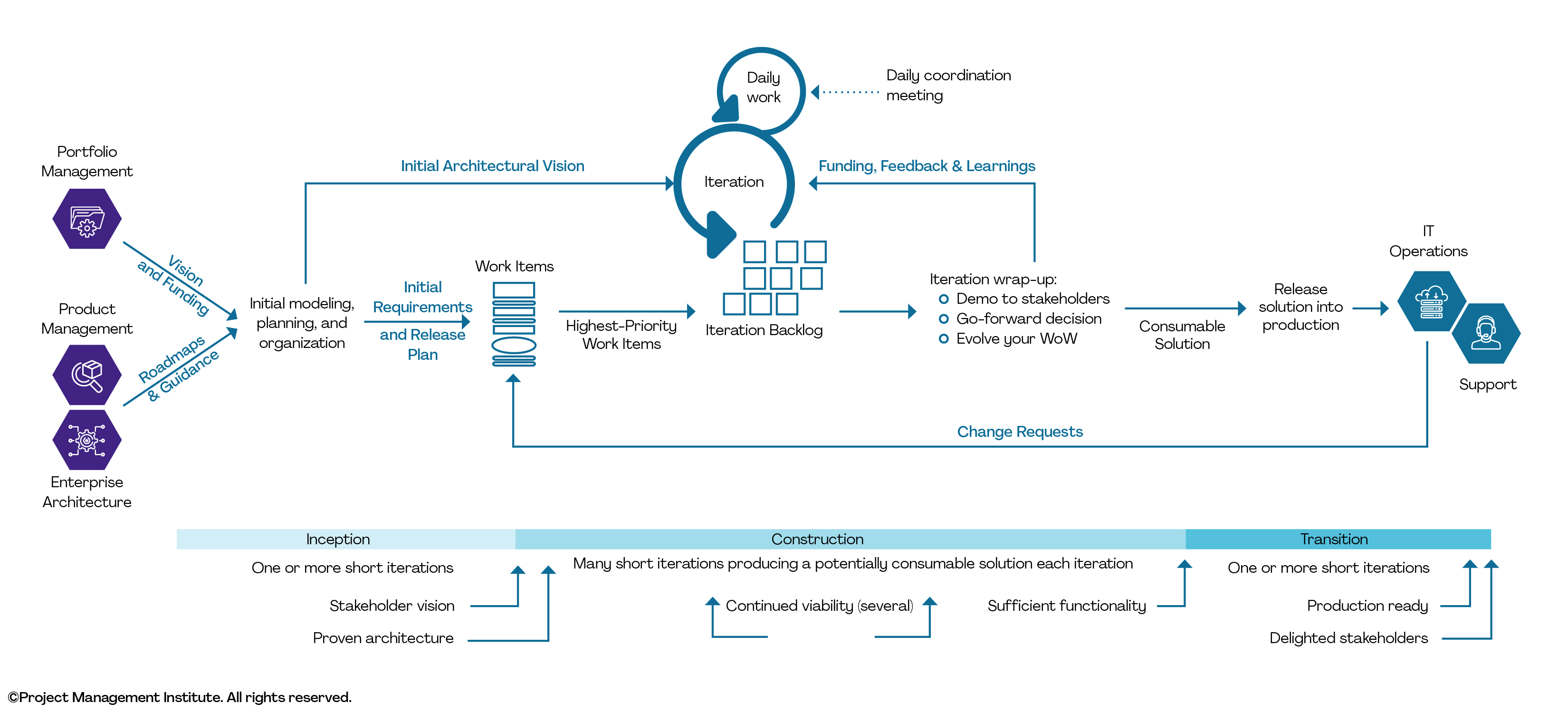
- The Inception phase. An important aspect of DAD is its explicit inclusion of an Inception phase where project initiation activities occur. As Scott Ambler says in one of his posts “Although phase tends to be a swear word within the agile community, the reality is that the vast majority of teams do some up front work at the beginning of a project. While some people will mistakenly refer to this effort as Sprint/Iteration 0 it is easy to observe that on average this effort takes longer than the general perception (the 2009 Agile Project Initiation survey found the average agile team spends 3.9 weeks in Inception)”. So in DAD’s Inception phase (usually one iteration) we do some very lightweight visioning activities to properly frame the project. The milestone for this phase is to obtain “Stakeholder consensus” on how to proceed. In the book we describe various strategies to get through the Inception phase as quickly as possible, what needs to be done, and how to get stakeholders consensus.
- The Construction phase. This phase can be viewed as a set of iterations (Sprints in Scrum parlance) to build increments of the solution. Within each iteration the team applies a hybrid of practices from Scrum, XP, Agile modeling, Agile data, and other methods to deliver the solution. DAD recommends a risk-value approach of prioritizing work in the early iterations which draws from the RUP principle of mitigating risk as early as possible in the project by proving the architecture with a working solution. We therefore balance delivering high-value work with delivering work related to mitigating these architectural risks. Ideally we deliver stories/features in the early iteration that deliver functionality related to both high business value and risk mitigation (hence DAD’s “risk-value” lifecycle). It is worthwhile to have a checkpoint at the end of the early iterations to verify that indeed our technical risks have been addressed. DAD has an explicit milestone for this called “Proven architecture”. This is similar to the RUP Elaboration milestone without risking the confusion that the Elaboration phase often caused for RUP implementations. All agile methods seek to deliver value into the hands of the stakeholders as quickly as possible. In many if not most large enterprises it is difficult to actually deliver new increments of the solution at the end of each iteration. DAD therefore recognizes this reality and assumes that in most cases there will be a number of iterations of Construction before the solution is actually deployed to the customer. As we make clear in the book, although this is the classic DAD pattern, you should strive to be able to release your solution on a much more frequent basis in the spirit of achieving the goal of “continuous delivery”. The milestone for the end of Construction is that we have “Sufficient functionality” to deploy to the stakeholders. This is the same milestone as the RUP’s Construction milestone. During the Construction phase it may make sense to periodically review the progress of the project against the vision agreed to in Inception and potentially adjust course. These optional milestones in DAD are referred to as “Project viability”.
- The Transition phase. DAD recognizes that for sophisticated enterprise agile projects often deploying the solution to the stakeholders is not a trivial exercise. To account for this reality DAD incorporates the RUP Transition phase which is usually one short iteration. As DAD teams, as well as the enterprise overall streamline their deployment processes this phase should become shorter and ideally disappear over time as continuous deployment becomes possible. RUP’s Transition milestone is achieved when the customer is satisfied and self-sufficient. DAD changes this to “Delighted stakeholders”. This is similar to lean’s delighted customers but we recognize that in an enterprise there are more stakeholders to delight than just customers, such as production support for instance. One aspect of RUP’s Transition phase is that it is not clear on when during the phase deployments actually take place. Clearly stakeholders aren’t delighted and satisfied the day the solution goes “live”. There is usually a period of stabilization, tuning, training etc. before the stakeholders are completely happy. So DAD has a mid-Transition milestone called “Production ready”. Some people formalize this as a “go/no go” decision.
So in summary, DAD frames an agile project within the context of an end-to-end risk-value lifecycle with specific milestones to ensure that the project is progressing appropriately. These checkpoints give specific opportunities to change course, adapt, and progress into the next phases of the project. While the lifecycle is similar to that of RUP, as described in Part 1 of this post it is important to realize that the actual work performed within the iterations is quite different and far more agile than a typical RUP project.
|
Posted
by
Mark Lines
on: November 11, 2012 11:48 AM
|
Permalink |
Comments (0)
|
We recently started a discussion group on LinkedIn called, you guessed it, Disciplined Agile Delivery (DAD). You’re welcome to join and get involved in the conversation.
|
Posted
by
Scott Ambler
on: November 07, 2012 05:37 PM
|
Permalink |
Comments (0)
|
 Last week I was in Moscow to do a workshop on DAD. Askhat Urazbaev, known for starting the first Agile User Group in Russia attended. He asked some good questions, including “Why is it called the Disciplined Agile (DA) toolkit? Are you suggesting that existing agile techniques are not disciplined?” I have heard this question a lot. As we describe in our book, clearly existing agile methods such as Scrum and XP require discipline to be effective, in fact more discipline than traditional approaches. However, this discipline is focused on practices used within the team to improve quality and meet the commitments made to the customer. For example, it certainly requires discipline to do test-driven development, continuous integration, to optimize team performance, and to recognize and deal with technical debt via refactoring. Last week I was in Moscow to do a workshop on DAD. Askhat Urazbaev, known for starting the first Agile User Group in Russia attended. He asked some good questions, including “Why is it called the Disciplined Agile (DA) toolkit? Are you suggesting that existing agile techniques are not disciplined?” I have heard this question a lot. As we describe in our book, clearly existing agile methods such as Scrum and XP require discipline to be effective, in fact more discipline than traditional approaches. However, this discipline is focused on practices used within the team to improve quality and meet the commitments made to the customer. For example, it certainly requires discipline to do test-driven development, continuous integration, to optimize team performance, and to recognize and deal with technical debt via refactoring.
In DAD, we support all these practices, but in addition we suggest that discipline needs to extend to other areas such as:
- giving adequate attention to forming an overall project vision before beginning Construction iterations
- framing the project within a lifecycle
- agreeing on appropriate lightweight milestones
- building enterprise awareness, not just team awareness
- adopting agile metrics and governance at the enterprise level
This week Scott and I are speaking at Agile East in Orlando and I just attended an excellent talk by Jim Highsmith regarding adaptive leadership on agile projects. He referred to mainstream agile as “Agile 101” and addressing some of these larger issues as “Mature Agile”. This is very similar to the concept that we are trying to get across with the term Disciplined. Mainstream agile methods address the discipline required to deliver value via Construction iterations (or without iterations with lean). DAD extends that discipline to the full lifecycle and the enterprise.
We have written a number of posts on this blog in the “Discipline” category that you may find interesting which discuss some of these topics in more detail.
|
Posted
by
Mark Lines
on: November 07, 2012 02:37 PM
|
Permalink |
Comments (0)
|
We are ready for any unforeseen event that may or may not occur.
- Dan Quayle
|




