


The Team Lead Role: Different Types of Teams Need Different Types of Leaders


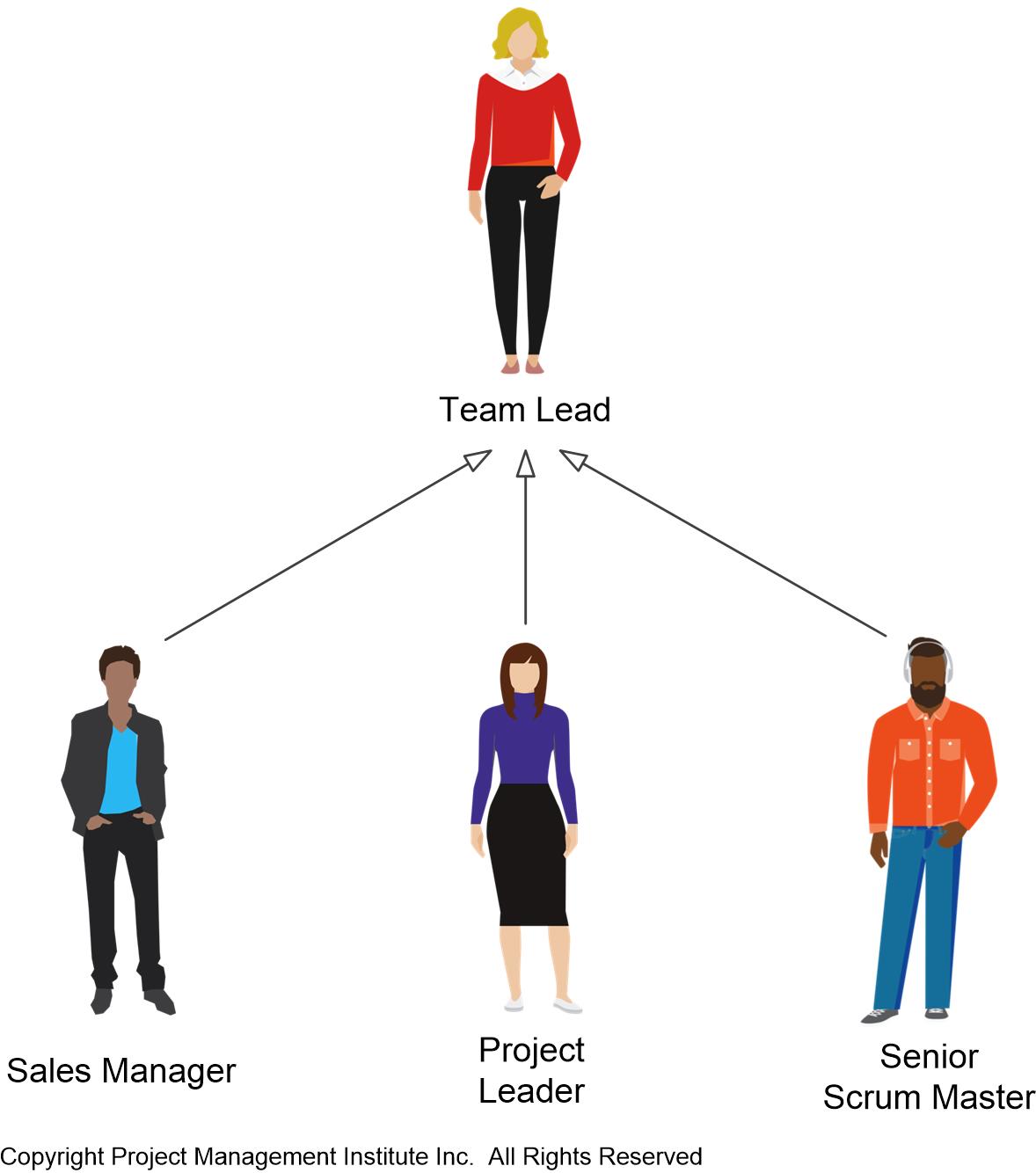
| We are often asked why Disciplined Agile (DA) has a team lead role instead of Scrum master or project manager. The answer is three-fold: different types of teams require different types of leaders, leadership responsibilities vary based on the type of team they are leading, and DA strives to be agnostic wherever possible. Let's explore the implications of this strategy. Team lead is what is known as a meta role. What we mean by this is that there are different types of team lead depending on the situation, as depicted in Figure 1. Think of team lead as a place holder for a more specific type of lead. So, a scrum master is a team lead of a Scrum team, a project leader is a team lead of a project team, a sales manager is a team lead of a sales team. At times, the team will choose to stick with the name “team lead” for the role due to their way of working best fitting that description. Figure 1. Types of team leads.
As I said above, there are three reasons for taking this approach with the team lead role:
The end result is that you may see some DA teams with a senior scrum master as the team lead, some DA teams with a project leader as a team lead, some DA teams with a functional leader in the role of team lead, and some teams with someone who is simply the team lead. Just like your way of working (WoW) should be fit for purpose, so should your approach to roles and responsibilities. |
Disciplined Agile is a Hybrid
| The Disciplined Agile (DA) tool kit has always been a hybrid of great strategies from the very beginning, with the focus being on how all of these strategies fit together in practice. In the current release of DA we made its hybrid nature explicit when we refactored the foundation, depicted in Figure 1, into its own layer. You can see this in that we clearly indicate that Agile, Lean, and Serial (traditional) strategies are all foundational aspects of DA. Figure 1. The foundation of DA is fundamentally hybrid in nature.
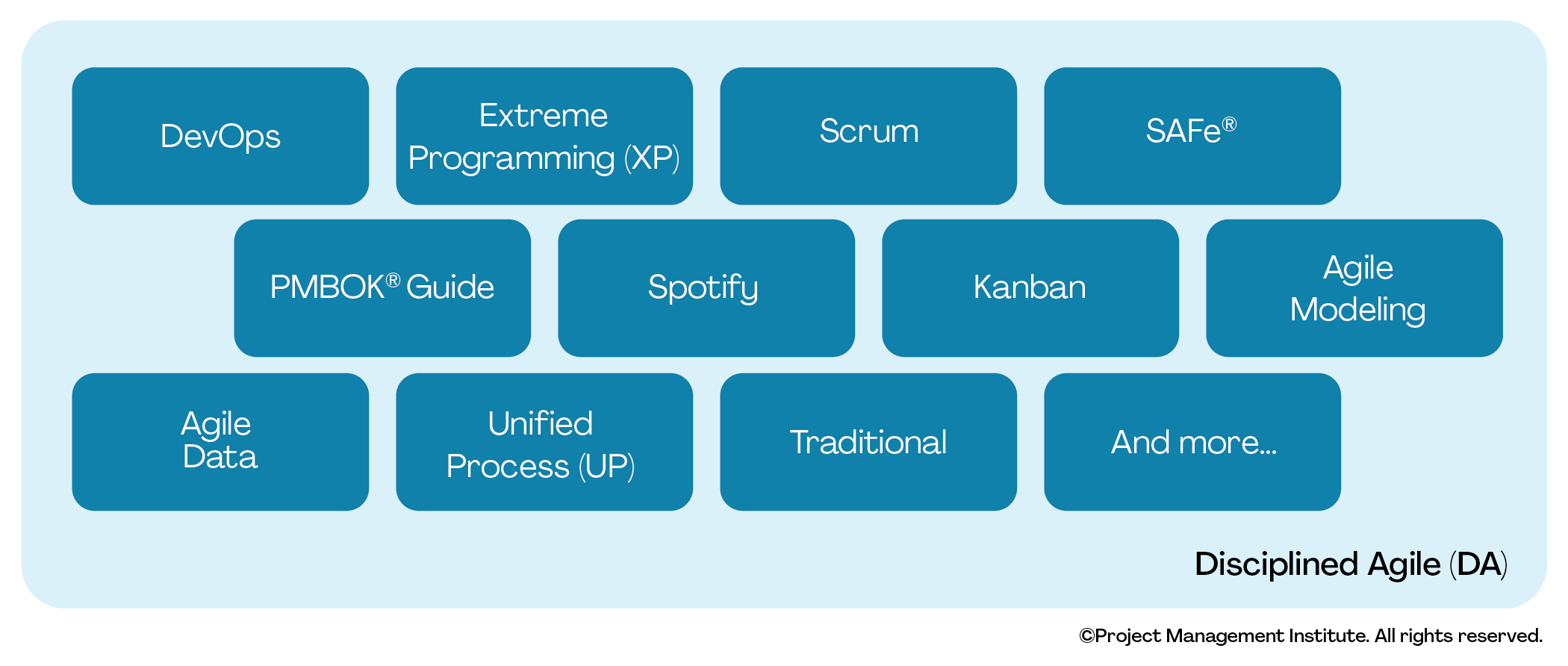
We like to say that DA does the heavy process lifting so that you don’t have to. We’ve mined the various methods, frameworks, and other sources to identify potential practices and strategies that your team may want to experiment with and adopt. DA puts these techniques into context, exploring fundamental concepts such as what are the advantages and disadvantages of the technique, when would you apply the technique, when wouldn’t you apply the technique, and to what extent would you apply it? Answers to these questions are critical when a team is choosing its way of working (WoW). Figure 2 shows that DA is a hybrid tool kit that puts great ideas from PMBOK Guide, Scrum, SAFe, Spotify, Agile Modeling (AM), Kanban, and several other methods into context.
DA has taken this approach because no framework, no book of knowledge (BoK), is complete. For example, XP is the source of technical practices such as test-driven development (TDD), refactoring, and pair programming but has nothing to say about project management. The PMBoK Guide has great strategies for project managers, but has nothing to say about data analytics. The Agile Data (AD) method has great strategies for creating and evolving data sources but has nothing to say about organizing agile teams. Scrum offers great strategies such as product backlogs, sprint/iteration planning, and daily coordination meetings for organizing agile teams but has nothing to say about documentation strategies. Agile Modeling gives us model storming, architecture envisioning, and continuous documentation strategies but has nothing to say about governance. You get the point. Each framework, each BoK, has its specific focus and thus is not sufficient on its own. The upside is that there are great strategies presented by each, often in great detail. The downside is that each source is locally optimize, they are inconsistent with one another, and there is very little advice for how to integrate these sources. This is where DA steps in - DA is hybrid that combines and puts these great ideas into context, providing advice for how to apply them effectively when you choose your WoW. |

HONESTY
|
In today’s blog we will explore HONESTY. Please share what are your perspectives on honesty. How do you apply it to lead and create the future. The PMI Code of Ethics and Professional Conduct describes honesty as follows: https://www.pmi.org/about/ethics/code Take a blank page and write out in your own words what HONESTY means to you? Write out why it is important. Reflect on how the power of honesty can be used as a tool to shape your journey through the new realities of our post-covid-19 world. Honesty is more than not telling lies, it is doing what is moral and just. Being honest means having integrity, a moral compass, being trustworthy, not spreading rumors, not saying one thing behind people’s backs and then being different in front of them. Honesty is not telling people what we think they want to hear so that they will like us and provide us with favors and opportunities. This is a passive form of dishonesty. Honesty means being who we say we are, saying what we will do and doing what we said, it means following through on our commitments. Honesty means being open to both positive and negative feedback. It is surprising how many people do not know how to take compliments or hearing positive things about themselves. And equally how many people only hear what they want to hear, filtering out things that are negative or uncomfortable.
The future is wide open, waiting for us to create it. What do you want to do with it? How are you going to use your HONESTY to create the future of your family, your work and your relationship with yourself? There are many things that we cannot choose in life, but our most important choices of all, who we are, how we show up, what we stand for and how we create the future through our values – these choices are in our complete control. Please share in your comments your thoughts on the importance of values, so we can all learn from each other. How are you going to use HONESTY to create the future through the chaos and turbulence of your new realities?
|

RESPECT
| RESPECT
Please share what are your perspectives on fairness. How do you apply it to lead and create the future. The PMI Code of Ethics and Professional Conduct describes respect as follows: https://www.pmi.org/about/ethics/code Respect means accepting ourselves for who we are. Respectful leadership means treating everyone, regardless of rank, status or position – with the same genuine regard and consideration, you would like them to give you. Respect creates a culture of trust and openness. It encourages people to speak their minds and share hard truths in ways that are maintains the dignity and honor. We cultivate respect in the culture by expressing a genuine interest in others, providing recognition and positive feedback, noticing when people do great things, being open and transparent about what is going on, taking others concerns seriously, and ensuring that when people feel wronged, that action is taken to remedy the concerns. How respectful are you?
When people say values cannot be measured, they have not been asked these hard questions. The future is wide open, waiting for us to create it. How do you want to create it? How are you going to use RESPECT to create the future of your family, your work and your relationship with yourself? There are many things that we cannot choose in life, but our most important choices of all, who we are, how we show up, what we stand for and how we create the future through our values – these choices are in our complete control. Please share in your comments your thoughts on the importance of values, so we can all learn from each other. How are you going to use RESPECT to create the future through the chaos and turbulence of your new realities? |
 This is the fifth of a six-part series that examines and explores how we might be able to use our personal and professional values the shape the future. In today’s blog we will explore RESPECT.
 FAIRNESS
| FAIRNESS This is the fourth of a six-part series that examines and explores how we might be able to use our personal and professional values the shape the future. In today’s blog we will explore FAIRNESS. Please share what are your perspectives on fairness. How do you apply it to lead and create the future. The PMI Code of Ethics and Professional Conduct describes responsibility as follows: https://www.pmi.org/about/ethics/code Take a minute to write out in your own words what FAIRNESS means to you and how it can be used as a precision tool to shape your future through the new realities of a post-covid-19 world.. In the midst of a crisis, fear of the unknown often provokes people to blame others and lash out at people who look and sound different. Diversity and inclusion is much more than a legal remedy to social imbalances and bias. In nature the more diversity there is in an ecosystem the more resilient and healthier the system is as a whole. Fairness begins with being objective about what we do right and wrong. Fairness is not the same as equality. Equality means giving everyone the same rights and opportunities, regardless of circumstances. Fairness means giving everyone what they deserve. Fairness is about being balanced, impartial and unbiased. It is about what is right and reasonable in the way we treat ourselves and each other. Fairness arises when we are dealing with differences, how others are treated and how we interpret our own freedom Some people do not treat themselves fairly. They are overly self-critical, struggle with compliments and take their own good nature or granted. When this happens, they struggle with setting boundaries, do not always know where to say “No” and how to stand in their own power. The primary step is to uncover our own “unconscious bias”. This requires us to slow down and step back, reflect on our own thinking, decisions and actions. It is also important to seek feedback from people around us, both those we trust but also the ones who we do not have a good relationship, as they may be more willing to challenge us. How fair are you?
Think for a minute about how you feel when others have been unfair and treated you in an unconsidered way. This is how others feel when you are unfair with them. It is important to feel what fairness is in your stomach and your skin, and why it is important. When people say values cannot be measured, they have not asked these hard questions of themselves. The future is wide open, waiting for us to create it. We can follow others, or we can be leaders, we can inspire others to lead. How are you going to use your FAIRNESS to create the future of your family, your work and your relationship with yourself? There are many things that we cannot choose in life, but our most important choices of all, who we are, how we show up, what we stand for and how we create the future through our values – these choices are in our complete control. Please share in your comments your thoughts on the importance of values, so we can all learn from each other. How are you going to use FAIRNESS to create the future through the chaos and turbulence of your new realities?
|



