

The Disciplined DevOps Layer
Categories:
layer,
business operations,
agile,
DAD,
DevOps,
Scrum,
release management,
Data Management,
security
Categories: layer, business operations, agile, DAD, DevOps, Scrum, release management, Data Management, security


|
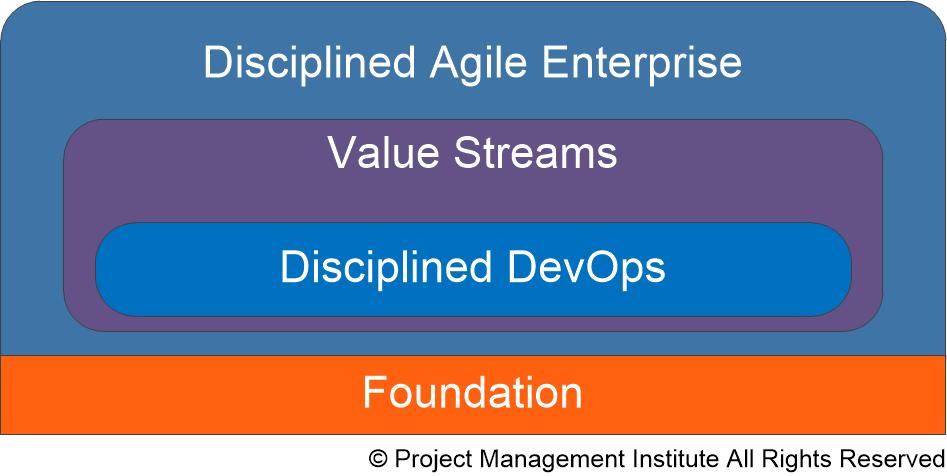
The Disciplined Agile (DA) tool kit is organized into four layers, overviewed in Figure 1. These layers are: Foundation, Disciplined DevOps, Value Streams, and Disciplined Agile Enterprise (DAE). This blog focuses on the Disciplined DevOps layer. Figure 1. The layers of the DA tool kit.
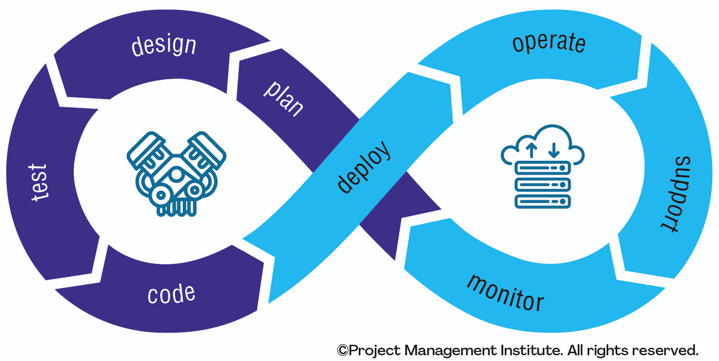
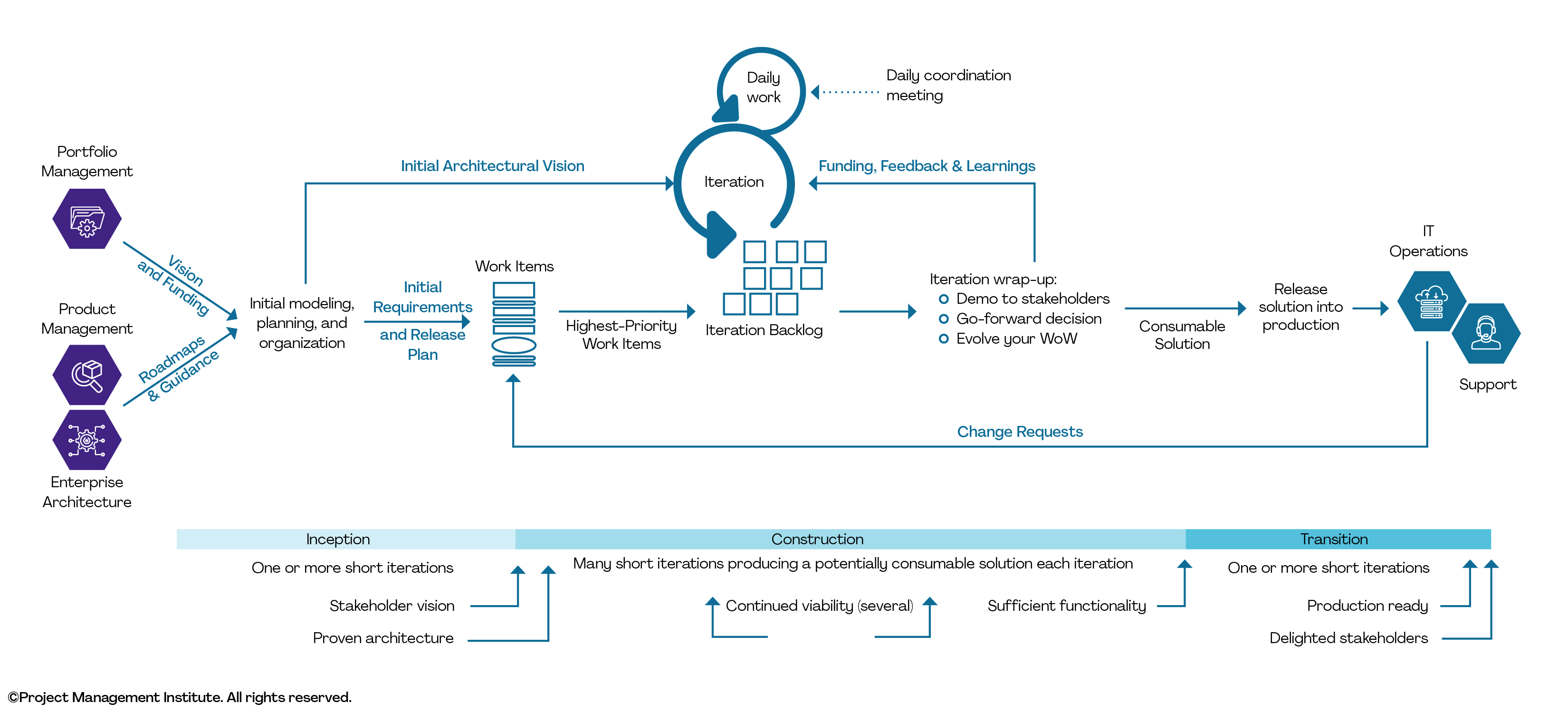
How is "Disciplined DevOps" different from normal/mainstream DevOps? Mainstream DevOps is the streamlining of software development, information technology (IT) operations, and support. This strategy is often depicted as an infinite loop as you see in Figure 2. Disciplined DevOps is an enterprise-ready approach that extends mainstream DevOps to include critical activities around security, data management, release management, and business operations. The high-level workflow for Disciplined DevOps is depicted in Figure 3. Figure 2. The classic DevOps workflow.
Figure 3. The workflow of Disciplined DevOps.
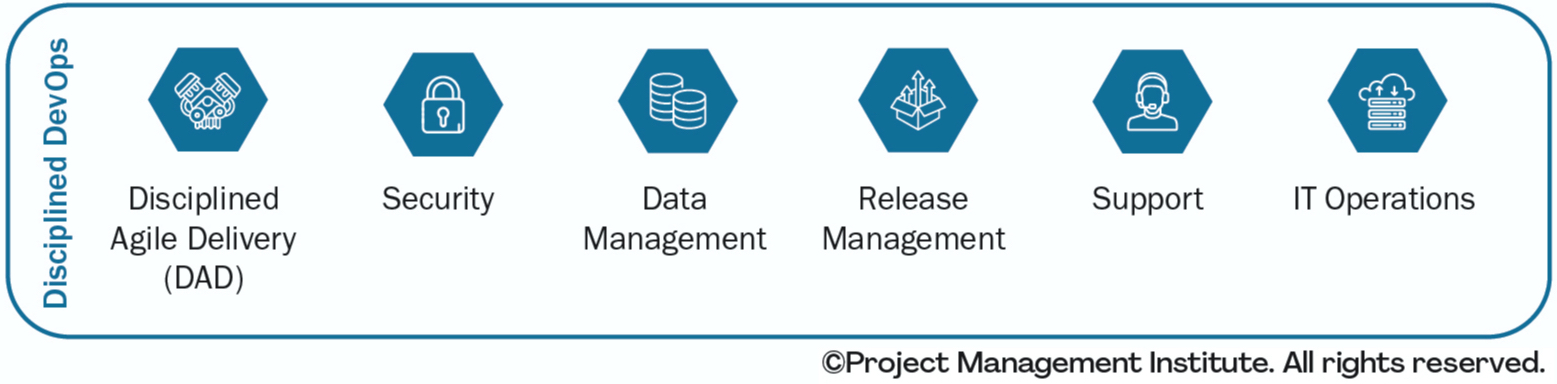
Let's explore the components of Disciplined DevOps. The hexes in Figure 3 represent process blades, sometimes called process areas. A process blade encompasses a cohesive collection of process options, such as practices and strategies, that should be chosen and then applied in a context sensitive manner. Process blades also address functional roles specific to that domain as well as extensions to the DA mindset specific to that domain. The process blades of Disciplined DevOps are:
Disciplined Agile Delivery (DAD)Disciplined Agile Delivery (DAD) is a people-first, learning-oriented hybrid approach to solution delivery. DAD teams focus on the creation of a new, or evolution of an existing, consumable solution for their customers. A solution may include any combination of software, physical assets (e.g. hardware), documentation, changes to the supported business process, and changes to the organizational structure(s) of the people involved. A solution is consumable when it is usable, desirable, and functional. DAD enables a flexible way of working (WoW), supporting several lifecycles in a manner that is tactically scalable. SecurityThe Security process blade focuses on how to protect your organization from both information/virtual and physical threats. This includes procedures for security governance, identity and access management, security policy management, incident response, and vulnerability management. As you would expect these policies will affect your organization’s strategies around change management, disaster recovery and business continuity, solution delivery, and vendor management. For security to be effective it has to be a fundamental aspect of your organizational culture. Data ManagementData management is the development, execution and supervision of plans, policies, programs and practices that control, protect, deliver and enhance the value of data and information assets. DA promotes a pragmatic, streamlined approach to data management that fits into the rest of your organizational processes – we need to optimize the entire workflow, not sub-optimize our data management strategy. Disciplined agile data management does this in an evolutionary and collaborative manner, via concrete data management strategies that provide the right data at the right time to the right people. Release ManagementThe release management process blade encompasses planning, coordinating, and verifying the deployment of solutions into production. Release management requires collaboration by the team(s) producing the solutions and the people responsible for your organization’s operational environment(s). In the case of organizations with a “you build it, you run it” DevOps mindset these people may be one in the same, although even in these situations you will often find a group of people responsible for governing the overall release management effort. In a true DevOps environment release management is fully automated for the intangible aspects (e.g. software and supporting documentation), and perhaps even some physical aspects, of your solution. SupportSupport focuses on helping customers/end users to work with the solutions produced by your delivery teams. Ideally your solutions should be designed so well that people don’t need anyone to help them but unfortunately it doesn’t always work out that way. So in many ways your support strategy is your “last line of defense” in your efforts to Delight Customers. Support goes by many names, including help desk, customer support, and customer care. IT OperationsThe primary aim of IT operations is to run a trustworthy IT ecosystem. From the point of view of your customers, you want to do such a good job that they don’t even notice IT. For older organizations this can be a challenge due to the existence of hundreds, if not thousands, of legacy systems that have been deployed over the decades. You may face daunting technical debt in these systems – poor quality data, overly complex or poorly written source code, systems with inadequate automated regression tests (if any), different versions of the same system, several systems offering similar functionality, numerous technology platforms, systems and technologies for which you have insufficient expertise, and more. Business OperationsBusiness operations is one of the process blades of the value stream layer, although as you see in Figure 3 it is a critical component of the Disciplined DevOps workflow. Business operations focuses on the activities required to provide services to customers and to support your products. The implementation of business operations will vary by value stream, in a bank retail account services is implemented in a very different manner than brokerage services for example. Business operations includes help desk and support services (integrated in with IT support where appropriate) as well as any technical sales support activities such as training, product installation, and product customization. As you can imagine close collaboration with both your Sales and Marketing efforts is required to successfully Delight Customers. |

Reiki Practices for Agile Teams
Categories:
agile,
DAD,
disciplined agile delivery,
Scrum,
Uncategorized,
DA,
Energy Healing,
post-format-quote,
Reiki,
Disciplined Agile
Categories: agile, DAD, disciplined agile delivery, Scrum, Uncategorized, DA, Energy Healing, post-format-quote, Reiki, Disciplined Agile
|
Why Energy Enhancement is Important “Your energy introduces you before you even speak” – I strongly believe in this famous quote and I am writing this article to enhance the positive energy level of every agile team, irrespective of their agile maturity level and experience. If your Enterprise is not very mature in Disciplined Agile (DA) implementation, then you need to work with a CDAC to increase this maturity. I’m not focusing on those aspects of DA implementation in this article. You can get that knowledge from the DA website, blog, any CDAC or many great books written by Scott Ambler and Mark Lines. I’m a certified Reiki Master Teacher and Disciplined Agile Coach & Instructor (CDAC & CDAI), who has been coaching and training agile teams, plus successfully healing people (in person or located thousands of miles away) by my Reiki knowledge. I’ve identified some basic Reiki practices which every agile practitioner can follow to increase their own positive energy level. No prior Reiki or Energy Healing knowledge is required to follow these time-tested practices and you can even measure the increase in this positive energy by Pendulum Dowsing, if you are interested in collecting the evidence. Background of Energy Healing and Reiki With the advancements of quantum physics, evidence supporting the concept that matter is made up of layers of energy came to light. For centuries, indigenous cultures have been positively influencing the body’s health by working with its energy fields, and many traditions around the world speak about how it can be used in medical practices. It was first observed by the eastern healers who identified seven Chakras and twelve major Meridians, or pathways of energy, in the body. They enhance the flow of energy to improve the health of the physical body. This is called Energy Healing. The word Reiki is made of two Japanese words – “Rei” which means “Universal” and “Ki” which is “Life Force Energy”. Reiki flows through all living things. It utilizes the Ki to strengthen and help others using a lot of hand techniques and specific symbols which channel the energy of the universe to heal the body, mind and spirit. With this background information, let’s explore some simple practices to enhance the positive Energy Level of your agile teams: Meditation on Five Reiki Principles (10-15 Minutes Daily)The following five Reiki principles are guidelines that everyone can live by, to promote a healthy, loving way of living.
Worry causes stress which is a major issue in our daily lives. So, for a day try to stop worrying. It will make your life peaceful which in turn, will also bring peace to others. Lowering down stress will also enhance your physical health. Just for today trust in the universal life force and it will help you in fixing your problems!
If a typical morning for you involves getting bug reports from the testers or high priority production tickets from the users, you probably default to anger. Why not just take a deep breath, relax and let it go? What will you achieve by remaining angry and increasing your own blood pressure? Nothing. All that you’ll end up with is an elevated heart rate (and more stress!) which is not good for your well-being.
We are always asking for more and only seeing what we don’t have. Let’s try for one day to be grateful for what we do have — like a job, a car, a roof over your head, good health, a family and your DA team that supports you. If you are grateful for what you have, you will attract more good. The law of attraction states that like attracts like and lack attracts lack, so stay positive and be grateful for what you have.
Doing your work honestly brings more purpose and meaning into your life. When you do your work honestly and with purpose, at the end of the day you’ll feel good about yourself and more fulfilled about your work. Just remember the following quote of quality guru Dr. W. Edwards Deming – “Quality is pride of workmanship.”
What you give out, you receive back multifold. Be nice, loving and caring to everyone, even if it’s not your favorite person in the world. We all deserve love and kindness. At the end of the day we will feel better about ourselves for bringing some light and love into someone else’s day, even if it’s just for a moment. Please note, all these principles start with “Just for today” phrase because our life is agile and every new day can be treated as a new iteration. You don’t need to plan your whole life today in Waterfall style. Just meditate on these principles and live one iteration (day) at a time. You will be much happier at the end of the day, I promise. Forgiveness Prayer (10-15 Minutes in Every Retrospective Meeting)Every team can spend 10-15 minutes in every Retrospective meeting to chant and meditate on the following forgiveness prayer:
Affirmation Slips (10-15 Minutes in Every Iteration Planning Meeting or as Needed)An affirmation is a simple, positive phrase that is meant to change our habit, belief, behavior, approach, emotion, feeling or opinion. For many people, it’s a great tool of healing and improving life. After all, it’s a tool of working with your inner self. How to make affirmation slips? Keep it as simple as possible. No need to be formal and go for fancy words or big-big affirmations. You can note down this wish on a piece of paper in clear words or use any simple affirmation related to your wish. Hold this slip between your palms and meditate for 5-10 minutes with the intention to manifest it for your highest good. To understand and explain affirmations better, here are two simple examples. I, YOUR NAME, write perfect code and delight our customers! I, YOUR NAME, catch every bug in testing and enhance the reliability of our software! Using this affirmation properly will establish a new opinion in your mind. And because our opinions create our reality (have you read/watched The Secret?), then with a bit of healing, you will be able to do your job perfectly and with pleasure. How to write affirmations? Well, there are few “rules” and some “guidelines”. First, the affirmation must be a positive phrase. So don’t use “no”, “never”, “not” and things like that. Always try to make sure that your affirmation sounds positive. Next, write affirmations for yourself, not for others. These are the basics of writing affirmation. You can also listen to a recorded affirmation or recite the affirmation, because it works, as well. My experiments with various DA teams have convinced me that these Energy Healing practices will work for your DA team as well. Even if you are not sure about the outcome or don’t know how to measure this enhanced positive energy by a Pendulum Dowser, I suggest you run it as an experiment for 2-3 iterations and observe the difference. Do share your experiences with me after conducting this experiment. May the force be with you! – Written by Dr. Sanjay Saxena, Ph.D., CDAC, CDAI, SPC4, PgMP, Reiki Master Teacher ([email protected]) |
An Exploratory
| One of the key philosophies of the Disciplined Agile (DA) toolkit is that it presents software development teams with choices and guides them through making the right choices given the situation they face. In other words, it helps them to truly own their process. Part of doing so is to choose the software delivery lifecycle (SDLC) that is the best fit for their context. In this blog posting we overview the DAD Exploratory lifecycle which is based in part on Lean Startup strategies. This lifecycle can be applied in two ways:
The following diagram overviews the DAD Exploratory lifecycle. This lifecycle is followed by agile or lean teams that find themselves in startup or research situations where their stakeholders have an idea for a new product but they do yet understand what is actually needed by their user base. As a result they need to quickly explore what the market wants via a series of quick learning experiments.
Now let’s describe how the Exploratory lifecycle works. There are six activities to this lifecycle:
To summarize, the DAD process framework takes a flexible, non-prescriptive approach to software-based solution delivery. As a result of this philosophy DAD supports several development lifecycles, one of which is the Lean-Startup-based Exploratory lifecycle described in this posting. This lifecycle is typically followed in situations where you are unsure of what your user base wants, and sometimes even when you are unsure of who your user base (your customers) will even be. |

Comparing DAD to the Rational Unified Process (RUP) - Part 2
Categories:
agile,
DAD,
mark lines,
Transition iteration,
Construction phase,
Inception phase,
Lifecycle,
Scrum,
Kanban,
lean
Categories: agile, DAD, mark lines, Transition iteration, Construction phase, Inception phase, Lifecycle, Scrum, Kanban, lean
| This post is a follow-up to Comparing DAD to the Rational Unified Process (RUP) – Part 1. In that post I described in some detail why Disciplined Agile Delivery (DAD) is not “Agile RUP”. DAD is quite different in both approach and content. There are however some very good principles that the Unified Process (UP) incorporates that are not part of mainstream agile methods. This post describes what parts of the UP made it into the DA toolkit. DAD suggests a full delivery lifecycle approach similar to RUP. DAD recognizes that despite some agile rhetoric projects do indeed go through specific phases. RUP explicitly has four phases for Inception, Elaboration, Construction, and Transition. For reasons that I described in the last post, DAD does not include an explicit Elaboration phase. However the milestone for Elaboration is still in DAD which I will describe shortly. As the DAD basic lifecycle diagram shows, DAD has three of the four RUP phases.
So in summary, DAD frames an agile project within the context of an end-to-end risk-value lifecycle with specific milestones to ensure that the project is progressing appropriately. These checkpoints give specific opportunities to change course, adapt, and progress into the next phases of the project. While the lifecycle is similar to that of RUP, as described in Part 1 of this post it is important to realize that the actual work performed within the iterations is quite different and far more agile than a typical RUP project.
|
Comparing DAD to the Rational Unified Process (RUP) - Part 1
Categories:
DAD discussions,
agile,
DAD,
mark lines,
disciplined agile delivery,
rational unified process,
RUP,
Scrum
Categories: DAD discussions, agile, DAD, mark lines, disciplined agile delivery, rational unified process, RUP, Scrum
|
Last week I was discussing DAD with a new client and he asked me “Is DAD just an Agile version of RUP?” In a word, no. DAD is a toolkit composed of a hybrid of methods and practices as shown in the diagram. It includes the best of Scrum, Extreme Programming (XP), Agile data and modeling, and yes, the Unified Process (UP). DAD also includes additional content such as agile governance that is not present in any of these methods. As the diagram indicates, probably the method that adds most to DAD is XP, not the UP. DAD does not prescribe a use case-driven approach, or insist that OOAD be rigorously applied to build out services/components. A use case-driven approach is a potential practice to apply but there is a danger that this could lead to an exhaustive requirements specification which is not particularly agile. We would prefer to use a user story-driven approach if that makes sense within the context of your project. User stories might not be the right choice either. Perhaps you are in a regulatory environment that demands a traditional software requirements specification (SRS). The key point is that you will have to adapt to the situation that you find yourself in. This is why we prioritize the team’s work with a work item list comprised of work items, rather than Scrum’s backlog comprised of user stories. Using a work item list allows us the flexibility to put any type of work onto our backlog, extending the applicability of DAD to many types of projects beyond those for which RUP or Scrum would be ideally suited. DAD is goal-driven, not artifact-driven. It does not prescribe practices or specific artifacts. Rather, it suggests alternative strategies than can be applied at certain parts of the lifecycle with the pros and cons for each, but which ones you choose is up to you. In my next post I will describe which aspects of the Unified Process did make it into DAD and why. |



