The Leadership Solution in Organizations
From the Support to Develop Blog
by Luis Branco

This blog addresses management-related topics and has three areas of focus: 1. Technical skills; 2. Competencies in the field of interpersonal relations and communication (including personal organization and delegation, leadership, teamwork, conflict resolution, conducting meetings, and negotiation); and 3. Strategy (including diagnosis, strategic guidelines, and implementation).4.Technology
Recent Posts
Delegation with Purpose: Building Autonomy and Developing Capability
RCPCV™: A Method for Decision-Making and Continuous Improvement
The Same Change Can Succeed and Fail at the Same Time
What Must Exist Even When No Single Role Owns the Whole?
PHASE 4 – THE EMERGENCE
Categories
Agile,
Career Development,
Career Development,
Career Development,
Career Development,
Career Development,
Career Development,
Career Development,
Career Development,
Career Development,
Career Development,
Career Development,
Career Development,
Career Development,
Career Development,
Career Development,
Career Development,
Career Development,
Career Development,
Career Development,
Career Development,
Career Development,
Career Development,
Career Development,
Career Development,
Career Development,
Career Development,
Career Development,
Career Development,
Career Development,
Career Development,
Career Development,
Career Development,
Career Development,
Career Development,
Career Development,
Career Development,
Career Development,
Career Development,
Career Development,
Career Development,
Career Development,
Career Development,
Career Development,
Career Development,
Career Development,
Career Development,
Career Development,
Career Development,
Career Development,
Career Development,
Career Development,
Career Development,
Career Development,
Career Development,
Career Development,
Career Development,
Career Development,
Career Development,
Career Development,
Career Development,
Career Development,
Career Development,
Career Development,
Career Development,
Career Development,
Career Development,
Career Development,
Career Development,
Career Development,
Career Development,
Career Development,
Career Development,
Career Development,
Career Development,
Career Development,
Career Development,
Career Development,
Career Development,
Career Development,
Career Development,
Career Development,
Career Development,
Career Development,
Career Development,
Career Development,
Career Development,
Career Development,
Career Development,
Career Development,
Career Development,
Career Development,
Career Development,
Career Development,
Career Development,
Career Development,
Career Development,
Career Development,
Career Development,
Career Development,
Career Development,
Career Development,
Career Development,
Career Development,
Career Development,
Career Development,
Career Development,
Career Development,
Career Development,
Career Development,
Career Development,
Career Development,
Career Development,
Career Development,
Career Development,
Career Development,
Career Development,
Career Development,
Career Development,
Career Development,
Career Development,
Career Development,
Career Development,
Education,
Governance,
Governance,
Governance,
Governance,
Governance,
Governance,
Governance,
Governance,
Governance,
Governance,
Governance,
Governance,
Governance,
Governance,
Governance,
Governance,
Governance,
Governance,
Governance,
Governance,
Governance,
Governance,
In,
Integration Management,
Interpersonal Skills,
Interpersonal Skills,
Interpersonal Skills,
Interpersonal Skills,
Interpersonal Skills,
Interpersonal Skills,
Interpersonal Skills,
Interpersonal Skills,
Interpersonal Skills,
Interpersonal Skills,
Interpersonal Skills,
Interpersonal Skills,
Interpersonal Skills,
Interpersonal Skills,
Interpersonal Skills,
Interpersonal Skills,
Interpersonal Skills,
Interpersonal Skills,
Interpersonal Skills,
Interpersonal Skills,
Interpersonal Skills,
Interpersonal Skills,
Interpersonal Skills,
Interpersonal Skills,
Interpersonal Skills,
Interpersonal Skills,
Interpersonal Skills,
Interpersonal Skills,
Interpersonal Skills,
Interpersonal Skills,
Interpersonal Skills,
Interpersonal Skills,
Interpersonal Skills,
Interpersonal Skills,
Interpersonal Skills,
Interpersonal Skills,
Interpersonal Skills,
Interpersonal Skills,
Interpersonal Skills,
Interpersonal Skills,
Interpersonal Skills,
Interpersonal Skills,
Interpersonal Skills,
Interpersonal Skills,
Interpersonal Skills,
Interpersonal Skills,
Interpersonal Skills,
Interpersonal Skills,
Interpersonal Skills,
Interpersonal Skills,
Interpersonal Skills,
Interpersonal Skills,
Interpersonal Skills,
Interpersonal Skills,
Interpersonal Skills,
Interpersonal Skills,
Interpersonal Skills,
Interpersonal Skills,
Interpersonal Skills,
Interpersonal Skills,
Interpersonal Skills,
Interpersonal Skills,
Interpersonal Skills,
Interpersonal Skills,
Interpersonal Skills,
Interpersonal Skills,
Interpersonal Skills,
Interpersonal Skills,
Interpersonal Skills,
Interpersonal Skills,
Interpersonal Skills,
Interpersonal Skills,
Interpersonal Skills,
Interpersonal Skills,
Interpersonal Skills,
Interpersonal Skills,
Interpersonal Skills,
Interpersonal Skills,
Interpersonal Skills,
Interpersonal Skills,
Interpersonal Skills,
Interpersonal Skills,
Interpersonal Skills,
Interpersonal Skills,
Interpersonal Skills,
Interpersonal Skills,
Interpersonal Skills,
Interpersonal Skills,
Interpersonal Skills,
Interpersonal Skills,
Interpersonal Skills,
Interpersonal Skills,
Interpersonal Skills,
Interpersonal Skills,
Interpersonal Skills,
Interpersonal Skills,
Interpersonal Skills,
Interpersonal Skills,
Interpersonal Skills,
Interpersonal Skills,
Interpersonal Skills,
Interpersonal Skills,
Interpersonal Skills,
Interpersonal Skills,
Interpersonal Skills,
Interpersonal Skills,
Interpersonal Skills,
Interpersonal Skills,
Interpersonal Skills,
Interpersonal Skills,
Interpersonal Skills,
Interpersonal Skills,
Interpersonal Skills,
Interpersonal Skills,
Interpersonal Skills,
Interpersonal Skills,
Interpersonal Skills,
Interpersonal Skills,
Interpersonal Skills,
Interpersonal Skills,
Interpersonal Skills,
Interpersonal Skills,
Knowledge Management,
le,
lea,
Leadership,
Leadership,
Leadership,
Leadership,
Leadership,
Leadership,
Leadership,
Leadership,
Leadership,
Leadership,
Leadership,
Leadership,
Leadership,
Leadership,
Leadership,
Leadership,
Leadership,
Leadership,
Leadership,
Leadership,
Leadership,
Leadership,
Leadership,
Leadership,
Leadership,
Leadership,
Leadership,
Leadership,
Leadership,
Leadership,
Leadership,
Leadership,
Leadership,
Leadership,
Leadership,
Leadership,
Leadership,
Leadership,
Leadership,
Leadership,
Leadership,
Leadership,
Leadership,
Leadership,
Leadership,
Leadership,
Leadership,
Leadership,
Leadership,
Leadership,
Leadership,
Leadership,
Leadership,
Leadership,
Leadership,
Leadership,
Leadership,
Leadership,
Leadership,
Leadership,
Leadership,
Leadership,
Leadership,
Leadership,
Leadership,
Leadership,
Leadership,
Leadership,
Leadership,
Leadership,
Leadership,
Leadership,
Leadership,
Leadership,
Leadership,
Leadership,
Leadership,
Leadership,
Leadership,
Leadership,
Leadership,
Leadership,
Leadership,
Leadership,
Leadership,
Leadership,
Leadership,
Leadership,
Leadership,
Leadership,
Leadership,
Leadership,
Leadership,
Leadership,
Leadership,
Leadership,
Leadership,
Leadership,
Leadership,
Leadership,
Leadership,
Leadership,
Leadership,
Leadership,
Leadership,
Leadership,
Leadership,
Leadership,
Leadership,
Leadership,
Leadership,
Leadership,
Leadership,
Leadership,
Leadership,
Leadership,
Leadership,
Leadership,
Leadership,
Leadership,
Leadership,
Leadership,
Leadership,
or,
Organizational Project Management,
Portfolio Management,
Program,
Program Management,
Strategy,
Strategy,
Strategy,
Strategy,
Strategy,
Strategy,
Strategy,
Strategy,
Strategy,
Strategy,
Strategy,
Strategy,
Strategy,
Strategy,
Strategy,
Strategy,
Strategy,
Strategy,
Strategy,
Strategy,
Strategy,
Strategy,
Strategy,
Strategy,
Strategy,
Strategy,
Strategy,
Strategy,
Strategy,
Strategy,
Strategy,
Strategy,
Strategy,
Strategy,
Strategy,
Strategy,
Strategy,
Strategy,
Strategy,
Strategy,
Strategy,
Strategy,
Strategy,
Strategy,
Strategy,
Strategy,
Strategy,
Strategy,
Strategy,
Strategy,
Strategy,
Strategy,
Strategy,
Strategy,
Strategy,
Strategy,
Strategy,
Strategy,
Strategy,
Strategy,
Strategy,
Strategy,
Strategy,
Strategy,
Strategy,
Strategy,
Strategy,
Strategy,
Strategy,
Strategy,
Strategy,
Strategy,
Strategy,
Strategy,
Strategy,
Strategy,
Strategy,
Strategy,
Strategy,
Strategy,
Strategy,
Strategy,
Strategy,
Strategy,
Strategy,
Strategy,
Strategy,
Strategy,
Strategy,
Strategy,
Strategy,
Strategy,
Strategy,
Strategy,
Strategy,
Strategy,
Strategy,
Strategy,
Strategy,
Strategy,
Strategy,
Strategy,
Strategy,
Strategy,
Strategy,
Strategy,
Strategy,
Strategy,
Strategy,
Strategy,
Strategy,
Strategy,
Strategy,
Strategy,
Strategy,
Strategy,
Strategy,
Strategy,
Strategy,
Strategy,
Strategy,
Strategy,
Strategy,
Sustainability,
Talent Management,
Talent Management,
Talent Management,
Talent Management,
Talent Management,
Talent Management,
Talent Management,
Talent Management,
Talent Management,
Talent Management,
Talent Management,
Talent Management,
Talent Management,
Talent Management,
Talent Management,
Talent Management,
Talent Management,
Talent Management,
Talent Management,
Talent Management,
Talent Management,
Talent Management,
Talent Management,
Talent Management,
Talent Management,
Talent Management,
Talent Management,
Talent Management,
Talent Management,
Talent Management,
Talent Management,
Talent Management,
Talent Management,
Talent Management,
Talent Management,
Talent Management,
Talent Management,
Talent Management,
Talent Management,
Talent Management,
Talent Management,
Talent Management,
Talent Management,
Talent Management,
Talent Management,
Talent Management,
Talent Management,
Talent Management,
Talent Management,
Talent Management,
Talent Management,
Talent Management,
Talent Management,
Talent Management,
Talent Management,
Talent Management,
Talent Management,
Talent Management,
Talent Management,
Talent Management,
Talent Management,
Talent Management,
Talent Management,
Talent Management,
Talent Management,
Talent Management,
Talent Management,
Talent Management,
Talent Management,
Talent Management,
Talent Management,
Talent Management,
Talent Management,
Talent Management,
Talent Management,
Talent Management,
Talent Management,
Talent Management,
Talent Management,
Talent Management,
Talent Management,
Talent Management,
Talent Management,
Talent Management,
Talent Management,
Talent Management,
Talent Management,
Talent Management,
Talent Management,
Talent Management,
Talent Management,
Talent Management,
Talent Management,
Talent Management,
Talent Management,
Talent Management,
Talent Management,
Talent Management,
Talent Management,
Talent Management,
Talent Management,
Talent Management,
Talent Management,
Talent Management,
Talent Management,
Talent Management,
Talent Management,
Talent Management,
Talent Management,
Talent Management,
Talent Management,
Talent Management,
Talent Management,
Talent Management,
Talent Management,
Talent Management,
Talent Management,
Talent Management,
Talent Management,
Talent Management,
Talent Management,
Talent Management,
Talent Management
Date

In the first article of this series of 3, the theme was addressed: "The paradigm of people as a whole". A simple way of thinking about life was suggested, addressing the 4 dimensions of the person as a whole, his needs, intelligences and attributes and how to light the inner fire and we find our voice.
In the second, "People and Work", a reflection was made on what people expect from their work, the main chronic and acute problems and the response of companies and organizations of the industrial era to solve these problems.
In this last article “The Leadership Solution in Organizations” the leadership solution to solve chronic problems is addressed. The 4 leadership roles are analyzed.
The leadership solution in organizations
The decision to inspire others to find their own voice takes us to the heart of the four chronic organizational problems that stem from the current model of the industrial age.
Each person who has found their own voice has the power to rewrite the software of the industrial age (boss, rules, efficiency, control) that prevails in organizations.
The process involves four functions that become the antidote to the four chronic organizational problems.
Where there is little trust, we focus on shaping integrity to build trust.
Where there is no vision or common values, we focus on moving towards creating a new vision and a set of common values.
Where there is misalignment, we focus on aligning objectives, structures, systems and processes to encourage and align the valuation of people and culture, in order to serve the vision and values.
Where there is weakness, we focus on valuing people and teams in terms of project or position.
The four roles of the leader are not about leadership as a position, but as a proactive intention to affirm the value and potential of those around us and unite them as a complementary team in an effort to increase influence and impact on organizations and causes important that we are part.
It should be remembered that, in a complementary team, the individual strengths (voices) become productive and the weaknesses become irrelevant because they are compensated for the strengths of the others.
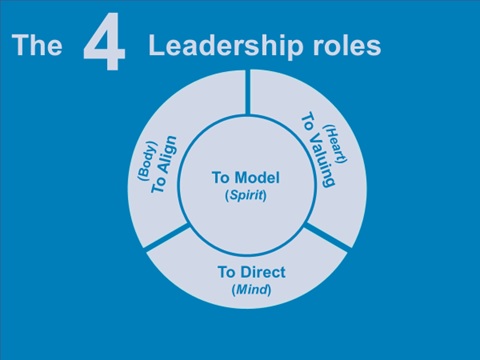
The 4 Leader Roles are simply four qualities of personal leadership - vision, discipline, passion and awareness - on an expanded scale for the entire organization.
To Model - (Conscience): Set a good example
To Direct (Vision) - Determine the route together
To Align (Discipline): Establish and manage systems to keep the course
To Valuing (Passion): Focus talent on results, not methods, after getting out of people's way and helping them if they ask us.
Whoever is in formal positions of authority in the organization can consider these four roles as a challenging but natural way of fulfilling their role.
But to see them only as functions of top executives would perpetuate the codependent mentality in effect, which says: "it is the boss who thinks and makes important decisions”.
The four roles fit everyone, whatever their position.
They simply represent the way to increase our influence and the influence of our team in the organization.

Fonte: O 8º Hábito - Da Eficácia à Grandeza
Stephen R. Covey
Posted on: March 21, 2020 06:35 AM |
Permalink
Comments (12)
Please login or join to subscribe to this item

Alexandre Costa
Scrum Master| Integer Consulting - Pictet technologies
Loures, Portugal
Dear Luis,
Among others is a good perspective of leadership, well presented and very synthetic, however no mater the kind of the leadership that anyone decides to use in their approach, to me the main problem today are the lack of principles and ethics, they are base cornerstones, foundations without them everything collapses.
We live in a society, where today the respect for the principles
it is very diffuse and ethical dilemmas are increasing, especially between cultures.
Alexandre
Alexandre Costa
Scrum Master| Integer Consulting - Pictet technologies
Loures, Portugal
I am happy about your theme, at least is not covid-19, i am a little tired about seeing articles and postings about the pandemic, suddenly everyone became an expert on recommendations and risk plans. :)
Alexandre

Luis Branco
CEO| Business Insight, Consultores de Gestão, Ldª
Carcavelos, Lisboa, Portugal
Dear Alexandre
Thank you for reading the article I published and for your opinion
Did you have the opportunity to see the video I shared?
In addition to addressing the theme of leadership, the author talks about the 3 immutable things:
- Change
- Principles
- Choices
Luis Branco
CEO| Business Insight, Consultores de Gestão, Ldª
Carcavelos, Lisboa, Portugal
Dear Alexandre
Interesting this your comment
Thanks for sharing
Since this is the first time such a situation has happened in human history, the only thing I worry about is:
- How can I help?
- As a community of project managers at a global level what can we do?
That's a big gold watch he's wearing in the video.
Luis Branco
CEO| Business Insight, Consultores de Gestão, Ldª
Carcavelos, Lisboa, Portugal
Dear Sante
Thank you for participating in this reflection and for your opinion
Would you like to know what you think about the video content?
It was ok Luis. The guy sounded like he was gearing up to start a cult or something, but on the whole there was some valid comments.
Luis Branco
CEO| Business Insight, Consultores de Gestão, Ldª
Carcavelos, Lisboa, Portugal
Dear Sante
Thank you for sharing your opinion with us
The most interesting thing, in my opinion, was the reference to the 3 things that don't change
Dear Luis,
I would agree with your four leadership roles - Model, Direct, Align and Valuing.
One thought did strike me when reading your blog is mapping these traits to the different parts of the brain as the brain is reponsible for controlling, monitoring and initiating these attributes.
It would be interesting if the absence of certain cognitive functions has a direct impact on their ability to manage people and projects.
Also you map the trait to skill in you blogs and do people compensate with other attributes, such as outgoing personality and charisma, when they are lacking in other key skills and attribute?
Daire
Luis Branco
CEO| Business Insight, Consultores de Gestão, Ldª
Carcavelos, Lisboa, Portugal
Dear Daire
Thank you for reading this article and for sharing your opinion
It would be interesting to ask neuroscientists to associate these 4 qualities with the brain and its functioning
Dear Luis,
Thank you for sharing your article.. The message on the video is quite interesting indeed and I do agree that organisations do need a strong core or base of principles that will drive them through any challenges that do come across their lifetime and that will enable them to not only survive but strive on the long term.
I have a personal perception that in many developing nations many public and private institution's leadership are still failing at the four leader roles. Although there is a wave of change in some developing nations (e.g. Angola) more needs to be done to include followers of top management in the decision making and defining the path of the institutions. People need more voice within some institutions to fully use their capabilities to help support the role of those who lead. Making people more engaged in defining the path , the strategies of the institution, helps people embody more easily the institution's principles and therefore embrace the vision being carried out by the leadership

Inocente Nkita
Senior Field Specialist| Baker Hughes
Soyo, Zaire, Angola
Hello dear Luis,
You made good insights on what leadership is all about and how to attain it in clear manner!
I 100% concur with the idea that leading is all about motivating team members to bring their best towards teams goals, of course under leader direction.Therefore is paramount that leader knows the teams goals better than no one else within his/her team. However, leader should recognise team's efforts is better than his/her single effort towards accomplish team's objective. Therefore, leader should facilitate and encourage every single team member to say or do something for their comom goals.
Best,
Inocente Nkita
Please Login/Register to leave a comment.
|
"Let us be thankful for fools. But for them the rest of us could not succeed."
- Mark Twain
|






