Cognitive Tension Orchestration™
From the Support to Develop Blog
by Luis Branco

This blog addresses management-related topics and has three areas of focus: 1. Technical skills; 2. Competencies in the field of interpersonal relations and communication (including personal organization and delegation, leadership, teamwork, conflict resolution, conducting meetings, and negotiation); and 3. Strategy (including diagnosis, strategic guidelines, and implementation).4.Technology
Recent Posts
RCPCV™: A Method for Decision-Making and Continuous Improvement
The Same Change Can Succeed and Fail at the Same Time
What Must Exist Even When No Single Role Owns the Whole?
PHASE 4 – THE EMERGENCE
When Structural Drift Becomes Consequential
Categories
Agile,
Career Development,
Career Development,
Career Development,
Career Development,
Career Development,
Career Development,
Career Development,
Career Development,
Career Development,
Career Development,
Career Development,
Career Development,
Career Development,
Career Development,
Career Development,
Career Development,
Career Development,
Career Development,
Career Development,
Career Development,
Career Development,
Career Development,
Career Development,
Career Development,
Career Development,
Career Development,
Career Development,
Career Development,
Career Development,
Career Development,
Career Development,
Career Development,
Career Development,
Career Development,
Career Development,
Career Development,
Career Development,
Career Development,
Career Development,
Career Development,
Career Development,
Career Development,
Career Development,
Career Development,
Career Development,
Career Development,
Career Development,
Career Development,
Career Development,
Career Development,
Career Development,
Career Development,
Career Development,
Career Development,
Career Development,
Career Development,
Career Development,
Career Development,
Career Development,
Career Development,
Career Development,
Career Development,
Career Development,
Career Development,
Career Development,
Career Development,
Career Development,
Career Development,
Career Development,
Career Development,
Career Development,
Career Development,
Career Development,
Career Development,
Career Development,
Career Development,
Career Development,
Career Development,
Career Development,
Career Development,
Career Development,
Career Development,
Career Development,
Career Development,
Career Development,
Career Development,
Career Development,
Career Development,
Career Development,
Career Development,
Career Development,
Career Development,
Career Development,
Career Development,
Career Development,
Career Development,
Career Development,
Career Development,
Career Development,
Career Development,
Career Development,
Career Development,
Career Development,
Career Development,
Career Development,
Career Development,
Career Development,
Career Development,
Career Development,
Career Development,
Career Development,
Career Development,
Career Development,
Career Development,
Career Development,
Career Development,
Career Development,
Career Development,
Career Development,
Career Development,
Career Development,
Career Development,
Education,
Governance,
Governance,
Governance,
Governance,
Governance,
Governance,
Governance,
Governance,
Governance,
Governance,
Governance,
Governance,
Governance,
Governance,
Governance,
Governance,
Governance,
Governance,
Governance,
Governance,
Governance,
In,
Integration Management,
Interpersonal Skills,
Interpersonal Skills,
Interpersonal Skills,
Interpersonal Skills,
Interpersonal Skills,
Interpersonal Skills,
Interpersonal Skills,
Interpersonal Skills,
Interpersonal Skills,
Interpersonal Skills,
Interpersonal Skills,
Interpersonal Skills,
Interpersonal Skills,
Interpersonal Skills,
Interpersonal Skills,
Interpersonal Skills,
Interpersonal Skills,
Interpersonal Skills,
Interpersonal Skills,
Interpersonal Skills,
Interpersonal Skills,
Interpersonal Skills,
Interpersonal Skills,
Interpersonal Skills,
Interpersonal Skills,
Interpersonal Skills,
Interpersonal Skills,
Interpersonal Skills,
Interpersonal Skills,
Interpersonal Skills,
Interpersonal Skills,
Interpersonal Skills,
Interpersonal Skills,
Interpersonal Skills,
Interpersonal Skills,
Interpersonal Skills,
Interpersonal Skills,
Interpersonal Skills,
Interpersonal Skills,
Interpersonal Skills,
Interpersonal Skills,
Interpersonal Skills,
Interpersonal Skills,
Interpersonal Skills,
Interpersonal Skills,
Interpersonal Skills,
Interpersonal Skills,
Interpersonal Skills,
Interpersonal Skills,
Interpersonal Skills,
Interpersonal Skills,
Interpersonal Skills,
Interpersonal Skills,
Interpersonal Skills,
Interpersonal Skills,
Interpersonal Skills,
Interpersonal Skills,
Interpersonal Skills,
Interpersonal Skills,
Interpersonal Skills,
Interpersonal Skills,
Interpersonal Skills,
Interpersonal Skills,
Interpersonal Skills,
Interpersonal Skills,
Interpersonal Skills,
Interpersonal Skills,
Interpersonal Skills,
Interpersonal Skills,
Interpersonal Skills,
Interpersonal Skills,
Interpersonal Skills,
Interpersonal Skills,
Interpersonal Skills,
Interpersonal Skills,
Interpersonal Skills,
Interpersonal Skills,
Interpersonal Skills,
Interpersonal Skills,
Interpersonal Skills,
Interpersonal Skills,
Interpersonal Skills,
Interpersonal Skills,
Interpersonal Skills,
Interpersonal Skills,
Interpersonal Skills,
Interpersonal Skills,
Interpersonal Skills,
Interpersonal Skills,
Interpersonal Skills,
Interpersonal Skills,
Interpersonal Skills,
Interpersonal Skills,
Interpersonal Skills,
Interpersonal Skills,
Interpersonal Skills,
Interpersonal Skills,
Interpersonal Skills,
Interpersonal Skills,
Interpersonal Skills,
Interpersonal Skills,
Interpersonal Skills,
Interpersonal Skills,
Interpersonal Skills,
Interpersonal Skills,
Interpersonal Skills,
Interpersonal Skills,
Interpersonal Skills,
Interpersonal Skills,
Interpersonal Skills,
Interpersonal Skills,
Interpersonal Skills,
Interpersonal Skills,
Interpersonal Skills,
Interpersonal Skills,
Interpersonal Skills,
Interpersonal Skills,
Interpersonal Skills,
Interpersonal Skills,
Interpersonal Skills,
Interpersonal Skills,
Interpersonal Skills,
Knowledge Management,
le,
lea,
Leadership,
Leadership,
Leadership,
Leadership,
Leadership,
Leadership,
Leadership,
Leadership,
Leadership,
Leadership,
Leadership,
Leadership,
Leadership,
Leadership,
Leadership,
Leadership,
Leadership,
Leadership,
Leadership,
Leadership,
Leadership,
Leadership,
Leadership,
Leadership,
Leadership,
Leadership,
Leadership,
Leadership,
Leadership,
Leadership,
Leadership,
Leadership,
Leadership,
Leadership,
Leadership,
Leadership,
Leadership,
Leadership,
Leadership,
Leadership,
Leadership,
Leadership,
Leadership,
Leadership,
Leadership,
Leadership,
Leadership,
Leadership,
Leadership,
Leadership,
Leadership,
Leadership,
Leadership,
Leadership,
Leadership,
Leadership,
Leadership,
Leadership,
Leadership,
Leadership,
Leadership,
Leadership,
Leadership,
Leadership,
Leadership,
Leadership,
Leadership,
Leadership,
Leadership,
Leadership,
Leadership,
Leadership,
Leadership,
Leadership,
Leadership,
Leadership,
Leadership,
Leadership,
Leadership,
Leadership,
Leadership,
Leadership,
Leadership,
Leadership,
Leadership,
Leadership,
Leadership,
Leadership,
Leadership,
Leadership,
Leadership,
Leadership,
Leadership,
Leadership,
Leadership,
Leadership,
Leadership,
Leadership,
Leadership,
Leadership,
Leadership,
Leadership,
Leadership,
Leadership,
Leadership,
Leadership,
Leadership,
Leadership,
Leadership,
Leadership,
Leadership,
Leadership,
Leadership,
Leadership,
Leadership,
Leadership,
Leadership,
Leadership,
Leadership,
Leadership,
Leadership,
Leadership,
Leadership,
or,
Organizational Project Management,
Portfolio Management,
Program,
Program Management,
Strategy,
Strategy,
Strategy,
Strategy,
Strategy,
Strategy,
Strategy,
Strategy,
Strategy,
Strategy,
Strategy,
Strategy,
Strategy,
Strategy,
Strategy,
Strategy,
Strategy,
Strategy,
Strategy,
Strategy,
Strategy,
Strategy,
Strategy,
Strategy,
Strategy,
Strategy,
Strategy,
Strategy,
Strategy,
Strategy,
Strategy,
Strategy,
Strategy,
Strategy,
Strategy,
Strategy,
Strategy,
Strategy,
Strategy,
Strategy,
Strategy,
Strategy,
Strategy,
Strategy,
Strategy,
Strategy,
Strategy,
Strategy,
Strategy,
Strategy,
Strategy,
Strategy,
Strategy,
Strategy,
Strategy,
Strategy,
Strategy,
Strategy,
Strategy,
Strategy,
Strategy,
Strategy,
Strategy,
Strategy,
Strategy,
Strategy,
Strategy,
Strategy,
Strategy,
Strategy,
Strategy,
Strategy,
Strategy,
Strategy,
Strategy,
Strategy,
Strategy,
Strategy,
Strategy,
Strategy,
Strategy,
Strategy,
Strategy,
Strategy,
Strategy,
Strategy,
Strategy,
Strategy,
Strategy,
Strategy,
Strategy,
Strategy,
Strategy,
Strategy,
Strategy,
Strategy,
Strategy,
Strategy,
Strategy,
Strategy,
Strategy,
Strategy,
Strategy,
Strategy,
Strategy,
Strategy,
Strategy,
Strategy,
Strategy,
Strategy,
Strategy,
Strategy,
Strategy,
Strategy,
Strategy,
Strategy,
Strategy,
Strategy,
Strategy,
Strategy,
Strategy,
Strategy,
Strategy,
Sustainability,
Talent Management,
Talent Management,
Talent Management,
Talent Management,
Talent Management,
Talent Management,
Talent Management,
Talent Management,
Talent Management,
Talent Management,
Talent Management,
Talent Management,
Talent Management,
Talent Management,
Talent Management,
Talent Management,
Talent Management,
Talent Management,
Talent Management,
Talent Management,
Talent Management,
Talent Management,
Talent Management,
Talent Management,
Talent Management,
Talent Management,
Talent Management,
Talent Management,
Talent Management,
Talent Management,
Talent Management,
Talent Management,
Talent Management,
Talent Management,
Talent Management,
Talent Management,
Talent Management,
Talent Management,
Talent Management,
Talent Management,
Talent Management,
Talent Management,
Talent Management,
Talent Management,
Talent Management,
Talent Management,
Talent Management,
Talent Management,
Talent Management,
Talent Management,
Talent Management,
Talent Management,
Talent Management,
Talent Management,
Talent Management,
Talent Management,
Talent Management,
Talent Management,
Talent Management,
Talent Management,
Talent Management,
Talent Management,
Talent Management,
Talent Management,
Talent Management,
Talent Management,
Talent Management,
Talent Management,
Talent Management,
Talent Management,
Talent Management,
Talent Management,
Talent Management,
Talent Management,
Talent Management,
Talent Management,
Talent Management,
Talent Management,
Talent Management,
Talent Management,
Talent Management,
Talent Management,
Talent Management,
Talent Management,
Talent Management,
Talent Management,
Talent Management,
Talent Management,
Talent Management,
Talent Management,
Talent Management,
Talent Management,
Talent Management,
Talent Management,
Talent Management,
Talent Management,
Talent Management,
Talent Management,
Talent Management,
Talent Management,
Talent Management,
Talent Management,
Talent Management,
Talent Management,
Talent Management,
Talent Management,
Talent Management,
Talent Management,
Talent Management,
Talent Management,
Talent Management,
Talent Management,
Talent Management,
Talent Management,
Talent Management,
Talent Management,
Talent Management,
Talent Management,
Talent Management,
Talent Management,
Talent Management,
Talent Management,
Talent Management
Date
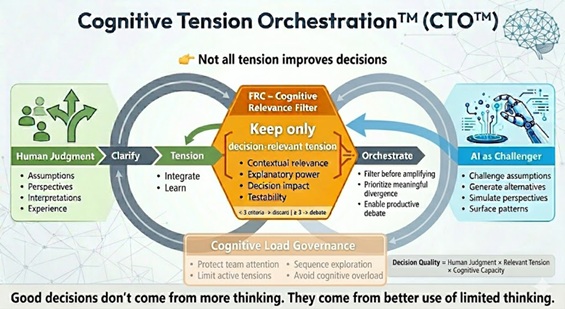 Why Better Decisions Don’t Come from More Thinking
1. The Illusion of Better Thinking
Most organizations believe that better decisions come from:
- More data
- More analysis
- More discussion
On the surface, this seems reasonable.
In practice, it often produces the opposite:
- Analysis paralysis
- Premature alignment
- Unchallenged assumptions
- Decisions that feel right, but fail under pressure
The issue is not lack of thinking.
It is
unstructured thinking under cognitive constraints.
2. The Hidden Problem: Decision Quality Is a Cognitive System
Every decision operates under three constraints:
- Bounded rationality – we cannot process everything
- Cognitive load – attention and energy are limited
- Social dynamics – alignment often replaces exploration
As Herbert Simon showed, humans do not optimize. They satisfice.
As Daniel Kahneman demonstrated, we are systematically biased.
And as Amy Edmondson observed, teams often suppress disagreement even when they claim to value it.
The result:
We don’t fail because we don’t think.
We fail because we don’t
govern how we think.
3. The Missing Layer: Structured Cognitive Tension
High-quality decisions require something uncomfortable:
Cognitive tensionNot conflict.
Not noise.
But structured divergence between:
- Assumptions
- Interpretations
- Perspectives
Without tension:
- Teams converge too early
- Risks remain invisible
- Decisions feel clean but are fragile
With unmanaged tension:
- Discussions become chaotic
- Cognitive overload increases
- Decision quality degrades
The problem is not tension.
The problem is
lack of orchestration.
4. Introducing Cognitive Tension Orchestration™ (CTO)
Cognitive Tension Orchestration™ is a framework designed to:
Generate, filter, and integrate cognitive tension
Under real-world cognitive limits
With ai as a structured challenger
Its purpose is simple:
Improve decision quality without delegating judgment5. The Core Mechanism
At its core, CTO™ operates through a structured loop:
Clarify → Tension → Filter → Orchestrate → Integrate → Learn5.1 Clarify
Make assumptions visible
- What do we believe is true?
- What are we taking for granted?
5.2 Tension (AI-enabled)
Introduce structured challenge
- Generate alternative scenarios
- Expose inconsistencies
- Simulate missing perspectives
AI does not decide.
It
expands the space of thinking.
5.3 Filter – The Critical Step
Not all tension improves decisions.
This is where most teams fail.
The
Cognitive Relevance Filter (FRC) ensures only meaningful tension is explored:
- Is it contextually relevant?
- Does it improve explanation?
- Can it impact the decision?
- Is it testable?
If not, it is noise.
5.4 Orchestrate
Turn tension into productive dialogue
- Filter before amplifying
- Prioritize meaningful divergence
- Enable structured exploration
5.5 Integrate
Synthesize before deciding
- What changed?
- What remains valid?
- What trade-offs are explicit?
5.6 Learn
Close the loop
- What did we miss?
- What was useful vs noise?
- How do we improve next time?
6. The Often-Ignored Constraint: Cognitive Capacity
Even relevant tension has a cost.
Thinking consumes energy.
Attention is finite.
This introduces a second critical layer:
Cognitive Load Governance
- Protect team attention
- Limit active tensions
- Sequence exploration
- Avoid overload
Because:
More thinking ≠ better thinking7. The Decision Formula
At a structural level:
Decision Quality = Human Judgment × Relevant Tension × Cognitive CapacityIf any of these collapse, decision quality collapses.
8. Real-World Example 1
Strategic Investment DecisionA leadership team evaluates entering a new market.
Typical approach- Market Data
- Financial Projections
- Executive Discussion
Outcome:
Fast alignment
Hidden risks ignored
CTO™ approachClarify “We assume demand will scale quickly.”
Tension (AI)- Scenario Where Adoption Is Delayed
- Competitor Response Simulation
- Regulatory Constraint Exposure
Filter- Discard Generic Risks
- Focus On Regulatory Delay And Competitor Reaction
Orchestrate- Structured Debate Around Two Critical Tensions
Integrate- Phased Entry Strategy Instead Of Full Rollout
Learn- Refine Assumptions For Future Expansions
Result:Not a safer decision.
A
more conscious decision.
9. Real-World Example 2
Project Risk ReviewA project team reviews risks in a complex delivery.
Typical outcome- Risk Register Updated
- No Real Shift In Thinking
CTO™ approachTension (AI)- Highlights Patterns From Past Failed Projects
- Simulates Stakeholder Misalignment
Filter- Removes Low-Impact Risks
- Focuses On Coordination Breakdown
Orchestrate- Forces Discussion On Uncomfortable Issues
Integrate- Governance Structure Adjusted
Learn- Embed Lessons Into Future Reviews
Result:Risk management becomes
decision-shaping, not documentation.
10. Integration with RCPCV™
In the RCPCV™ decision cycle:
Recolher → Consultar →
Pensar/Decidir → Comunicar → Verificar
CTO™ operates inside
Pensar:
Structuring how thinking happens before the decision
This transforms:
- Thinking from implicit → explicit
- Discussion from reactive → structured
- Decision from intuitive → conscious
11. What This Changes
This is not a framework about AI.
It is about:
Decision quality under constraintIt changes four things:
- AI stops being a source of answers
- → becomes a generator of better questions
- disagreement stops being a risk
- → becomes structured input
- thinking stops being unlimited
- → becomes governed
- culture stops being about “Getting Along”
- → becomes about “Thinking Better Together”
12. Final Insight
Good decisions don’t come from more thinking.
They come from:
Better use of limited thinking
Structured tension
Conscious integration
And ultimately:
Human responsibility for the final choiceClosing Line
Do not automate judgment.Orchestrate thinking. Decide consciously.
Posted on: April 10, 2026 09:30 AM |
Permalink
Comments (1)
Please login or join to subscribe to this item
I’ve seen this play out in product decisions, more data doesn’t always mean better outcomes. Structured challenge and conscious integration make all the difference. This framework captures that well.
Please Login/Register to leave a comment.
|
"If you would be a real seeker after truth, it is necessary that at least once in your life you doubt, as far as possible, all things."
- Rene Descartes
|




