Connections Matter


| The environment around us changes rapidly. Intellectually we know this, yet often the understanding stops short of personal impact. Over the past few weeks we have experienced change at an unprecedented pace that leaves many of us bewildered, anxious, and even fatigued. The coronavirus outbreak has provided an unwanted opportunity to experience the difference between intellectually understanding change and feeling the impact at organizational and personal levels. The impacts of this new environment vary widely. As we begin to take preventative measures, one of the recommendations is to limit our human interaction. This precaution means that we are faced with an important question: How do we keep our connections to each other and the broader world we live in? Do we:
Offered below are a few organizational and personal actions to help navigate this difficult and disorienting time. ORGANIZATIONAL ACTIONS
PERSONAL ACTIONS
Looking at the glass as half full, we have a forced opportunity for solitude and reflection on the deep introspective stage of transition and change, healing, and energy renewal. Making small changes to the way we choose to connect with those around us may be just what we need to thrive.
|

Corona: Reducing Team Uncertainty
| Welcome to my second blog on dealing with Corona Uncertainty. The message in my first blog was clear We need Thinking brains online for high quality decision making. This means learning to contain anxiety so we don't get caught up in Project Stress Cycles. With Thinking Brains online we can have informed discussions and take high quality decisions about how to proceed. In this blog, I'm offering a tool to facilitate your discussions and decision making. This tool is designed to help keep your Thinking Brains online because it allows you to talk explicitly about uncertainty. Yes, you read that right! It's a tool for talking about uncertainty - not risk. The case for talking about uncertainty Project Managers love a business case - here's mine.
I unpacked the differences between risk and uncertainty with help from Elmer Kutsch and colleagues in Project Delivery, Uncertainty and Neuroscience [1]
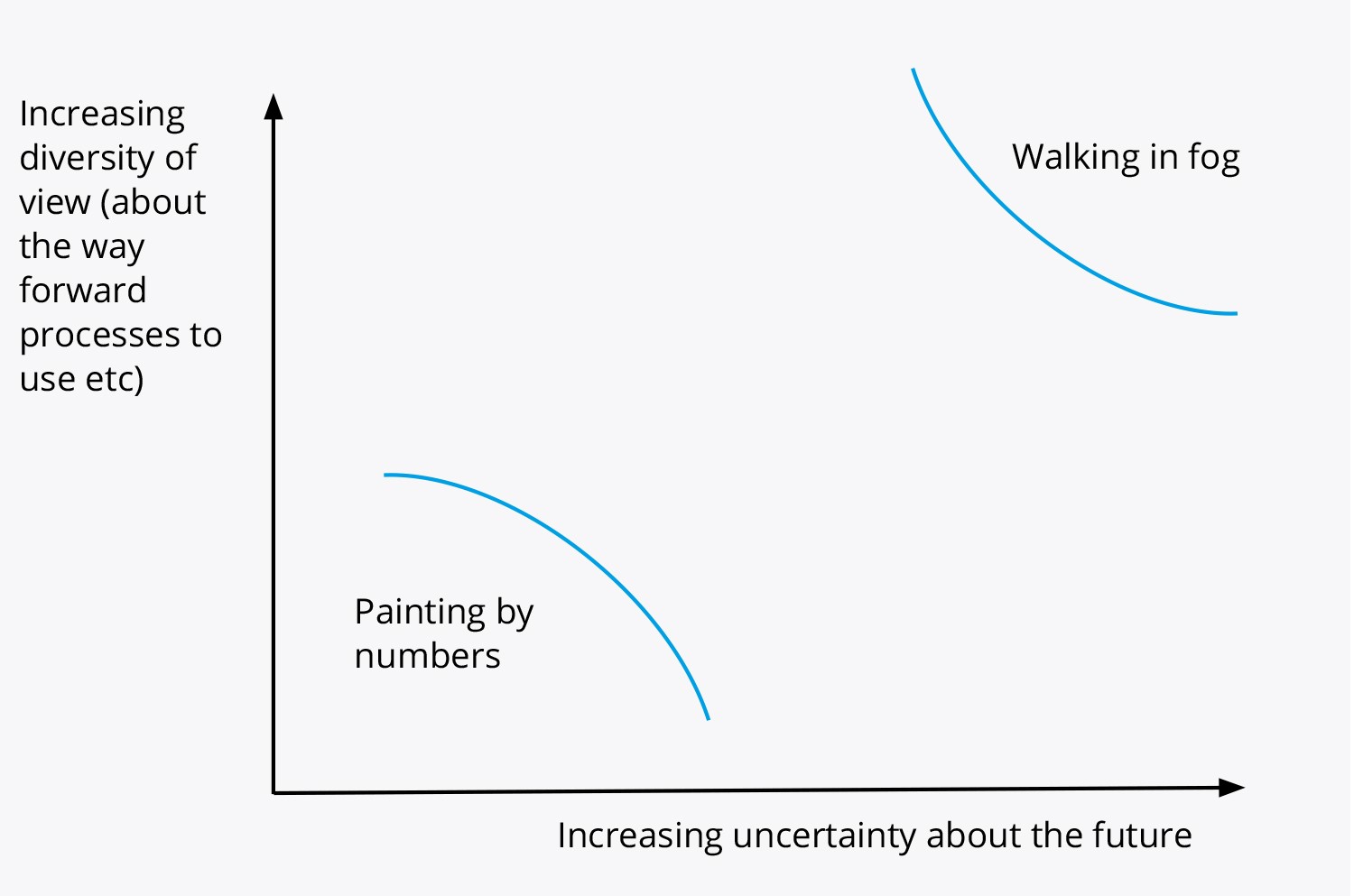
Corona is an uncertainty that has come to pass and it's bringing many more in its wake. We can't manage the risks away - no matter how much we want to! We simply don't have the past experience to draw on. Sticking our heads in the sand or pretending we can manage the risks away doesn't work. It doesn't contain anxiety - people can see straight through it - as our politicians are discovering. The only way to proceed is by being transparent and talking about uncertainty. Doing so reduces social threat and social contagion. When you use the tool below, talking about uncertainty it is quite straightforward. You'll find it makes a huge difference. Tool for Exploring UncertaintyMy tool is based on Eddie Obeng’s project typology and Ralph Stacey’s work on complexity
Source: Project Delivery, Uncertainty and Neuroscience © Visible Dynamics Try it now in three steps. Go on. Step 1 Use the graph to plot where you are today with a project to deliver and Corona looming. Put a cross in the top right if you feel like you’re Walking in Fog (very uncertain with little agreement on the way forward ). Put it in the bottom left if it’s more like Painting by Numbers (you know the kids’s game – where there's a clear outline and you just have to add the colours to make the picture) Step 2 Forget about Corona, think about your personal preferences. Where do you usually feel most comfortable? Top right, bottom left, somewhere in the middle? Step 3 What does this tell you about yourself and the impact of Corona Uncertainty on you and your Thinking Brain? I’m guessing that most of us are in the top right. I’m also guessing that it's a pretty uncomfortable place to be - even for those of us who like fog and are drawn to uncertainty. And I’m curious, what is it like to have these labels and to be explicit about your response to uncertainty? In my experience these labels help us make sense of uncertainty. They provide great clarity and help to bring our Thinking Brains online. Add to this the knowledge that Walking in Fog needs a completely different approach to Painting by Numbers and you have a way forward. Walking in Fog needs a completely different approach When you’re Walking in Fog the best approach is to set out to explore and understand the uncertainty. You make progress by explicitly exploring the terrain, aiming to put stakes in the ground as you gain clarity, and making informed decisions about where to look next to reduce the uncertainty further. Working in this way, you eventually develop enough experience of the terrain to make realistic risk assessments. When you reach this point it’s appropriate to adopt more traditional approaches to project planning and risk management. You can start Painting by Numbers. TAKEAWAYSThere is no way of escaping the fog! Pretending it’s not foggy, or confusing risk and uncertainty leads to all kinds of problems. If you don’t want to get caught out (and this applies to starting a new project or taking over an existing one) as well as responding to Corona:
And tell me how you get on! Other Blogs in this Series
References[1] Osterweil, C (2019) Project Delivery, Uncertainty and Neuroscience – a Leader’s Guide to Walking in Fog, London: Visible Dynamics |
Corona - Reducing Personal Uncertainty
| “It’s nuts. We’re in freefall. Business has dropped by 30% overnight. We’ve never seen anything like it. We don’t know if we’ll be here in 2 weeks”. This client, like many of us in the early days of the Corona outbreak, is in a spin. How can he deal with the uncertainty? It’s tempting to turn very British and tell him to Keep Calm and Carry On. But he, like many others needs more than that. In this, and the next blog of the series, I’ll be answering his question. How? By offering a route for containing anxiety and a tool for dealing with uncertainty so that you can be confident in the quality of your decision making and avoid getting caught up in a Project Stress Cycle. My recommendations build on the foundations set out in my previous blog SCARF a Brain–based Model for Managing People on Projects. If you have read that blog you will know
For high quality decisions we need our Thinking Brains online. With Corona dominating everything around us, our challenge is to get our Thinking Brains online and to keep them there.
How do we get our Thinking Brains online? Part of the answer is to label accurately how you are feeling. Now I may have trained in psychotherapy, but I am not going to put you on the couch or suggest you do lots of touchy-feely stuff! Instead, I’m offering you a Brain Hack for dealing with anxiety BRAIN HACKJudson Brewer a psychiatrist writing in the New York Times about the Corona virus, anxiety and social contagion (the fact that other people, seeing we are anxious, begin to feel anxious too), suggests this brain hack [1]. “To hack our brains and break the anxiety cycle, we need to become aware of two things: that we are getting anxious or panicking and what the result is. This helps us see if our behavior is actually helping us survive, or in fact moving us in the opposite direction — panic can lead to impulsive behaviors that are dangerous... Once we are aware of how unrewarding anxiety is, we can then deliberately bring in the “bigger better offer.” Since our brains will choose more rewarding behaviors simply because they feel better, we can practice replacing old habitual behaviors — such as worry — with those that are naturally more rewarding. For example, if we notice that we have a habit of touching our face, we can be on the lookout for when we act that behavior out. For example:
THE HACK SEQUENCELet me summarise the sequence for you
Neuroscience research tells us that this sequence helps to bring our Thinking brain online. It's a sequence I've used frequently in my coaching over the last five years. Clients are typically delighted with the clarity it brings to their decision making. They are often surprised too. Surprised because many of them had previously dismissed any suggestion of focusing on their breath/ feelings' as new age nonsense! I used to do the same. In fact, like many of my clients, when feeling anxious my reflex response used to be to ignore it - I'd carry on regardless. I didn't understand that my anxiety would leak out anyway, and other people would pick it up at a subconscious level. My anxiety would add to their anxiety levels and impact their decision making too. Learning to keep our Thinking brain online is a core skill Learning to keep our Thinking brain online is a core skill for every project professional. Using this sequence may fell clunky at first - in that respect it's just like learning any other skill. Persevere with it and teach it your families, colleagues and friends. Corona virus is unlike any challenge we've faced before. Dealing with it well requires us to contain anxiety and to keep our Thinking brains online. Do this and we can be confident of making informed decisions about what's required and how to behave. BLOGS IN THIS SERIES
and coming soon
REFERENCES [1] https://www.nytimes.com/2020/03/13/well/mind/a-brain-hack-to-break-the-coronavirus-anxiety-cycle.html A Brain Hack to Break the Coronavirus Anxiety Cycle, Judson A. Brewer, M.D. accessed March 14 Photo by Viktor Forgacs on Unsplash |

Social Intelligence for the Project Manager
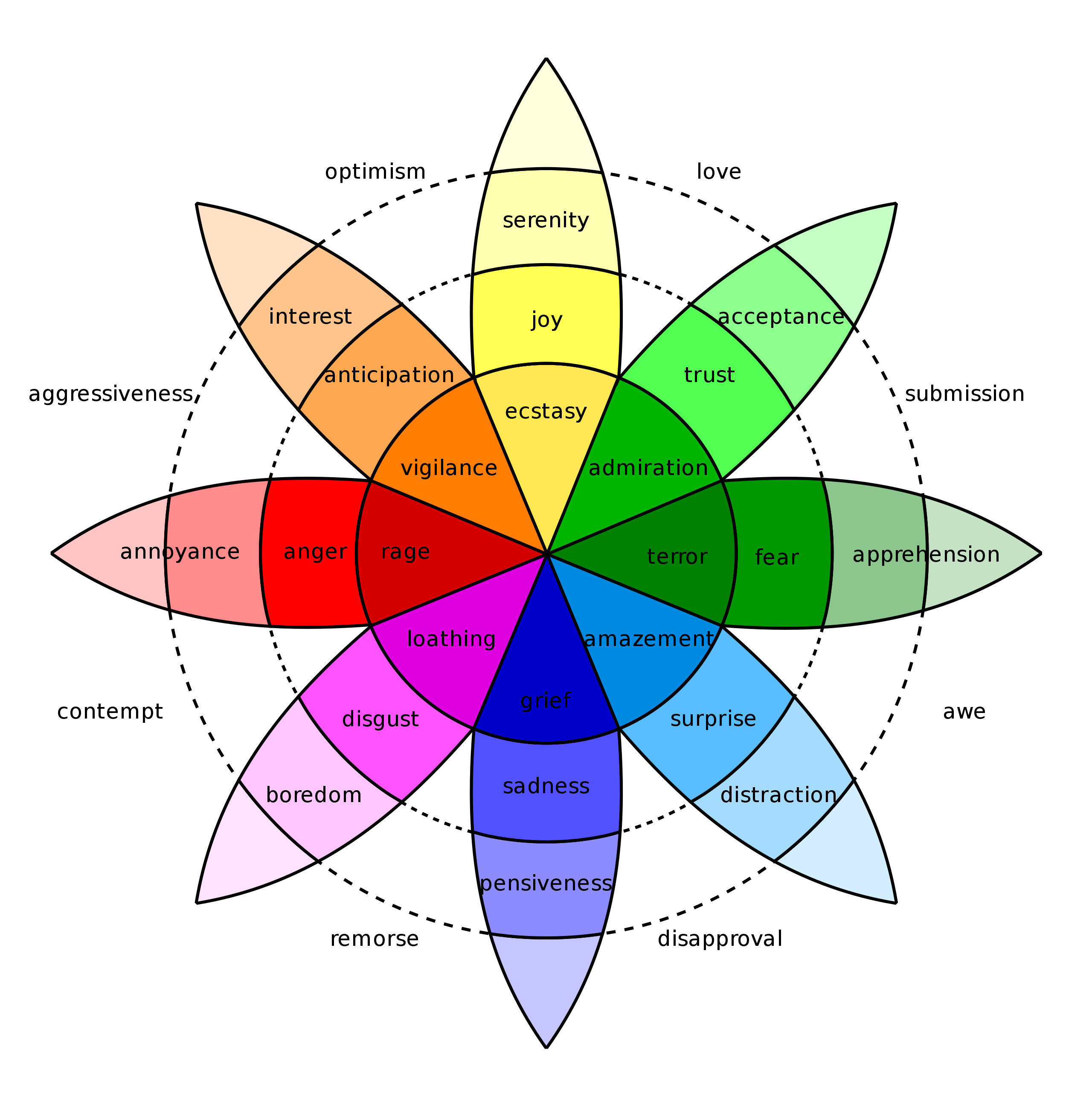
| Originally, I was going to share the results of some of my research on project managers, and some ways to close the gap on this critical business and team strength. Suffice to say, we, as a group, do not score high in social intelligence. We seem to show more perseverance and prudence. And when it comes to understanding and reading others, we are not necessarily as comfortable as others are. In these difficult times though, let’s look at social intelligence from a different perspective. We ALL need it – along with emotional intelligence (awareness of emotions and the ability to manage our emotions). Alexithymia is the inability to identify and describe emotions. Let’s face it, most of us are not taught to recognize and name our emotions and, in the West at least, it is common to “stuff” them. We want to push away emotions that are uncomfortable or that we perceive as “bad”. We rarely pause and take stock of our emotions and are even less likely to describe them to others. Until one day our emotions take over our behavior! So I encourage everyone to practice naming their emotions - see below for a tool to help! Starting with us: Emotional IntelligenceToday I was listening in on a coaching session and the client – we will call her Amy – wanted to explore ways of decompressing and building resilience during these difficult times. She asked her coach for suggestions, and what followed was a process of the coach helping the client to explore what already helps her reset. She identified being in nature (research shows this is a huge de-stressor), exercising, meditating, reading poetry and planning wonderful trips in the future as ways she can change her emotions from ones that seem to drain energy to ones that help her to feel more Zest, Hope and enthusiasm. In the course of the hour – one that she had considered canceling – she not only identified rejuvenating practices but EXPERIENCED them. At the end of the hour she commented on how important it had been for her to keep the appointment and she made the following observations: In the face of stress, we often cancel the things that rejuvenate us FIRST in order to claw back time. We cancel the yoga practice, our meditation, that virtual cup of coffee with a friend, our walk outside, or our coaching session. What Amy said at the end was “I want to make a note of how this feels. It is the best way I could spend this hour. I have identified practices that I will use to help myself and in this moment my head feels clearer and I feel calmer and more optimistic than when we started.” What does this have to do with Alexithymia – one of the things we often forget to do is CHECK-IN with ourselves. As project managers, we are constantly transitioning – moving from a team meeting to a meeting with frustrated stakeholders, to a briefing with the project sponsor and then to our desks to update reports and statuses. Each encounter generates a response in us and if we don’t take stock, name our emotions, acknowledge them without judgment and then mindfully select the ones we want to leverage, we become overwhelmed and unfocused. This is often when we snap at people unexpectedly or fly off the handle at the smallest thing. I recommend using a tool such as Plutchik’s Wheel of Emotions. Pause for 1 minute and think about where you just were and where you are going. Ask the following questions:
Don’t be surprised when conflicting emotions come up. We often have so-called “mixed feelings” about things or we can feel excited about one part of our lives and anxiety about another – all at the same time!
Expanding to others: Social IntelligenceHow do we expand this to those around us? After all, everyone could use a little help right now! A way I like to recommend is the SEA method:
I usually focus on VIA Character strengths when doing this. At the same time, it can be used for any kind of strength or skill. You might focus on the technical skills of the person; their character strengths of perspective, kindness, honesty, humor and more; you might focus on their behavior from being on time to offering help to someone who is struggling more than they; you might focus on their attitudes – always spreading hope and focusing on what we can do right now, or gratitude – focusing on what they DO have in this moment rather than what they are afraid of. So here are three questions for you to think about in this moment:
These three steps are the foundations of Social Intelligence!
1. https://commons.wikimedia.org/wiki/File:Plutchik-wheel.svg 2. Image by Sydney Rae on Unsplash |

Engaging Employees to Drive Success
|
“I told them once, didn’t they get it?”
These words will forever ring in my ears as a textbook example of an executive who doesn’t understand how to effectively lead change. The underlying issue facing this change: the leader failed to engage his front-line to successfully drive a major transformation. Ultimately it failed to produce the intended results.
From a front-line employee perspective:
Let’s turn these statements around. Effective leaders engage the front-line to help drive change. They do this by a), clearly articulating the purpose for the change, by b), helping employees understand how they will work differently, and c), enlist them as advocates for the change.
Purpose: A leader starts by clearly articulating clear purpose and benefits, and then relates these to the employees. Once employees understand how the purpose and benefits relate to them, they are more likely to embrace the change and support it. For the employees, this is the WIIFM, or “what’s in it for me.” When one of my clients implemented a large change, the leaders talked with employees about the benefits to the ultimate end-consumer of their products and services, and how different employee groups contributed to this larger result. As a result, the employees became advocates for the change.
Work differently: I don’t expect a CEO to define in detail how employees on the shop-floor might interact differently with each other because of a change. She will, however, speak broadly about how different departments are impacted by the change. She holds executives accountable to drive to deeper detail AND engages employees to help define and implement the changes in the work process.
Advocates: One of the most effective ways to drive a change is to engage the front-line as advocates for the change. One client actively engaged their front-line team to talk about the change with others inside and outside the function. This team, once beleaguered with low morale, started talking about the results of the change. Early on when formal statistics weren’t yet available, these employees described how “things felt better,” because of senior leader action. Later the formal measures proved that “things” improved significantly with lower attrition and higher engagement.
A 2012 Gallup report said this: “People have emotional needs, and if they are not attended to, the result is subpar performance and increased turnover. Even the best processes and systems are inefficient if the people who run them aren't emotionally invested in the outcome. To drive performance, organizations must engage their employees.” I completely agree.
Call to action:
Strong leaders say front-line involvement is one of the most impactful elements for them because it launches significant buy-in and acceptance, which in turn helps them exceed profitability expectations. Who wouldn’t want that?
|