
The Delegation Boundary


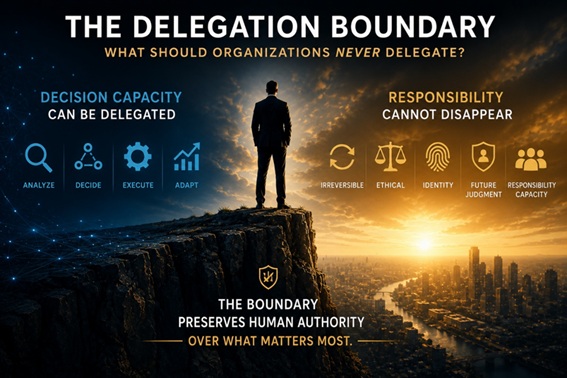 What Should Organizations Never Delegate? Artificial intelligence is making delegation easier than ever. Organizations can increasingly delegate: Analysis. Prioritization. Recommendation. Coordination. Execution. Monitoring. Adaptation. And, increasingly, decision-making itself. The technical question is rapidly becoming simpler. Can the system do it? More often, the answer will be yes. AI systems will become capable of making decisions faster than humans. Across more variables. Across larger systems. With greater consistency. At lower marginal cost. And without fatigue. But technical capability does not resolve the deeper governance question. Should the decision be delegated? These are not the same question. And the distance between them may become one of the most important governance problems of AI-native organizations. Because autonomy creates value precisely by reducing the need for continuous human intervention. If every automated decision requires human approval, autonomy becomes little more than accelerated recommendation. The promise of autonomous systems lies in their capacity to act. To respond. To coordinate. To adapt. Without waiting for a human decision at every step. This is enormously valuable. But it also means that organizations must determine something they have rarely had to define explicitly. Where should autonomy stop? For most of organizational history, delegation boundaries were primarily human boundaries. A board delegated authority to executives. Executives delegated to managers. Managers delegated to teams. Authority moved through organizational structures. The person receiving authority was expected to exercise judgment within a defined domain. The architecture was imperfect. But it contained an important assumption. The recipient of delegated authority could understand the responsibility being received. AI changes this assumption. An intelligent system may exercise decision capacity without experiencing responsibility. It may optimize across alternatives. Evaluate probabilities. Apply policies. Adapt to feedback. Select actions. But the fact that a system can select an action does not mean that the organization can legitimately delegate every kind of decision to it. This is where the delegation boundary begins. Not every decision that can be automated should be delegated. The difficulty lies in determining why. A common answer is risk. High-risk decisions require human oversight. Low-risk decisions can be automated. This distinction is useful. But insufficient. Because risk is only one dimension of delegation. The deeper question is not merely: How likely is the system to be wrong? It is also: What kind of authority is being exercised, and what does its consequence change? Some decisions matter not because their probability of failure is high. They matter because of the nature of the consequence they create. Consider reversibility. A system adjusts inventory allocation. The decision can be corrected. Resources can be reassigned. The consequences are limited. The organization can learn and adapt. Now consider an irreversible decision. A life-changing medical intervention. The permanent exclusion of an individual from an opportunity. The destruction of a critical asset. The disclosure of information that cannot be recovered. The consequences cannot simply be undone. The decision may be analytically excellent. But irreversibility changes the governance requirement. The harder a consequence is to reverse, the stronger the case for preserving meaningful human judgment before commitment. But reversibility is still not enough. Some decisions are ethically significant. They determine how competing interests are weighed. Whose harm is considered acceptable. Whose rights receive priority. Which trade-offs an organization is willing to defend. An AI system may analyze these tensions. It may model consequences. It may reveal inconsistencies. It may even generate sophisticated ethical arguments. But ethical decisions are not merely problems of analytical resolution. They are acts of responsibility. Someone must remain answerable for the values expressed through the choice. This creates another boundary. Organizations should be cautious about delegating decisions whose legitimacy depends on the ability to answer for the values they enact. There are also identity decisions. Every organization possesses, explicitly or implicitly, an understanding of what it is. What it exists to do. What it refuses to become. Which principles define its continuity. Which relationships deserve protection. These questions may not appear operational. Yet they shape thousands of operational decisions. A system can optimize strategy. Recommend restructuring. Reallocate resources. Redesign customer interactions. Modify workforce composition. Accelerate transformation. But some choices gradually redefine the organization itself. The danger is subtle. No single decision announces: We are changing who we are. Instead, identity shifts through accumulation. A policy changes. A threshold moves. A relationship becomes transactional. A capability is removed. A human judgment becomes an automated default. Each choice appears reasonable. Together, they alter the organization. This is why identity creates a distinct delegation problem. Can an organization delegate decisions that gradually determine what the organization is becoming? The question becomes even more difficult with existential decisions. Decisions that affect whether the organization continues. Whether it abandons a market. Whether it accepts systemic risk. Whether it fundamentally changes its purpose. Whether it transfers control over critical capabilities. Whether it creates consequences that threaten its own continuity. These decisions are rare. But their significance is disproportionate. They do not merely optimize within the existing system. They determine whether the system, in its current form, continues to exist. At this level, delegation becomes more than an operational choice. It becomes a question of sovereignty. Because a sovereign organization must retain some meaningful authority over the conditions of its own continuity. Taken together, these distinctions suggest that the delegation boundary cannot be defined by a single threshold. Not merely risk. Not merely monetary value. Not merely confidence scores. Not merely regulatory classification. The boundary must consider the nature of the authority being delegated and the consequences that authority is capable of creating. How reversible is the consequence? How ethically significant is the trade-off? How deeply does the decision affect organizational identity? How much does it influence the conditions of future judgment? Could the decision alter the organization's capacity to remain responsible for what follows? That final question deserves particular attention. Because the most consequential delegation may not be the decision with the largest immediate impact. It may be the delegation that changes the organization's future capacity to understand, challenge, or remain meaningfully responsible for what happens next. A system may perform exceptionally well. Its recommendations become trusted. Its decisions become defaults. Human intervention declines. Skills weaken through disuse. Operational dependence deepens. And gradually, the organization becomes less capable of independently reconstructing why the system acts as it does. Formal responsibility may remain exactly where it was. But the capacity to exercise that responsibility may already be changing. This reveals a deeper problem. The most consequential delegation may be the one that changes the organization's future capacity to exercise responsibility. Consider a system authorized to optimize customer service. Initially, it recommends responses. Then it handles routine interactions. Then it adapts communication strategies. Then it prioritizes customers. Then it determines which cases deserve human attention. At what point did the organization delegate a consequential decision? There may be no single moment. The boundary moved through accumulation. No board necessarily approved a new constitutional distribution of authority. No executive necessarily declared that the system should determine which customers deserve human attention. Each expansion may have emerged from operational success. A useful recommendation became a trusted default. A trusted default became automated practice. Automated practice expanded into adjacent decisions. And the delegation boundary migrated. A delegation boundary may move through operational success without an explicit decision to redistribute authority. This is why delegation cannot be governed only at the point of initial authorization. Autonomy evolves. Systems learn. Workflows change. Dependencies deepen. Human skills may weaken through disuse. Exceptions become normalized. And authority expands through operational success. A delegation boundary that was legitimate yesterday may become insufficient tomorrow. This is one of the defining challenges of adaptive systems. The question is not merely: What authority did we delegate? It is also: What has the system gradually become capable of determining because of that delegation? This requires organizations to think differently about autonomy. Delegation should not be treated as a binary choice. Human or machine. Manual or automated. Approved or prohibited. Autonomy exists across domains. Across levels of consequence. Across degrees of reversibility. Across different forms of influence. A system may be free to optimize execution while prohibited from redefining objectives. It may recommend ethical trade-offs while lacking authority to commit the organization to them. It may adapt processes while remaining unable to alter foundational constraints. It may coordinate resources while lacking authority to determine which human interests are expendable. It may act autonomously while remaining unable to expand its own domain of autonomy. This is the essence of a meaningful delegation boundary. The purpose of the boundary is not to prevent autonomy. It is to preserve legitimate authority over the consequences autonomy is allowed to create. And this distinction becomes increasingly important under competitive pressure. Organizations will be tempted to move boundaries. A human review takes time. An escalation creates friction. A constraint reduces optimization. A prohibited action limits system performance. Competitors move faster. The system performs well. The obvious question becomes: Why not delegate more? Sometimes, the correct answer will be: We should. But mature governance must also remain capable of saying: Because this decision changes something we are not willing to let optimization determine for us. This is not resistance to technology. It is not nostalgia for human control. It is not the assumption that humans always decide better. Humans make poor decisions. Humans carry bias. Humans overlook evidence. Humans fail ethically. The case for delegation boundaries cannot depend on human infallibility. It depends on something else. Responsibility requires that some forms of authority remain connected to a legitimate capacity to answer for consequence. AI can expand decision capacity. It can improve judgment. It can challenge assumptions. It can expose blind spots. It can make organizations extraordinarily more capable. But capability alone does not create legitimacy. And technical competence does not determine the rightful scope of delegated authority. That remains a governance responsibility. The future of AI-native organizations will therefore depend not only on how effectively they delegate. It will depend on how intelligently they define, observe, and reconsider the limits of delegation. Because the most important question may no longer be: What can AI decide? It may be: What authority are we no longer willing to surrender simply because a system has become capable of exercising it? Human sovereignty requires more than retaining responsibility in principle. It requires boundaries around delegation in practice. Because autonomy without boundaries can gradually redistribute authority faster than organizations redistribute responsibility. And when authority becomes distributed while responsibility becomes fragmented, another problem emerges. What happens when everyone influences the decision, but no one truly owns the consequence? |
Posted on: July 22, 2026 04:25 AM
| Permalink |
Comments (1)


