


Beyond Habits: Designing Systems That Make Conscious Leadership Inevitable


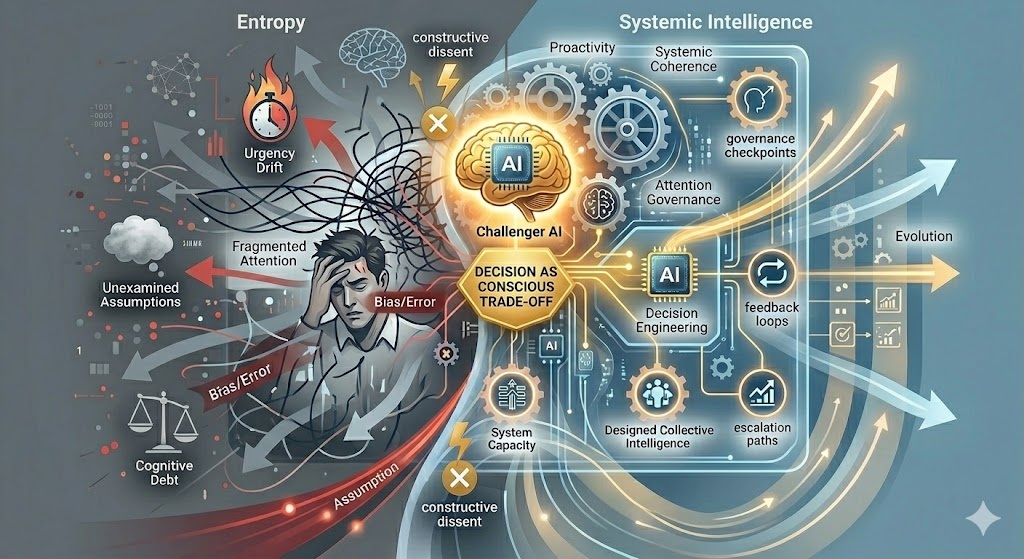 For decades, the work of Stephen R. Covey has shaped how we understand leadership. Be proactive. Begin with the end in mind. Put first things first. These principles remain powerful. But they were designed for individuals. Projects, however, do not fail at the level of intention. They fail at the level of system design. Teams know what they should do. Leaders understand what matters. Yet under pressure, urgency takes over, assumptions go unchallenged, and attention drifts. The problem is not awareness. It is architecture. The real question is no longer whether individuals can practice good habits. It is whether the system makes those habits possible under real conditions. From Personal Discipline to System Design In complex project environments, behavior does not operate in isolation. It is shaped by: Decision structures Governance mechanisms Attention constraints Power dynamics Cognitive load Under these forces, even the most capable professionals revert to what the system rewards. Speed over reflection. Alignment over thinking. Execution over understanding. This is why leadership cannot rely solely on personal discipline. It must be embedded in the design of the system itself. Revisiting Covey’s seven habits through this lens reveals a critical shift: From habits we try to practice to conditions we deliberately design. Habit 1 – Be Proactive From Individual Choice to Decision Architecture Proactivity is often understood as personal responsibility. The ability to choose a response rather than react. But in project environments, reaction is frequently systemic. Constant interruptions. Escalation pressure. Compressed timelines. Without structural space, there is no real “space between stimulus and response.” There is another force at play. Fear. In systems where mistakes are penalized, where questioning delays progress, and where escalation carries risk, people do not choose freely. They protect themselves. Under these conditions, reactivity is not a failure of discipline. It is a rational response to the system. Proactivity therefore cannot depend only on individual will. It must be supported by an environment that makes exploration safe. Systems that enable proactivity: Create structured pauses before irreversible decisions Require evidence before escalation Integrate consultation as part of decision flow Use AI not to confirm thinking, but to challenge it De-penalize intelligent experimentation and early questioning Proactivity becomes real when the system protects not only the space to think, but the safety to act consciously within it. Habit 2 – Begin with the End in Mind From Vision to Systemic Coherence Defining purpose is not difficult. Maintaining it is. Most projects begin aligned. They drift over time. Not because people forget the vision. But because the system does not continuously reconnect execution to purpose. Systemic coherence requires more than a kickoff alignment session. It requires architecture. Systems that sustain purpose: Continuously validate whether execution still serves the original intent Revisit success criteria as conditions evolve Integrate learning loops into governance Make alignment a dynamic process, not a one-time declaration Vision is not a statement. It is a continuously governed reference point. Habit 3 – Put First Things First From Time Management to Attention Governance The core challenge in projects is not lack of time. It is fragmentation of attention. Urgency expands to fill all available capacity. Prevention is postponed. Reflection disappears. Teams work harder. Value erodes. Managing priorities is therefore not about scheduling tasks. It is about governing attention. Systems that protect what matters: Allocate explicit capacity for planning, learning and prevention Introduce strategic slack to absorb variability Measure how attention is spent, not only what is delivered Treat energy and cognitive load as risk factors Execution discipline is not personal productivity. It is a governance choice. Habit 4 – Think Win-Win From Mindset to Decision Engineering Win-Win is often framed as a moral principle. A commitment to mutual benefit. In real projects, however, decisions occur under constraint: Power asymmetry Limited resources Competing priorities In these conditions, Win-Win does not emerge from goodwill. It must be engineered. Systems that enable balanced decisions: Make trade-offs explicit rather than implicit Quantify impact across schedule, cost and value Surface underlying interests instead of positions Define clear alternatives, including fallback scenarios Win-Win is not about avoiding tension. It is about structuring it productively. Habit 5 – Seek First to Understand From Communication Skill to Cognitive Risk Management Listening is often treated as a soft skill. In reality, it is a primary mechanism for reducing cognitive risk. Projects are shaped by assumptions. Most of them remain implicit. Unexamined assumptions become structural errors. Every misunderstanding today becomes a correction tomorrow. This is the accumulation of cognitive debt, the hidden cost of decisions made on incomplete or misaligned understanding. Like financial debt, it compounds. The longer it remains unaddressed, the more expensive it becomes to correct. Listening deeply reveals: Hidden expectations Divergent interpretations Unspoken constraints Conflicting mental models Systems that institutionalize understanding: Validate stakeholder interpretation before committing execution Create structured spaces for surfacing assumptions Treat divergence as a signal, not a disruption Integrate listening into governance, not only into conversation Understanding is not courtesy. It is alignment infrastructure. And when neglected, it becomes one of the most expensive liabilities a project can carry. Habit 6 – Synergize From Collaboration to Designed Collective Intelligence Collaboration is often encouraged. But rarely designed. Without structure, teams default to coordination. They share updates. They align tasks. They converge quickly. But they do not think together. Synergy requires more than cooperation. It requires constructive tension. Systems that enable collective intelligence: Create forums where ideas are explored before decisions are made Distinguish cognitive conflict from personal conflict Protect dissent as part of the process Use AI as a cognitive challenger, not a confirmation tool Synergy is not harmony. It is structured divergence leading to better integration. Habit 7 – Sharpen the Saw From Personal Renewal to System Capacity Sustainable performance is not a function of effort. It is a function of capacity. Most project systems are designed for output. Few are designed for renewal. The result is predictable: Cognitive fatigue Declining decision quality Reduced learning Increasing rework Renewal must therefore move from intention to infrastructure. Systems that sustain performance: Embed learning loops into execution Protect time for reflection and improvement Monitor cognitive load and decision fatigue Align delivery pace with human sustainability Renewal is not a break from performance. It is what makes performance possible over time. The Shift That Changes Everything The original seven habits assume a human-centered environment, where individuals retain control over attention, decision pace, and cognitive space. Today, this assumption no longer holds. In AI-augmented, high-pressure systems, attention is fragmented, decisions are accelerated, and thinking is increasingly influenced by both human and machine inputs. Under these conditions, habits alone are insufficient. They must be embedded in the architecture of how decisions are made. The seven habits remain valid. But they are incomplete when treated as individual responsibility alone. In complex environments, behavior follows structure. If the system rewards speed, people will rush. If it rewards alignment, people will converge. If it penalizes questioning, people will stay silent. The real leverage point is not behavior. It is design. Final Reflection The future of project leadership does not depend on better intentions. It depends on better systems. Systems that: Protect attention Surface assumptions Enable constructive dissent Integrate human and artificial intelligence Sustain learning and capacity over time Because the real transformation is this: Not teaching individuals to act differently, but designing environments where better thinking becomes inevitable. And in that shift, leadership evolves: From personal discipline To systemic intelligence. |
Posted on: April 08, 2026 04:44 AM
| Permalink |
Comments (0)
Governing the Regenerative PMO
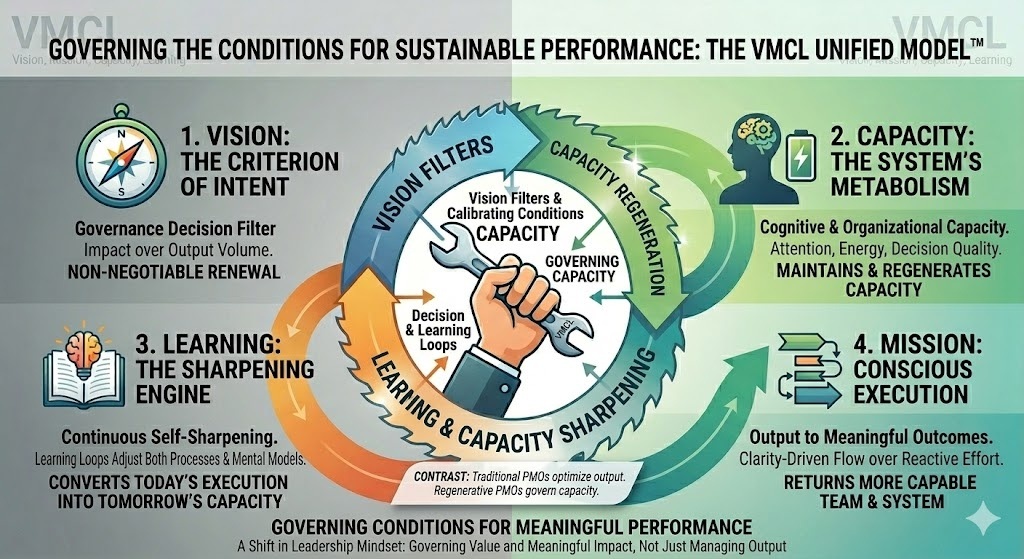 The VMCL Unified Model™ as a Systemic Architecture The Fallacy of the Infinite Saw Traditional project environments operate under a dangerous assumption: that execution alone drives performance. In reality, unrelenting execution pressure is often the very force that most rapidly destroys a system’s capacity to perform. When a Project Management Office (PMO) focuses obsessively on Mission (delivery) while neglecting Capacity, it ends up operating with a blunt saw. The result is systemic erosion: more effort for diminishing returns. The VMCL Unified Model™ transforms renewal from a mere "good intention" into a governed, strategic capability. 1. Vision: The Criterion of Intent In a regenerative system, Vision is not a static statement on a wall; it is a dynamic decision filter. It dictates the long-term direction and ensures that every tactical move serves the systemic whole. The Leadership Question: A regenerative leader moves beyond "When will it be done?" and asks: “Is this delivery expanding or eroding our ability to succeed in the next challenge?” 2. Capacity: The System’s Ability to Perform Capacity is the "steel" of the saw. It represents the system’s total metabolism, including human energy, attention, and decision quality. Continuous Maintenance: Most PMOs treat capacity as a static resource to be spent. A regenerative PMO treats it as a living asset. It doesn't just repair capacity after a breakdown; it continuously maintains and regenerates it as a core governance function. 3. Learning: The Sharpening Engine In the VMCL architecture, Learning is the mechanism through which the system sharpens itself. It is the feedback loop that prevents stagnation. Evolution over Repetition: Learning transforms today’s execution into tomorrow’s capacity. Without it, systems are doomed to repeat past efforts and errors; with it, the entire organization evolves its baseline of performance. 4. Mission: Conscious Execution When the saw is sharp, the nature of work changes. Mission is no longer a reactive race against the clock. Intentional Delivery: It becomes a deliberate flow, aligned with Vision and supported by a robust Capacity. This shift moves the organization from "output obsession" to "meaningful value creation." Conclusion: The Advantage of Deciding Better Sustainable performance is not a function of output volume. It is a function of how well a system preserves and develops its capacity to think, decide, and act over time. The real shift in modern leadership is moving from managing projects to governing the conditions that make meaningful and sustainable performance possible. By applying the VMCL Unified Model™, you aren't just finishing a project; you are returning to the organization a system that is more capable, more aware, and more resilient than before. |
Posted on: April 06, 2026 05:45 AM
| Permalink |
Comments (2)
The Regenerative PMO
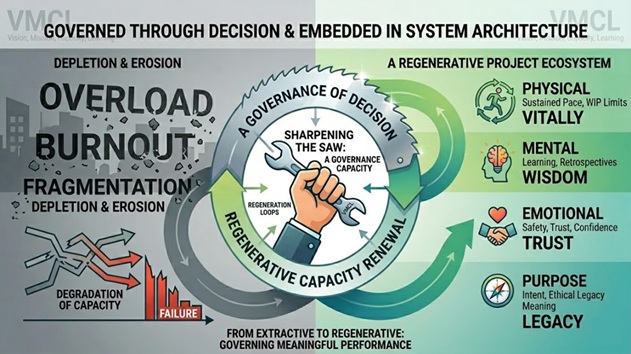 Operationalizing Renewal in Project Management “We don’t have time to sharpen the saw, we are too busy sawing.” This classic insight from Stephen R. Covey captures a trap that many Project Management Offices (PMOs) and project leaders have fallen into. In the relentless pursuit of deadlines and delivery, we overlook a critical reality: the most important tool in any project, people and their cognitive capacity, is constantly being depleted. Most PMOs are not designed to sustain performance. They are designed to maximize output. And in doing so, they often erode the very capacity they depend on. A PMO that ignores renewal is not efficient. It is a system of programmed obsolescence. To sustain high performance in an increasingly complex world, leadership must treat renewal not as a luxury, but as performance infrastructure. From Extractive to Regenerative PMOs Transitioning from an extractive model to a regenerative one requires a deliberate focus on four fundamental dimensions: 1. Physical Renewal: Sustainable Rhythm In a PMO context, physical renewal goes beyond ergonomics. It is about the health and flow of the work system itself. Approach: Implement Work In Progress limits. An overloaded system generates stress and wastes energy through constant context switching. Leadership Role: Enable managers to protect the team’s energy. This means creating space for focused work and ensuring that sustainable pace becomes as critical a success metric as delivery timelines. 2. Mental Renewal: Intellectual Capital The mind of a project is its accumulated knowledge. Without renewal, lessons learned become archived knowledge that no one uses. Approach: Institutionalize learning as part of the workflow. The PMO should act as a hub that continuously refreshes practices through communities of practice and meaningful retrospectives. Leadership Role: Stimulate critical thinking. Leaders must challenge managers to move beyond execution mode and reflect on the mental models shaping their decisions. 3. Emotional Renewal: Psychological Safety Projects are human systems. When trust breaks, collaboration collapses and invisible risk increases. Approach: Move beyond control-based metrics toward trust-based indicators. A regenerative PMO acts as a support and mentoring structure, not a policing function. Leadership Role: Develop emotional intelligence. Help leaders absorb stakeholder pressure without transferring it directly to the team, and create environments where mistakes become learning opportunities rather than sources of fear. 4. Purpose Renewal: Meaning and Ethics Purpose is what sustains teams through complexity and pressure. It is the dimension of meaning and integrity. Approach: Connect every deliverable to strategic intent and real impact. When teams do not understand the value of their work, execution becomes mechanical and motivation declines. Leadership Role: Support leaders in the search for meaning. Ask deeper questions:
To “sharpen the saw” in a PMO means recognizing that the sustainability of the project ecosystem is what enables consistent long-term results. Leaders who master these four dimensions move beyond task execution. They become regenerative leaders, capable of delivering exceptional value without degrading the system that produces it. The question for your PMO today is simple, yet profound:
If renewal is essential for sustainable performance, how do we ensure it does not depend on individual intent, but becomes embedded in the very architecture of how the system operates? |
Posted on: April 03, 2026 02:50 PM
| Permalink |
Comments (0)
Sharpen the Saw
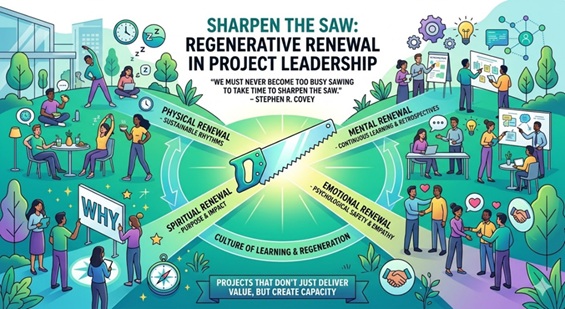 Regenerative Renewal in Project Leadership “We must never become too busy sawing to take time to sharpen the saw.” — Stephen R. Covey The Meaning Behind Renewal Habit 7 is the practice of continuous renewal of body, mind, heart, and spirit. It reminds us that sustainable performance depends on intentional regeneration. In project management, this translates to more than rest or efficiency; it’s about keeping our energy, purpose, and learning capacity alive, both individually and collectively. Projects are demanding. Deadlines, stakeholders, and uncertainty can wear down even the most capable teams. Without renewal, discipline becomes exhaustion; without reflection, execution becomes repetition. Regenerative Renewal in Project Contexts A regenerative project leader cultivates renewal as a strategic discipline:
Sharpening the Organizational Saw At the organizational level, Habit 7 means embedding learning and regeneration loops into the culture:
The Regenerative Lesson A project is not only a path to results. It’s also a mirror of how consciously we evolve while pursuing them. To “sharpen the saw” in project leadership means to treat renewal as performance infrastructure. But this raises a deeper question: If renewal is essential for sustainable performance, what does this mean for the way Project Management Offices are designed and operated? |
Posted on: April 01, 2026 02:27 AM
| Permalink |
Comments (2)
AI Should Not Be Your Assistant. It Should Be Your Greatest Challenge.
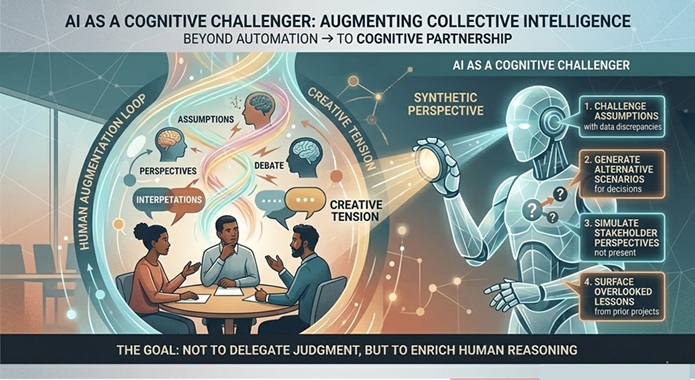 Most organizations are using AI to move faster. That is the mistake. AI does not improve thinking by accelerating execution. It improves thinking by challenging it. Without challenge, something dangerous happens: AI makes weak thinking scale. Faster decisions. More confidence. Same flawed assumptions. High-performing systems use AI differently:
But to stress-test them. This is not a tool issue. It is a system design issue. Do your systems:
The goal is not to delegate thinking. It is to elevate it. So the real question is: Does your system allow a different perspective to be voiced? “I see this differently.” If not, AI will not make you smarter. It will make you faster at being wrong. |
Posted on: March 30, 2026 02:36 AM
| Permalink |
Comments (1)


