Support to Develop
by Luis Branco

This blog addresses management-related topics and has three areas of focus: 1. Technical skills; 2. Competencies in the field of interpersonal relations and communication (including personal organization and delegation, leadership, teamwork, conflict resolution, conducting meetings, and negotiation); and 3. Strategy (including diagnosis, strategic guidelines, and implementation).4.Technology
Recent Posts
Regenerative Learning: Turning Experience into Organizational Capability
Delegation with Purpose: Building Autonomy and Developing Capability
RCPCV™: A Method for Decision-Making and Continuous Improvement
The Same Change Can Succeed and Fail at the Same Time
What Must Exist Even When No Single Role Owns the Whole?
Categories
Agile,
Career Development,
Career Development,
Career Development,
Career Development,
Career Development,
Career Development,
Career Development,
Career Development,
Career Development,
Career Development,
Career Development,
Career Development,
Career Development,
Career Development,
Career Development,
Career Development,
Career Development,
Career Development,
Career Development,
Career Development,
Career Development,
Career Development,
Career Development,
Career Development,
Career Development,
Career Development,
Career Development,
Career Development,
Career Development,
Career Development,
Career Development,
Career Development,
Career Development,
Career Development,
Career Development,
Career Development,
Career Development,
Career Development,
Career Development,
Career Development,
Career Development,
Career Development,
Career Development,
Career Development,
Career Development,
Career Development,
Career Development,
Career Development,
Career Development,
Career Development,
Career Development,
Career Development,
Career Development,
Career Development,
Career Development,
Career Development,
Career Development,
Career Development,
Career Development,
Career Development,
Career Development,
Career Development,
Career Development,
Career Development,
Career Development,
Career Development,
Career Development,
Career Development,
Career Development,
Career Development,
Career Development,
Career Development,
Career Development,
Career Development,
Career Development,
Career Development,
Career Development,
Career Development,
Career Development,
Career Development,
Career Development,
Career Development,
Career Development,
Career Development,
Career Development,
Career Development,
Career Development,
Career Development,
Career Development,
Career Development,
Career Development,
Career Development,
Career Development,
Career Development,
Career Development,
Career Development,
Career Development,
Career Development,
Career Development,
Career Development,
Career Development,
Career Development,
Career Development,
Career Development,
Career Development,
Career Development,
Career Development,
Career Development,
Career Development,
Career Development,
Career Development,
Career Development,
Career Development,
Career Development,
Career Development,
Career Development,
Career Development,
Career Development,
Career Development,
Career Development,
Career Development,
Career Development,
Education,
Governance,
Governance,
Governance,
Governance,
Governance,
Governance,
Governance,
Governance,
Governance,
Governance,
Governance,
Governance,
Governance,
Governance,
Governance,
Governance,
Governance,
Governance,
Governance,
Governance,
Governance,
Governance,
Governance,
In,
Integration Management,
Interpersonal Skills,
Interpersonal Skills,
Interpersonal Skills,
Interpersonal Skills,
Interpersonal Skills,
Interpersonal Skills,
Interpersonal Skills,
Interpersonal Skills,
Interpersonal Skills,
Interpersonal Skills,
Interpersonal Skills,
Interpersonal Skills,
Interpersonal Skills,
Interpersonal Skills,
Interpersonal Skills,
Interpersonal Skills,
Interpersonal Skills,
Interpersonal Skills,
Interpersonal Skills,
Interpersonal Skills,
Interpersonal Skills,
Interpersonal Skills,
Interpersonal Skills,
Interpersonal Skills,
Interpersonal Skills,
Interpersonal Skills,
Interpersonal Skills,
Interpersonal Skills,
Interpersonal Skills,
Interpersonal Skills,
Interpersonal Skills,
Interpersonal Skills,
Interpersonal Skills,
Interpersonal Skills,
Interpersonal Skills,
Interpersonal Skills,
Interpersonal Skills,
Interpersonal Skills,
Interpersonal Skills,
Interpersonal Skills,
Interpersonal Skills,
Interpersonal Skills,
Interpersonal Skills,
Interpersonal Skills,
Interpersonal Skills,
Interpersonal Skills,
Interpersonal Skills,
Interpersonal Skills,
Interpersonal Skills,
Interpersonal Skills,
Interpersonal Skills,
Interpersonal Skills,
Interpersonal Skills,
Interpersonal Skills,
Interpersonal Skills,
Interpersonal Skills,
Interpersonal Skills,
Interpersonal Skills,
Interpersonal Skills,
Interpersonal Skills,
Interpersonal Skills,
Interpersonal Skills,
Interpersonal Skills,
Interpersonal Skills,
Interpersonal Skills,
Interpersonal Skills,
Interpersonal Skills,
Interpersonal Skills,
Interpersonal Skills,
Interpersonal Skills,
Interpersonal Skills,
Interpersonal Skills,
Interpersonal Skills,
Interpersonal Skills,
Interpersonal Skills,
Interpersonal Skills,
Interpersonal Skills,
Interpersonal Skills,
Interpersonal Skills,
Interpersonal Skills,
Interpersonal Skills,
Interpersonal Skills,
Interpersonal Skills,
Interpersonal Skills,
Interpersonal Skills,
Interpersonal Skills,
Interpersonal Skills,
Interpersonal Skills,
Interpersonal Skills,
Interpersonal Skills,
Interpersonal Skills,
Interpersonal Skills,
Interpersonal Skills,
Interpersonal Skills,
Interpersonal Skills,
Interpersonal Skills,
Interpersonal Skills,
Interpersonal Skills,
Interpersonal Skills,
Interpersonal Skills,
Interpersonal Skills,
Interpersonal Skills,
Interpersonal Skills,
Interpersonal Skills,
Interpersonal Skills,
Interpersonal Skills,
Interpersonal Skills,
Interpersonal Skills,
Interpersonal Skills,
Interpersonal Skills,
Interpersonal Skills,
Interpersonal Skills,
Interpersonal Skills,
Interpersonal Skills,
Interpersonal Skills,
Interpersonal Skills,
Interpersonal Skills,
Interpersonal Skills,
Interpersonal Skills,
Interpersonal Skills,
Interpersonal Skills,
Interpersonal Skills,
Knowledge Management,
le,
lea,
Leadership,
Leadership,
Leadership,
Leadership,
Leadership,
Leadership,
Leadership,
Leadership,
Leadership,
Leadership,
Leadership,
Leadership,
Leadership,
Leadership,
Leadership,
Leadership,
Leadership,
Leadership,
Leadership,
Leadership,
Leadership,
Leadership,
Leadership,
Leadership,
Leadership,
Leadership,
Leadership,
Leadership,
Leadership,
Leadership,
Leadership,
Leadership,
Leadership,
Leadership,
Leadership,
Leadership,
Leadership,
Leadership,
Leadership,
Leadership,
Leadership,
Leadership,
Leadership,
Leadership,
Leadership,
Leadership,
Leadership,
Leadership,
Leadership,
Leadership,
Leadership,
Leadership,
Leadership,
Leadership,
Leadership,
Leadership,
Leadership,
Leadership,
Leadership,
Leadership,
Leadership,
Leadership,
Leadership,
Leadership,
Leadership,
Leadership,
Leadership,
Leadership,
Leadership,
Leadership,
Leadership,
Leadership,
Leadership,
Leadership,
Leadership,
Leadership,
Leadership,
Leadership,
Leadership,
Leadership,
Leadership,
Leadership,
Leadership,
Leadership,
Leadership,
Leadership,
Leadership,
Leadership,
Leadership,
Leadership,
Leadership,
Leadership,
Leadership,
Leadership,
Leadership,
Leadership,
Leadership,
Leadership,
Leadership,
Leadership,
Leadership,
Leadership,
Leadership,
Leadership,
Leadership,
Leadership,
Leadership,
Leadership,
Leadership,
Leadership,
Leadership,
Leadership,
Leadership,
Leadership,
Leadership,
Leadership,
Leadership,
Leadership,
Leadership,
Leadership,
Leadership,
Leadership,
Leadership,
or,
Organizational Project Management,
Portfolio Management,
Program,
Program Management,
Strategy,
Strategy,
Strategy,
Strategy,
Strategy,
Strategy,
Strategy,
Strategy,
Strategy,
Strategy,
Strategy,
Strategy,
Strategy,
Strategy,
Strategy,
Strategy,
Strategy,
Strategy,
Strategy,
Strategy,
Strategy,
Strategy,
Strategy,
Strategy,
Strategy,
Strategy,
Strategy,
Strategy,
Strategy,
Strategy,
Strategy,
Strategy,
Strategy,
Strategy,
Strategy,
Strategy,
Strategy,
Strategy,
Strategy,
Strategy,
Strategy,
Strategy,
Strategy,
Strategy,
Strategy,
Strategy,
Strategy,
Strategy,
Strategy,
Strategy,
Strategy,
Strategy,
Strategy,
Strategy,
Strategy,
Strategy,
Strategy,
Strategy,
Strategy,
Strategy,
Strategy,
Strategy,
Strategy,
Strategy,
Strategy,
Strategy,
Strategy,
Strategy,
Strategy,
Strategy,
Strategy,
Strategy,
Strategy,
Strategy,
Strategy,
Strategy,
Strategy,
Strategy,
Strategy,
Strategy,
Strategy,
Strategy,
Strategy,
Strategy,
Strategy,
Strategy,
Strategy,
Strategy,
Strategy,
Strategy,
Strategy,
Strategy,
Strategy,
Strategy,
Strategy,
Strategy,
Strategy,
Strategy,
Strategy,
Strategy,
Strategy,
Strategy,
Strategy,
Strategy,
Strategy,
Strategy,
Strategy,
Strategy,
Strategy,
Strategy,
Strategy,
Strategy,
Strategy,
Strategy,
Strategy,
Strategy,
Strategy,
Strategy,
Strategy,
Strategy,
Strategy,
Strategy,
Strategy,
Sustainability,
Talent Management,
Talent Management,
Talent Management,
Talent Management,
Talent Management,
Talent Management,
Talent Management,
Talent Management,
Talent Management,
Talent Management,
Talent Management,
Talent Management,
Talent Management,
Talent Management,
Talent Management,
Talent Management,
Talent Management,
Talent Management,
Talent Management,
Talent Management,
Talent Management,
Talent Management,
Talent Management,
Talent Management,
Talent Management,
Talent Management,
Talent Management,
Talent Management,
Talent Management,
Talent Management,
Talent Management,
Talent Management,
Talent Management,
Talent Management,
Talent Management,
Talent Management,
Talent Management,
Talent Management,
Talent Management,
Talent Management,
Talent Management,
Talent Management,
Talent Management,
Talent Management,
Talent Management,
Talent Management,
Talent Management,
Talent Management,
Talent Management,
Talent Management,
Talent Management,
Talent Management,
Talent Management,
Talent Management,
Talent Management,
Talent Management,
Talent Management,
Talent Management,
Talent Management,
Talent Management,
Talent Management,
Talent Management,
Talent Management,
Talent Management,
Talent Management,
Talent Management,
Talent Management,
Talent Management,
Talent Management,
Talent Management,
Talent Management,
Talent Management,
Talent Management,
Talent Management,
Talent Management,
Talent Management,
Talent Management,
Talent Management,
Talent Management,
Talent Management,
Talent Management,
Talent Management,
Talent Management,
Talent Management,
Talent Management,
Talent Management,
Talent Management,
Talent Management,
Talent Management,
Talent Management,
Talent Management,
Talent Management,
Talent Management,
Talent Management,
Talent Management,
Talent Management,
Talent Management,
Talent Management,
Talent Management,
Talent Management,
Talent Management,
Talent Management,
Talent Management,
Talent Management,
Talent Management,
Talent Management,
Talent Management,
Talent Management,
Talent Management,
Talent Management,
Talent Management,
Talent Management,
Talent Management,
Talent Management,
Talent Management,
Talent Management,
Talent Management,
Talent Management,
Talent Management,
Talent Management,
Talent Management,
Talent Management,
Talent Management,
Teams
Date
For years, modern organizations have operated under a powerful assumption:
Command-and-control management is disappearing.
Agile operating models, adaptive governance, empowered teams, distributed coordination, AI-enabled workflows, and continuous feedback systems all appeared to signal the decline of rigid hierarchical control structures.
Organizations became flatter.
Decision-making became more distributed.
Teams became more autonomous.
Governance became more adaptive.
Leadership became more collaborative.
At least on the surface.
But beneath this transformation, something more complex may be emerging.
Because while visible command-and-control structures may be weakening, organizations are simultaneously becoming:
• More observable,
• More measurable,
• More behaviorally coordinated,
• More continuously monitored than ever before.
This creates an uncomfortable question:
Did command-and-control actually disappear?
Or did it simply evolve into forms that are less visible, more distributed, and algorithmically mediated?
This question matters enormously in AI-native environments.
Because modern organizational systems increasingly operate through:
• Dashboards,
• Telemetry,
• Behavioral metrics,
• Real-time analytics,
• Continuous feedback loops,
• Productivity tracking,
• Workflow visibility,
• Algorithmic recommendations,
• Predictive coordination systems.
Individually, each mechanism often appears legitimate.
Most are introduced:
• To improve coordination,
• Increase visibility,
• Accelerate adaptation,
• Optimize performance,
• Reduce friction,
• Strengthen responsiveness.
And in many cases, they genuinely create value.
But systems thinking suggests something deeper may also be happening simultaneously.
Because organizations no longer need rigid hierarchical supervision to influence behavior continuously.
Behavior can increasingly be shaped indirectly through:
• Visibility,
• Metrics,
• Incentives,
• Dashboards,
• Response-Time expectations,
• Engagement signals,
• Transparency systems,
• Algorithmically amplified feedback loops.
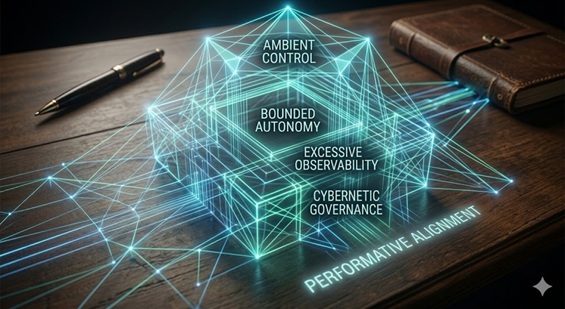
Control becomes ambient.
Distributed.
Continuous.
And increasingly psychologically internalized by the system itself.
This is one of the defining transformations of modern governance.
Traditional command-and-control systems operated visibly.
Authority was explicit.
Hierarchy was clear.
Control was identifiable.
Supervision was centralized.
Modern behavioral coordination systems operate differently.
Instead of forcing compliance directly, they increasingly shape:
• Interpretation,
• Incentives,
• Perceived legitimacy,
• Behavioral expectations,
• Adaptive responses across distributed systems.
The result is not necessarily less control.
In some environments, it may actually produce more pervasive forms of coordination than traditional hierarchical systems ever achieved.
But because these systems often emerge gradually through operational optimization, organizations may fail to recognize the governance implications of what they are building.
Especially when adaptation, responsiveness, and performance visibility become cultural virtues.
This is where the tension becomes particularly important.
Because adaptive governance can unintentionally evolve into continuous behavioral regulation.
Not through coercion.
But through:
• Permanent observability,
• Metric-driven legitimacy,
• Performative alignment,
• Social signaling,
• Continuous interpretive pressure inside the system.
Over time, people learn:
• Which behaviors are rewarded,
• Which narratives are acceptable,
• Which signals create legitimacy,
• Which metrics receive visibility,
• Which forms of disagreement increase organizational friction.
This does not necessarily eliminate autonomy.
But it changes how autonomy behaves inside the system.
Modern organizations increasingly operate through a form of bounded autonomy:
Teams remain free to decide how to execute locally, while the broader architecture of metrics, visibility, legitimacy, responsiveness, and behavioral expectations continuously shapes what becomes acceptable, rewarded, and strategically viable inside the system.
The organization may still appear decentralized.
Yet behavior becomes increasingly synchronized through systemic visibility and adaptive pressure.
This creates another paradox of modern governance:
The same systems designed to increase flexibility and empowerment may simultaneously expand behavioral coordination and invisible control.
And AI accelerates this transformation dramatically.
Because AI-native systems amplify:
• Sensing capacity,
• Behavioral analytics,
• Anomaly detection,
• Predictive visibility,
• Workflow monitoring,
• Coordination speed,
• Pattern interpretation across the organization.
As a result, governance increasingly shifts from:
• Supervising actions,
toward:
• Shaping behavioral conditions continuously.
This distinction is profound.
Because it changes the nature of organizational power itself.
The issue is no longer merely:
“Who controls the organization?”
The deeper question becomes:
“How does the system continuously shape behavior, interpretation, legitimacy, and adaptive response under conditions of distributed visibility?”
This is where modern organizations begin approaching a cybernetic model of governance.
Not necessarily because leaders intentionally seek centralized domination.
But because adaptive systems naturally generate increasing pressure for:
• Observability,
• Coordination,
• Prediction,
• Responsiveness,
• Synchronization,
• Behavioral alignment under complexity.
And under continuous operational acceleration, organizations increasingly interpret more visibility as more control capacity.
But visibility and wisdom are not the same thing.
Measurement and understanding are not equivalent.
And continuous observation does not automatically produce healthier organizational behavior.
In fact, excessive observability can generate unintended consequences:
• Performative behavior,
• Defensive adaptation,
• Metric gaming,
• Local optimization,
• Legitimacy signaling,
• Reduced psychological safety,
• Gradual erosion of authentic organizational learning.
People may slowly begin adapting not to operational reality itself, but to how reality is interpreted, measured, and legitimized inside the system.
This is where modern governance becomes extraordinarily delicate.
Because organizations genuinely need:
• Coordination,
• Observability,
• Adaptive capacity,
• Operational visibility.
Especially in AI-native environments.
But they also need:
• Trust,
• Autonomy,
• Interpretive diversity,
• Responsible dissent,
• Cognitive space for authentic learning,
• Enough human sovereignty to prevent the system from collapsing into continuous behavioral optimization.
This is why the future governance challenge may no longer be simply balancing:
• Control
vs
• Autonomy.
The deeper challenge may become:
How do organizations preserve human judgment, authentic learning, and strategic coherence inside systems that are becoming continuously observable, measurable, adaptive, behaviorally synchronized, and algorithmically mediated?
Because command-and-control may not be disappearing.
It may simply be dissolving into the architecture of the system itself.
In the next article, I will explore another emerging tension:
What happens when governance itself increasingly operates through behavioral influence, perception management, legitimacy engineering, and narrative synchronization rather than explicit authority alone?
And at what point does governance stop coordinating behavior and start engineering perception itself? |
Posted on: June 10, 2026 03:24 AM
|
Permalink |
Comments (4)
|
"If you can't convince them, confuse them."
- Harry S. Truman
|




