Disciplined Agile
by Tatsiana Balshakova,
Mark Lines, Mike Griffiths, Scott Ambler, Bjorn Gustafsson, Curtis Hibbs, James Trott

This blog contains details about various aspects of PMI's Disciplined Agile (DA) tool kit, including new and upcoming topics.
View Posts By:
Tatsiana Balshakova
Mark Lines
Mike Griffiths
Scott Ambler
Bjorn Gustafsson
Curtis Hibbs
James Trott
Past Contributors:
Joshua Barnes
Michael Richardson
Daniel Gagnon
Valentin Tudor Mocanu
Kashmir Birk
Glen Little
Klaus Boedker
Recent Posts
DA 5.6 is released
Disciplined Agile 5.5 Released
Choose Your WoW! Second Edition Is Now Available
Requisite Agility applied in Project Management
Disciplined Agile and PMBoK Guide 7th Edition
Categories
#ChoiceIsGood,
#ChooseYourWoW,
#ConsumableSolution,
#ContinuousImprovement,
#CoreAgilePractices,
#experiment,
#Experimentation,
#GuidedContinuousImprovement,
#Kaizen,
#LifeCycles,
#ProcessImprovement,
#TealOrganizations,
Adoption,
agile,
agile adoption,
Agile Alliance,
Agile Business Analyst,
Agile certification,
agile data,
agile governance,
agile lifecycle,
agile metrics,
agile principles,
agile transformation,
Agile2018,
Agile2019,
Agile20Reflect,
AgileData,
Analogy,
announcement,
Architecture,
architecture,
architecture owner,
Articles and publications,
Asset Management,
Atari,
Backlog,
Barclays,
being agile,
benefits,
bi,
blades,
book,
Branching strategies,
Browser,
Business Agility,
business intelligence,
business operations,
capex,
Case Study,
Certification,
certification,
charity,
Choose your WoW,
CMMI,
cmmi,
Coaching,
Collaboration,
Communications Management,
Compliance,
Compliancy,
Conference,
Construction,
Construction phase,
Context,
Continuous Improvement,
coordination,
COVID-19,
Culture,
culture,
Cutter,
DA,
DAD,
DAD Book,
DAD discussions,
DAD press,
DAD roles,
DAD supporters,
DAD webcast,
DADay2019,
Data Management,
database,
dependencies,
Deployment,
Development Strategies,
DevOps,
disaster,
Discipline,
discipline,
Disciplined Agile,
disciplined agile delivery,
disciplined agile delivery blog,
Disciplined Agile Enterprise,
disciplined devops,
Documentation,
Domain complexity,
dw,
DW/BI,
Energy Healing,
Enterprise Agile,
Enterprise Architecture,
Enterprise Awareness,
enterprise awareness,
Essence,
estimation,
Evolving DA,
Executive,
Experiment,
facilitation,
FailureBow,
feedback-cycle,
finance,
Financial,
FLEX,
Flow,
foundation layer,
Funding,
GCI,
GDD,
Geographic Distribution,
gladwell,
global development,
Goal-Driven,
goal-driven,
goals,
Governance,
GQM,
Guideline,
Hybrid,
Improvement,
inception,
Inception phase,
India,
information technology,
infosec,
Introduction,
iterations,
Kanban,
large teams,
layer,
lean,
Lean Startup,
learning,
Legal Project Management,
LeSS,
Lifecycle,
lifecycle,
Manifesto,
mark lines,
marketing,
MBI,
Metaphor,
Metrics,
metrics,
mindset,
Miscellaneous,
MVP,
News,
News and events,
Non-Functional Requirements,
non-functional requirements,
Non-solo development,
offshoring,
Operations,
opex,
Organization,
Outsourcing,
outsourcing,
paired programming,
pairing,
paper,
People,
People Management,
phases,
Philosophies,
Planning,
PMBoK,
PMI,
PMI and DA,
PMI Chapter,
Portfolio Management,
post-format-quote,
Practices,
practices,
Principle,
Process,
process improvement,
process tailoring,
Product Management,
product owner,
Product Owners,
productivity,
Program Management,
Project Management,
project-initiation,
Promise,
Quality,
quality,
rational unified process,
Refactoring,
Reiki,
Release Management,
release management,
Remote Training,
Remote Work,
repeatability,
requirements,
Requirements Management,
research&development,
responsibilities,
retrospectives,
Reuse,
Reuse Engineering,
ride for heart,
rights,
Risk Management,
Risk Management,
Risk management,
Roles,
RUP,
SAFe,
sales,
Scaling,
scaling,
scaling agile,
Scheduled Workshops,
SCM,
scorecard,
Scrum,
ScrumMaster,
SDLC,
Security,
security,
self-organization,
SEMAT,
serial,
skill,
solutions software consumable shippable,
Stakeholder Management,
strategy,
Support,
Surveys,
Teal organizations,
team development,
Team Lead,
team lead,
Teams,
Technical Debt,
Teleconferencing,
Terminology,
terraforming,
test strategy,
testing,
time tracking,
Tool kit,
Toolkit,
tools,
traditional,
Transformation,
Transition iteration,
transition phase,
Uncategorized,
Upmentors,
Using PMI Standards,
value stream,
velocity,
vendor management,
Virtual Training,
Workflow,
workflow,
workspaces
Date
| We often hear that agile software development is fine when you face a simple problem, but that agile isn’t sufficient for more difficult problems. Of course this falsehood is promoted by people who have little or no agile experience, or who have been involved with a failed “agile adoption” (usually these teams adopted ad hoc strategies thinking they were agile). Anyway, we decided to look into whether agile teams are taking on hard domain problems in practice.
The following diagram summarizes the responses to our question around agile teams and compliance from our 2016 Agility at Scale study. As you can see, 40% of respondents indicated that their agile team faced either complex or very complex problems, and that a further 38% faced medium complexity. Interestingly, only one in eight respondents said that their team faced a straight forward problem.

The bottom line is that agile strategies, and in particular disciplined agile strategies, are in fact applicable for taking on complex problems. More importantly, this is happening in practice around the world on a regular basis.
Related Posts
|
Posted
by
Scott Ambler
on: February 19, 2017 02:53 PM
|
Permalink |
Comments (0)
| We often hear that agile is great for simple situations but as soon as you face compliancy issues that it doesn’t work. Is it possible to be agile when you face regulatory compliance, such as PCI and FDA compliancy? Is it possible to be agile when you face organizational compliance, such as working in a CMMI regime? Important questions that we decided to look into.
The following diagram summarizes the responses to our question around agile teams and compliance from our 2016 Agility at Scale study. As you can see, 62% of respondents indicated that their agile team faced some form of regulatory compliance, 20% some form of organizational compliance, and 15% said both. In fact, two-thirds of agile teams operate under one or more compliancy requirements.
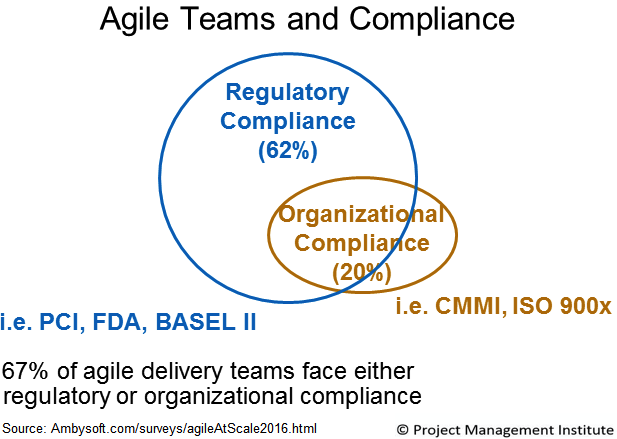
For further reading about compliancy, please read our detailed blog posting Agile and Regulatory Compliance.
Related Posts
|
Posted
by
Scott Ambler
on: February 15, 2017 08:40 PM
|
Permalink |
Comments (0)
| We are often told that agile teams should be whole, that they should have sufficient people, funding, and skills to fulfill their mission. The idea is that this reduces the dependencies that your team has on others, enabling them to make decisions and to collaborate more effectively. But, is this actually happening in practice? Are agile teams truly whole, or do they still need to collaborate with other teams (hopefully productively) to get the job done? Being strong believers in empiricism over rhetoric we decided to look into this issue.
In November of 2016 we ran the 2016 Agility at Scale survey. It was targeted at people who were currently working on agile teams, or who had recently worked on agile teams, and we asked them straightforward questions around the size of the team, how distributed it was, what complexities they faced, an so on. The following infographic summarizes the findings from the question that explored whether agile delivery teams need to work with external teams or groups to get their work done – in other words, are agile teams truly whole or do they rely on others? As you can see, 96% of respondents indicated that in practice their team had to work with one or more other teams, leading to the conclusion that very few agile teams appear to be truly whole.

One of the fundamental principles underlying the Disciplined Agile (DA) toolkit is that disciplined agilists should be enterprise aware – they should recognize that they need to collaborate with others outside of their team, that they should work towards a common organizational vision, and that they should strive to do what is best for the organization and not just what is convenient for them. Given that agile teams are collaborating with others in practice, it is clear that this philosophy of being enterprise aware is important.
The following diagram presents the results from the survey question in greater detail. You can obtain the source data, a copy of the original questions, and a slide deck key diagrams at the 2016 Agility at Scale survey page.

Related Posts:
|
Posted
by
Scott Ambler
on: February 09, 2017 12:37 PM
|
Permalink |
Comments (0)
|  There are several strategies that you can choose to employ with vertically slicing the requirements for a DW/BI solution. These strategies are described in the following table. There are example stories for each strategy as well as some advice for when to apply each strategy. There are several strategies that you can choose to employ with vertically slicing the requirements for a DW/BI solution. These strategies are described in the following table. There are example stories for each strategy as well as some advice for when to apply each strategy.
Table 1. Vertical slicing strategies for a DW/BI solution.
| Slicing Strategy |
Example Stories |
When to Do This |
| One new data element from a single data source |
- As a Professor I would like to know the names of my students so that I know who should be there
- As a Student I would like to know what courses are taught at the university
|
Very early days when you are still building out fundamental infrastructure components. Very common for the first iteration or two of Construction. These slices still add real business value, albeit minimal. |
| One new data element from several sources |
- As a Professor I would like the student list for a seminar that I teach
- As a Student I would like to know what seminars are being taught this semester
|
Early days during Construction when you are still building out the infrastructure. These slices add some business value, often fleshing a DW data element to include the full range of data values for it. |
| A change to an existing report |
- As a Professor I would like to know the standard deviation of marks within a seminar that I teach
- As a Student I would like to know how many spots are still available in a seminar
|
Evolution of existing functionality to support new decision making |
| A new report |
- As a Professor I would like to know the distribution curve of student marks in a seminar that I teach so I may adjust accordingly
- As a Registrar I would like to know what Seminars are close to being full
|
Several iterations into Construction when the DW/BI solution has been built up sufficiently. |
| A new reporting view |
- As a Registrar I would like to know what the prerequisites are for a seminar so that I can advise students
- As a Professor I would like to know the current course load of each student within a seminar that I teach
|
Several iterations into Construction when the DW/BI solution has been built up sufficiently. |
| A new DW/DM table |
- As a Chancellor I would like to track the revenues generated from parking pay meters to identify potential profits to divert to supporting students
- As a Professor I would like to recommend suggested readings to help people prepare before taking a seminar
|
Several iterations into Construction when the DW/BI solution has been built up sufficiently. |
There are several interesting things about the stories in the table:
- They are written from the point of view of your stakeholders. They aren’t a technical specification. For example, the first story describes how professors want a list of student names but it isn’t saying from what data source(s), what the element names are, … These are design issues, not requirement issues.
- They always provide business value. The first story appears to be the beginnings of an attendee list for a seminar. Having something as simple as a list of names does in fact provide a bit of value to professors.
- Sometimes that business value isn’t (yet) sufficient. It may take several iterations to implement something that your stakeholders want delivered into production, particularly at first. For example, although a list of student names is the beginnings of a class list it might not be enough functionality to justify putting it into production. Perhaps professors also need to know the program that the student is enrolled in, their current year of study, and basic information about the seminar such as the course name, time, and location of it. The decision as to whether the functionality is sufficient to ship is in the hands of your stakeholder (this is one of the reasons why you want to demo your work on a regular basis).
I’ve written a detailed explanation of vertical slicing for a DW/BI solution, and of course there is a wealth of information about agile database techniques in general for those of you interested in greater detail.
|
Posted
by
Scott Ambler
on: February 06, 2017 03:06 PM
|
Permalink |
Comments (0)
| Many people, particularly those new to agile, will tell you that agile teams must be small and co-located. That is certainly a smart way of organizing a team, but is isn’t required. In fact agile teams are more likely to be geographically distributed in some way than they are to be co-located. In practice, not theory.
In November of 2016 we ran the 2016 Agility at Scale survey. It was targeted at people who were currently working on agile teams, or who had recently worked on agile teams, and we asked them straightforward questions around the size of the team, how distributed it was, what complexities they faced, an so on. The following graph summarizes the responses around geographic distribution.

The survey found that less than one-third of agile teams are near-located, where all of the IT members are either co-located or at least in a shared open space. Previous studies have found that this number drops to one-in-ten teams being near located when you also include primary stakeholders.
Don’t let anyone tell you that you can’t do agile with a geographically distributed team because others are clearly doing so in practice. Yes, geographically distributed agile is different than near-located agile, which is one of the reasons why you need to take a pragmatic, context-sensitive approach to agile solution delivery. The Disciplined Agile (DA) toolkit provides the foundation from which to scale your approach to solution delivery to address a range of scaling factors, including geographic distribution. In fact, you may find our article around geographically distributed agile teams to be an interesting read.
Related Posts:
|
Posted
by
Scott Ambler
on: February 06, 2017 09:20 AM
|
Permalink |
Comments (0)
|
Waiting for the time when I can finally say that this has all been wonderful but now I'm on my way.
- Phish
|




