Better Projects through Team Alignment
From the PMI Global Insights Blog
by Cameron McGaughy,
James Turchick

Whether it’s in-person or virtual, PMI events give you the right skills to complete amazing projects. In this blog, whether it be our Virtual Experience Series, PMI Training (formerly Seminars World) or PMI® Global Summit, experienced event presenters past, present and future from the entire PMI event family share their knowledge on a wide range of issues important to project managers.
View Posts By:
Cameron McGaughy
James Turchick
Past Contributors:
Kimberly Whitby
Johanna Rusly
April Birchmeier
Nikki Evans
Dalibor Ninkovic
Dr. Deepa Bhide
Morten Sorensen
Tao Chun Liu
Jonathan Spiteri
Chris DiBella
Nic Jain
Tyler Norman
Nicholas Sonnenberg
Tam Abaku
Klaus Nielsen, MBA, PMI-ACP, PMP
Karen Chovan
Jack Duggal
Catalin Dogaru
Priya Patra
Josh Parrott
Scott Lesnick-CSP
Antonio Nieto
Dimitrios Zaires
Ahmed Zouhair
Carmine Paragano
Te Wu
Scott Bain
Katie Mcconochie
Fabiola Maisonnier
Erik Agudelo
Paul A Capello
Kiron Bondale
Jamie Champagne
Esra Tepeli
Renaldi Gondosubroto
Joseph Musiitwa
Mel Ross
Laura Lazzerini
Yonela Yolanda Mfeya
Kim Essendrup
Geetha Gopal
David Summers
Carol Martinez
Lisa DiTullio
Tai Cochran
Fabio Rigamonti
Archana Shetty
Geneviève Bouchard
Teresa Lawrence, PhD, PMP, CSM
Randall Englund
Kristy Tan Neckowicz
Moritz Sprenger
Mike Frenette
O. Chima Okereke
David Maynard
Nancie Celini
Brantlee Underhill
Claudia Alcelay
Sandra MacGillivray
Vibha Tripathi
Sharmila Das
Michelle Brown
Gina Abudi
Greg Githens
Joy Beatty
Sarah Mersereau
Lawrence Cooper
Donna Gregorio
Seth Greenwald
Bruce Gay
Michele Mattera
Wael Ramadan
Fiona Lin
Somnath Ghosh
Yasmina Khelifi
Erik Rueter
Joe Shi
Michel Thiry
Erika Kiely
Heather van Wyk
Jennifer Donahue
Barbara Trautlein
Julie Ho
Steve Salisbury
Jill Diffendal
Yves Cavarec
Rose James
Drew Craig
Vinay Babu Tarala
Stephanie Jaeger
Diana Robertson
Zahid Khan
Benjamin C. Anyacho
Nadia Vincent
Carlos Javier Pampliega García
Norma Lynch
Heather McLarnon, CSPO
Lissette Indhira Pimentel Sosa
Emily Luijbregts
Susan Coleman
Aneliya Chervenova
Michelle Stronach
Sydni Neptune
Louise Fournier
Quincy Wright
Dr Peace Opuruiche Echeonwu, FHEA
N. Christine Aykac
Ming Yeung
Laura Samsó
Lily Woi
Jill Almaguer
Mayte Mata Sivera
Prof. Éamonn Kelly
Marcos Arias
Karthik Ramamurthy
Michelle Venezia
Yoram Solomon
Cheryl Lee
Kelly George
Dan Furlong
Kristin Jones
Jeannette Cabanis-Brewin
Olivia Montgomery
Carlene Szostak
Hilary Kinney
Annmarie Curley
Dave Davis
Recent Posts
Presentation Recap: Sustainability in Project Management
Presentation Recap: Measuring and Managing Enterprise Portfolio Health
Elevating Leadership Through Community: Reflections from the PMI Global Summit 2025
Why the PMI Global Summit Series Africa Is a Classroom of Urgency
Presentation Recap: Women in Project Management - Breaking the Glass Ceiling
Categories
Agile,
Agility,
alignment,
Ask the Expert,
Benefits Realization,
Best Practices,
Bonding,
Business Analysis,
Calculating Project Value,
Capital Projects,
Career Development,
Change Management,
Cloud Computing,
Collaboration,
collaboration,
Communications Management,
Complexity,
Congress 2016 Ask an Expert,
Construction,
Curiosity,
Digital Transformation,
digital transformation,
Documentation,
Earned Value Management,
Education,
EMEA,
EMEA Congress Reflections,
Engagement,
engagement,
Ethics,
Events,
Extra Info,
Facilitation,
forecasting,
future,
Generational PM,
Global Congress 2016,
Global Congress 2016 - North America,
Global Summit,
Global Summit 2023,
Global Summit Series,
Good News,
Government,
Healthcare,
Human Aspects of PM,
Human Resources,
Identity,
Information Technology,
Innovation,
Kickoff,
Leadership,
Lessons Learned,
Mentoring,
Metrics,
Networking,
New Practitioners,
Nontraditional Project Management,
organisations,
Organizational Risk,
PM & the Economy,
PM Think About It,
PMI,
PMI Congress,
PMI Congress NA 2016,
PMI EMEA Congress 2018,
PMI Global Conference,
PMI Global Conference 2017,
PMI Global Conference 2019,
PMI Global Congress - 2016,
PMI Global Congress 2012 - North America,
PMI Global Congress 2013 - EMEA,
PMI Global Congress 2014 - North America,
Pmi global congress 2014 - North America,
PMI Global Congress 2015,
PMI Global Congress 2015 - Ask the Expert,
PMI Global Congress 2016 - EMEA,
PMI Hours for Impact,
PMI PMO Symposium 2013,
PMI Pulse of the Profession,
PMI Training,
PMI Virtual Experience Series,
PMIEMEA17,
PMIEMEA19,
PMO,
PMO,
PMXPO,
Portfolio Management,
Procurement Management,
Professional Development,
Program Management,
Project Delivery,
Project Failure,
project kickoff,
Project Planning,
Project Requirements,
Reflections on the PM Life,
Risk Management,
Risk Management,
ROI,
Roundtable,
Scheduling,
SeminarsWorld,
Social Impact,
Social Responsibility,
SoftSkills,
Stakeholder Management,
Strategy,
Sustainability,
Teams,
Techniques,
test,
The Moon,
Tools,
Training,
Translations,
Videos,
Virtual Experience Series,
Virtual Teams,
Volunteering,
war
Date
What is Team Alignment?
Managing projects is challenging. My first hand experience has been that the most challenging aspects of project management are more behavioral than quantitative.

Alignment in Front End Planning
Proper team alignment, starting in front end planning, is proven to positively affect behaviors and help you lead a team focused on a common project objective.
The Construction Industry Institute (CII) defines alignment as the condition when project participants are working within acceptable tolerances to develop and meet a defined set of project objectives. People, not only need to work together, you have to ensure the team has exactly the same vision of what the objective is and how you, as a team, are going to successfully achieve that objective.
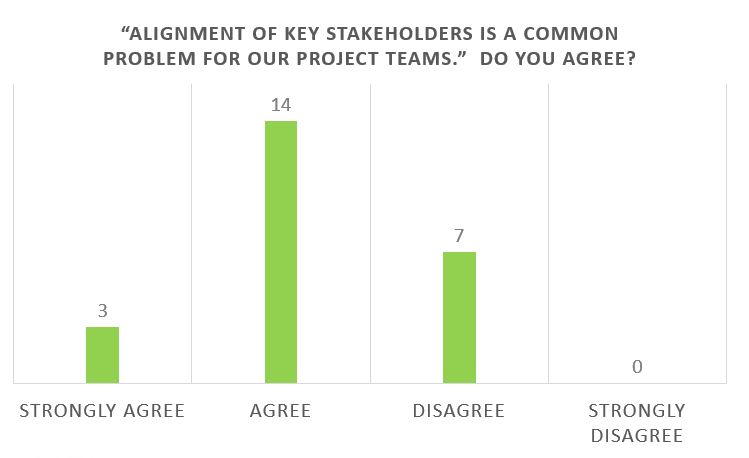
Though the sample size is small, a recent survey we ran showed that team alignment of key stakeholders is a common problem.
Barriers to Project Team Alignment
This not uncommon. The idea of alignment is simple enough, but the complexity of the conflicts and barriers project teams face can make achieving alignment very difficult. Some of the most common barriers experienced during front end planning include:
- Cooperation among specialists. Specialists tend to take off and “do there own thing”. Many capital projects are highly reliant on specialists, and it is a careful balancing act during front end planning to avoid having specialists quickly head down a narrow path that lacks coordination with other team members.
- Decentralized decision-making. More and more project teams are in geographically dispersed locations. This calls for increased need in coordination. Without it, we end up with conflicting decisions and the classic “one step forward, two steps back”.
- Multiple stakeholder groups. Complex relationships including joint ventures and public-private partnerships increase the likelihood of conflicting stakeholder objectives for the same project.
- Compressed project schedules. Our required completion dates are usually driven by external factors that are outside of the project team’s control. Pressure to reduce the time to value on a capital investment frequently leads to decisions such as:
- overlapping project phases,
- concurrent engineering,
- and other innovative approaches to crash the schedule.
Have you experienced any of these challenges?
The Alignment Thermometer
Often project alignment issues start in front end planning, as we try to bring a diverse group of stakeholders together. The Alignment Thermometer was developed by CII to address this challenge.
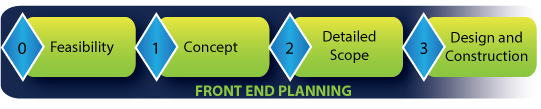
There are 3 phases and 3 logical application points to apply the Alignment Thermometer tool in Front End Planning.
The Thermometer can be used by projects teams by taking the first 5 minutes of a team meeting to have team members answer a short 10-question survey. This will provide a quantifiable measure of team alignment and identify the specific areas of disagreement that need to be addressed.
Each of the 10 questions in the survey correlate to CII research findings on the top 10 issues that have the greatest effect on team alignment during front end planning. As an example:
- Are stakeholders appropriately represented on the project team?
- Is project leadership defined, effective and accountable?
- Is the priority between cost, schedule and project quality features clear?
The results are tallied and give a current “temperature” on team alignment. It will help you quickly measure if your team is:
- Comfortable, and on the road to success,
- At a level of discomfort, and issues need to be addressed, or
- Working a stressful environment, and unchecked will likely lead to failure
As you move through the Front End Planning phases from Feasibility to Concept, your team size normally grows. With new team members coming to the table, we must ensure we maintain alignment around project objectives.
It’s a similar scenario as you move from Concept into the Detailed Scope phase. The team size will grow again, and clear roles and responsibilities become even more important. Again, using the Alignment Thermometer is a great tool to ensure the team is working together in a way that will increase the likelihood of success.
Several additional alignment tools can be introduced at this step including:
- Team building resources,
- The Partnering toolkit,
- Team leadership tools, and again,
- The Alignment thermometer
Are you facing uncertainty aligning your project team members and stakeholders? For more information on achieving alignment in Front End Planning here’s a link to a recent whitepaper:
Posted
by
Sandra MacGillivray
on: September 07, 2016 01:31 PM |
Permalink
Comments (4)
Please login or join to subscribe to this item

fosco frongia
Senior project manager| ENTE PATRIMONIALE CHIESA GESU' CRISTO SUG
Fino Mornasco, Como, Italy
very interesting article, many thanks to share it

Karthik T
Senior Engineering Manager| Nike
Bangalore, Karnataka, India
Great. Thanks for sharing

Tim Podesta
Director of PM/PMO| Former BP- now Independent
Penn, Bucks, United Kingdom
Team alignment is a key driver of project success, particularly for complex projects where the combination of poor alignment and greater complexity is proven to lead to long schedule slippage.
Please Login/Register to leave a comment.
|
"Military justice is to justice what military music is to music."
- Groucho Marx
|




