EV: Start by Organising Your Project


|
The first process detailed by the Earned Value standard is ‘Organise Project’. Basically, you can’t run earned value management on your project if your project is a disorganised mess. But it also means more than that: you have to have an understanding of scope so you can split the project into work packages that make sense and can be tracked. How do you work out the scope?The easiest way to work out the scope of the project is from the charter: this outlines what you were tasked with doing. The requirements documentation will also have useful information. However, that’s all likely to be quite high level. To get to work package level, you have to use decomposition. All this means is breaking down big chunks of work into smaller sections until you get to a level where it’s possible for someone to take responsibility for managing the thing. This is how you create the work breakdown structure: take the high level requirements and decompose them, structure them, into something that gives you a logical overview of what is happening on the project. You might think it’s not worth starting at the top and breaking it down. Why not start at the bottom and build it up? I suppose either works fine. For me the default would be to start with the big picture because then we make sure that what we build meets that need. There’s a chance that if you start at the bottom and build up, what you actually end up with isn’t quite what was asked for. However, do what works for you: as long as you end up with decomposed work packages (as in, broken down, not mouldy), then you’re good. The WBS is linear, in that the branches don’t twine together. Once you’re on a branch, you stay on that branch, and all you are doing is breaking the work down further and further. How do you know when to stop? I say that’s a judgement call. The work package size needs to be controlled enough for someone to feel like they can get their arms around it and lead it, but not so detailed that you are creating a ton of WBS paperwork for something that ends up taking a couple of hours. How to represent your WBS: diagram or list?When you see WBS info in textbooks, and indeed, in the EV standard, you’ll see it as a picture; a kind of tree diagram or hierarchy chart. Personally, I don’t think in pictures so I prefer to create a numbered list. I love the fact that my scheduling tool of choice will add in the WBS numbering automatically as I create the list. Creating your WBS directly into your scheduling tool is not (in my view) a great practice, but it works for the kind of projects I do as they are generally pretty small at the moment. Your project is organisedThe end result of the first EV process is that you end up with a WBS and some other scope documentation that fleshes out what you have agreed to do, like the scope statement and a plan for managing scope should things change. If you’re going down the route of preparing a ‘proper’ WBS instead of a simple numbered list of tasks – which is necessary if you are handing work packages over to teams to run with – then you’ll also have a WBS dictionary which is the text part that adds detail and colour to the titles on the WBS diagram. All this forms your scope baseline: the official statement of what it is you intend to deliver. The important thing to remember is that you do not create this alone – just don’t! Scope needs to be created with input from technical experts because you don’t know what you don’t know. Even if you think you are an expert in the subject – or you were at some point in your career – the people doing the work need a say in what they are doing so they can start thinking about how best to do it. Collaboration is your friend: yes, it takes longer but the end result is a project that everyone can buy into, and that will save you a lot more time in the long run. Setting up your project for success with a solid scope is important all the time, but if you are going to follow the EV standard, it’s essential. You can’t measure project performance unless you know what you should be performing! Pin for later reading
|


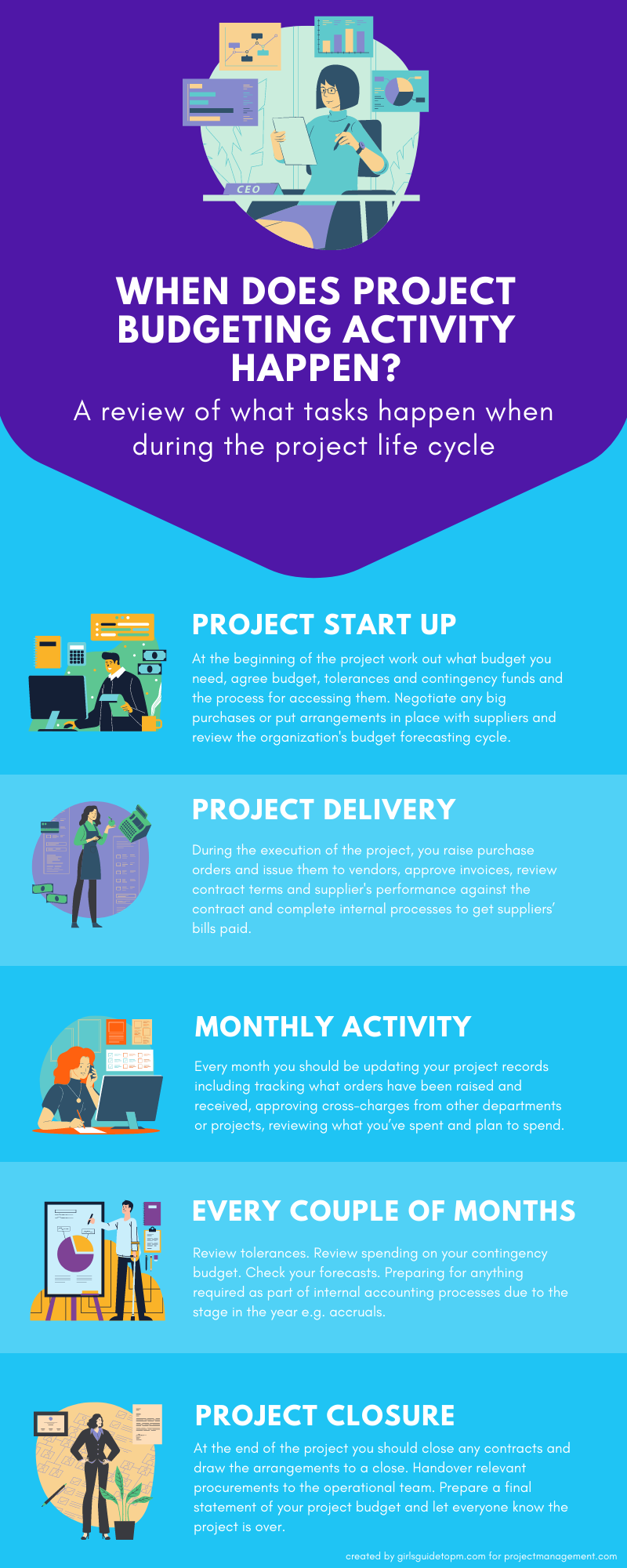
When does project budgeting activity happen? [Infographic]
Categories:
budget
Categories: budget
| Let’s look at what tasks happen when during the project life cycle. Different budget requirements fall into different parts of the project, from start up through to delivery and closure, with different tasks required every month and then different tasks again every couple of months. The infographic below explains what to be focused on at different points in the project life cycle. What would you add? Let me know in the comments!
|
5 Strategies for Dealing with Threats
Categories:
risk
Categories: risk
|
A threat is a risk with a negative impact on the project – so this article isn’t about dealing with bullying behaviour at work or anything like that. We often talk about risk as if all risks are the same, but they aren’t. There are ‘negative’ risks i.e. threats and ‘positive’ risks i.e. opportunities. The way we respond to each is different because you want a different outcome each time. With threats, you want the risk to go away. With opportunities, you want the risk to happen so you get the benefit. In this article I’m talking about your options for responding to risks that are perceived to be a threat to the project. There are 5 responses:
Let’s look at each of those in turn. 1.EscalateEscalating means passing the risk up to someone else to deal with, because the team and/or the project sponsor believe it’s something that is outside of the scope of the project. Often projects will uncover risk or issues that are actually nothing to do with the scope of their work. In my experience, sometimes that means my project gets extended to also deal with whatever problem we’ve found, but sometimes the right thing to do is escalate to the PMO and let someone else deal with it. This is also an appropriate strategy if the risk response you’re considering would need more than the level of authority you have within the team. Basically, you’re passing the risk up to the programme or portfolio management team and while you’ll input to the response, it’s no longer your risk to track and manage. I don’t remember this being an option when I first learned project management on an internal course my employer ran. I think it’s definitely a valid option and one we’ve used on my projects. 2.AvoidYou can avoid a risk if you change your plans so it couldn’t possibly happen. For example: there’s a risk of getting wet if you go out because it’s raining. You remove the risk and don’t get wet because you don’t go out that day. Sometimes you can make this happen with project risk but often avoiding a risk is expensive and time-consuming so it might not be worth it. However, some risks can be avoided simply by gathering more information like getting clearer requirements, hiring someone with particular skills who would know what to do or being better at stakeholder engagement. 3.TransferTransferring risk means passing it over to another party to manage and the example typically given is insurance. You can transfer the risk (in exchange for a fee) over to an insurance company who then take the risk on your behalf. A similar thing happens when you write warranties and guarantees into contracts – the other party carries the risk in exchange for some kind of consideration on your part. 4.MitigateThis is what we normally think of when it comes to risk management, and often internally – at least in my teams – we talk about risk mitigation instead of risk management because it’s what we do most often. Mitigation is about reducing the impact and likelihood or a risk so that if it does happen it’s easier to manage the situation. We take steps to make the risk less likely to happen and less of a problem if it does. For example, we might do more testing, add more resources to a project task, review more thoroughly, subject a process to internal audit or peer review and so on. We create back up plans, policies and build redundancy into the system so if something does go wrong, it’s easier to cope and get the project back on track without a major interruption. 5.AcceptFinally, you can choose to do nothing. This is an appropriate response to small, low level risks. It’s also a temporary response to risks that are likely to happen far into the future where it’s not necessary to spend time preparing a response yet. You can put aside time or money to prepare for dealing with the risk as a minimum if you can’t do anything else. However, it’s important to monitor the risks where you have chosen acceptance as a strategy, because something might change in the future that makes it a less attractive option. Keep these risks under review and adapt your strategy as necessary to ensure you’re still doing the right thing for the project. All risk responses could be combined if it’s appropriate to take two or three actions. You can even have different people responsible for taking different actions, although I’d stick with having one risk owner so that someone has a complete picture of what is going on. Prioritise managing the most risky risks first and then invest the appropriate amount of time, resource and budget into reviewing and acting on the others. Next month I’ll be looking at 5 strategies for dealing with opportunities – those positive risks we want to encourage. Pin for later reading
|

What to do when supplier costs increase [Video]
|
Let’s say your company has entered into an agreement with a supplier and now the bills are starting to rack up. This could happen if your agreement is on a time and materials basis, or a fixed price plus extra costs for changes to scope. Find out why the costs are overrunning. Is it because your team is putting through too many change requests, which is hitting a contract clause that lets the supplier charge more? Or is something else at play? Whatever the cause, pin it down and work from there. Involve the supplier as well, so that they know that you can’t afford, or choose not to afford, to put up with those costs going forward. You may end up renegotiating the whole thing, but better to do that early than to put up with overspends for too long. This video explains more. Pin for later reading
|

What is the Practice Standard for Earned Value?
Categories:
earned value
Categories: earned value
|
Have you used the Practice Standard for Earned Value Management? It’s another one of the documents and standards available to project managers who are members of PMI. Go to your members area and log in, then navigate to the standards section and you’ll be able to download a copy. It’s a detailed guide to how to do earned value, but more than that, it also talks about scheduling elements that are so important to getting your project plans set up correctly from the beginning. Look at me, mixing up ‘schedule’ and ‘plan’ already. How many times have you heard ‘plan’ and known the person talking really means ‘schedule’ today? Earned Value requires that you are all on the same page with terminology and it’s a good way to standardise your approach to managing project performance. What’s in the standard?The standard is a document that sits alongside the PMBOK® Guide and doesn’t replace it. You can use them both together. Think of the standard as a deep dive into how to make earned value work. Like all standards, it is not prescriptive in that it doesn’t tell you that you need to use certain software tools to do the processes. It’s up to you to work out the best ways to implement the guidance. The standard covers the following areas:
And then it goes through the process for running an earned value management, in exactly the same way as the PMBOK® Guide is laid out:
If you are used to using the PMBOK® Guide as a reference, then the format of the EVM standard will be familiar to you. Each section talks about the process as a whole, then covers the inputs, outputs and considerations, enabling you to map it to your current work. There are some appendices that cover additional topics like how the standard was put together and how the subject of EV fits with risk management. There’s also a short system on deploying a full EVM system which is helpful if you are about to start software selection. It’s much shorter than the PMBOK® Guide (thankfully!) so if you are wondering whether it’s worth diving into, I say go for it. What I liked about it is that it’s readable – in as far as any standard and set of processes is – and I felt like I could implement it if I wanted to. It’s not the same as the standard required if you are bidding for US federal contracts, but if you want a place to start with EV, then this is a comprehensive guide. Plus, it’s free to PMI members, so what have you got to lose? I know that many PMP® students do worry about the earned value formulas and EV in general, especially if they don’t use the concepts day-to-day – and in my experience most of the people and companies I work with do not choose to use EV as a performance management method. So if you are going for the exam and want to build your confidence about EV, then this is a helpful read. It’s still basically a textbook though (maybe I find these things more interesting than the average person – certainly I’m the only one in my household who would pull out an EV book by choice). The thing about EV is that you need to know a little about it to know that it is not relevant to your projects. It’s a topic worth learning about as a project manager if only so you can have the confidence that you and your PMO are making the right choice by not adopting this way of tracking performance. Do you use EV on your projects? Let me know in the comments! Pin for later reading:
|