3 Financial signs PMs often miss


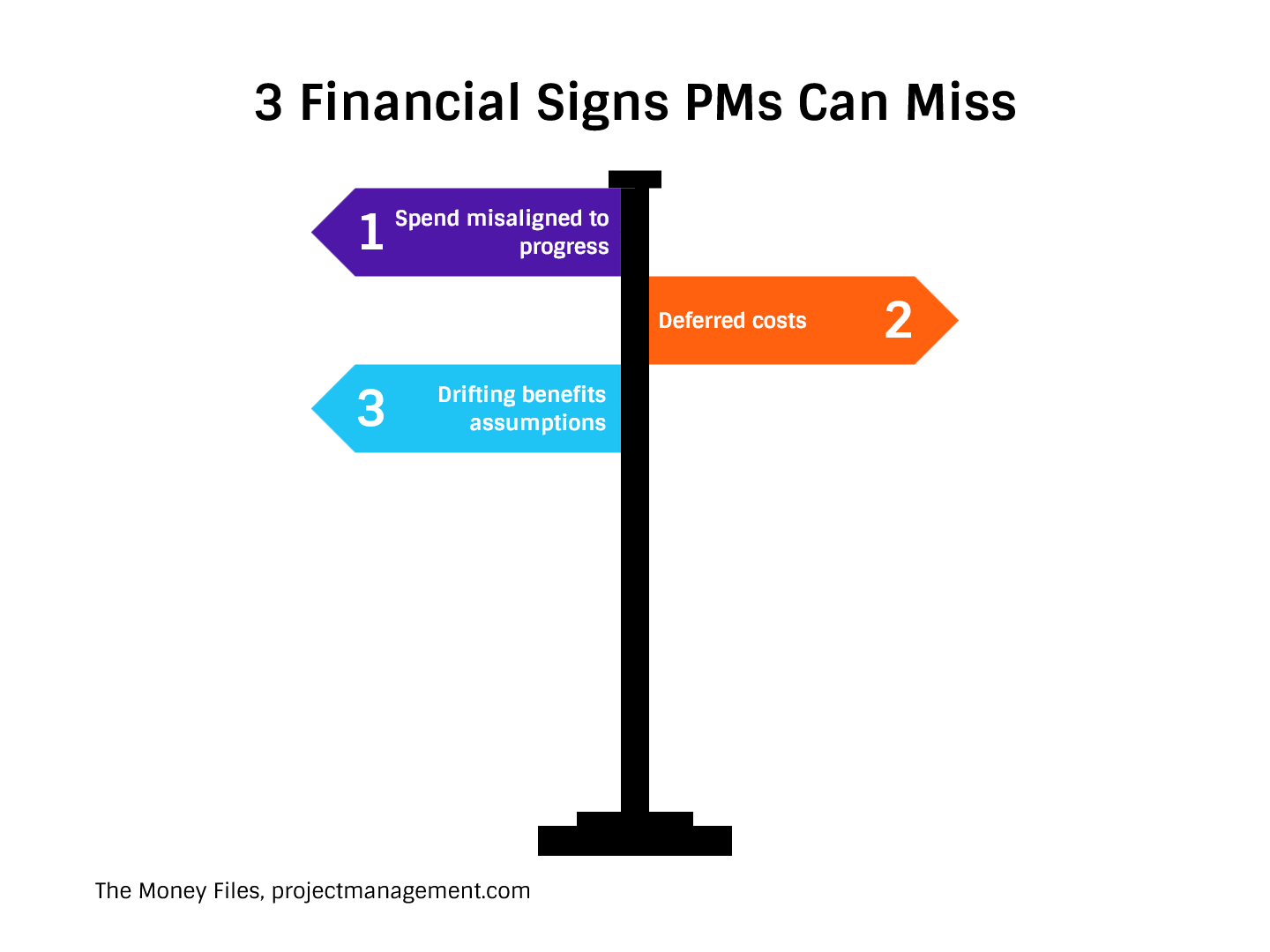
Green is good, right? But a project that is on budget can still be in trouble, even if all the signs are pointing to a Green RAG status. Let’s look at some early warning indicators beyond headline budget, which are sometimes financial signals that project managers miss.
|
 Hidden financial risks
Making sense of project cost reports
| Argh, cost reports have landed in my inbox and now I have to look at them… Do you feel like that? Project accountants are sending out end of month financial reports for us to reconcile or review and somehow cost reports feel harder than schedules. So let’s whisper it: if you receive financial reports you don’t fully understand, you are not alone!  The numbers might look familiar, but the relationships between them are not always clear. This can make financial conversations uncomfortable and reactive – not a good look when you’re sharing the budget position in Steering. Definitions project managers should be confident usingWe should be able to confidently understand and use these terms, as project managers: Actuals Actuals are what has already been spent and recorded. This includes money that has been spent outside the organisation e.g. to suppliers, and any internal costs you have to take like resource costs for colleagues working on the project. Forecast Forecasts are estimates of what the project is expected to cost in total, or in your organisation it might mean what is left to spend. In a view of a year, you’ll have actuals for the months that have closed and forecasts for predicted spend in the months to come. Commitments Commitments sit in between: money that has been contractually committed but not yet spent. These are normally reflected in purchase orders or statements of work, where you’ve told the vendor it’s OK to go ahead but they haven’t invoiced yet, or maybe even done the work yet. However, you can’t look at these figures are viewed in isolation. A common misunderstanding is assuming that unspent money is still available – it’s not because some of that will already be committed to suppliers (through POs or SOWs) or in internal resource costs (for example, if you have fixed term contractors on the job). In reality, committed costs may already consume much of the remaining budget – yikes. That doesn’t give you much to play with if you need to move things around. Another issue is focusing only on current-period actuals, rather than cumulative spend and future obligations. The current month might be looking great, but if all the other months are overspent, that’s not a good big picture. Financial fluency is a core skill for project managers, but I find that we don’t get taught it. The trouble is, you can understand it in theory and read the relevant sections of the PMBOK® Guide, but in practice, your own country-specific accounting rules and organisation-specific processes mean that it’s a bit different wherever you work. You can start building confidence with cost reports starts with asking basic questions. What is included in actuals this month? What commitments are expected to convert into spend next month? What assumptions underpin the forecast? And are these still what we believe? Financial fluency doesn’t require accounting expertise (thank goodness). You can get there with curiosity, a willingness to ask questions, and regular engagement with the numbers. Book a monthly chat with your project finance person. The more comfortable you get with what the cost reports, and all the other financial reports, are telling you, the easier you will find it to manage your project budgets and answer questions about the money side. |
End-of-year budget scramble: Maximising financial efficiency
| OK, this might not be relevant to everyone reading, but sometimes project managers are left with ‘spare’ budget in December. How are you going to make use of any available funds – assuming you are not under pressure to give them back – to maximise project value. Here are some ideas.
Conduct a year-end financial review First, make sure your budget trackers and up to date, and that everything that should have been accounted for has been added on. That will give you a true picture of your actuals, so you can review the financial status of the project, including how much budget is left and what key areas need funding. If you need to move money around, talk to the finance team so that the right amounts can be journalled to the right budget lines to tidy up your accounting. Prioritise high-impact investmentsNext, think about where you could use leftover budget in the remaining weeks of the year to make the most impact. That could be new tools (testing software licences are always a win), training for project team members, especially if that will help them develop skills they will need next year, or risk mitigation activities. Perhaps you can buy a few days of consultancy time that will speed up a particular task? Perhaps there are licences that need renewing, or equipment that you could invest in? Perhaps you could talk to suppliers about getting a discount if you place an order now instead of in January – many suppliers have targets to hit at year end and might be open to negotiation. I think that spending money on training and certification is a good choice. It helps team morale as individuals see that their future is being invested in, and you get skilled team members who have the skills required to continue to support the project, or future projects. So my recommendation would be to look at investing here, in team development, if you aren’t sure what use you can make of additional funding. If you need to buy anything, make sure to get approval and move quickly before the year end deadlines. Don’t spend for the sake of itWe want to avoid wasteful spending. Be aware of what is going on in the rest of the organisation. For example, other projects might be struggling, and the most prudent thing is to always offer the money back to the ‘pot’ as a first point of call. In my experience, budget that is not spent is not carried over to the new year unless it can be accrued against a committed spend. In other words, if you have got £20k sitting waiting to be spent, there is a high chance that you will lose it unless it is spent on something. Talk to your Finance team to find out whether that is likely to apply to your budget, and what they recommend you do at this time of year. Work with Finance to reallocate fundsTalking of working with Finance – they are the guardians of spending rules and regulations, and they will help you maintain compliance and an audit trail for spend. They will know if it is possible to carry budget over – and it might be, if your financial year does not end in December. |

How to conduct a successful year-end project audit
Categories:
Quarterly Review,
budget,
financial management,
reports,
audit,
Scope Management,
Risk Management,
Lessons Learned
Categories: Quarterly Review, budget, financial management, reports, audit, Scope Management, Risk Management, Lessons Learned
| Are you thinking about year-end project audits? Perhaps your PMO is thinking about how to learn from the past year. Perhaps you want to set a good foundation for projects next year. Perhaps you just had a rubbish past few months and want a second opinion to see if there was anything you could have done differently to avoid the outcomes you got. Whatever your reason, many project leaders’ thoughts will be turning to audits at this time of year, so let’s talk about how to make the most of this exercise – it’s not as awful as you might be thinking!
Planning the auditFirst up, make sure the audit is planned in. Schedule it in advance to ensure key team members are available. Look out the documentation that is required, which is normally things like financial reports, scope changes, and risk logs. You’ll also want to make sure that the business case, project plan, and schedule are available, as well as any change requests that changed those, so the auditor can compare the original planned baselines to the current baselines. Key areas to auditSo what is your audit going to look at? Whether you have been asked to audit someone else’s project, or you want projects in your PMO to be audited, here are some things you’ll probably want to put on your checklist.
Identify lessons learnedThe main purpose of an audit is to review what worked, what didn’t and what needs to change (or be continued). So you can think of the output of the audit as a sort of lessons learned report. If you already have scheduled lessons learned activities, you can feed those in to the audit report. If not, it never hurts to have a lessons learned conversation with the team. Set the stage for next yearIf your project is running into next year, discuss how the results of the audit can be used to improve processes, define new standards or ways of working, and inform the next year’s project strategy. There might be some easy things you can do to change up how things work to make them more effective. Whether the outcome is a lot of things to change or the reassurance that you are doing everything right, it’s a good time of year to be reflecting on project management practice. Take stock of where you are and how far the project has come, and if an audit is offered, say yes! It really is a good learning experience. |

Economic vs Financial Appraisals
|
Let me see if I can make the difference between economic appraisals and financial appraisals interesting…. They are both covered in the UK Government’s Better Business Cases document. Here’s my take on what they both mean and why you’d want to use them.
Economic appraisalsThe document says that economic appraisals are all about value and benefits from the perspective of the stakeholders, users, and wider societal impact. They consider “all social, economic, environmental costs and all effects on public welfare.” Remember, this is a government publication, so the assumption is that projects will be for the public good. Your project might not have an effect on public welfare, but you can imagine that it will have an effect on the project’s customers or end users. This is the core of a business case. It includes an element of financial information as well, such as relative prices, direct and indirect costs, opportunity costs where there are any, environmental costs, and benefits however these play out. You’d also include staff time. It would exclude inflation, tax, sunk costs (let’s hope there aren’t any of those), depreciation of assets, and other accounting treatments. Financial appraisalsFinancial appraisals are purely the monetary calculations: can we afford it? Where is the money coming from? They consider cash flow, budgets, and accounting practices. This would feed into a business case because there is no point in progressing a project that you can’t afford to complete or that would not provide adequate financial returns where these are measured. A financial analysis would look at current pricing, cash-releasing benefits (like delivering a portion of the project early so it could start to ‘earn’ for you), capex and opex costs, tax payment, and inflation. The do nothing optionA business case should also include the minimum possible approach, which is normally the ‘do nothing’ case against which to compare your alternative(s). Complete an economic appraisal for that option, too, taking into account what stays the same and the benefit cost ratio of doing nothing. In my experience, it’s always worth including a ‘do nothing’ option as it really makes it clear to execs what they are giving up if they choose to reject a project. Is an economic appraisal a new thing?I don’t think an economic appraisal is a new thing, but I think project managers are more used to seeing it be called a business case or an options analysis. Once you have created an economic appraisal for a variety of options (including the ‘do nothing’), there is likely to be a clear option that stands out as the best course of action. If not, there might be a few to choose from with subtle differences – leave the choice up to the execs to debate in that case! I think the thing about an economic appraisal is that it forces you to think wider than the numbers. You’re looking for social and environmental benefit, community impact, and return instead of just a simple ‘if we do this, we’ll get paid that in a year’. It’s a way of reframing the business case conversation into something that is wider and more rounded, helping teams become aware of the full impact and benefit of their initiative instead of simply the bottom line. And I think that’s a good thing. We should be making rounded, fully informed decisions instead of simply relying on the top level numbers. We need to be aware of the full impact from idea to decommissioning and what impact that is going to have on the world around us, not just the bank account. By adopting the language of economic appraisal instead of business case, we might be shifting the thought process into a richer dialogue with ultimately better decisions being made. What do you think? Let me know in the comments! |