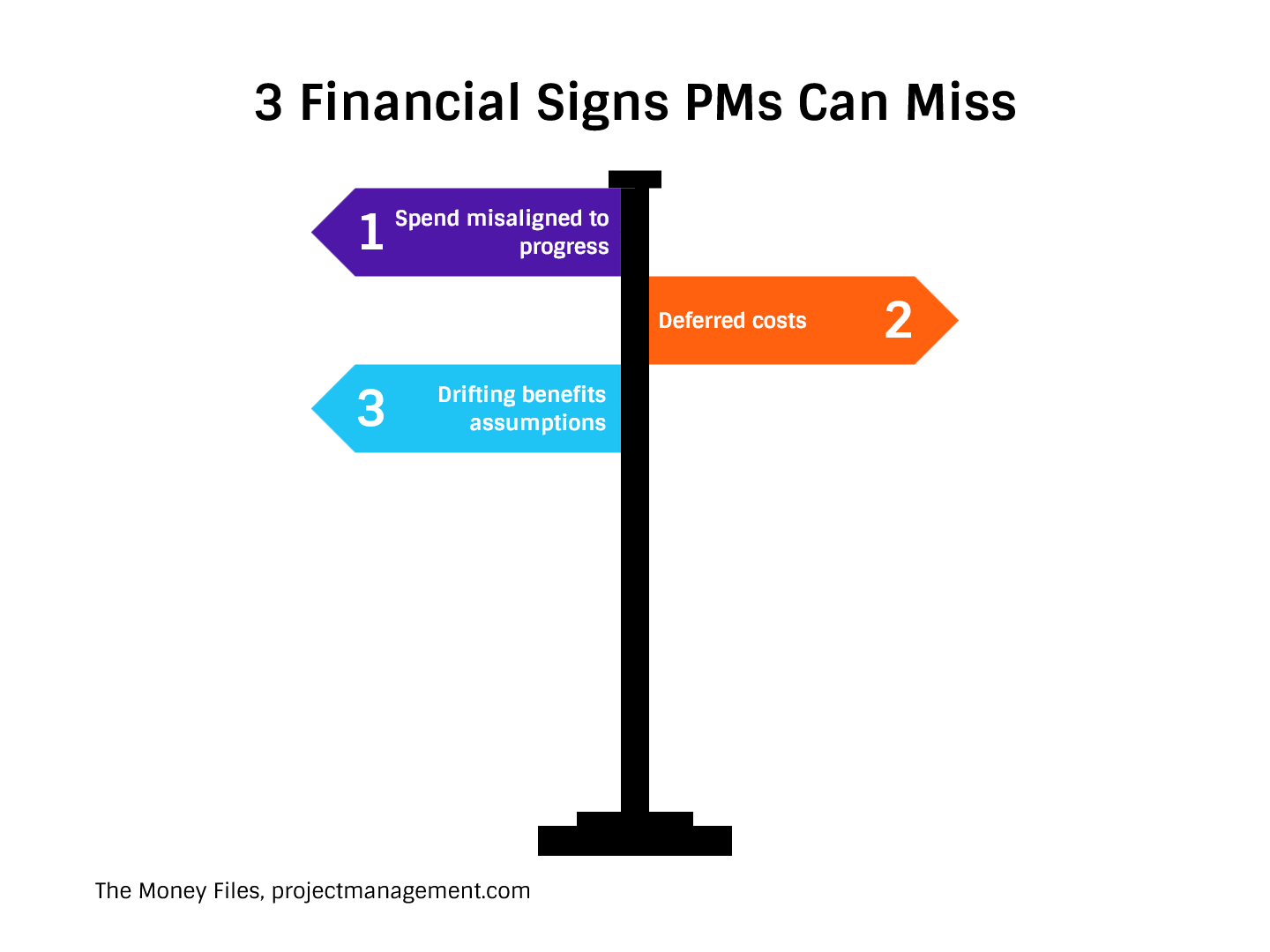
3 Financial signs PMs often miss


Green is good, right? But a project that is on budget can still be in trouble, even if all the signs are pointing to a Green RAG status. Let’s look at some early warning indicators beyond headline budget, which are sometimes financial signals that project managers miss.
|
 Hidden financial risks
Who really owns the project budget? Clarifying financial accountability
If you work in a matrix environment, you’ve probably had this thought: who really owns the budget? I’ve certainly had situations in past roles where I’ve thought I could make decisions and then found out these were overruled, or held back from making decisions only to find someone else thought I was empowered to do so.  Budget ownership confusion is common, especially in matrix environments, and leads to weak financial control. It sometimes happens because people don’t know who has final sign off, and sometimes because people don’t want to take responsibility for fear of getting it wrong or overstepping. However, if there are assumptions about budget accountability but these aren’t made explicit, then how is anyone supposed to know what’s going on? It ultimately doesn’t matter where accountability sits, as long as the person who is accountable knows it is them, and so does everyone else. Typical budget ownership modelsTypical budget ownership models, in my experience, fall into three buckets: Sponsor-owned: Where all budget decisions run through the exec sponsor. PM-managed: Where you get given a pot of funding and are expected to manage it. Shared accountability: The hardest type, where there is a mix of what needs to be approved by the sponsor and what the PM can sign off. Different organisations adopt different models. In some cases, the sponsor owns the budget and the project manager runs day-to-day tracking. In others, the project manager has delegated authority within agreed tolerances. And it can differ between projects as well, so just because you used one model on your last project doesn’t mean it will be the same this time round. Risks of unclear ownershipWhen you don’t know who owns the project budget, you risk slow decisions and surprise overruns, neither of which are great for the project. When changes are needed, you should know who to go to for approval for the change, if there is a cost aspect to it. And definitely avoid surprises – I’ve never met a stakeholder who is happy to be kept in the dark about financial pressures! Clarifying financial decisionsWe can help the situation by clarifying financial decision rights early. Who approves changes that affect cost? Who decides how contingency is used? Who is accountable for explaining variances to senior stakeholders? These conversations can feel awkward (especially if the answer is, “you, of course!”), but they prevent much bigger issues later. And clear ownership doesn’t mean working without help. Good financial governance relies on collaboration between the project team, sponsor, and finance colleagues aligned to the project, maybe the vendor as well. When everyone understands their role, financial conversations become more straightforward. At least you know who to ask! Clarity on budget ownership reduces friction and creates space for better decisions, and it’s not that difficult to sort out. As part of project governance, these are the kinds of conversations to have early on, to make sure that you know who’s doing what, and in particular, what falls to you. Then you can plan your time appropriately so you’ve got time to focus on the financial management of the project in the right way. How does it work for your projects? Let us know in the comments whether you’re “in charge” of the budget or whether the accountability sits elsewhere. I’m sure there will be lots of variations! |
3 Types of programme cost (that are not project costs)
Categories:
cost,
transparency,
software,
audit,
Cost Management,
Program Management,
Benefits Realization
Categories: cost, transparency, software, audit, Cost Management, Program Management, Benefits Realization
| I’ve been managing a programme for a while now, and it’s quite different from managing projects, or the very large projects that we call programmes that are really not programmes! Programmes need their own budget as well as the budget of the projects, and here are the things I think should be included in that.
1. Costs of running the programmeIt seems silly to point it out explicitly, but there are costs incurred from running a programme with a programme management structure. For example, my time as programme manager needs to be costed and included along with any support resource from the programme office. Even though we are not full-time, the programme wouldn’t run without us so our costs have to go somewhere. Ideally, there would also be a programme-level risk budget for handling unforeseen issues. You may also find that on your programme there are other costs associated with running the programme, such as office space, software licences for third parties to access your programme management software (which is likely to be the same project management software everyone else uses, so hopefully not too large of an overhead there). 2. Assurance costsAre you planning on having internal (or external) audits and reviews as part of the programme? If so, those costs should be picked up by the programme budget. Internal reviews, in my experience, don’t cost anything except time, but if you are bringing in consultants or external auditors, there is definitely a cost associated with that (as well as time). Certification or compliance programmes may have extra costs here too, for example, if you have to comply to certain standards, going through the accreditation process is both time-consuming and normally costs something. There’s also often an annual cost to main the accreditation so factor that in too if your programme is multi-year. Plan all those costs into the programme budget at the frequency and estimate required. 3. Benefits realisation costsBenefits might be realised at project level, but you’ll likely have some programme benefits to track as well. And the cost of delivering and tracking those should be included somewhere – in your programme budget. For example, you may need to programme software to create new reports. You may need a new role, and someone hired to go into that role. Some benefits might include making staff redundant due to organisational restructure, and there are costs associated with that activity too. Plan all of those in at programme level. You may find that it’s useful to take the project-level benefits realisation costs into the programme budget as well so you can track benefits all in one place, but that’s up to you. Project costsOf course, there are costs to running the projects too, and in your overall programme budget, you’ll want visibility of those for forecasting and tracking. But these are the ‘obvious’ costs so it’s likely you already have them. The project costs would normally include the large infrastructure type items that are necessary for the programme to move forward. The first project would normally take the hit for any large infrastructure-type investment, but that makes the business case for that project rather wobbly. You might decide that large capital costs are picked up by the programme as an overhead instead, and then each project goes forward on its own merit without having to fund the infrastructure required to make it and future projects work. Talk to your financial analyst or project accountant for how best to apportion the costs across the programme and projects so it’s transparent and reasonable. |

More schedule tasks to do before you baseline
Categories:
checklist,
stakeholders,
Schedule Management,
Cost Management,
Stakeholder Management,
Scheduling
Categories: checklist, stakeholders, Schedule Management, Cost Management, Stakeholder Management, Scheduling
| Last month, I wrote about 3 things to include in your schedule creation activity before you could say your schedule is ready for use, after you’ve created the work breakdown structure and added in dates, dependencies and task owners. Here are another 3 things you can build into your project planning tasks to polish your schedule.
1. Add in the costs One thing we’re doing at work more and more is cost loading schedules. You don’t have to do this in your project scheduling software unless it makes sense to do it there. You could also create a phased version of your budget that shows when costs are going to hit. Adding costs into the schedule to each individual task is a more accurate and detailed view, and then if work is rescheduled or delayed, the costs move too. However, you can get started with a simple spreadsheet where you phase the forecasted budget across the months of delivery and then record the actuals. You can do this as a practice exercise if you want to give it a go, even if you don’t have external costs. Resource costs are normally a huge chunk of budget, so if you are tracking time, you can match up how many hours/days were worked against the forecasted effort in the week/month and use that to phase the costs by activity. 2. Look for float Float is where a task has the ‘luxury’ of being able to start or finish later than the dates on the plan and not affect the critical path. Look out for the tasks with wiggle room – where you could let them slip a day or so or start them early and overall it has no impact on your ability to deliver to the agreed end date. Personally, I like to get ahead with those tasks because you never know when the resources or work might change later and you need that time for something else, for example a team member going off sick. However, some tasks are better done in a just-in-time way, so don’t bring forward those. You risk rework if you do something too early that might need to be changed later, even if there isn’t a formal task that would drive the change. For example, project communications can be drafted early but might need to change if the context changes, and if you are going through a transformation or strategic reset, the direction of travel might change mid-project causing you some more effort later. 3. Check in with stakeholders It should go without saying, but given that I’ve reviewed project plans created by the project manager with no input from the team when I’m mentoring project managers, I feel it does warrant a note – check your schedule with the stakeholders. I do create a high level overview with as much detail as I can before I share it with the rest of the team, because it saves time, and the alternative is having a giant workshop for planning. And frankly, we don’t have time for that (I know, I know…. The irony of not having the time to plan!). If we’ve had phone calls and conversations, there is probably enough I can glean from those to put together an outline and fit it to our project methodology. But the plan is not workable and achievable unless the key members of staff doing the work have signed off on it. A project schedule is a working document, so even when it has been around the team for discussion and refinement, it will need to be revised later on. |

How to reduce your project’s carbon footprint
| In December I looked at how to reduce your project’s carbon footprint and provided a few ideas you could take into consideration when you’re working on a project. One of the questions I got asked on that article was how have I seen these sustainability practices implemented effectively in projects? Sustainability practices are easier to implement if there is corporate-wide mandated practices and the expectation that you will manage your project and create products in a sustainable way, but let me share a little of my experience.
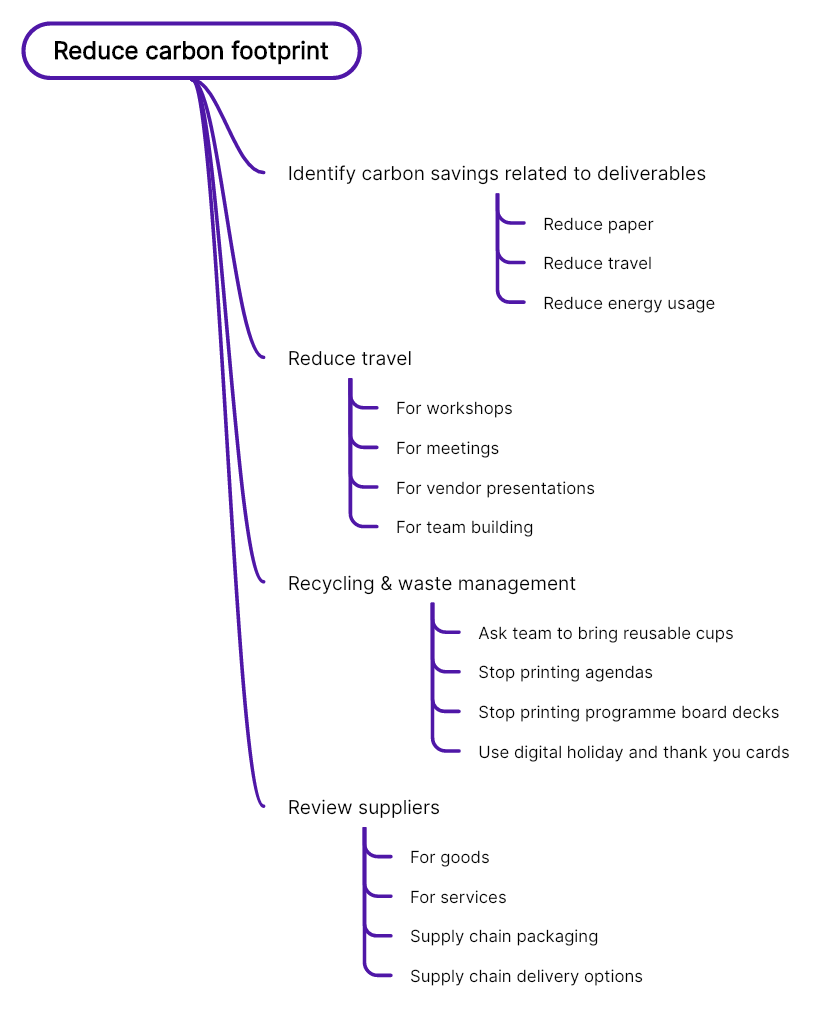
Carbon savingsWhen working out project benefits, include carbon saving as one of the metrics you will track, as long as your project does something that will reduce carbon. This could be by digitalizing a process so less paper is used, removing paper cups from coffee machines and replacing them with a ‘bring your own reusable cup’ policy in your project office or something else. I’m aware that digital solutions also have a carbon footprint in that they use energy and land as there are vast data centres behind the scenes of every virtual meeting, so you’ll have to draw your own conclusions about whether the savings you are claiming are ‘real’ or not. Many companies are now very much focused on energy saving and the equivalent carbon saving this equates to, so someone in your organization is likely to be able to tell you what measures are used in the business to track and report on carbon usage. Talk to your energy manager or the sustainability team if you have one, or someone in Finance who could help you work out what, if any, carbon savings you can reasonably track. Ideally, the project’s deliverables would have a benefit that demonstrates carbon reduction, but if not, you could look to track carbon usage related to managing the project itself, for example, you could track number of journeys that did not happen because you chose to meet virtually instead. Paper usage and waste recyclingA very small thing you can do on your project is to make sure that the team does not use excessive paper. Stop printing project board decks and meeting agendas. Make these available on digital solutions instead. Use digital thank you cards instead of real ones (although you’ll have to weigh up the value in a digital one – some how for me, a physical card feels like it means more). TravelI mentioned avoiding meetings where the journey would create a carbon emission – see how much travel it is possible to cut out of your project. There’s probably some. Supply chainEven if your project is not buying anything in terms of goods, there are probably some items that you end up procuring, for example, lunches for workshops. Choose local suppliers using locally-sourced products. Ask questions of your suppliers and see if there are choices to be made. Document your decisionsThe easiest way to make sure that you are living your goals and managing to make a carbon impact is to ensure your project management plan and documentation includes the commitment. Put your metrics in your benefits tracker. Put targets in the quality plan. Make sure your schedule includes any specific actions you are going to do as a team. What other suggestions do you have for reducing your carbon footprint as a project team? Let us know in the comments section below! |