Holiday Celebration Ideas
Categories:
events
Categories: events


|
Is it too early to be thinking about project team ideas for celebrating the end of the year? Probably not! And don’t worry about not having anything to celebrate. You made it through another year – that’s enough! If you do have project deliverables or milestones that happen to time with the end of the year, even better, but don’t postpone having a party until you’ve got “something” to celebrate. Working hard all year is enough. Here are some tips for ending 2019 on a high with your team. 1.Don’t leave it too latePlan your end of year celebrations now, if you haven’t already started! Many people will be advanced with their planning, and they’ll be booking up the best restaurants and venues. Also, it takes a while to search for places to go that suit your team and your budget. I remember last year’s Christmas team party for our PMO: we needed somewhere that could cater for vegetarian and gluten free, plus a colleague who was coming in from maternity leave and bringing small baby (and accompanying pram). And we needed it to be cost-effective as we were paying for ourselves. And we wanted to order in advance so we didn’t have ages to wait for the food, because we were on our lunch break! That also meant it had to be close enough to the office to get there and back in a reasonable amount of time. I scouted out a few venues and found somewhere within our budget, but it took a while. 2.Think outside the restaurantsOver here in the UK, it’s traditional in many companies to have a meal at Christmas with your team. Whether that’s lunch or dinner is up to you. But it isn’t your only choice. Whether you are celebrating Christmas, another festival, or just marking the passing of another year, food is not your only option for work events. We’ve been out to a comedy club, been sailing (although not something I would do at this time of year) and had a mini-sports day. You could go to a skating rink, do an open top bus tour to see the lights or something else. Make it accessible. Make it fun! 3. Plan your holiday cardsIf you haven’t already, start thinking about who is going to get a holiday card. As the project manager, it’s my responsibility to send cards to the suppliers and colleagues who have supported us through the year. Ask your Marketing department if they have cards you can use. You don’t actually need to send a physical card – a nice email with a seasonal picture is enough. Maybe your team could dress up in Santa hats and you take a photo? 4.Manage the team’s liabilityTax rules vary from place to place. Make sure your holiday party/meal and any gifts you give or receive don’t fall foul of local laws. Here in the UK, my company is limited to annual staff entertaining events totalling £150 per head per year. I believe we could spend this on several different events, like a summer barbecue and a Christmas party, as long as that doesn’t go over. If we go over, we pay tax on the whole amount, and I think there is a liability for the employee as well. Just be careful what you do, so that no employee ends up with an unexpected tax bill on the ‘benefit’ of having a meal with work colleagues. Check that any project or team event doesn’t conflict with whatever your company might be doing on an ‘all hands’ basis. 5.Have fun!Whatever you do, try to make it fun. It’s often not fun for the person organising, because there’s the stress of hoping people have a good time, collecting money, being Secret Santa, organising payments and so on. Perhaps split the work of organising your holiday celebration between the team, so that the burden doesn’t fall all on one person. Take photographs! You’ll be glad you did when you look back at the end of the project and see what you managed to achieve, and the relationships you built on the way. Pin for later reading:
|


Where to get help with project budgeting
Categories:
budget
Categories: budget
|
I get it. Managing project budgets is daunting when you start out. Suddenly, someone is giving you thousands to track and manage. You’re approving invoices for more than the cost of your household monthly outgoings. I was lucky in that when I was very junior in my career, my manager gave me the job of tracking the project spending on a larger project. He was the main project manager, and I was part of the project team, managing smaller initiatives, a workstream, and the budget and risk management. Probably because no one else wanted those jobs! They aren’t the most glamourous part of project management, but the experience actually served me very well for the future. I got used to the scale of the numbers we were dealing with. But you have to start somewhere, and like me, you need to get your hands stuck into managing budgets before you get confident with the methods used for tracking, monitoring and controlling project finances. When you’re starting out, you might need a bit of support with the processes and techniques for budget tracking. The infographic below shares 6 places you can go for help. Of course, you can also talk to your manager or mentor as the first point of call. There are lots of places to get help if you are new to project budgeting, and plenty of people prepared to give advice! After all, the business has a vested interest in you learning more and being able to manage the money confidently!
There’s more information about where to go for help with project budgeting (including some ideas of my favourite books) in this article. Pin for later reading:
|


Project Scope Management Part 5: Validate Scope
Categories:
scope
Categories: scope
|
It’s time for part 5 of our journey through the Scope Management Knowledge Area from the PMBOK® Guide-- Sixth Edition, although it does feel like once I’ve got through the whole PMBOK® Guide we’ll be on the Seventh Edition, as I know that will be with us before we know it. Anyhow, today, we’re looking at the Validate Scope process. You can find the previous parts here: This will be a super-short look at the process, because there haven’t been many changes and it’s a pretty simple process. The Validate Scope ProcessThis is the fifth process in the Knowledge Area. We have moved from the Planning process group to the Monitoring and Controlling process group. What we’re doing at this point in the project is formalising the process of acceptance. As we’re in Monitoring and Controlling, we’ve got to the point in the project where something has been delivered. Now we have to check whether we’ve delivered the right thing. Basically, you review the deliverable with the person responsible for approving it, and receive formal sign off. When you’re doing this process in real life, it’s likely to overlap with with the Control Quality process, because you have to check the deliverables match the defined quality standards before you ask a sponsor to sign them off. So now we know what this process is all about, let’s look at what we need to perform it. InputsThere isn’t much that has changed from the Fifth Edition. Instead of requirements documentation and requirements traceability matrix, we just have project documents. No biggie. That means the inputs to this process are:
Tools & TechniquesGroup decision making techniques has dropped off the list of Tools and Techniques, to be replaced by generic decision making (which includes, of course, techniques for groups to make decisions like voting). Personally, I can’t think of many (any?) situations where my project quality would be assessed by vote. The deliverable either meets the criteria or it doesn’t. However, the PMBOK® Guide does list voting as a way to reach a conclusion when “the validation is performed by the project team and other stakeholders.” Alongside that, we also have inspection (as previously in the Fifth Edition). OutputsOnce again, there are no new or changed outputs to this process. The outputs are:
Of these, the most important for me is the accepted deliverables. The formal documentation for sign off of a deliverable is used later in the process for closing down the project, because you can’t close a project if the deliverables haven’t been accepted. Next time I’ll be looking at the sixth and final process in this Knowledge Area: Control Scope. Pin for later reading:
|

3 Ways to Think About Risk [Video]
Categories:
risk
Categories: risk
| Getting a handle on risk is so important when it comes to keeping your project under control. There are plenty of different ways to categorise and think about risk, and today’s video considers three ways you can group risk:
Watch the video below and then let me know – do you agree with these categories, or do you use a different way of bundling your risks together? Pin for later reading:
|
5 Non-Financial Benefits for Your Business Case
Categories:
business case
Categories: business case
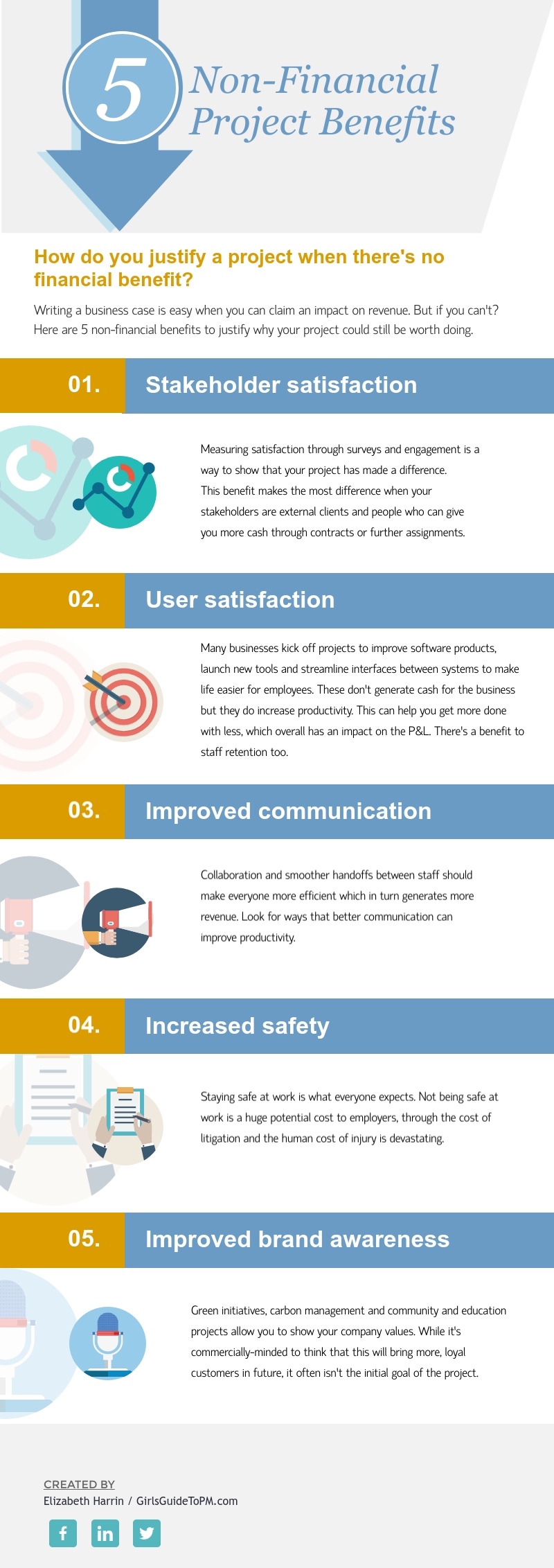
| When your project is making a tangible financial contribution to the company’s profit or revenue, then putting your business case together is pretty easy. If the financial case stands up, many execs will put a tick in the box. But when you can’t demonstrate that there are financial reasons to do your project, should you put the business case in the bin? No, of course not. There are lots of non-financial reasons to invest money in a project. And some of them might even pay back in cash! It’s just that measuring them and attributing the benefit specifically to your project could be difficult to do. Here are 5 common non-financial benefits that you could consider adding into your business case, even if there are plenty of cash benefits too.
There’s more information about the concepts of non-financial benefits in this article. |