


Is your project budget red?


|
As least one of your project metrics should relate to your budget – assuming you have the responsibility for tracking how much the project is spending. There are a number of different ways to track the budget, for example:
Again, project stakeholders will respond better to some measures than others. It depends who they are, what they want, what they need to do their jobs and what their previous experience is. A project sponsor with a finance background is likely to want a far greater degree of visibility of your budget than someone whose main focus is quality. Your job is to find out what they want and provide it. It really doesn’t matter what the metric is that you use, provided it fulfils two criteria: 1. It must make sense to the people who are using it 2. It must have clear boundaries defined so that you all know what ‘red’ means. There is no point in having Red, Amber, Green (RAG) or any other categorisation method (click here for a Gantthead discussion on how to categorise projects) if no one knows what the different categories mean. Set thresholds. Define what the tolerance levels are for each metric and publish them. Then stick to them. Your budget RAG status could look like this: Green: within +/-1% of budget Amber: within +/- 5% of budget Red: over +/-6% of budget Choose figures that make sense to you: 1% of a £5m is not very much in the grand scheme of things so you could probably agree different tolerances with your project sponsor. As long as you are clear about what ‘Red’ means, everyone will be operating from the same information and your metrics will be meaningful. How do you define Red? |
 As part of your project status reporting you probably include metrics. You might even have a project dashboard that calculates the metrics from an enterprise PM tool and displays them for you. Project metrics are things like resources consumed and estimate to complete. Some metrics mean more to stakeholders than others. Personally, I am not a fan of percent complete for tasks, for example.
The Hidden Cost of Change
|
In this video, I look at the hidden cost of project changes. |
Ask the Experts: Cost audits with Todd Williams
|
Todd, what is a cost audit? A cost audit is a relatively simple task of reviewing all of the costs on a project and ensuring they are in line with the project’s anticipated spend. It validates the right amount is going to the right people at the right time. Simple, right? The sticky part is usually that last clause—at the right time. Projects have specific milestones for when items should be paid for. Usually it is when a tangible item is delivered. Some form of acceptance document is signed and the vendor gets paid. Internally, the demarcation point is resources moving on to new tasks. If they still have lots of loose end to tie up, then you keep spending money on something that is supposed to be complete. In other words, money starts leaking out of the project. It can, however, be a little more tricky. When you are determining the cost of internal resources, you need to determine they are performing to expected goals. Are they spending time on non-project tasks or inefficiently getting toward deliverables? They may be salaried and simply billed to your project. In this case you need to be diligent ensuring hours (which translate to money) are spent on completing their work and that these hours are in compliance with industry standards. If time gets excessive you have a problem. The best measure of this is a cost performance index. But that indicator is imperfect. If deliverables are being signed off as complete when there is still work to do, then people need to keep working to get a workable product. Money to cover the expense, with the best of intentions, can get pulled out of some other budget. This is similar to the Ponzi schemes we have seen in the headlines recently and can be hard to find until after it is too late. OK, so I guess you don’t want to wait until the end of the project to carry out a cost audit. When is the best time to do one? The minute you get a funny feeling in your gut that something is not right. This goes for the Project Manager or the project sponsors and executives. Often the latter can get someone to come in and find the problems in short order, before they get too big. Always assume positive intent—the mistakes are honest misunderstandings. For some organizations it is a matter of course; however, it takes a significant amount of time. This is far from a lean process and I do not recommend it. If you are dealing with the government, you are often required to have some audit process in place. In any case, if you see the cost performance index starting to go awry, it is a good time to do one. You mentioned bringing someone in. Can project managers carry out cost audits themselves or should someone else do it? Using and internal or external auditor? Answering this question with a question will make my point. Would you trust a company where you have a significant amount of your savings invested if you knew they did their own audits instead of having an independent auditor do the work? Of course not. You would want them to have an outside firm review the books to ensure there were no mistakes. It is of little value to have the person that was making the mistakes try to find them—it is harder for me to discover that I do not understand something than for someone else. In addition, if someone is cooking the books, the exercise of an internal audit is a waste of time. Right, so say I get someone in to do a cost audit on my project. What form does the output take? I am sure there is a formal layout that finance people like to see, but I simply put the variances items in a spreadsheet showing the anticipated cost, actual cost, and whether it can be recovered. Then I total out what is lost and what can be recovered. The last step is to give a set of recommendations for fixing the issues and preventing them from recurring. I bet the reports have lots of interesting things in them. You must have uncovered some sneaky deals. Although I said to always assume positive intent, there are times when people do not have the best intentions. I have seen people who were buying equipment that was not needed so they could get a gift from the vendor. They labeled the purchase order as if it was an item that was needed and the audit found it sitting unused on a shelf. The buyer had a positive intent (beyond the gift)—to improve the capabilities of the deliverable. Unfortunately that functionality was out of scope and it was questionable if the purchased equipment would meet original scope. In cases like this, the report, or that section of the report, should be confidential. Covert and clandestine discoveries are the exception. The information should be an educational tool to reduce the chance of the mistake recurring. Remember that the data can be sensitive and publicity can cause a lot of pain. I am sure the readers can think of some big items in the press.
I am not a finance guy. After all, I have a bachelor of science in chemistry. Being called in by the CFO, I was certain I was being set up and was scared to death. I started by reviewing all the invoices and reconciling them to the material we had on hand and the functions that were supposed to be delivered. Finding numerous major discrepancies, I got even more nervous thinking I was doing something wrong. After double-checking the numbers, I called a couple vendors. They got very defensive. It turns out that the vendors had learned the client would pay anything without validating the fit of the deliverable. They could meet their revenue numbers by delivering and billing early. Unfortunately, the vendor’s management would not let them work on the items that had been delivered and invoiced since there was no more revenue to gain. There were hundreds of thousands of dollars that had been spent on partially delivered items. With new confidence, on a regular basis I would walk into the CFO’s office and write the new funds found and recovered. The value dwarfed my billings by an order of magnitude. Needless to say, the CFO was pleased. I’m sure he was! Thanks, Todd. About my interviewee: For twenty-five years, Presidents, V-Level, and C-Level executives of manufacturing and service companies have asked Todd Williams to help them build leading-edge systems, improve organizational efficiency, and rescue problem projects. From this experience, he has developed methods to streamline organizations, turn-around troubled projects, and help prevent recurring failures. As President of eCameron, Inc. and a professional member of the National Speakers Association, he is an expert in project rescue, failure prevention and engaging people in the solution. He maintains a blog that has been quoted on CIO Update, ZDNet, IT Business Edge, Center for CIO Leadership, and CIO Essentials, among others. He has been chosen to speak to numerous companies including NASA, AMA and PMI. |
 Today I’m interviewing Todd Williams, author of the popular book,
 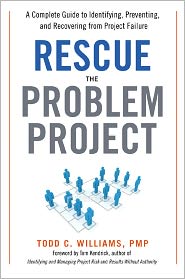 I know that now you are very experienced in doing cost audits, but tell us about the first time you were asked to carry out this type of review.
Value for money: The Scottish Parliament building project
| I’ve been working on my new book, Customer-Centric Project Management, and one of the main concepts my co-author Phil Peplow and I discuss is how projects define success. The current draft of the book (no guarantee it will make it into the final version) includes the construction of the Scottish Parliament building as an example of how different stakeholder groups interpret success differently. The design of the building was the result of a competition, and architectural firms responded to a brief with the hope of being selected as the company that would win the work of designing the prestigious new building. The Secretary of State for Scotland at the time, Donald Dewar, launched the competition saying that architectural quality, value for money, accessibility and a design “worthy of the hopes and aspirations of the Scottish people” were important. The building user brief that the contest entrants were issued with also stressed the importance of a stunning architectural design, saying it must “reflect the Parliament’s status,” “promote good environmental practice” and “be an important symbol for Scotland” while offering value for money. In other words, these were the critical success factors for the project, and from the beginning there was a focus on the design and the budget. As experienced project managers will realise, this situation created the risk of conflict between these two factors. Could you really have a fabulous design while still delivering value for money?
Scottish Parliament Debating Chamber: Photo: copyright andrew_j_w Building projects are notorious for going over budget, and this project was no different. The guideline at the beginning of the procurement process was for a budget of £50m but an inquiry into the overspend concluded that in reality quality was more important than cost. The project suffered from not having realistic budget estimates. Poor communication also played a part in the rocketing costs. Messages were filtered for political reasons before being passed on to management. For example, a quantity surveyor produced an estimate of £89m, including a margin in case of risk; after all, this was a one-of-a-kind project, and it was highly likely there would be some unforeseen circumstances. The actual estimate passed up the line did not include this risk prediction, and was given as £62m. The project involved a number of different contractors, all of whom used different jargon. Is ‘estimate’ the same as ‘forecast’? Putting jargon aside, if you don’t have project reports at all you have no chance of knowing what is going on. There were concerns over whether or not the project would be completed within budget as early as November 1998. However, it took until March 1999 before Dewar was given formal warning of any potential cost rise. If budget was a key success criteria for the project, it seems it was not communicated adequately to those responsible for reporting against it – or they were providing the information to the wrong stakeholders. The Scottish Parliament building has been open for years now – the Members met there for the first time in 2004, three years later than expected. The project finished late, and went significantly over budget. The estimated final cost reported to the Finance Committee was £431m! That’s a long way from the original £50m.
Scottish Parliament building. Photo: copyright ajnabeee If sticking to budget was important for the project, the team didn’t do a particularly good job of delivering successfully. Was it value for money? That’s a different matter altogether, as value for money is subjective. The building attracted 100,000 visitors in the first 3 months. It has won nine design awards. The three main parts of the building have been rated as ‘Excellent’ for environmental performance and the development has increased biodiversity in the area. The carbon footprint of the Holyrood complex has been reduced by 12% in 5 years. These results show that the success criteria of accessibility, stunning design and good environmental practice have been met. Maybe that does mean the project achieved value for money. What do you think? |


What's the future of project management software?
|
In this video I recap the discussion at the APM Round Table debate on project management in the collaborative age, specifically the ideas we had about the future of project management software. If you would rather read, here is the transcript: My name is Elizabeth Harrin and I’m from The Gantthead Blog, The Money Files. I’ve spent the morning with a group of people discussing collaboration tools and the future of project management technology which was a really interesting discussion and there were few points that came out that I thought I wanted to share with you. Good collaboration tools can basically save project managers money because they can increase efficiency and they can reduce the need to travel to meetings. So there’s a lot to be said for making sure that you are up to date with the best technology that you can possibly have and that you know how to use it effectively. And those were some of the things that came out of the discussion today. We had a representative there from the software provider Projectplace called Fredrik and he raised the issue around the future of technology in this particular type of project management tool being collaborative planning. So the way the tools are moving, it looks as if people are putting out functionality that allows project managers and their teams and their other project customers and stakeholders to collaborate effectively on the plan and make sure that is kept up to date at any one time which gives your customers more engagement in the schedule which has to be a good thing. He also talked about mobility and the fact that project managers now are expected to travel to work and that technology needs to evolve more so than it already has to do with being able to be used on mobile phones, on iPads, tablets, touchscreen PCs and things like that. We had a project manager there who was called Anne and she talked about the vision that she had for the future around interconnectivity between tools. She raised the point that project managers often have several different tools that they have to update especially if they’re working with social media tools both in their personal lives and in their professional lives. It ends up with a number of different logins. Interconnectivity allows software and products to talk to each other. So hopefully, tools in the future will become a lot more open in the way that they share information between each other so that we can start seeing portal style tools which consolidate feeds of information from various different places and again that should help us be more efficient. There was a project manager there from Transport for London and he was talking about the challenges of being in a construction environment and not being able to access the information that you want to be able to run your project while you’re on a building site or in his case, potentially underground. And he said that real-time communications in construction is a really big challenge and the introduction of 4G next year will be a step in the right direction and as long as the software that project managers are using can tap into that. It helps network capability, the requirement on the bandwidth is lower then information can move backwards and forwards in real time and that’s a good thing as well. We talked about the perceived barrier to entry for a lot of project management software products and potentially stakeholders see it as: “Oh that’s project management tool. That’s very complicated to use,” and really that isn’t the case. So we’ve got to find a way to get over this perceived barrier to entry and the fact that people don’t want to use the project management software because it seems too difficult. So maybe there’s something there in the future that software vendors can do to make it seem easier to use or to make software more intuitive so it can be used by a greater number of people. That creates another problem which is getting the information to the right people at the right time and you want one product that serves all of your needs and as a professional project manager, you would want that to be a tool that will do scheduling, risk management, budget handling potentially, time sheets, all kinds of different bits of information that you require to manage the project effectively. If you are a stakeholder or if you’re the project sponsor, you want to see a dashboard potentially of the major risks: ‘Are we on track; are we not on track’ for the budget and what are we doing with the scheduling: ‘Are our main tasks on time?’ which is very high level, dashboard information which is not useful for a project manager at that level. Then you’ll have project team members who perhaps doesn’t understand a lot about the project methodology but know that they have to do certain tasks at certain times and so they will want to see the information related to them in a different way. So tools have got to be able to allow different stakeholder groups to carry out all of these different functions. We also talked a little bit about biometrics because currently, tools require you to log in and they trust that you are who you say you are and this is particularly an issue with social media where you can create a profile on Facebook or Twitter and pretend to be whoever you want. Biometrics, which is if you log in with an eye scan or with a fingerprint, will then enable technology to determine that you are who you say you are. That sounded like an interesting way forward for software as well so that you would automatically be able to log in to different sets of tools with fingerprints or eye scanning. Apparently, that technology is already out there. It’s used on some corporate laptops, used on some tablet PCs and obviously it is used in the security industry. So it’s there. It’s just not being adequately used within the project management software arena. So we’ve spent the morning really looking at collaboration and how technology can help us engage with our project customers more effectively. As a result of that, we thought about ways where the technology can evolve in the future and how that would help us be more effective to save more money, be more collaborative and get better engagement from the people that we are working with. So I think a lot of ideas that came out of that and hopefully the software vendors who were there will look at ways of educating the project managers and their PMOs in those particular bits of functionality and perhaps develop some of that functionality that we’re looking for. |


